Aerospace heat treatment with AI — quality cannot be verified afterwards: you have to prove the curve was THE curve.
Heat treatment is a special process: nobody can open the part to check whether the cycle was correct. Nadcap and the AMS specs do not audit the part, they audit the evidence of the cycle. And today that evidence lives on a paper chart recorder or in a system isolated from the furnace. iLEAN Edge captures the real curve without touching the equipment, Connect links it to the load and to every part, and an agent prepares the Nadcap dossier per load batch. The certified person signs.
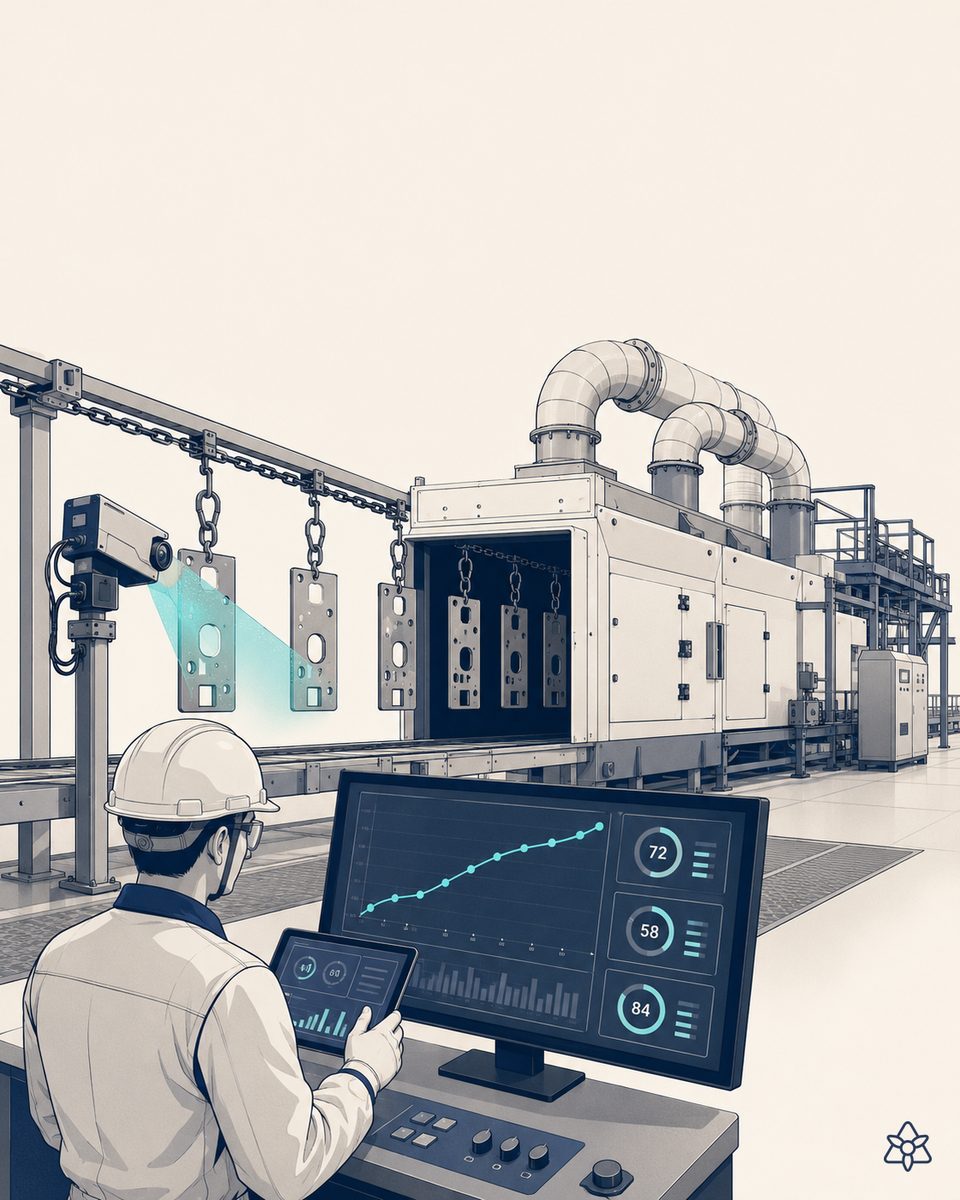
The part comes out of the furnace perfect on the outside. The doubt is not about the part — it is about the paperwork.
In an aerospace heat treatment shop everyone knows how to run the cycle. The furnaces are validated, the thermocouples calibrated, the TUS and the SAT up to date. The problem is not thermal: it is documentary, and it always shows up at the same point — when somebody has to prove, months later, that that load followed that curve.
- The curve lives outside the system — it comes out on a strip chart recorder, on a thermal printer or in software from the furnace manufacturer that nobody else opens. It is a chart in a folder, not a data point you can cross-reference. If the recorder jams or the ink runs out, the evidence of the cycle simply does not exist.
- The load is linked by hand — the operator notes on a sheet which batches went into the basket and at what time. That sheet, the chart and the work order are three separate pieces of paper that only a person with a good memory can put back together. When that person is away, the link is made by deduction.
- The audit rebuilds it — Nadcap arrives, the auditor picks ten batches at random and the hunt begins: which furnace, which zone, which thermocouple, which calibration was current, which operator loaded it. Weeks in the office rebuilding something that happened correctly but was never tied together.
And there is the worst case, the one nobody logs in the KPI: the load lost to a doubtful record. The part is fine, the cycle went fine, but the evidence is not conclusive and the only safe way out is to redo the treatment or scrap it. It is not that the shop treats badly — it is that the proof it treated well is kept worse than the treatment itself.
iLEAN touches neither the furnace nor the control loop — it seals the crack between the curve and the dossier.
Here the rule is non-negotiable: the furnace is not touched. It is validated, it has its TUS, its SAT and its history, and any intervention on the control would force a revalidation. iLEAN acts as putty between what the furnace already shows and what the audit needs to read, without connecting to the control loop and without writing a single setpoint.
Edge reads the curve off the panel without going into the equipment. Connect ties the load to the batches and to the parts at loading time. The agent assembles the Nadcap dossier per load batch with the real curve — the certified person signs by role.
The three iLEAN pieces applied to an aerospace heat treatment shop:
- iLEAN Edge — a terminal with computer vision aimed at the recorder or controller panel: it reads the curve, the setpoint, the temperature by zone and the status of the cycle exactly as they appear on screen. Non-invasive capture: no new wiring, no touching the cabinet, no impact on the furnace's validation. When the equipment already exposes data, the reading is done through direct integration. It works with no network: if the plant goes offline, Edge keeps recording and syncs when the link comes back.
- iLEAN Connect — at loading time, the operator confirms on the terminal which batches and part numbers are going into the basket or the rack, by reading the label, the DMC or the work order. From then on there is a load identifier the curve attaches itself to. It also captures thermocouple calibration certificates and TUS/SAT reports whether they come by email, as a PDF or as a photo of the paper, and leaves them where the dossier is going to need them.
- iLEAN Agents — the agent cross-references part ↔ load ↔ curve ↔ thermocouples ↔ furnace ↔ operator and assembles the Nadcap/AMS dossier per load batch: real curve against the specification limits, times at temperature, ramps, current calibrations and deviations. It does not sign: it prepares it and hands it to the heat treatment or quality manager. The human signature is sacred; the three safety rings are there precisely to protect it.
Heat treatment documented by hand vs. the curve linked with iLEAN
| Aspect | Paper chart recorder + load sheet | With iLEAN Edge + Connect + Agents |
|---|---|---|
| Cycle curve | Chart in a folder, impossible to cross-reference | Real curve captured and linked to the load |
| Load ↔ part link | Handwritten sheet and the operator's memory | Load identifier at second zero |
| Thermocouple calibration / TUS / SAT | PDF in a quality folder | Captured and linked to the load batch |
| Nadcap dossier per batch | Manual reconstruction, weeks | Prepared by the agent, ready for signature |
| Load with a doubtful record | Redo the treatment or scrap it | Conclusive evidence from the start |
| Intervention on the furnace | n/a | None — non-invasive reading, no revalidation |
| Manager's signature | On a file rebuilt by hand | By role, on a dossier prepared by the agent |
Impact estimate for your plant — to be validated with your numbers.
The block below is an estimate to be validated with the specific data of your shop. We put it forward so the committee has an order of magnitude; we refine it during the diagnostic.
- Aerospace heat treatment shop with three to six furnaces (vacuum and/or atmosphere), at least one with a paper chart recorder, and Nadcap AC7102 approval in force or in progress.
- Edge pilot on one furnace with non-invasive panel capture and load linking on the terminal. First value expected within a few weeks: the first load batch with its real curve linked and searchable in seconds, without having touched the furnace.
- Expected reduction in the time to prepare the audit dossier ≥50% and a target of zero loads redone or scrapped over a doubtful record. Indicative payback between 5 and 10 months, depending on the number of furnaces, audit frequency and the unit value of the parts that today get redone for lack of evidence.
- The hard lever is the quality manager's hours that today go into rebuilding Nadcap files and the loads that stop being lost because the curve was already tied to the part.
And the aerospace CAIO's reasonable doubt
"What if the system misreads a value off the panel and an incorrect curve ends up in a Nadcap dossier?" — hallucination is a problem of free generation, not of anchored tasks. Reading a numeric value and a temperature trace on a known panel and checking them against the specification limits is an anchored task: the best models brought error below 1.5% [1]. And even so, the system does not decide — it proposes, flags, records, and marks any low-confidence reading for a person to confirm. The heat treatment or quality manager's signature stays exactly where it has to be. The three safety rings are there precisely for this: conformity of a special process is not closed out by an AI, it is closed out by a certified person.
[1] OpenAI paper "Why Language Models Hallucinate", 2025 — on the reliability of AI in anchored tasks.
What people ask about aerospace heat treatment with AI
Why is aerospace heat treatment a "special process"?
Because the result cannot be verified afterwards without destroying the part. Solution treatment, quenching or aging of an aluminum or titanium alloy changes the microstructure on the inside: there is no visual, dimensional or surface inspection that confirms the part received the correct cycle. That is why Nadcap AC7102 and the applicable AMS specs (AMS2750 for pyrometry systems, AMS2770 / AMS2774 depending on the alloy) do not audit the part — they audit the evidence of the process. The auditor's question is not "is the part good?", it is "show me that the curve of that load was the specified curve".
How is the furnace curve captured without touching or recertifying the equipment?
In two ways, and we choose whichever forces no revalidation. The first is non-invasive capture: an iLEAN Edge camera frames the recorder or controller panel and reads the curve and the setpoint values exactly as the screen shows them — it does not connect to the control loop, no wiring is touched, no equipment is modified, and therefore the furnace's TUS/SAT validation is unaffected. The second, when the furnace already exposes data, is read-only integration through the port or the file the recorder generates. In both cases iLEAN is an observer: it writes no setpoints, it does not command the furnace, it takes no part in process control.
How is the load automatically linked to the curve and to each part?
At the moment the furnace is loaded, the operator confirms on the Edge terminal which batches and which part numbers are going into that basket or rack — by reading the label, the part's DMC or the work order. From that instant a load identifier exists. The curve that starts being recorded is associated with that identifier without anyone transcribing anything, and when the furnace is unloaded each part inherits the real curve of its load. The result is a part ↔ load ↔ curve ↔ thermocouples ↔ furnace ↔ operator cross-reference that today is rebuilt by hand matching paper charts against routers, and that from now on exists at second zero.
What Nadcap/AMS evidence does the system deliver, and who signs it?
The agent prepares the dossier per load batch with what the audit asks for and what today is rebuilt by hand: the real curve recorded (not the nominal one from the program), times at temperature, ramps and cooling against the specification limits, identification of the furnace and the zone, calibration status of thermocouples and instrumentation per AMS2750, reference to the current TUS and SAT, the batches and part numbers included, and any deviations there were. The agent does not sign: it prepares the dossier and hands it to the heat treatment or quality manager, who is the one who signs by role. The human signature is still what closes out the batch.
Does it work with old furnaces and paper chart recorders?
Yes, and that is the most frequent case. A twenty- or thirty-year-old vacuum or atmosphere furnace is still perfectly capable and is validated — what it does not have is a usable data output. There, non-invasive camera capture over the strip chart recorder or over the controller screen turns that curve into data without replacing the furnace, without opening the electrical cabinet and without recertifying the equipment. The paper record keeps being filed if the procedure requires it; what changes is that a digital copy also exists, linked to the load and searchable in seconds. Indicative payback between 5 and 10 months — an estimate to be validated with your numbers.
Related: Nadcap aerospace part traceability · Penetrant and ultrasonic NDT with AI · Aerospace painting and coating with AI
More cases in other sectors
- UDI traceability for surgical hernia mesh under MDR — the implant file, ready when EUDAMED asks for it.iLEAN Tracer builds UDI traceability for surgical hernia mesh under MDR: batch file and chain of custody…
- Vehicle armor with AI — a badly welded bead is not a quality defect, it is the occupant's life.How iLEAN inspects weld beads, captures ballistic tests and builds the per-vehicle dossier in armored…
- 5-axis aerospace machining with AI — a titanium part with forty machine hours on it cannot be scrapped over a data point nobody cross-referenced.iLEAN cross-references the machining log, the CNC panel and CMM measurement into an AS9100 genealogy per…
- Aircraft propeller control with AI — a live dossier per serial number, not a folder thrown together at the last minute.How iLEAN combines Edge vision, balancing machine readings and agents to certify every aircraft…
- Aero turbine manufacturing with AI — the FAI is not rebuilt; it is generated while you build.How iLEAN combines vision, heat-number OCR and evidence-pack agents to build aero turbine parts to…
- Aeronautical configuration with AI — Mod Status and effectivity per aircraft, without aircraft 247 living in a spreadsheet.iLEAN manages Mod Status and ECN/ECO effectivity per aircraft or batch. Traceable configuration from…
Tell us how you record your furnace curves today and in 48h we'll send you the estimated ROI of this AI project for your plant.
We work on your shop's real data, not ours. Diagnostic with no commitment.
Request estimated ROI in 48h See other sectors