Aerospace NDT with AI — the inspector's eye, amplified and traced by part and operator.
Non-destructive testing in aero depends on the inspector's eye and their certified level. iLEAN assists with machine vision over liquid penetrant and phased array ultrasound, keeps traceability by part and by operator, and leaves the signature on the verdict with the person. Level 3 stays in charge; the system takes away the grunt work of rebuilding traceability.
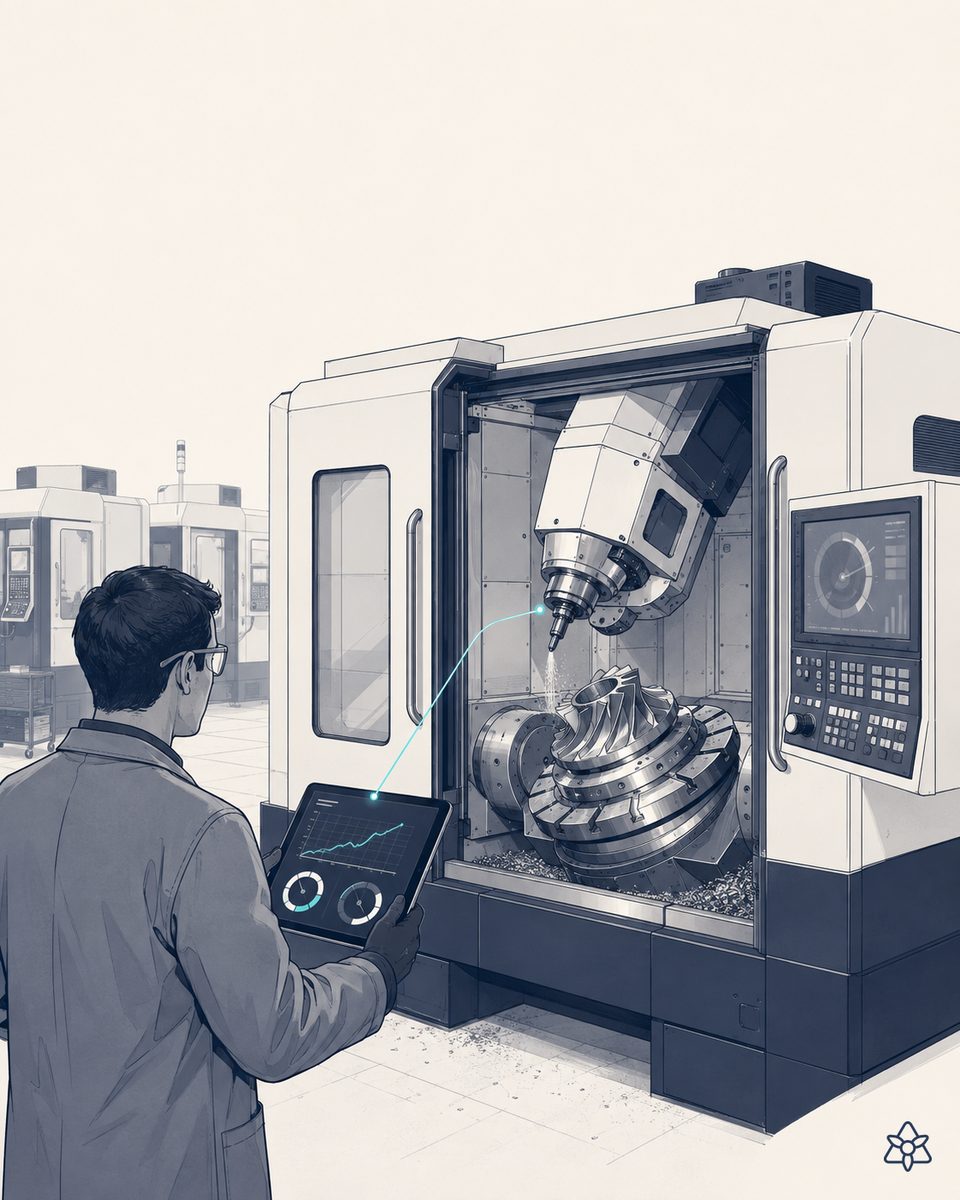
Three inspectors, three opinions — and the signature of whoever happened to be there.
In an aero NDT booth, the same defect (a fluorescent penetrant indication on the radius of a blade, a phased array UT echo at a landing gear weld) can end up "acceptable" or "reject" depending on which inspector was there and which shift it was. All of them are certified, all of them are competent — and still there is an inter-inspector range. It is structural to the trade.
What has no defense is what gets lost along the way. The indication flagged on part 17 of the batch — did it end up on the operator's sheet, or only in their head? The penetrant bath — is it losing sensitivity batch after batch with nobody cross-referencing the data? Level 3 audits once a month and rebuilds traceability from Excel and handwritten reports — and that only surfaces when the Nadcap or EASA auditor shows up asking for evidence.
The result is not that bad parts slip through (the classic system works 99% of the time). The result is the cost of the 1%: a hold tag applied too late, a re-shoot requested by the customer, an audit that drags on because the traceability was in a drawer.
iLEAN does not replace the inspector — it seals the crack between their eye, the instrument and the file.
NDT is the industrial discipline where the human decision is sacred: a Level 2 or Level 3 signature on an aero part is not delegated. iLEAN acts as the putty between three islands that do not talk to each other today: what the inspector sees, what the UT/penetrant instrument records, and what the Nadcap file demands. Without scrapping the booth, without changing the Olympus or GE instrument, without touching the approved procedure.
Vision flags the candidate indication. Tracer ties it to the part and the operator. Writer drafts the dossier by serial number. The person signs — the system never closes the verdict on its own.
The three iLEAN pieces applied to aero NDT:
- iLEAN Vision (Edge) — a camera with a convolutional neural network (CNN) over the penetrant table (visible and fluorescent under UV-A) plus capture of the phased array UT screen. It flags candidate indications by type (porosity, linear crack, lack of fusion), overlays them on the image and keeps an immutable record. It works without a network, because what is critical cannot depend on plant WiFi.
- iLEAN Tracer + Connect — cross-references the part ID (read from the marking or from the work order) with the certified inspector on shift, the procedure applied, the bath concentration and the UT instrument's calibration. It also captures what arrives from outside (a procedure revision change emailed by the Level 3, an alert from the penetrant supplier) at second zero.
- iLEAN Writer + Agent — the agent drafts the inspection dossier by part and by batch, ready for the Nadcap/EASA auditor. It does not sign — it proposes the complete dossier and the certified person reviews and signs it. If it detects a deviation between inspectors or an anomalous pattern in a batch, it escalates to Level 3, not to production.
NDT with a manual sheet vs. NDT assisted by iLEAN
| Aspect | Manual NDT + paper report | With iLEAN Vision + Tracer + Writer |
|---|---|---|
| Indication marking | Inspector circles it with a marker on the part or the sheet | CNN overlays the candidate; inspector validates with one tap |
| Part ↔ operator traceability | Initials on a paper report, manual reconstruction | Automatic association part + serial + operator + shift |
| Inter-inspector range | Invisible until the next audit | Pattern visible to Level 3 in real time |
| Bath / instrument condition | Calibration logged in a notebook | Cross-referenced with every inspection, alert if it drifts |
| Dossier for the Nadcap/EASA auditor | Rebuilt from Excel and physical archives | Generated by the agent, signed by Level 3 |
| Operation without a network | n/a | Vision keeps capturing, syncs on reconnect |
Impact estimate for your plant — to be validated with your numbers.
The block below is an estimate to be validated with the specific data of your booth. We put it forward so the committee has an order of magnitude; we refine it during the diagnostic.
- Booth with a fluorescent penetrant table (PT method C) + 1 or 2 phased array UT units, 3 or 4 Level 2 inspectors and one Level 3 supervising, annual Nadcap audit.
- Vision pilot on the penetrant table plus screen capture of one UT unit. First value expected within a few weeks: the system sees the inter-inspector range the Level 3 suspected but could not prove.
- Indicative payback between 4 and 9 months, depending on the frequency of customer-requested re-shoots and the Level 3 hours spent rebuilding audit dossiers.
- Expected inter-inspector range reduction ≥30% and Nadcap dossier preparation time reduction ≥50%. The hard lever is the Level 3 hours recovered to audit technique instead of chasing paperwork.
And the Level 3's reasonable doubt
"What if the CNN invents an indication or, worse, misses a real one?" — hallucination is a problem of free generation, not of anchored tasks. Flagging candidate indications on an image and comparing them against the reference of the master part is an anchored task: the best models brought error below 1.5% [1]. And even so, the system does not decide — it proposes, flags, records. The Level 2 or 3 signature stays where it belongs. The three safety rings exist precisely for this: the decision on a critical aero part is not closed by an AI, it is closed by a certified person.
[1] OpenAI paper "Why Language Models Hallucinate", 2025 — on the reliability of AI in anchored tasks.
What people ask about aerospace NDT with AI
Does it replace the NDT inspector?
No. Non-destructive testing in aeronautics is regulated by levels (NAS 410 / EN 4179: Level 1, 2 and 3), and the decision on an indication stays with the certified person. iLEAN assists the inspector: the vision camera over the penetrant table or the UT screen flags candidate indications, classifies them by type (porosity, linear crack, lack of fusion) and keeps a record by part and operator. The person signs the verdict. iLEAN exists to amplify the inspector, not to replace them.
What about Level 3?
Level 3 writes procedures, validates techniques and audits. iLEAN gives them something they never had: a cross-referenced history of every flagged indication, by part, by operator, by shift and by alloy. That surfaces patterns (a specific operator who under-reports, an alloy batch with more indications than average, a penetrant bath losing sensitivity) without waiting for the next Nadcap audit. Level 3 keeps ownership of the technique; the system takes away the grunt work of rebuilding traceability.
Does it work with both visible-dye and fluorescent penetrant?
Yes. Visible (color contrast) and fluorescent (PT methods A and C) are processed with CNNs trained for each: red contrast on white developer for visible, fluorescence under UV-A for fluorescent. The part is photographed in the booth (in darkness for fluorescent) and the network flags indications by intensity, length and geometry. The inspector sees the same image with the indications overlaid and decides.
And phased array UT?
Phased array ultrasound generates S-scans and C-scans on the instrument screen. iLEAN Vision captures the screen (or integrates via the instrument's export when an interface exists) and processes the C-scan: echoes above threshold, indication geometry, comparison against the reference of the master part. The record is tied to the part's serial number and to the certified Level 2 operator who validated it. It works without a network: local capture does not depend on plant WiFi.
What real improvement in consistency can be expected?
In NDT the hard lever is not speed — it is consistency across inspectors and across shifts. A conservative estimate to be validated at the plant: an inter-inspector range reduction on the order of ≥30%, first value within a few weeks (the system sees a pattern the Level 3 could not see from their office), and a Nadcap file that builds itself. We send you the estimated ROI with your NDT booth's data in 48h, with your numbers.
More cases in other sectors
- Landing gear control with AI — the pattern is already proven at an aeronautical Tier 1.How iLEAN combines vision, traceability OCR, operator voice assistance and dossier agents to certify…
- Lean in an aerospace plant with AI — kanban, flow and andon translated to low-volume high-mix.iLEAN applies kanban, flow and andon in low-volume high-mix aerospace, without Excel.
- Missile system manufacturing control with AI — batches of twenty units, zero tolerance and a dossier that today lives on paper.How iLEAN controls quality and traceability in missile system manufacturing: paperless on-premise…
- Rail cars and coaches with AI — a badly sealed panel on the line is not a touch-up, it is an operator finding.How iLEAN inspects rail car underframe welds, interior fit-out and the per-coach dossier in railway…
- Rail manufacturing with AI — a bad bead on a frame is not a touch-up, it is a file that does not add up.How iLEAN cross-references EN 15085 welding, rail car painting and the ISO/TS 22163 dossier at rolling…
- Rail signaling with AI — the unit does not leave the shop until the SIL file adds up.How iLEAN cross-checks PCB inspection, SIL testing and EN 50128/50129 records so every rail signaling…
Tell us your case and in 48h we'll send you the estimated ROI of this AI project for your NDT booth.
We work on your plant's real data, not ours. Diagnostic with no commitment.
Request estimated ROI in 48h See other industries