Lean in an aerospace plant with AI — kanban, flow and andon translated to low-volume high-mix.
Textbook Lean was born in automotive, for long production runs. In aerospace, volume is low and complexity is high — kanban is a signal in the system, takt is measured in hours and andon is an alert to the right person on their channel. iLEAN translates Lean to the reality of your aerospace plant without replacing your MES, and leaves the decision where it belongs: with the person.
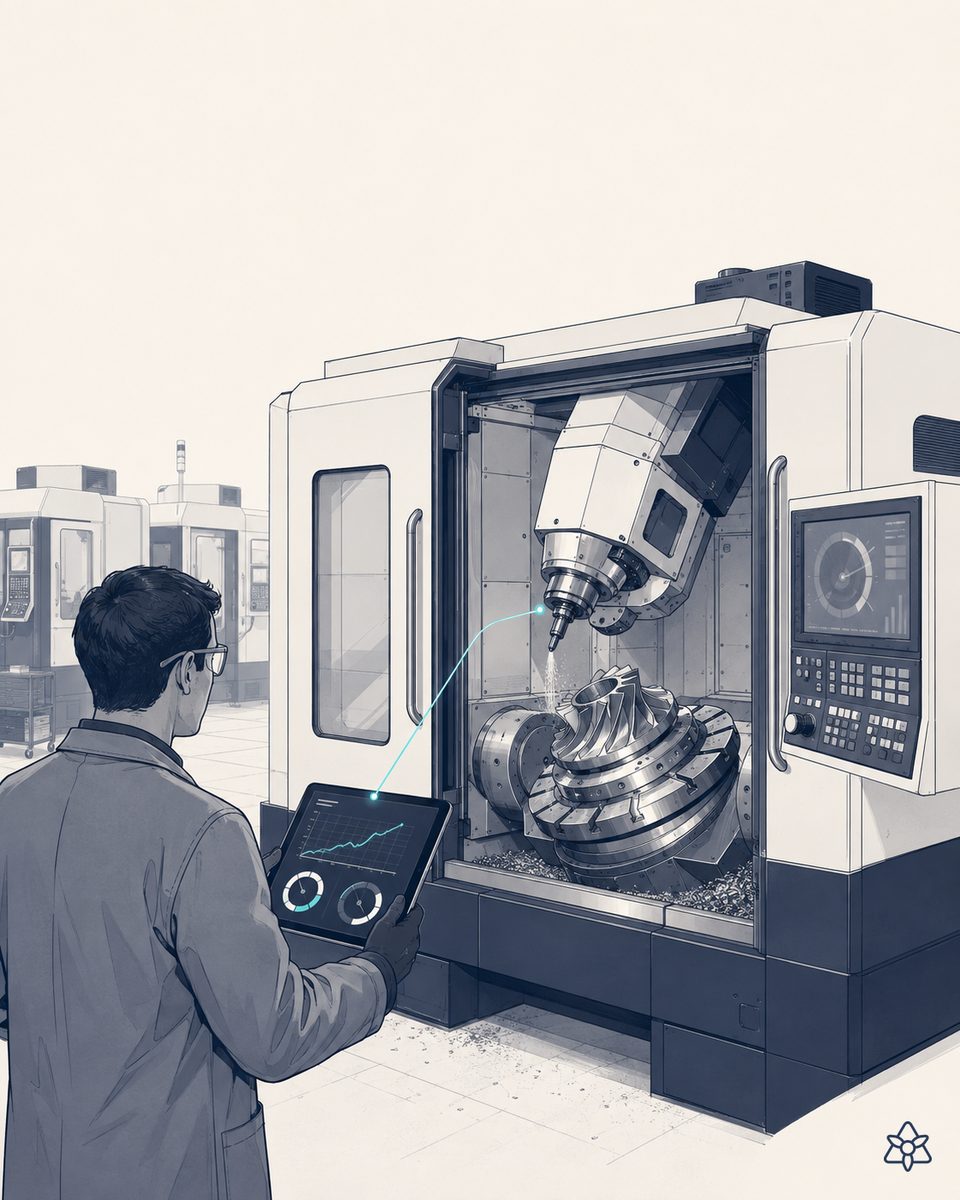
Lean as-is does not fit a plant that makes ten large parts a month — and skipping Lean is not the answer either.
Plenty of aerospace plants carry a comfortable tension: “textbook” Lean (Toyota, very high volume automotive) does not match their reality (short runs, high mix, parts that spend days across several stations), so it gets applied halfway — a cardboard kanban here, an andon over the radio there, a years-old VSM pinned to the wall — and nobody ends up fully believing in any of the methodologies. The consequence is not scandalous, but it is expensive: hidden waits between stations, WIP that grows because nobody knows how much there really is, and daily meetings just to reconstruct the state of the line.
The one who knows where the bottlenecks are is the plant manager — and they know it in their head, from shift experience and manual reports. The day they retire, part of the flow retires with them. And the day the vertical MES (because aerospace has very good MES products, but they are islands) does not talk to quality, to the warehouse or to the end customer, the bottleneck is discovered only after it has already blown the delivery date.
The question is not whether Lean fits aerospace — it is how Lean gets translated to a plant where the part is worth €80,000 and spends a week on the line.
iLEAN does not replace the MES — it seals the crack between the MES, the reality of the line and the person who decides.
The aerospace MES does its job well: it plans orders, manages work orders, lives on its island. Lean needs something the MES alone does not give: a live view of the real flow (not the planned flow), of WIP per station, of the hidden waits, plus the ability to alert the right person when something drifts. iLEAN acts as the putty that covers that crack — without asking you to change the MES, without imposing a new cardboard kanban, without turning andon into one more screen that nobody looks at.
Brain sees the real flow. Agent translates kanban, takt and andon to this plant. Connect alerts the right person on their channel. The decision on how to unblock stays where it belongs.
The three iLEAN pieces applied to aerospace Lean:
- iLEAN Brain (Central) — a live view of each part's flow by serial number, station by station, with its WIP, its queue time and its processing time. Kanban stops being cardboard and becomes a signal in the system; takt stops being seconds and becomes hours/days per station; the VSM stops being a poster and becomes a view of the real flow that updates itself.
- iLEAN Agent — the brain that cross-references the plan against reality and spots the hidden waits before they blow the deadline. If station 7 has spent two days waiting for a quality report from station 5, the agent sees it and escalates. It does not reorganize the line on its own — it proposes, and the person decides.
- iLEAN Connect — andon, translated: an alert to the right person (process engineer, plant manager, inspector) on their channel (phone, WhatsApp, earpiece, tablet) with the context already written up. It also captures what comes from outside: a customer change, a tooling supplier delay, an alert from the legacy MES. Everything enters at second zero.
“Old-school” aerospace Lean vs. aerospace Lean assisted by iLEAN
| Aspect | Classic aerospace Lean | With iLEAN Brain + Agent + Connect |
|---|---|---|
| Kanban | Cardboard cards between stations | A signal in the system, by serial number |
| Takt time | Impossible to define (high mix) | Live takt per station and per part type |
| Andon | Radio, email, a voice at the meeting | Alert to the right person on their channel, with context |
| Hidden waits | Discovered at the afternoon meeting | Detected in real time, escalated automatically |
| VSM | A poster on the wall, updated by hand | A live view of the real flow, with no manual effort |
| MES integration | A master spreadsheet cross-referenced by hand | API or capture, without replacing the MES |
Impact estimate for your plant — to be validated with your numbers.
The block below is an estimate to be validated with the specific data of your line. We put it forward so the committee has an order of magnitude; we refine it during the diagnostic.
- Aerospace Tier-1 plant with 10-30 critical parts a month, several machining/assembly/inspection stations, a vertical MES (Quasar, IFS, SAP DMC or similar) + a master spreadsheet, cardboard kanban and andon over the radio.
- Brain + Agent pilot on one part family (the Pareto one: the family that concentrates most of the value) + Connect integration with the MES by API where one exists. First value expected within a few weeks: the system sees the waits between stations that the plant manager already suspected.
- Indicative payback between 4 and 9 months, depending on the waiting hours cut and the delivery lead time recovered.
- Waiting time between stations down ≥30%, a proportional reduction in shop-floor WIP, and better on-time delivery performance. The hard lever is a single late delivery avoided: one aerospace contractual penalty can pay for the entire pilot.
And the number that separates those who grow from those who fall behind
Between 2000 and 2021, the least digitalized sectors barely improved productivity — the most digitalized raised it by as much as 40% [1]. AI-assisted Lean in an aerospace plant is exactly the digitalization lever that closes that gap without cutting people: what changes is not the headcount, it is how much each hour worked delivers.
[1] Fundación BBVA / Ivie — productivity by level of digitalization, 2000-2021.
What people ask about Lean in an aerospace plant with AI
Does Lean fit low-volume aerospace?
Yes, but translated. Textbook Lean assumes long runs, a stable takt time and frequent tooling changeovers. The typical aerospace plant has short runs (a dozen aircraft a year, not ten thousand cars a day), a high mix of configurations and operations that take hours or days on a single part. The translation: kanban stops being a card and becomes a signal in the system; takt stops being seconds and becomes hours/days per station; andon stops being a cord and becomes an alert about a blockage upstream. The Lean philosophy (eliminate muda, pull flow, continuous improvement) is the same — the implementation changes.
What about one-piece flow?
One-piece flow does exist in aerospace — but the “piece” can be an engine nacelle that passes through twenty stations over several days. Every station has its quality check, its signed torque, its inspector stamp. iLEAN follows the part by its serial number station by station: when it came in, when it left, what deviation was raised, what signature was recorded. When the flow jams (waiting for a part, waiting for an inspector, waiting for tooling), the system sees it before the plant manager finds out at the afternoon meeting.
Andon in an aerospace plant?
Aerospace andon is rarely a cord hanging from the ceiling — it is an alert to the right person on whatever channel they use. If station 7 is waiting for a quality report that station 5 left open, iLEAN does not send an email — it escalates to the process engineer by phone or WhatsApp, with the context (which part, which deviation, what is missing to release it) already written up. The person decides how to unblock it; the system saves them the 20 minutes of piecing the case back together.
Does it work with a legacy MES?
Yes. iLEAN Connect connects to the MES by API if one exists, and by screen capture / document reading if not. We do not ask you to migrate the MES: integration used to sit in the “costs more than it is worth” category — AI drove that cost through the floor. The iLEAN putty covers the crack between MES, ERP, quality and the reality of the part at each station.
What real lead time improvement should you expect?
In low-volume aerospace, lead time is eaten by waiting: waiting for the quality report, waiting for tooling, waiting for the part from the previous cell, waiting for the inspector. Conservative estimate to be validated on site: waiting time between stations down ≥30%, first value in a few weeks (the system sees the waits the plant manager suspected but could not prove), and a proportional reduction in shop-floor WIP. We send you the ROI with your line's data in 48h.
More cases in other sectors
- Helicopter MRO with AI — the aircraft does not fly again until the Form 1 adds up.How iLEAN cross-references visual inspection, NDT, OEM manuals and airworthiness directives to return…
- ITAR/EAR aerospace with AI — a part shipped without a license is a federal crime in the US.iLEAN classifies ECCN/USML, screens restricted-party lists and traces ITAR/EAR licenses for every…
- Landing gear control with AI — the pattern is already proven at an aeronautical Tier 1.How iLEAN combines vision, traceability OCR, operator voice assistance and dossier agents to certify…
- Missile system manufacturing control with AI — batches of twenty units, zero tolerance and a dossier that today lives on paper.How iLEAN controls quality and traceability in missile system manufacturing: paperless on-premise…
- Aerospace NDT with AI — the inspector's eye, amplified and traced by part and operator.iLEAN assists NDT inspectors with AI vision. Inconsistency detected and tracked by part and operator.
- Rail cars and coaches with AI — a badly sealed panel on the line is not a touch-up, it is an operator finding.How iLEAN inspects rail car underframe welds, interior fit-out and the per-coach dossier in railway…
Tell us your case and in 48h we'll send you the estimated ROI of this AI project for your aerospace plant.
We work on your plant's real data, not ours. Diagnostic with no commitment.
Request estimated ROI in 48h See other sectors