Missile system manufacturing control with AI — batches of twenty units, zero tolerance and a dossier that today lives on paper.
A defense contractor does not manufacture in series: it manufactures small batches with total traceability, where every joint, every test and every signature has to be reconstructable years later. For security and compartmentalization reasons, that record usually stays on paper inside the perimeter. iLEAN deploys on-premise: paperless capture without a single data point leaving, local Edge vision on joints and assemblies, and a genealogy dossier by serial number signed by role. The responsible person signs; the system only prepares it.
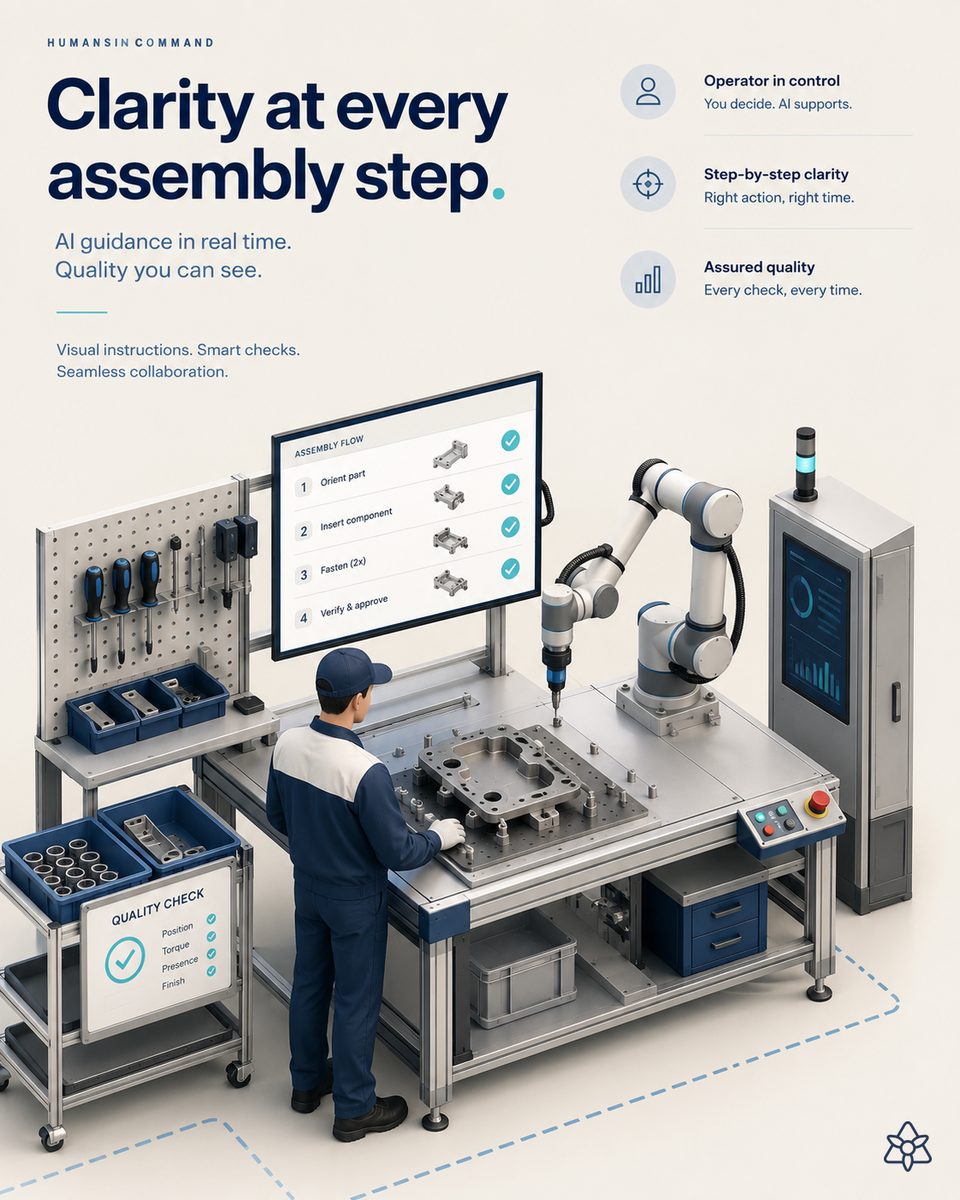
The problem is not building the unit — it is proving, five years later, how it was built.
Missile system manufacturing brings together a combination of constraints that almost no other sector faces all at once:
- Small batches and zero tolerance — there is no volume to amortize a classic automated line, nor enough statistics for a comfortable sampling-based control. Every unit counts, and a unit that comes out wrong is not scrap: it is a nonconformity in front of an institutional customer.
- Total contractual traceability — the defense customer requires you to reconstruct, by serial number, the complete genealogy: material melt, consumable batches, tightening torque at every critical joint, the result of every non-destructive test, the test bench, the calibration of the equipment used to take the measurement, and the signature of whoever validated it. The sector's usual quality schemes (AS9100 and AQAP equivalents) take this for granted.
- Security compartmentalization — and here is the knot. Precisely because the data is sensitive, many programs keep the record on paper: folders, stamped travelers, filing cabinets in the program room. It is the simplest way to guarantee that nothing leaves, and also the most expensive way to guarantee it.
The result is familiar in any defense plant: the operator fills in the traveler with a pen, somebody types it up afterwards, and when the customer asks for the file on serial number 0147, an entire team spends weeks cross-checking filing cabinets, emails and spreadsheets. It is not that the process is bad — it is that the evidence is generated twice and reconstructed a third time.
iLEAN does not open the perimeter — it takes the paperless record inside it.
The legitimate objection a security officer raises about any new software is “where does the data get out?”. iLEAN's answer in defense is that it does not get out anywhere: the installation is fully on-premise, on the contractor's hardware, on whichever network security decides. No cloud, no telemetry, no outbound calls. iLEAN acts as putty between the ERP, the test bench and the assembly cell you already have, without asking you to change any of them.
Edge inspects the joint locally and stores the result, not the image. Connect turns the paper traveler into a digital record at second zero. The agent assembles the genealogy by serial number — and the program's quality manager signs.
The three iLEAN pieces applied to a defense assembly:
- iLEAN Edge — a terminal with computer vision (CNN) in the assembly cell and at the inspection bench. It checks the presence and orientation of components, the condition of joints and welds, the absence of debris, and the match with the configuration of the serial number being built. Inference is local: the model runs on the terminal itself, inside the perimeter, and what gets recorded is the result.
- iLEAN Connect — replaces the paper traveler without taking it out of the room: the operator records tightening torque, consumable batch and test result on the terminal, and the data enters already linked to the serial number. It reads the torque wrench, the test bench or the measuring equipment — through a modern interface or by photographing the screen of an older unit — and captures the supplier's material certificate without anyone transcribing it.
- iLEAN Agents — the agent cross-references material ↔ operation ↔ test ↔ assembly ↔ serial number and builds the genealogy dossier the customer asks for, with the chain of signatures by role. It does not sign: it prepares it, flags the gaps and hands it to the program's quality manager. The three safety rings exist precisely to protect that human signature.
Paper records vs. digital genealogy inside the perimeter
| Aspect | Paper traveler + Excel | With iLEAN Edge + Connect + Agents (on-premise) |
|---|---|---|
| Process record | Handwritten, then typed up | Captured once only, at second zero |
| Inspection of joints and assemblies | Operator's eye and self-check | Local Edge vision, result recorded by serial |
| Genealogy by serial number | Rebuilt by hand, weeks of work | Builds itself while you manufacture |
| Data leaving the perimeter | None (that is why it is on paper) | None: on-premise installation, no cloud |
| Compartmentalization between programs | Physical: one filing cabinet per program | Permissions by role and program, with an access log |
| Customer audit | A dedicated team spends weeks assembling it | Dossier prepared by the agent, reviewed and signed |
| Conformity signature | On a file rebuilt by hand | On a prepared dossier, with a chain of signatures by role |
Impact estimate for your plant — to be validated with your numbers.
The block below is an estimate to be validated with the specific data of your program. We put it forward so the committee has an order of magnitude; we refine it during the diagnostic.
- A defense program in short batches, one or two precision assembly cells, a test bench and a quality team that today assembles the files by hand.
- Edge pilot on one cell, with paperless capture of that cell's complete traveler. First value expected within a few weeks: the process record stops being typed twice and the pilot batch's genealogy can be looked up in seconds.
- Expected reduction of ≥50% in the time spent preparing the audit file and ≥25% in rework caused by nonconformities detected late. Indicative payback between 6 and 12 months, depending on how many quality and engineering hours go into rebuilding traceability today — an estimate to be validated with your numbers.
- The hard lever is the quality and program engineering hours recovered: they stop rebuilding evidence and go back to working on the process.
And the program quality manager's reasonable doubt
“What if the model invents a defect or, worse, lets a real one through on a critical joint?” — hallucination is a problem of free generation, not of anchored tasks. Flagging candidate defects on a joint and comparing them with the reference configuration for that serial number is an anchored task: the best models brought error below 1.5% [1]. And even so, the system does not decide — it proposes, flags, records. The signature of the certified operator, of the inspector and of the quality manager stays exactly where it has to be. The three safety rings exist precisely for this: the conformity of a critical part is not closed out by an AI, it is closed out by a person with a name and a role.
[1] OpenAI paper “Why Language Models Hallucinate”, 2025 — on the reliability of AI in anchored tasks.
What people ask about missile system manufacturing control with AI
Why is iLEAN deployed on-premise, with no cloud, at a defense contractor?
Because the defense customer's requirement leaves no room for nuance: manufacturing data from a sensitive program does not leave the perimeter. iLEAN is installed entirely inside the plant — terminals, inference server, database and agent engine all live on the contractor's hardware, on whichever network the security officer decides. There are no outbound calls, no telemetry, no SaaS. Updates come in through the same controlled channel as any other approved software in the program. If the external link goes down, the system does not even notice: it keeps capturing, inspecting and signing records exactly the same.
How does it work alongside security compartmentalization between programs?
Compartmentalization is modeled for what it is: data partitions with permissions by role and by program. An operator in one program's cell sees the records of their program and their shift; a quality manager sees their own scope; nobody sees the whole picture except the person whose role allows it. Every query, every export and every signature is logged with user, time and reason, so the compartmentalization itself is auditable. The three safety rings of the iLEAN architecture fit well here: ring 1, where the primary data lives, accepts no inbound connections; inference and agents work in ring 3, on whatever ring 1 lets them read.
What exactly is genealogy by serial number for an assembly?
It is the complete tree of what makes up one specific unit and everything that was done to it. For a defense assembly that means: which melt and which material certificate went into each machined part, which batch of adhesive or consumable was used in each operation, what tightening torque was recorded at each critical joint, which non-destructive test each weld passed, which functional test bench gave the green light and which person signed each step. iLEAN builds that tree at the moment each operation happens, not by reconstructing it at the end. When somebody asks about serial number 0147, the answer is a dossier, not a three-week hunt through folders and filing cabinets.
What evidence is left for the defense customer's audits?
What is left is exactly the file the auditor asks for and that today is assembled by hand: genealogy by serial number, process records with values and tolerances, test results, nonconformities with their disposition, calibration of the equipment used for each measurement, and the chain of signatures by role. The format follows what the sector's usual quality schemes require (AS9100 and AQAP equivalents) and whatever the customer adds in the contract. The agent does not sign: it prepares the dossier, flags the gaps and hands it to the program's quality manager, who is the one who closes it. Preparing for an audit stops emptying an office for weeks.
Can machine vision be used without any image leaving the plant?
Yes, and it is the default mode in defense. The vision model runs on the Edge terminal itself, inside the cell. The image is processed locally and what gets stored is the result — conforming / non-conforming, the candidate defect class, the measurement, the timestamp and the part reference. Images, if the program keeps them, stay in local storage under the contractor's retention policy; if the program does not want them, they are discarded after inference and only the record remains. Nothing is uploaded anywhere: there is no external vision service to call, because the model is inside.
Related: Defense radar with AI · Avionics with AI · Satellite components with AI
More cases in other sectors
- ITAR/EAR aerospace with AI — a part shipped without a license is a federal crime in the US.iLEAN classifies ECCN/USML, screens restricted-party lists and traces ITAR/EAR licenses for every…
- Landing gear control with AI — the pattern is already proven at an aeronautical Tier 1.How iLEAN combines vision, traceability OCR, operator voice assistance and dossier agents to certify…
- Lean in an aerospace plant with AI — kanban, flow and andon translated to low-volume high-mix.iLEAN applies kanban, flow and andon in low-volume high-mix aerospace, without Excel.
- Aerospace NDT with AI — the inspector's eye, amplified and traced by part and operator.iLEAN assists NDT inspectors with AI vision. Inconsistency detected and tracked by part and operator.
- Rail cars and coaches with AI — a badly sealed panel on the line is not a touch-up, it is an operator finding.How iLEAN inspects rail car underframe welds, interior fit-out and the per-coach dossier in railway…
- Rail manufacturing with AI — a bad bead on a frame is not a touch-up, it is a file that does not add up.How iLEAN cross-references EN 15085 welding, rail car painting and the ISO/TS 22163 dossier at rolling…
Tell us about your program and in 48h we'll send you the estimated ROI of this AI project for your plant.
We work on your program's real data, not ours. Diagnostic with no commitment.
Request estimated ROI in 48h See other sectors