Satellite component control with AI — the part flies only once. So does the file.
Building satellite components means cross-referencing three demands — cleanroom inspection, ECSS-Q-ST traceability of EEE parts and a live AIT/ABCL dossier for the program customer. iLEAN puts Edge vision in place while respecting the clean flow, Connect captures the certificates, and an agent keeps the As-Built Configuration List signed component by component. The space engineer keeps signing — and stops transcribing.
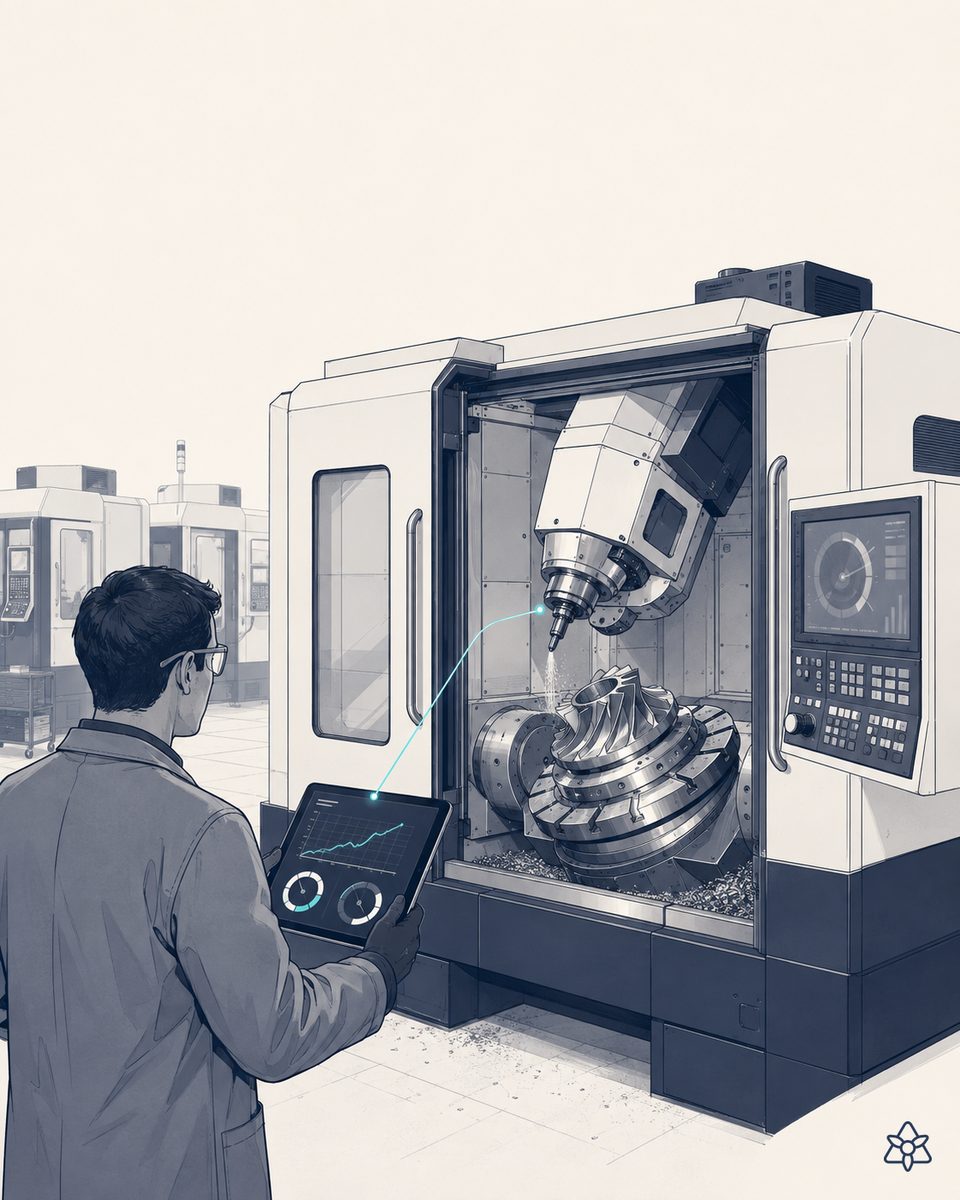
A one-off part, a file that has to be perfect, and a program that forgives nothing.
A satellite component is not reproduced: it is built once, it flies once, and the file that goes with it has to satisfy the ESA or NASA PA engineer down to the last detail. The space quality manager lives with three fronts at the same time:
- Cleanroom inspection — ISO class 8/7, restricted personnel, restricted contact. Every manual inspection adds contamination risk and human error from fatigue. And yet a crack in a NASA-STD-8739.3 solder joint or visible particulate contamination is immediate scrap.
- EEE parts traceability — every component comes in with its lot date code, its URO, its DPA, its ESCC QPL entry and its outgassing history. The master spreadsheet “knows” which manufacturer validated which lot, but the day the person in charge goes on vacation, the knowledge goes with them.
- AIT dossier and ABCL — the As-Built Configuration List, the NCRs, the PFRs, the special process certificates, the bake-out records. When the program customer calls the review, the quality team spends weeks rebuilding what it already knew and had already done. Every review is a sprint, and every sprint costs money and nerves.
The classic system works — but it rests on the space veteran's eye and on a master spreadsheet that copes worse and worse with the pace of a real program. Losing the knowledge of a single senior engineer can stall an AIT campaign for weeks.
iLEAN does not recertify your cleanroom — it seals the cracks between the PLM, MES, ERP and master spreadsheets you already have.
The problem in space is not a lack of data — it is data scattered across islands that gets rebuilt by hand on review day. iLEAN acts as the putty that fills the gaps between PLM (configuration), MES (operations), ERP (EEE parts purchasing) and the veteran's master spreadsheets, without asking you to touch your PA Plan or your approved QMS.
Edge looks at the part inside the cleanroom without putting extra people in. Connect captures the certificate whatever channel it arrives on. The agent keeps the ABCL live part by part. The person signs — always.
The three iLEAN pieces applied to satellite component control:
- Edge — a vision head with a convolutional neural network, mounted fixed or on an articulated arm inside the cleanroom. It reads space soldering (NASA-STD-8739.3), torque on critical joints, visible particulate contamination and geometric deviations in milliseconds. It works with no network: the critical cycle does not depend on WiFi in a room with a Faraday cage.
- Connect — captures the certificate of origin, lot date code and URO of every EEE part whether it comes by email from the qualified distributor, as a PDF from the foundry or in the space procurement lead's master spreadsheet. It also captures what comes from outside (GIDEP alerts, ESCC QPL changes, technical notes from the program customer) at second zero.
- Agents in Central — they cross-reference Edge images, lot traceability, bake-out / outgassing measurements and the MES work order to keep the ABCL live, draft consistent NCRs/PFRs and assemble the AIT procedure. The team reviews instead of transcribing. The three rings guarantee that ITAR/EAR data does not leave ring 1 without a human signature.
Manual satellite component control vs. cross-referenced control with iLEAN
| Aspect | Classic space AIT | With iLEAN Edge + Connect + Agents |
|---|---|---|
| Cleanroom inspection | Manual inspector + magnifier + paper checklist | Edge head with a trained CNN + the PA engineer's signature |
| EEE parts traceability | Master spreadsheet + PDFs in a shared folder | Captured at second zero + cross-referenced with GIDEP/ESCC QPL |
| As-Built Configuration List | Rebuilt the week before the review | Live per component, signed in line |
| Consistent NCRs and PFRs | Free text written by the engineer on shift | Agent template + photo/Edge evidence |
| AIT dossier for the program customer | A manual sprint lasting weeks | Generated; the team reviews |
| ITAR/EAR — data sovereignty | Agreements based on intent | Three physical rings + a signed file drop per plant |
Impact estimate for your plant — to be validated with your numbers.
The block below is an estimate to be validated with the specific data of your plant. We put it forward so the committee has an order of magnitude; we refine it during the immersion diagnostic.
- A plant building electronic units for satellites with a class 8/7 cleanroom, a mix of ESA programs + commercial customers, EEE parts with an ESCC QPL entry and mandatory URO.
- Edge pilot on one critical AIT station + Connect for EEE parts certificates + an ABCL agent. First value expected within a few weeks (one NCR caught in line, one questionable lot blocked before assembly).
- Indicative payback between 5 and 9 months, depending on how often rework is triggered by contamination or incomplete traceability, and on the average time spent preparing the AIT dossier for each program review.
- The hard levers are one flight unit recovered before ATP and a ≥ 30% reduction in the time spent preparing the AIT dossier. One flight unit pays for the entire pilot.
And the PA manager's reasonable doubt
“What if the AI passes a space solder joint that is not good?” — hallucination is a problem of free generation, not of anchored tasks. In tasks where the AI merely compares an image against a reference trained on your own NASA-STD-8739.3 solder joints, the best models brought error below 1.5% [1]. And even so, what is critical is never decided alone: iLEAN holds the unit, the PA engineer signs, and ring 1 (where the program's sensitive ITAR/EAR data lives) never accepts anything that has not been validated, packaged in signed JSON and approved by a person.
[1] OpenAI paper “Why Language Models Hallucinate”, 2025 — on the reliability of AI in anchored tasks.
What people ask about satellite component control with AI
Which standards govern satellite component manufacturing?
In Europe, the ECSS family (European Cooperation for Space Standardization): ECSS-Q-ST-10 for quality, ECSS-Q-ST-60 for EEE parts, ECSS-Q-ST-70 for materials and processes, ECSS-Q-ST-20 for PA. On programs with an American partner, AS9100 is added and, depending on the customer, MIL-STD-1540 for integration or NASA-STD-8739 for space soldering. Every component flies with its signed As-Built Configuration List (ABCL) — which lot, which wafer, which operator, which special process — because in orbit there is no second visit.
How do you inspect a satellite component in a cleanroom without contaminating it?
iLEAN Edge is mounted as a vision head on the cleanroom station itself (ISO class 8/7), with no extra operator inside. The CNN trained on your parts detects space soldering defects (NASA-STD-8739.3), visible particulate contamination and torque deviations on critical joints from the post-operation image. The part is not released on its own: the space process engineer validates and signs. The AI acts as a safety net, not as a judge, and it respects the clean flow.
What about EEE parts traceability and the risk of a contaminated or counterfeit lot?
Connect captures the certificate of origin, the lot date code and the URO (Up-screening Report) of every EEE component entering the warehouse — whether it comes by email from the qualified distributor, as a PDF from the foundry or in a spreadsheet kept by the space procurement lead. An agent cross-references those lots with the program's DPA (Destructive Physical Analysis), with the ESCC QPL and with GIDEP alerts, and blocks any assembly that would fit a suspect lot. The As-Built Configuration List is generated live, with no final sprint.
How is the AIT (Assembly, Integration & Test) dossier assembled without putting people on transcription duty?
An agent in Central assembles the AIT procedure, the nonconformity reports (NCR), the deviations (PFR), the special process certificates and the bake-out / outgassing records from the measurements taken in line, the Edge photos and the MES work order. The space quality team reviews instead of transcribing. The ABCL stays live and signed component by component, ready for the program customer or for the review at ESA/NASA — with no marathon beforehand.
What happens with ITAR/EAR and data sovereignty on dual-use projects?
When the program involves components controlled under ITAR (USML category XV) or EAR99/600, iLEAN's three-ring architecture is the direct answer: ring 1 (the OT network holding the program's data) never accepts inbound connections; transport between rings is a signed file drop, with a cryptographic key per plant. The TAA agreement is anchored to a physical perimeter, not to a promise. The powerful AI lives in ring 3; sensitive data does not leave ring 1 without a human signature.
More cases in other sectors
- Rail manufacturing with AI — a bad bead on a frame is not a touch-up, it is a file that does not add up.How iLEAN cross-references EN 15085 welding, rail car painting and the ISO/TS 22163 dossier at rolling…
- Rail signaling with AI — the unit does not leave the shop until the SIL file adds up.How iLEAN cross-checks PCB inspection, SIL testing and EN 50128/50129 records so every rail signaling…
- Rocket manufacturing control with AI — a launcher admits no recall, so control has to sit in manufacturing.Extreme tolerances and genealogy by serial number: iLEAN captures tests with no paper, inspects joints…
- Shipbuilding with AI — one badly finished seam on the slipway is a month of delay.How iLEAN inspects hull weld seams, block alignment and anticorrosion coating in shipyards, with Edge…
- Specialty chemicals — the batch you cannot repeat is the one nobody measured while it was being made.20 industrial AI cases in specialty chemicals: measured ink color, pigment dispersion, coating…
- Accelerated stability of the pigment batch — evidence tied to the batch, not a loose sheet.How iLEAN ties every accelerated stability test — oven, UV, sedimentation — to its batch, with readings…
Tell us your case and in 48h we'll send you the estimated ROI of this AI project for your satellite plant.
We work on your program's real data, not ours. Diagnostic with no commitment.
Request estimated ROI in 48h See aerospace and defense