Rocket manufacturing control with AI — a launcher admits no recall, so control has to sit in manufacturing.
Building rockets the new space way demands three things at once that almost no plant has solved: extreme tolerances verified at the station, full genealogy of every component (material → machining → test → integration) and AS9100 evidence ready without rebuilding it. iLEAN Edge inspects critical joints and surfaces, Connect captures machining and test reports with no paper, and an agent assembles the genealogy dossier by serial number. The qualified person signs.
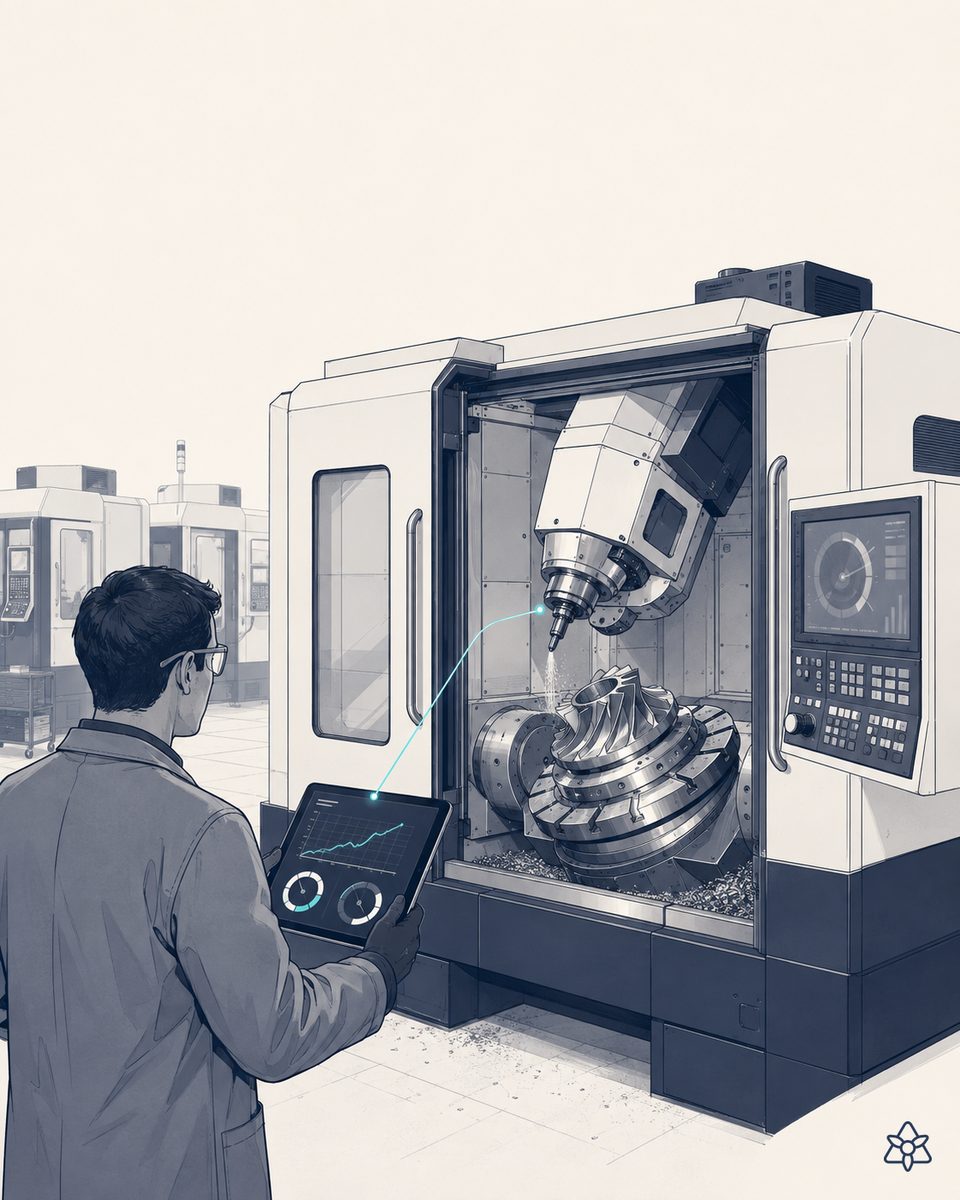
On a launcher there is no second chance — and the evidence is asked for months after the part was made.
A launcher stage is a thin-walled structure, light to the limit and subject to loads no other industry handles: cryogenic pressure, vibration, thrust. Machining tolerances are measured in microns on parts that are meters long. And manufacturing combines three realities that in the plant live on separate islands:
- The extreme tolerance — barrel sections, bulkheads, joint flanges, turbomachinery housings. The machine measures, the operator writes it down, and the data ends up on a paper report or in a local spreadsheet. When somebody wants to know whether a tool's drift started three parts earlier, that data is no longer searchable.
- The critical joint — tank weld beads, seals, contact surfaces with the thermal protection. Visual inspection is done by a qualified person under schedule pressure, and whatever is found after assembly can no longer be fixed without opening the assembly up.
- The genealogy — which heat the material came from, who machined it and with what parameters, who welded it and with what current qualification, which non-destructive test it passed, which subassembly serial number it was integrated into. AS9100 requires all of it. Today it is rebuilt by hand when the audit arrives or when a problem shows up.
The quality manager lives between the three, and when a full-stage test returns an odd result they have to go back component by component to find out what exactly went into that stage. Failure admits no recall: you cannot call back a vehicle that has already flown. That is why control cannot be a document review at the end — it has to sit where the part is made.
iLEAN does not replace your machine or your test bench — it seals the crack between the station and the dossier.
The new space problem is not buying more measuring equipment: it is that the machining center, the test bench, the ERP, the supplier certificate and the operator's signed report do not talk to each other in real time. iLEAN acts as putty between the systems you already have, without asking you to change the machine, the test equipment or the program's ERP.
Edge inspects the joint and the critical surface and flags what the classic recipe never anticipated. Connect captures the machining report and the test result at second zero, with no paper. The agent stitches the genealogy by serial number and prepares the AS9100 dossier — the qualified person signs.
The three iLEAN pieces applied to launcher manufacturing:
- iLEAN Edge — a terminal with computer vision (CNN) over the inspection bench and over the welding station. It flags surface porosity, apparent lack of penetration in the bead, tooling marks on a sealing area and finish variations that signal a worn tool. It marks the part for review by the qualified inspector. It works with no network: if the shop loses connectivity, Edge keeps capturing and syncs when it recovers.
- iLEAN Connect — paperless capture of the machining report (parameters, key characteristics measured, operator), the material heat certificate and the result of the non-destructive or leak test, from equipment with a modern interface as well as from older equipment whose screen is simply photographed. The report that today ends up in a filing cabinet becomes usable data the same day.
- iLEAN Agents — the agent cross-references heat ↔ part ↔ test ↔ subassembly ↔ stage serial number and assembles the genealogy dossier and the AS9100 file the auditor asks for. It does not sign: it prepares it and hands it to the quality or program manager. The human signature is sacred; the three safety rings exist precisely to protect it.
Launcher manufacturing with paper reports vs. control at the station with iLEAN
| Aspect | Paper reports + spreadsheets | With iLEAN Edge + Connect + Agents |
|---|---|---|
| Machining key characteristic | Written down by hand, searchable only with effort | Captured at the station, with a trend per tool |
| Defect on a joint or critical surface | Depends on the recipe and on the shift's workload | The CNN also flags the unanticipated pattern and marks it for the inspector |
| Genealogy material → stage | Rebuilt by hand whenever it is needed | Chain stitched by serial number from day one |
| Supplier heat certificate | PDF in the purchasing folder | Captured by Connect, linked to the batch and the part |
| AS9100 file for the audit | Weeks of work before the audit | Dossier per serial number prepared by the agent |
| Quality manager's signature | On a file rebuilt by a person | On a dossier prepared by the agent |
Impact estimate for your plant — to be validated with your numbers.
The block below is an estimate to be validated with the specific data of your program. We put it forward so the committee has an order of magnitude; we refine it during the diagnostic.
- A short-run manufacturer of launcher structures and components: machining of barrel sections and flanges, welding and sealing of tanks, a test bench and a quality team with AS9100 responsibility.
- Edge pilot on one joint inspection station plus paperless capture of the machining report. First value expected within a few weeks: a tool drift or a surface defect pattern shows up that the classic control never had in its recipe.
- Expected reduction of non-conformances found too late — the ones that appear after assembly, when they already cost weeks — and of the time spent preparing the genealogy dossier. Indicative payback between 6 and 12 months — an estimate to be validated with your numbers, depending on the volume of critical parts and the quality hours spent today rebuilding traceability.
- The hard lever here is not only economic: it is strategic. A non-conformance that escapes into integration is not fixed with a service campaign, and the real cost is a compromised flight campaign. The return is measured as much in quality hours recovered as in program risk that simply stops existing.
And the aerospace CAIO's reasonable doubt
“What if the CNN invents a defect or, worse, misses a real one on a weld bead?” — hallucination is a problem of free generation, not of anchored tasks. Flagging candidate defects on a surface and comparing them against the reference part is an anchored task: the best models brought error below 1.5% [1]. And even so, the system does not decide — it proposes, flags, records. The signature of the qualified inspector, of the test lead or of the quality manager stays exactly where it belongs. The three safety rings exist precisely for this: the disposition of a critical flight part is not closed by an AI, it is closed by a qualified person.
[1] OpenAI paper “Why Language Models Hallucinate”, 2025 — on the reliability of AI in anchored tasks.
What people ask about rocket manufacturing control with AI
Why does control of a launcher have to sit in manufacturing and not at the end?
Because a rocket admits no recall. In automotive or consumer electronics, a defect that escapes is fixed with a service campaign; on a launcher, the first and only real load test is the flight, and there is no going back from there. On top of that, assembly is irreversible: once a barrel section is welded to the tank and the tank is integrated into the stage, reopening it to verify an internal joint costs weeks and sometimes destroys the part. Control has to happen at the station where the value is created — in machining, in welding, in testing the loose part — because afterwards it is no longer control, it is archaeology. That forces you to capture the evidence at second zero, not to rebuild it in a later document review.
How is the full genealogy of a component built?
Genealogy is the chain material → machining → treatment → test → integration, tied to a unique serial number. iLEAN Connect captures every link at the moment it happens: the heat and the material certificate at goods-in, the parameters and the report from the machining center, the qualified operator's signature on the weld, the result of the non-destructive test and the leak test, and finally the serial number of the subassembly the part is integrated into. The agent stitches those links together and leaves the chain searchable upward (which launcher carries this heat?) and downward (which heat did this barrel section come from?). The difference with paper is not the information: it is that the chain exists in full from day one and does not have to be rebuilt.
What evidence does AS9100 require and how does the system prepare it?
AS9100 requires, among other things, configuration control, product traceability, key characteristic management, qualification of the personnel who run special processes, and objective evidence of first article inspection and of non-conformances. None of that is exotic — the problem is that today it lives scattered across paper reports, spreadsheets and network folders. The iLEAN agent gathers, by serial number, the file the auditor asks for: material certificate, machining report with the key characteristics measured, the welder's current qualification, the test report, deviations and their disposition. The agent does not sign: it prepares the dossier and hands it to the quality manager, who is the one who closes it.
What does Edge vision add on critical joints and surfaces?
On a launcher the critical surfaces are thin-walled and held to extreme tolerances: light-alloy barrel sections, friction stir weld beads, tank joints, thermal protection layers. The defects that matter are subtle — surface porosity, lack of penetration in the bead, a scratch or tooling mark on a sealing area, a finish variation that signals a worn tool. A classic inspection system sees what its recipe covers; Edge vision trained with a CNN also flags the pattern nobody had anticipated and marks it for the qualified inspector. The terminal works with no network, so capture does not depend on the shop's connectivity.
How does it integrate with the ERP, the MES and the quality systems we already have?
Without replacing them. iLEAN acts as a joining layer between what is already installed: it reads the work order and the serial number from the ERP, posts the station's progress to the MES, and publishes the genealogy dossier where the quality team already works. When an older piece of equipment has no interface, Connect reads its screen or its printed report and turns it into data. Typical integration is done through signed files or an API, depending on what the existing system allows, and it respects the three safety rings: the plant network accepts no inbound connections from outside. Nothing has to be migrated to start: you begin at one station and expand.
Related: Satellite components with AI · Aero turbines with AI · AS9100 with continuous auditing
More cases in other sectors
- Rail cars and coaches with AI — a badly sealed panel on the line is not a touch-up, it is an operator finding.How iLEAN inspects rail car underframe welds, interior fit-out and the per-coach dossier in railway…
- Rail manufacturing with AI — a bad bead on a frame is not a touch-up, it is a file that does not add up.How iLEAN cross-references EN 15085 welding, rail car painting and the ISO/TS 22163 dossier at rolling…
- Rail signaling with AI — the unit does not leave the shop until the SIL file adds up.How iLEAN cross-checks PCB inspection, SIL testing and EN 50128/50129 records so every rail signaling…
- Satellite component control with AI — the part flies only once. So does the file.iLEAN combines Edge inspection, ECSS/AS9100 traceability and dossier agents to build satellite…
- Shipbuilding with AI — one badly finished seam on the slipway is a month of delay.How iLEAN inspects hull weld seams, block alignment and anticorrosion coating in shipyards, with Edge…
- Specialty chemicals — the batch you cannot repeat is the one nobody measured while it was being made.20 industrial AI cases in specialty chemicals: measured ink color, pigment dispersion, coating…
Tell us about your launcher program and in 48h we'll send you the estimated ROI of this AI project for your plant.
We work on your program's real data, not ours. Diagnostic with no commitment.
Request estimated ROI in 48h See other sectors