Aero turbine manufacturing with AI — the FAI is not rebuilt; it is generated while you build.
Aero turbine manufacturing is where three demands meet — critical tolerances in geometry and surface finish, traceability from heat number to certified part and the AS9100 / NADCAP evidence pack the engine maker asks for at every step. iLEAN sees every operation with Edge, ties traceability together with OCR and Connect, and an agent assembles the FAI as you go — with the ITAR/EAR integrity of the three safety rings. The person signs.
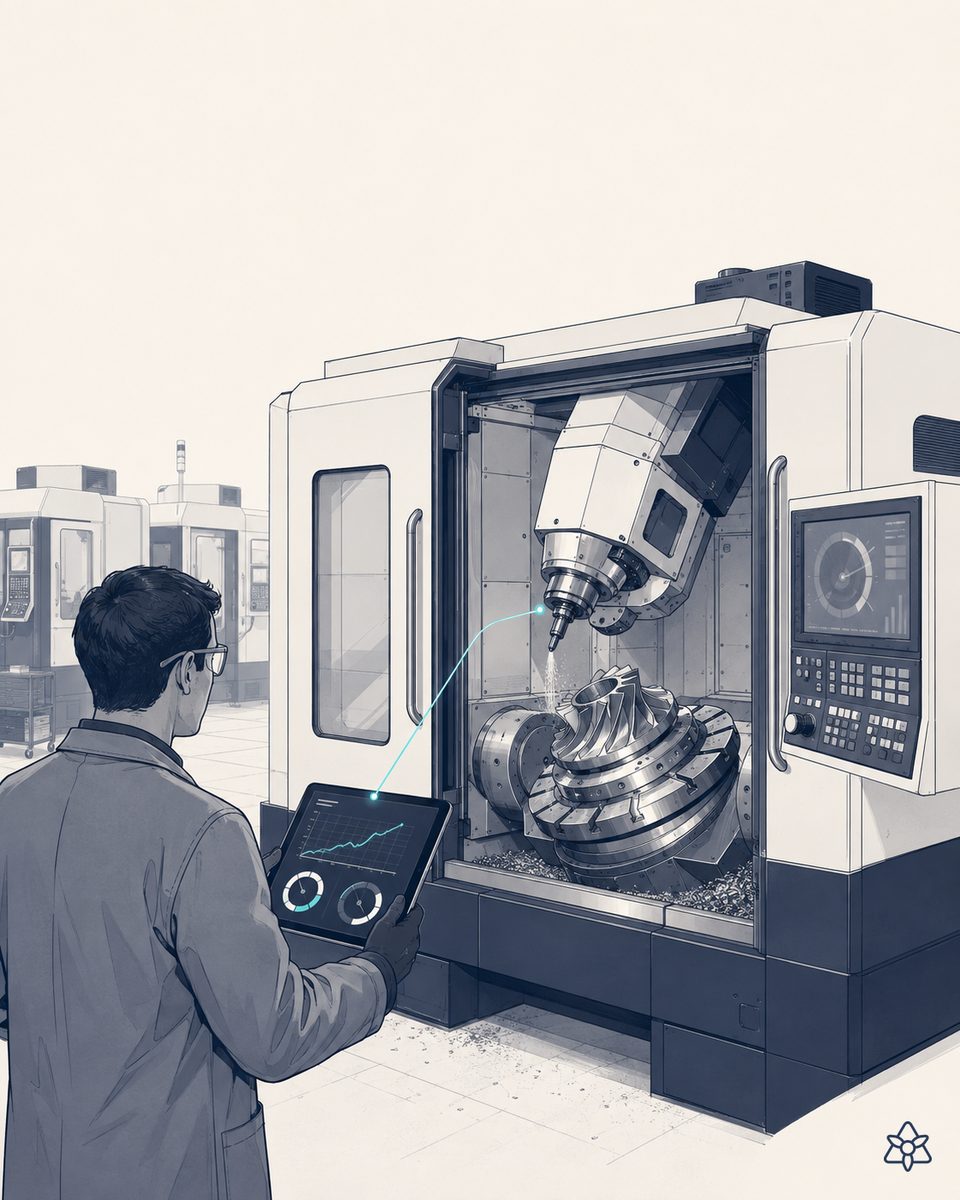
You make the part right; you rebuild the dossier every single time.
An aero turbine admits no excuses. You know how to make a good part: 5-axis machines, calibrated furnaces, NDT inspection by certified personnel, CMM in series. What hurts is not the part — it is the evidence that the part is good. Today that evidence rests on four systems that do not talk to each other:
- The drawing and the specification — from the engine maker, revised through SR/SCN letters, living in PDM and in a parallel folder on the quality manager's drive.
- Material traceability — the heat number of the melt, the foundry certificate, tied to each part lot through marks that manual OCR misreads on reflective superalloy surfaces.
- The operation — the 5-axis recipe, the heat treatment furnace curve, the coating parameters, the NDT result. Each one on its own island.
- The evidence pack — AS9102 FAI, NADCAP packages, the engine maker's own requirement. Assembled by hand, part by part, whenever it is asked for.
When the engine maker demands an FAI on a new part, the quality engineer disappears into a corner for a week to gather drawings, certificates, measurements, photos and signatures. When there is a complaint, months get reconstructed. The problem is not the part — it is that the evidence is built at the end, and everything built at the end weighs more than it should.
iLEAN does not replace your PDM or your MES — it keeps the evidence pack alive between the two.
The FAI/NADCAP problem is not a lack of data: it is data on four different islands (PDM/PLM, MES, inspection systems, foundry certificates) that only get cross-referenced at the end. iLEAN acts as the putty that fills the gaps without asking you to change anything critical. And everything that touches AS9100, ITAR or EAR lives where it has to live — inside the three safety rings.
Edge sees every manufacturing and inspection operation. Connect ties traceability and certificate to the part. The agent assembles the FAI as you go — and the three rings guarantee ITAR/EAR. The person signs.
The three iLEAN pieces applied to aero turbine manufacturing:
- Edge — a machine-vision terminal (CNN) over critical stations: 5-axis output, NDT, coating, edge inspection. It detects surface defects, out-of-spec marks and NDT indications, and records the image tied to the part. It works with no network; what is critical does not wait for WiFi.
- Connect — captures the heat number by OCR even on reflective surfaces, ties the foundry certificate to the part, reads the furnace curve even when the controller is old, and captures the engine maker's SR/SCN changes through whatever channel they arrive on. And it also captures what comes from outside (NADCAP audit, complaint, regulatory change).
- Agent — knows the documentation tree of AS9100, AS9102 (FAI), the NADCAP special processes and the engine maker's own requirements. It assembles the evidence pack as the part goes through each operation. The quality engineer moves from building to reviewing and signing.
Classic manufacturing vs. manufacturing with live iLEAN evidence
| Aspect | Classic manufacturing | With iLEAN Edge + Connect + Agent |
|---|---|---|
| FAI / AS9102 on a new part | A week of a quality engineer's time | Generated as you go; the engineer reviews and signs |
| Heat number → part traceability | Manual OCR + Excel | Automatic reading + part tied to heat in line |
| Engine maker SR/SCN change | Arrives by email, distributed by hand | Connect captures it, the agent updates the live tree |
| Finding parts affected by an NCR heat | Manual reconstruction across systems | A direct query to the agent, in seconds |
| NADCAP pack (HT, NDT, coating) | Assembled for each audit | Live and traced by special process |
| Data sovereignty (ITAR / EAR) | Trust placed in heterogeneous silos | Three rings + cryptographic signature per plant |
Impact estimate for your plant — to be validated with your numbers.
The block below is an estimate to be validated with the specific data of your plant. We put it forward so the committee has an order of magnitude; we refine it during the diagnostic.
- Tier-1 or Tier-2 supplier to an engine maker, manufacturing blades / disks / casings in Inconel or titanium alloys, AS9100 and NADCAP in force, several programs with an active FAI.
- Edge + Connect + Agent pilot on one priority part family (the one that eats the most FAI time today). First value expected within a few weeks: automated heat number traceability and a first FAI generated as you go, ready for review.
- Indicative payback between 4 and 9 months, depending on the current volume of engineer-hours spent assembling FAIs and NADCAP packs, and on the cost of rework caused by incomplete or late documentation.
- A reasonable reduction to expect: ≥30% in engineer-hours spent on evidence, and a sharp drop in response time to a complaint or a NADCAP audit.
And the quality manager's reasonable doubt
“What if the AI builds the wrong heat number / part correlation and it slips into an FAI?” — hallucination is a problem of free generation, not of anchored tasks. Extracting a heat number from an image, reading a melt certificate and matching it to the part are anchored tasks; in those, the best models brought error below 1.5% [1]. And the quality standard in critical industries is measured in 25 PPM (parts per million) [2] — a level only reachable with systems that see everything and leave critical judgment to the person. What counts for certification is decided by the engineer, on top of a proposal signed by the corresponding ring.
[1] OpenAI paper “Why Language Models Hallucinate”, 2025 — on the reliability of AI in anchored tasks.
[2] The 25 PPM quality standard in critical sectors — Symestic reference.
What people ask about aero turbine manufacturing with AI
Which critical defects does AI detect on turbine components?
The usual ones on blades, vanes, disks and casings made of Inconel and titanium alloys: surface defects on the airfoil profile, machining marks outside specification, heat treatment defects (oxidation, localized decarburization), NDT indications (penetrant, magnetic particle, ultrasound) and dimensional deviations on critical features. iLEAN Edge, with vision and a CNN trained on good part/bad part, classifies them in line; an agent cross-checks against the drawing specification to decide acceptance, rework or rejection. The person signs.
How is heat traceability maintained all the way to the finished part?
Every turbine component requires cradle-to-grave traceability from the material heat number to the certified part delivered to the engine maker. iLEAN Connect captures the OCR of heat marks at every operation, ties them to the part number, and keeps the chain of evidence alive. If a heat is later found out of spec, the agent identifies in seconds which parts used it and where they are. It is not an Excel search — it is a direct query to the system.
How do you assemble the FAI / First Article Inspection without tying up an engineer for a week?
The traditional FAI (AS9102) is a reconstruction job: for days, the quality engineer hunts for drawings, material certificates, NDT records, CMM measurements, photos and signatures across different systems. iLEAN changes the order: the FAI is built as you go. While the part is machined, heat treated and NDT inspected, iLEAN Edge records image + measurement, Connect captures certificate + furnace curve + NDT record, and the agent assembles the evidence pack. When the FAI is requested, it is already there. The engineer reviews and signs — they do not build.
Is it compatible with AS9100, NADCAP and the engine maker's requirements?
Yes, by design. iLEAN does not replace your quality system — it sustains the evidence that AS9100 (system), NADCAP (special processes such as heat treatment, NDT, welding, coating) and the engine maker's own requirements demand at every step. Each major engine OEM has its own documentation tree; the agent knows the tree every customer and every standard requires, and keeps it alive instead of rebuilding it for the next audit.
Does it comply with ITAR / EAR and defense data sovereignty?
Yes. iLEAN is built on the three safety rings: the critical OT network isolated in ring 1, a validation chamber in ring 2 and the AI horsepower in ring 3. Sensitive data (part geometry, ITAR/EAR-protected specification, military customer data) lives in ring 1 and is only exposed outside with explicit human validation. No data leaves for a generic cloud; the plant can run on-premise with full data sovereignty. The architecture fits DO-326A, IEC 62443 and the serious OT protocols of the sector.
More cases in other sectors
- 5-axis aerospace machining with AI — a titanium part with forty machine hours on it cannot be scrapped over a data point nobody cross-referenced.iLEAN cross-references the machining log, the CNC panel and CMM measurement into an AS9100 genealogy per…
- Aerospace heat treatment with AI — quality cannot be verified afterwards: you have to prove the curve was THE curve.How iLEAN captures the real furnace curve without touching it, links load ↔ curve ↔ part and prepares…
- Aircraft propeller control with AI — a live dossier per serial number, not a folder thrown together at the last minute.How iLEAN combines Edge vision, balancing machine readings and agents to certify every aircraft…
- Aeronautical configuration with AI — Mod Status and effectivity per aircraft, without aircraft 247 living in a spreadsheet.iLEAN manages Mod Status and ECN/ECO effectivity per aircraft or batch. Traceable configuration from…
- An aerospace claim years down the line demands knowing which heat lot was used — and only whoever kept the link from day one can answer that.iLEAN traces every aerospace part back to its original heat lot, with the mill cert and the RMA linked…
- Aero paint & coating with AI — the bath drifts in silence and you find out 200 parts later.iLEAN controls bath, thickness and NADCAP chemical processing in aerospace coatings — AI vision + Edge +…
Tell us your case and in 48h we'll send you the estimated ROI of this AI project for your aerospace plant.
We work on your plant's real data, not ours. Diagnostic with no commitment.
Request estimated ROI in 48h See aerospace and defense