Aero paint & coating with AI — the bath drifts in silence and you find out 200 parts later.
Aero coating demands NADCAP chemical processing and strict mil-specs. iLEAN controls the bath continuously, measures thickness per part in line and compiles the NADCAP dossier automatically — the inspector signs, the system never approves a part on its own.
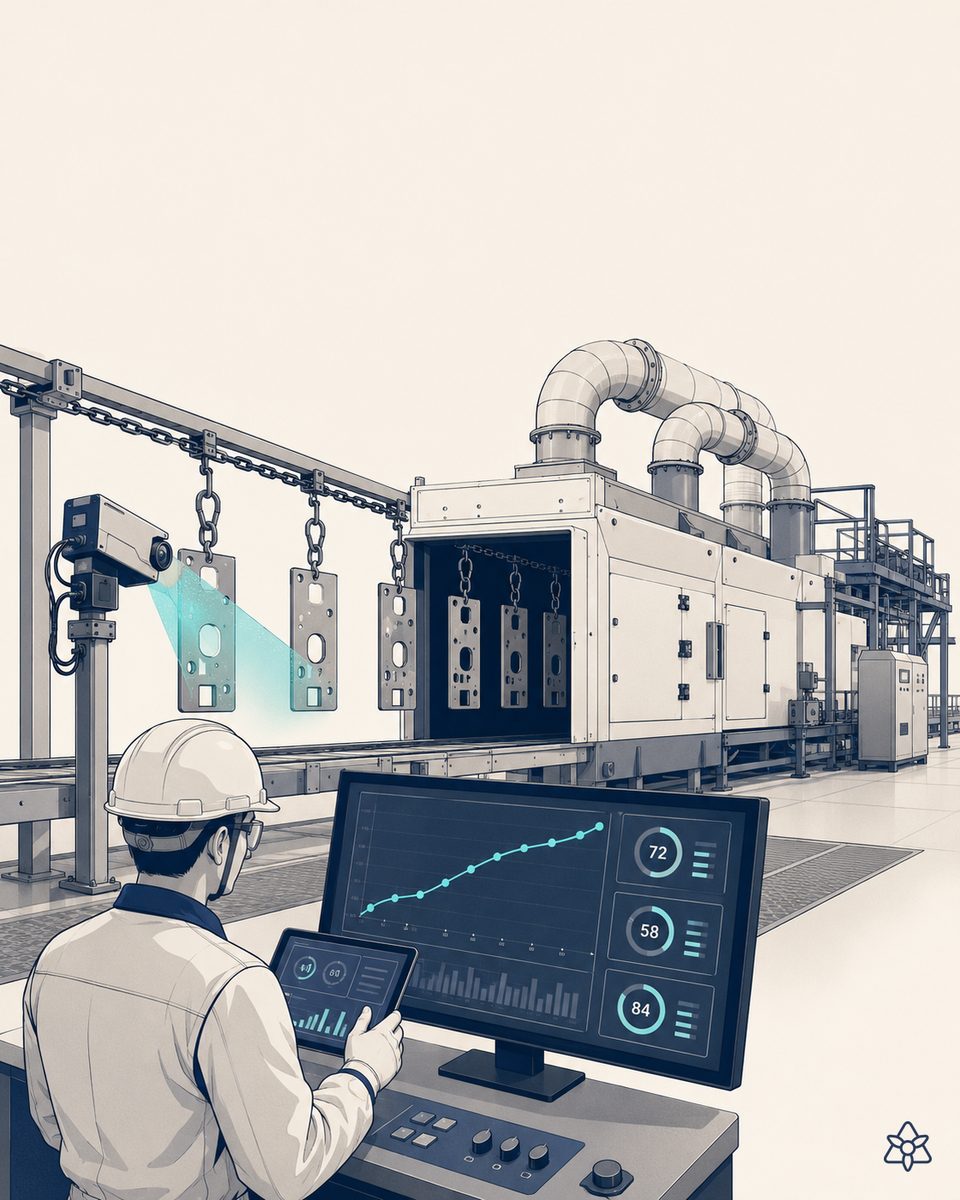
The tank runs fine until it doesn't, and the sampling never arrives in time.
Every chem proc manager tells the same story: "my line meets mil-spec as long as the parameters stay in range. The problem is that sampling runs every 8 hours and the bath drifts in 3." And underneath, the reality:
- The bath is titrated at 7 and known at 4 pm — the operator takes a sample, the lab titrates, the result comes back. If in that window a run of parts went through dragging chemistry with it, the drift appeared and was seen afterwards.
- Thickness is measured at the end, not in line — the inspector pulls the part, measures with a handheld probe, jots it on a sheet. If it's out, curing is already done, tank time already spent, paint already used.
- The cure curve lives in another system — the oven records, the batch is in the MES, tying them to the part's dossier is manual work.
- The per-part NADCAP chem proc dossier — bath composition, thickness per point, cure curve, paint batch, certs — gets assembled when the OEM customer asks for it. A sprint for the quality team.
And the worst-case scenario: discovering the bath was contaminated retroactively, with 200 parts already made, already painted, already delivered. Customer claim, rework, program delay.
iLEAN does not replace the tank or the lab — it seals the cracks between bath, thickness and dossier.
The problem in chem proc is not a lack of control: it is that the control lives in islands and on a delay. The tank has its sensors, the lab has its titration, the inspector has their probe, the oven has its curve — but joining them per part and in the moment requires a person cross-referencing screens and filling in sheets. iLEAN acts as the putty that joins tank + lab + thickness + curing + MES batch into a living per-part dossier.
Edge measures thickness in line and sees the part. Vision reads the serial number. Tracer joins bath, curve and certs. The agent holds the part if a reading falls out, holds the batch if the bath approaches the limit. The person signs.
The three iLEAN pieces applied to aero coating:
- iLEAN Edge — an in-line terminal with a thickness probe (eddy current / XRF / interferometry depending on the process) and an industrial camera (CNN). It measures N points per part defined by geometry, links them to the part's serial, and holds before the next step if a reading falls out of range. It works without a network — if the plant loses WiFi, the Edge keeps measuring and holding.
- iLEAN Vision — assisted visual inspection on the coated part (cosmetic defects, missing coverage, visible contamination, out-of-range color). The CNN learns the defects your inspector sees. It does not replace the inspector — it gives them a first filter and takes the bulk of trivial inspections off their plate so they can spend time on the real doubts.
- iLEAN Tracer (Connect) — capture from the bath sensor (pH, conductivity, temperature, concentration of the key chemical) continuously, from the lab titrator when the result arrives, from the curing oven (curve per load), from the MES (which part, which batch, which SKU), from the PLM (which specification applies). The agent assembles the per-part NADCAP chem proc dossier, ready when the customer asks.
Manual chem proc vs. with iLEAN
| Aspect | Periodic sampling + handheld probe | With iLEAN Edge + Vision + Tracer |
|---|---|---|
| Bath control | Titration every shift, result hours later | Continuous in-tank sensor + agent that alerts |
| Thickness measurement | Handheld probe at the end of the line | Online, per part, in line |
| Out-of-range detection | After curing, with the part already made | Before the next step, in milliseconds |
| Curing-part-bath association | Manual cross-reference across three systems | Living per-part dossier, self-generated |
| Visual inspection | Inspector goes over every part | Vision filter + inspector focuses on doubts |
| NADCAP chem proc dossier | Assembled by hand when the customer asks | Generated automatically by the Writer |
Impact estimate for your plant — to be validated with your numbers.
The block below is an estimate to be validated with the specific data of your line. We put it forward so the committee has an order of magnitude; we refine it during the diagnostic.
- Aero NADCAP chem proc line with anodizing or plating + paint, a mix of Boeing/Airbus/Safran/RR programs.
- Edge pilot at the thickness measurement point + continuous bath sensor. First value within a few weeks: the first bath drift caught before it affects parts pays for the pilot.
- Indicative payback between 4 and 9 months, depending on parts volume per year, frequency of recent chem proc incidents and average rework cost.
- Rework reduction ≥30% once Edge and Tracer are on the line. The hard lever: one single bath drift caught in time saves the annual cost of the investment.
And the chem proc lead's doubt
"What if the camera mistakes a cosmetic defect for dust on the part?" — hallucination is a problem of free generation, not of anchored tasks. Identifying a defect on a painted part is exactly what computer vision does best: it learns from your historical rejects. In anchored tasks, the best models brought error below 1.5% [1]. And the line does not approve on its own: Vision flags the doubtful, the inspector decides and signs. What is critical always has a human in the loop.
[1] OpenAI paper "Why Language Models Hallucinate", 2025 — on the reliability of AI in anchored tasks.
What people ask about aero paint & coating with AI
Which processes does it cover?
The NADCAP chemical processing (AC7108) processes most typical in aero: aluminum anodizing (sulfuric, chromic, phosphoric acid, TSA), hard chrome and functional chrome plating, cadmium plating, nickel and electroless nickel plating, chemical conversion coating (Alodine/Iridite), stainless steel passivation, chromated and chrome-free primer paint, polyurethane top coats and epoxy bases, and specific mil-specs (MIL-DTL-5541, MIL-DTL-8625, MIL-PRF-23377, MIL-PRF-85285). iLEAN sits on top of the existing line — it does not force you to change the tank, the extractor or the dispenser.
What about mil-spec?
Mil-spec is prescriptive: it defines the pH range, the concentration of each chemical, temperature, immersion time, sampling frequency, rejection criteria. The part that fails is almost never the bath — it is the sampling and recording: the operator titrates at 7, jots it on a sheet, the lab receives the sample at 11, the result enters the system at 4 pm. iLEAN Tracer captures the titration with OCR or a direct connection to the titrator, logs pH and concentration continuously from the sensor immersed in the tank, and the agent warns when the bath approaches the limit, not when it has already crossed it.
How is thickness measured online?
For anodizing and plating, eddy current or XRF is used (handheld probes or fixed probes on the exit line). For paint, interferometry or ultrasound. iLEAN Edge integrates the probe and the camera: the probe reads thickness at N points defined by the part's geometry, the camera identifies the part by OCR of the serial number, and the dossier is linked automatically. If a reading falls out of range, the agent holds the part before the next step. It works without a network: if the plant loses WiFi, the Edge keeps measuring and holding.
Does it integrate with the drying / curing oven?
Yes. The cure curve (ramp, plateau, cool-down) is critical for adhesion and the coating's final resistance. iLEAN Connect captures from the curing oven the same way as in heat treat: API if there is one, local PC if there are only logs, OCR if the panel is analog. The agent links cure curve + thickness measurement + paint batch + part batch, and compiles the per-part NADCAP chem proc dossier, without waiting for the customer to ask.
How much rework reduction to expect?
Estimate to be validated with your line. Rework in aero paint is high: a part with out-of-range thickness, a cosmetic defect caught by the visual inspector after curing, undetected bath contamination that affected 200 parts. A ≥30% rework reduction is reasonable when you have (a) continuous bath control that warns before the out-of-range, (b) online per-part thickness measurement, and (c) in-line Edge vision-assisted visual inspection. The hard lever: every reworked part costs operator hours, paint raw material, tank and curing occupancy, plus the risk of degrading the part.
More cases in other sectors
- Aero turbine manufacturing with AI — the FAI is not rebuilt; it is generated while you build.How iLEAN combines vision, heat-number OCR and evidence-pack agents to build aero turbine parts to…
- Aeronautical configuration with AI — Mod Status and effectivity per aircraft, without aircraft 247 living in a spreadsheet.iLEAN manages Mod Status and ECN/ECO effectivity per aircraft or batch. Traceable configuration from…
- An aerospace claim years down the line demands knowing which heat lot was used — and only whoever kept the link from day one can answer that.iLEAN traces every aerospace part back to its original heat lot, with the mill cert and the RMA linked…
- An aerospace part without NADCAP traceability is undeliverable productiLEAN generates the CofC automatically and keeps the NADCAP process record alive for every aerospace…
- Aircraft cabin control with AI — FOD-free assembly, verified wiring and a signed configuration.How iLEAN combines Edge vision, avionics panel reading and agents to secure aircraft cabin assembly with…
- Aluminum fuselage control with AI — riveting, shot peening and coating in a single live dossier.How iLEAN combines Edge vision, traceability OCR and agents to secure riveting, shot peening and coating…
Tell us about your paint/coating line and in 48h we'll send you the estimated ROI of aero chem proc with AI.
We work on your line's real data, not ours. Diagnostic with no commitment.
Request estimated ROI in 48h See other industries