An aerospace part without NADCAP traceability is undeliverable product — iLEAN assembles the file, not your quality team.
An aerospace part without NADCAP traceability is undeliverable product. iLEAN covers it from raw material to CofC: Tracer weaves the file part by part, Writer generates the automatic CofC in the customer's format and Vision reads the visual records of the special processes. The person signs — the dossier is already done.
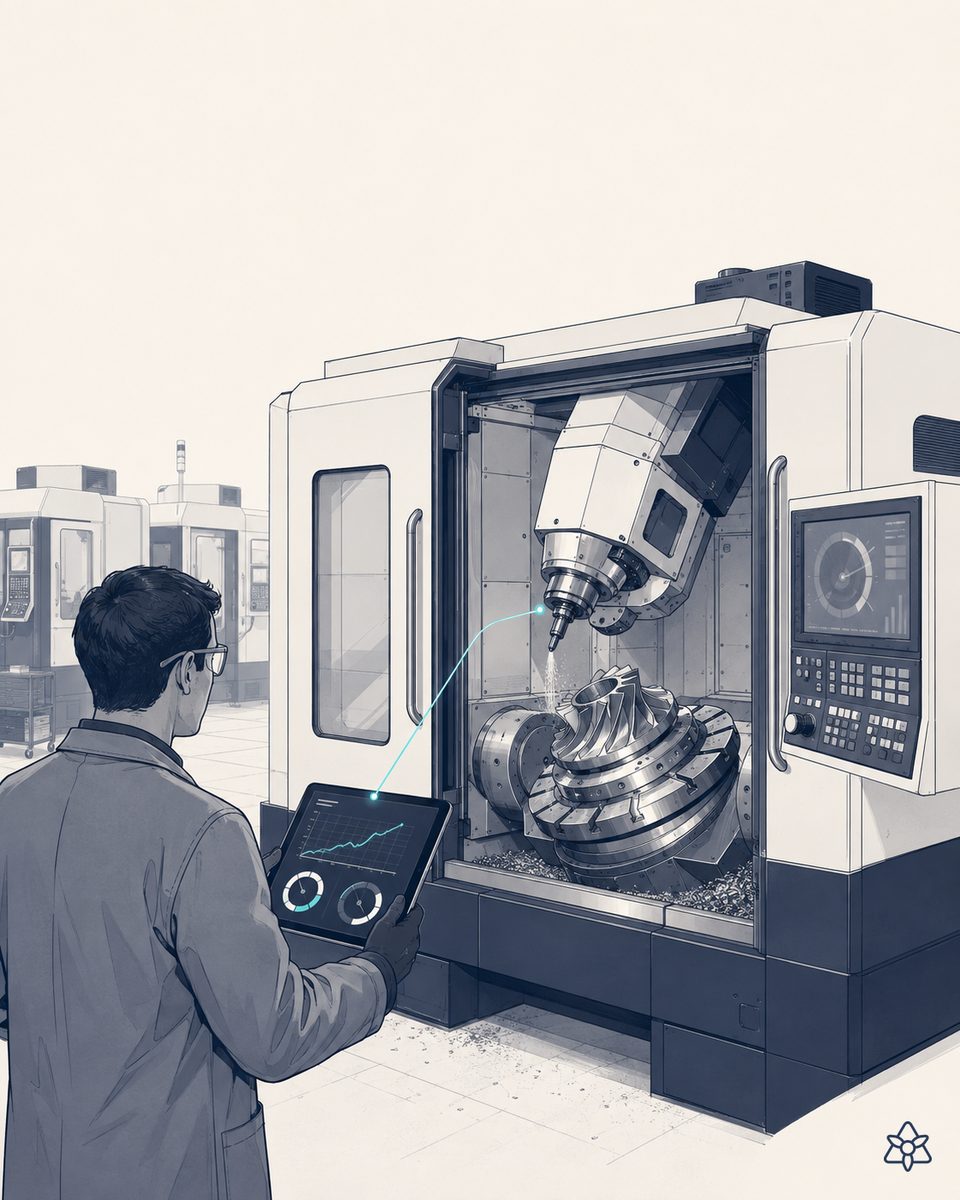
The part's file lives in six places — and nobody stitches it together until the auditor calls.
The aerospace quality manager knows the routine by heart: the work order is in the ERP, the material trace in a warehouse spreadsheet, the real furnace parameters in the heat treat subcontractor's SCADA, the penetrant results in the PDF the NDT lab emailed over, the plating supplier's CofC in a drawer, and the operator's signature on the router that travels with the part. Stitching all that together for a single part takes hours. For a batch of 50, it takes a week. For a NADCAP audit that asks for 30 parts at random, it takes the whole month before.
The NADCAP file is not done badly — it is done late. And when it is done late, it is done with disproportionate effort and with the fear that something is missing. The data existed at the time, but it was not captured at the time; you try to rebuild it, and in aerospace rebuilding is exactly what the auditor does not want to see.
iLEAN does not add a seventh system — it seals the cracks between the six you already have.
The problem with NADCAP traceability is not missing information: it is information that lives on islands and that, at the moment of truth (the part going out for delivery, the auditor asking for a random dossier), does not reach the person who signs it already stitched together. iLEAN acts as the putty that fills those cracks, without asking you to change your ERP, your MES, the furnace SCADA or the subcontractor's procedure.
Tracer stitches traceability part by part. Writer assembles the CofC in the customer's format. Vision reads furnace curves and NDT records as evidence. The person signs — never the other way round.
The three iLEAN pieces applied to NADCAP traceability:
- iLEAN Tracer — an agent that keeps the file of every part alive from raw material intake (heat lot, mill cert) through to delivery. It cross-references the work order, the router, the operations performed and the operator who signed each one, and links the evidence arriving from outside (subcontractors, NDT labs). There is no need to "close out" the file — it is always closed and always alive.
- iLEAN Writer — an agent that assembles the CofC in the format each customer asks for (OEM CofC, FAA 8130-3 where applicable, EASA Form 1, the tier-1's internal format). The quality team does not open templates: they review the document already assembled, check that the evidence adds up, and sign. If something is missing, the batch is not marked deliverable.
- iLEAN Vision — a vision terminal over the special-process points: it reads the heat treat furnace curve at the end of the cycle, reads the photographic record of the penetrant inspection, reads the data matrix marked on the part to link the operation to the work order. It works with no network: if the plant loses connectivity, it keeps capturing and links up when the connection returns. The visual evidence is stored cryptographically signed in the file.
A rebuilt file vs. a live file with iLEAN
| Aspect | Manual traceability + spreadsheets + email | With iLEAN Tracer + Writer + Vision |
|---|---|---|
| Heat lot ↔ part | Handwritten note on the router | Automatic link by data matrix, read by Vision |
| Real heat treat furnace parameters | Subcontractor's PDF arriving by email | Curve read by Vision or captured by Connect, attached to the file |
| Subcontractor's CofC | PDF in a drawer / shared folder | Captured by Connect at second zero, linked to the part |
| CofC to the customer | Word template the technician fills in | Assembled by Writer in the customer's format; a person reviews and signs |
| NADCAP audit: dossier for 30 random parts | The whole month before spent rebuilding | Minutes per part; evidence already stitched and signed |
| Part with an incomplete file | Discovered at delivery or during the audit | Batch held before it can be marked deliverable |
Impact estimate for your plant — to be validated with your numbers.
The block below is an estimate to be validated with the specific data of your plant. We put it forward so the committee has an order of magnitude; we refine it during the diagnostic.
- Tier-1 plant machining structural parts, NADCAP heat treat subcontracted, penetrant NDT in house or external, plating subcontracted. Volume in the order of hundreds of parts/month with several references running in parallel.
- Tracer + Writer + Vision pilot on one specific part family (the customer Pareto — usually a recurring part for a large OEM). First value expected within a few weeks: a live dossier for that family instead of ad-hoc reconstruction.
- Indicative payback between 4 and 9 months. Levers: quality time rescued from stitching dossiers, less risk of undeliverable product, NADCAP audit preparation in hours instead of weeks, less documentary rework from paperwork non-conformities.
- A ≥50% reduction in audit preparation time is a prudent target; the plants that have already seen it in operation bring it down further.
And the aerospace CAIO's reasonable doubt
"What if the AI makes up a data point on the CofC?" — hallucination is a problem of free generation, not of anchored tasks. Writer does not "write" the CofC: it assembles it from evidence already captured (material heat lot, furnace curve, NDT record, operator signature). In tasks anchored to the source, the best models brought error below 1.5% [1]. And even so, what is critical is never decided alone: the CofC goes out with a human signature, and iLEAN's three safety rings guarantee that no agent touches the plant's critical work order — documentation goes out cryptographically signed from ring 2 outward, not the other way round.
[1] OpenAI paper "Why Language Models Hallucinate", 2025 — on the reliability of AI in anchored tasks.
What people ask about NADCAP traceability with AI
What does NADCAP require for each special process?
NADCAP (National Aerospace and Defense Contractors Accreditation Program) accredits special processes — heat treatment, welding, NDT, coatings, non-metallic materials — under the AC7xxx families. For each process it requires: a validated, signed recipe, real parameters recorded (not just setpoints), an operator qualified for that recipe, equipment with calibration in force, visual evidence/continuous recording, and the ability to rebuild the file part by part whenever the auditor asks. The spirit is simple: if you cannot prove it was done to the recipe, it was not done.
How is the automatic CofC generated?
The Certificate of Conformance (CofC) is assembled, not written. iLEAN Tracer gathers everything already in the plant — work order, material heat lot, real parameters of the special process, NDT records, operator and quality signatures — and the Writer agent assembles it in the format your customer or your authority asks for (FAA 8130-3, EASA Form 1, customer CofC). The operator does not open Word: they review the dossier the agent already assembled and sign. If a piece of the puzzle is missing, the batch is held before it can be marked complete.
And what about special processes (heat treat, NDT, plating)?
Every special process has its own profile. iLEAN Vision reads the visual records (furnace curve, penetrant record, coating thickness) and matches them to the part through its traceability. For processes where the plant uses NADCAP subcontractors (the norm in heat treat or plating), Connect captures the subcontractor's documentation through whichever channel it arrives on (email with a signed PDF, supplier portal, a WhatsApp message from the manager) and inserts it into the part's file, at second zero. The file is alive — it is not rebuilt by hand two months later.
And tier-2 suppliers who do not use your system?
Connect is bidirectional and multichannel. The tier-2 supplier does not need to install anything: they keep sending their mill cert by email, their CofC as a PDF, their traceability in the same old spreadsheet. iLEAN captures it, recontextualizes it into the common format of your part file, and leaves the original evidence attached to the dossier (because the NADCAP auditor may ask for it). The rule is: the system adapts to the supplier you have, not the other way round.
How does the NADCAP / AS9100 audit change?
From weeks preparing ad-hoc dossiers to presenting the live file of any part in minutes. What the auditor asks for is already there: part number → work order → heat lot → process curves → NDT records → signatures → final CofC, all linked and with the evidence attached. The quality team moves from rebuilding to explaining; the auditor finishes sooner and the plant does not stop to get ready for the visit. Estimate to be validated: audit preparation time cut by more than 50%.
More cases in other sectors
- Aeronautical configuration with AI — Mod Status and effectivity per aircraft, without aircraft 247 living in a spreadsheet.iLEAN manages Mod Status and ECN/ECO effectivity per aircraft or batch. Traceable configuration from…
- An aerospace claim years down the line demands knowing which heat lot was used — and only whoever kept the link from day one can answer that.iLEAN traces every aerospace part back to its original heat lot, with the mill cert and the RMA linked…
- Aero paint & coating with AI — the bath drifts in silence and you find out 200 parts later.iLEAN controls bath, thickness and NADCAP chemical processing in aerospace coatings — AI vision + Edge +…
- Aircraft cabin control with AI — FOD-free assembly, verified wiring and a signed configuration.How iLEAN combines Edge vision, avionics panel reading and agents to secure aircraft cabin assembly with…
- Aluminum fuselage control with AI — riveting, shot peening and coating in a single live dossier.How iLEAN combines Edge vision, traceability OCR and agents to secure riveting, shot peening and coating…
- Digital aerospace APQP/PPAP — this used to take a whole team weeks; now iLEAN does it.iLEAN keeps APQP live by phase and auto-generates the PPAP run-at-rate. Aero NPI without an entire team…
Tell us your case and in 48h we'll send you the estimated ROI of this AI project for your aerospace plant.
We work on your plant's real data, not ours. Diagnostic with no commitment.
Request estimated ROI in 48h See aerospace