Aluminum fuselage control with AI — riveting, shot peening and coating in a single live dossier.
An aerospace aluminum fuselage panel (Al 2024, 7075, Al-Li) demands cross-referencing four realities — melt, riveting, shot peening and coating — that are almost never in the same system. iLEAN puts Edge vision over every step, Connect reads the old machines and the anodizing baths, and an agent assembles the dossier by serial number. The quality inspector is the one who signs.
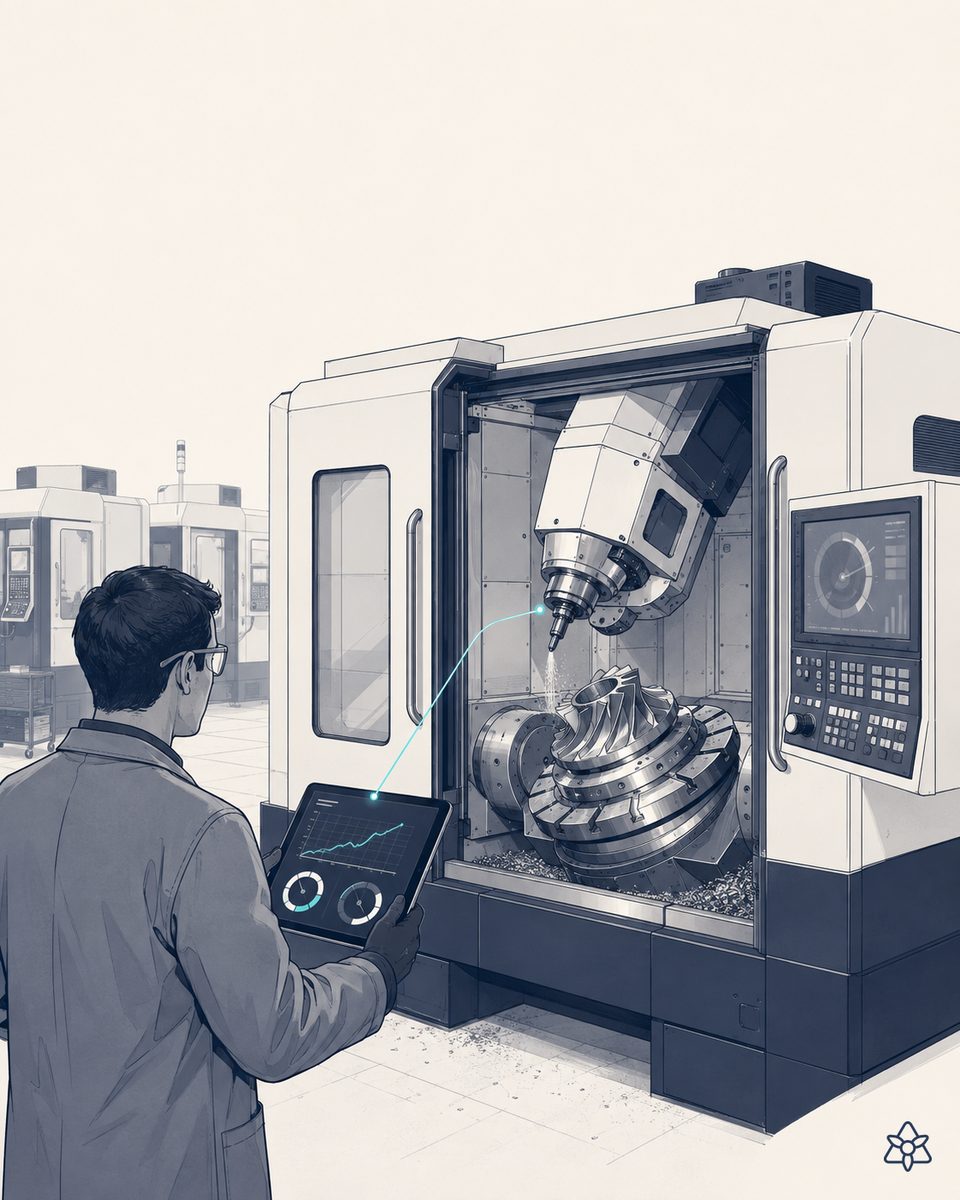
A fuselage panel flies for decades — and the dossier should still be readable 20 years later.
The quality manager of a fuselage plant knows that an aerospace aluminum fuselage is designed to fatigue in its own time, not before. A fatigue crack shows up decades later and the NTSB accident report asks: what shot peening did that panel get? What anodizing thickness? Did the riveting follow the recipe? The answer has to be alive, indexed by fuselage serial number, for the whole operational life of the aircraft.
The bottleneck is four realities living in different systems:
- The sheet — aluminum heat lot (Al 2024, 7075, Al-Li), supplier mill cert. ERP + a supplier PDF.
- The riveting — correct pattern, head, alignment, no damage to the skin. Today it is validated with a gauge and a veteran's eye.
- The shot peening — Almen parameter, coverage. In the machine or on a paper report.
- The coating — anodizing, primer, thickness. On the anodizing line and in thickness-measurement software.
The classic system works 99% of the time. And even so, every time the auditor asks you to rebuild the dossier of a panel made two years ago, the quality team spends weeks assembling a PDF that should have been alive since the very first operation.
iLEAN does not add a fifth system — it seals the cracks between the ones you already have.
The problem with fuselage control is not a lack of information: it is information in islands that, at the moment of signing, never quite lands in the same file. iLEAN acts as the putty that fills those gaps, without asking you to change your riveting machine, your shot peening machine or your anodizing line.
Edge sees every panel after every operation. Connect reads the old machine and the bath even when it is isolated. The agent assembles the dossier by serial number and, if something does not add up, it holds the panel. The person signs — never the other way round.
The three iLEAN pieces applied to aluminum fuselage control:
- Edge — terminals with machine vision (CNN) at the critical stations: after riveting (head, alignment, missing rivet, skin damage), after shot peening (visible uniformity), after anodizing/primer (coverage, missing coating). Actuator at 45 ms when a hold is needed. It works with no network.
- Connect — captures the Almen parameter reading from shot peening whether the equipment is modern (direct integration) or old (panel reading by vision, or serial-port reading); captures the anodizing thickness measurements from the vertical software; captures the supplier mill cert whether it arrives by email or as a PDF. Voice assistance for the operator works both ways: the agent talks to them, the operator dictates back.
- Agent — cross-references heat lot, riveting, shot peening, coating, NDT and the human signature. It assembles the dossier by fuselage panel serial number. If any step is missing, it holds the panel before the next assembly step and alerts the person in charge. The person signs; the panel does not move on by itself.
Manual control with a checklist vs. cross-referenced control with iLEAN
| Aspect | Manual control + checklist | With iLEAN Edge + Connect + Agent |
|---|---|---|
| Riveting per panel | Gauge + veteran's eye + paper record | Edge vision per panel, photo filed by serial number |
| Shot peening (Almen) | Operator reading written on a report | Connect captures it from the equipment (even isolated) |
| Anodizing thickness | Vertical software, PDF at the end | Cross-referenced with the recipe and filed by serial number |
| Melt traceability | PDF in a shared folder | Heat lot indexed to the panel dossier |
| Operation with no network | n/a | Edge keeps running on the panel's own power |
| Dossier for auditor / customer | Rebuilt by hand, weeks of work | Live dossier by serial number, automatic |
Impact estimate for your plant — to be validated with your numbers.
The block below is an estimate to be validated with the specific data of your plant. We put it forward so the committee has an order of magnitude; we refine it during the diagnostic.
- Aerospace Tier 1/2 with fuselage panels in Al 2024 / 7075 / Al-Li. Riveting + shot peening + anodizing + NDT line by eddy current/dye penetrant.
- Edge pilot at the riveting station + Connect over shot peening and anodizing + a dossier agent by serial number. First value expected within a few weeks.
- Indicative payback between 4 and 9 months, depending on the frequency of NCRs for out-of-spec rivets/skin damage and the quality hours spent assembling audit dossiers over recent years.
- Reduction in rework caused by rivet/skin damage detected late: conservative estimate ≥ 30%. The hard lever is the rework avoided on an already assembled panel.
And a side data point from the quality standard: automotive demands levels in the order of 25 PPM [2] — aerospace fights with even tighter tolerances and with operational lives measured in decades. The argument is the same: at those levels, the eye alone does not get there.
And the quality data point for the committee
“What if the AI gets it wrong and lets a badly set rivet through?” — hallucination is a problem of free generation, not of anchored tasks. In tasks where the AI merely compares an image with a learned pattern and recontextualizes a shot peening reading into a file, the best models brought error below 1.5% [1]. And even so, a critical panel is never signed off alone: iLEAN holds and the person signs. The three safety rings exist precisely for this.
[1] OpenAI paper “Why Language Models Hallucinate”, 2025 — on the reliability of AI in anchored tasks.
[2] The 25 PPM quality standard in automotive — Symestic.
What people ask about aluminum fuselage control with AI
What does the AI check on an aluminum fuselage?
Three critical realities in aerospace aluminum (Al 2024, 7075, Al-Li): riveting (correct head, alignment, missing rivet, damage to the adjacent skin), shot peening (Almen parameter reading, coverage) and coating (anodizing, primer, missing coverage, visible corrosion). iLEAN cross-references these three with melt traceability (heat lot, mill cert) and the assembly sequence by fuselage serial number. The inspector signs.
How are badly set or missing rivets detected?
iLEAN Edge is installed as vision over the riveting station after every panel. It detects a badly formed head, an off-center rivet, a missing rivet in the pattern, damage to the adjacent skin, tool marks out of range. Everything is compared against the learned pattern of a correct fuselage. If it finds something, it holds the panel before the next step and alerts the operator. It works with no network. Final validation is signed by the quality inspector, not by the AI — but the Edge eye does not blink, not even on the night shift.
How are shot peening and anodizing readings integrated?
Connect handles integration with the shot peening machine and the anodizing line at the usual levels: if the equipment only writes to its own panel, vision reading; if it has a structured output, direct integration; if it only writes to a PDF, Connect digitizes it. The agent cross-references the Almen parameter reading from shot peening, the measured coating thickness and the anodizing bath certificates with the serial number of the fuselage panel. If anything does not match the recipe, it holds the panel before assembly.
Does it work for commercial aircraft and for general aviation / drone fuselage?
Yes. The architecture is the same; what changes is the pattern learned by the vision model and the process recipe. Edge is trained on real panels from your product — a classic monocoque panel, a chem-milled panel, a machined Al-Li panel. The initial immersion measures the baseline per family, and the mixed team (your people + an embedded engineer) defines the tolerances together with the process lead. This is not a generic off-the-shelf model.
What dossier is left at the end for each panel/fuselage?
A file per serial number with: sheet traceability (heat lot, mill cert), forming and machining parameters, visual evidence of riveting per panel (Edge photo), shot peening reading (Almen, coverage), anodizing/coating evidence, NDT evidence (dye penetrant, eddy current), assembly sequence and the inspector's signature. It is the dossier the EASA Part 21 / FAA Production Approval auditor would ask you for too late — and with iLEAN it is already live from the very first operation.
Cross-links: composite wing control · aerospace material traceability by melt · ultrasonic NDT in aerospace
More cases in other sectors
- Aero paint & coating with AI — the bath drifts in silence and you find out 200 parts later.iLEAN controls bath, thickness and NADCAP chemical processing in aerospace coatings — AI vision + Edge +…
- An aerospace part without NADCAP traceability is undeliverable productiLEAN generates the CofC automatically and keeps the NADCAP process record alive for every aerospace…
- Aircraft cabin control with AI — FOD-free assembly, verified wiring and a signed configuration.How iLEAN combines Edge vision, avionics panel reading and agents to secure aircraft cabin assembly with…
- Digital aerospace APQP/PPAP — this used to take a whole team weeks; now iLEAN does it.iLEAN keeps APQP live by phase and auto-generates the PPAP run-at-rate. Aero NPI without an entire team…
- AS9100 with AI — the audit stops being a three-month sprint and becomes living evidence.iLEAN keeps AS9100 evidence alive and first article inspection traceable. Aerospace audits without the…
- Avionics control with AI — a person still signs the board, but nothing slips past anymore.How iLEAN combines Edge vision, Connect and iLEAN Agents for inspection, traceability and the…
Tell us your case and in 48h we'll send you the estimated ROI of this AI project for your fuselage plant.
We work on your plant's real data, not ours. Diagnostic with no commitment.
Request estimated ROI in 48h See aerospace