Composite wing control with AI — an internal defect only shows up in ultrasonics. iLEAN combines vision, UT and the autoclave cycle.
Controlling a composite wing means cross-referencing three realities — vision over every ply, ultrasonic NDT and the autoclave cycle — against the part recipe. iLEAN puts Edge over the layup, Connect reads the ultrasonic scanner even when it is a closed vertical system, and an agent assembles the dossier by serial number. The NDT inspector signs.
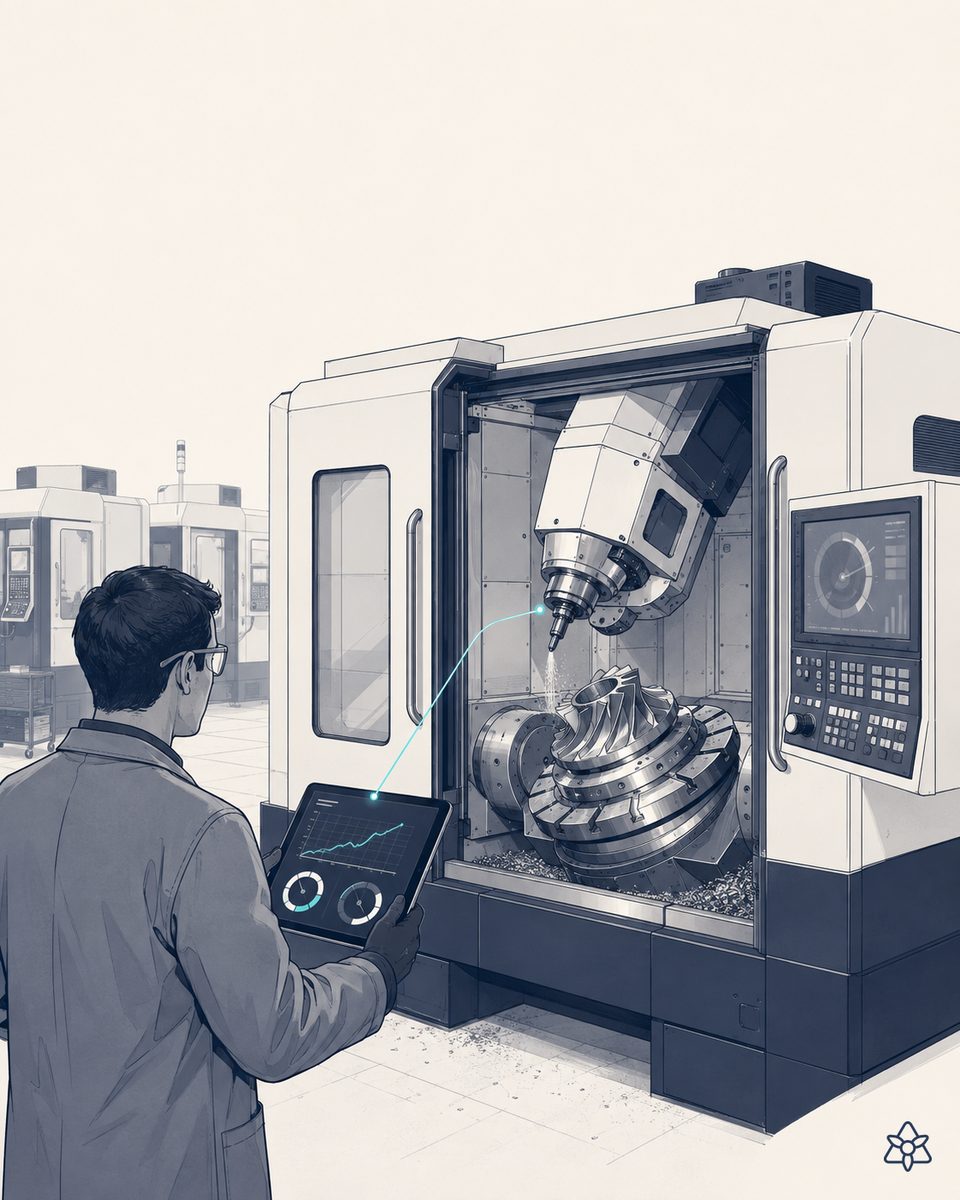
In composites, an internal defect costs a whole part — and a whole part costs a fortune.
The composite process lead knows that a wing cured in the autoclave is a point of no return: if porosity, delamination or a disbond with the core turns up after the cycle, the part is expensive scrap — there is no recovery. And they also know that the truth about how it got there is scattered:
- The layup — fiber orientation ply by ply, no wrinkles and no FOD between plies, correct impregnation. Today this is verified by the operator's eye and a checklist; some shops run ATL/AFP with data that is never integrated.
- The autoclave cycle — temperature, pressure, vacuum, ramp. It lives in the autoclave controller; nobody later cross-references it with what the operator saw during layup.
- NDT — ultrasonic C-scan, sometimes thermography. In the lab's vertical software, in yet another system.
- The veteran's knowledge — the "I went over that area myself" that no system captures.
The classic setup works 99% of the time. And even so, a single wing with porosity found after the autoclave is a scrapped part whose material, labor and autoclave slot are gone for good. The question is not whether it will happen; it is how much it costs every time it does.
iLEAN does not add a fifth system — it seals the cracks between the ones you already have.
The problem with composite wing control is not a lack of information: it is information split into islands that, at the moment of decision (next ply, autoclave entry, NDT release), never quite reaches the same file. iLEAN acts as the putty that fills those gaps, without asking you to change your ATL/AFP, your autoclave or your NDT equipment.
Edge sees each ply before the next one goes down. Connect captures the autoclave cycle and the NDT. The agent cross-references against the recipe and, if something does not add up, holds the part. The person signs — never the other way round.
The three iLEAN pieces applied to composite wing control:
- Edge — a terminal with machine vision (CNN) over the layup station. It detects wrinkles, off-axis fiber orientation, FOD between plies, poor impregnation and vacuum bag failures. Actuator at 45 ms when the part has to be held before the next ply. It works with no network.
- Connect — captures the full autoclave cycle record (temperature, pressure, vacuum, ramp), captures the ultrasonic scanner readings (whether by direct integration, serial reading or PDF digitization), captures the supplier's prepreg batch certificate, and captures the operator's voice during layup. Information arriving by email from a supplier (a change in the resin batch) enters at second zero.
- Agent — cross-references the wing recipe, the ply-by-ply layup (as seen by Edge), the autoclave cycle (Connect), the ultrasonic NDT and the material certificates. If any of them deviates, it holds the part before the next step and alerts the person responsible. The person signs; the wing does not move on by itself.
Manual control with a checklist vs. cross-referenced control with iLEAN
| Aspect | Manual control + checklist | With iLEAN Edge + Connect + Agent |
|---|---|---|
| Fiber orientation ply by ply | Operator's eye, checklist | Edge vision after every ply, image archived |
| FOD between plies | Visual walkthrough | Edge detection before the bag is closed |
| Autoclave cycle | Trace inside the autoclave system | Cross-referenced with the recipe and the layup in the file |
| Ultrasonic NDT | PDF from the lab software | C-scan indexed to the serial number + cross-referenced with the cycle |
| Operation with no network | n/a | Edge keeps running on the cabinet's own power |
| Dossier for the auditor / OEM | Rebuilt by hand, weeks | Live dossier per serial number, automatic |
Impact estimate for your plant — to be validated with your numbers.
The block below is an estimate to be validated with the specific data of your plant. We put it forward so the committee has an order of magnitude; we refine it during the diagnostic.
- A CFRP/GFRP layup line for a full wing or a subassembly (spar, rib), a consolidated autoclave and in-house ultrasonic NDT.
- Edge pilot at the layup station + Connect over the autoclave cycle and the ultrasonic scanner + a dossier agent per serial number. First value expected within a few weeks.
- Indicative payback between 4 and 9 months, depending on how often you have scrapped parts for defects found after the autoclave in recent years and on the cost of a single part (material + hours + autoclave slot).
- Reduction of scrap caused by defects found too late: conservative estimate ≥ 30%. The hard lever is a single wing part recovered before the autoclave: that alone pays for the pilot.
And the quality data point for the committee
“What if the AI gets it wrong and lets a defective layup through?” — hallucination is a problem of free generation, not of anchored tasks. In tasks where the AI merely compares an image against a learned pattern and recontextualizes an autoclave data point into a file, the best models brought error below 1.5% [1]. And even so, the critical part is never signed off alone: iLEAN holds and the person signs. The three safety rings exist precisely for this.
[1] OpenAI paper “Why Language Models Hallucinate”, 2025 — on the reliability of AI in anchored tasks.
What people ask about composite wing control with AI
What does the AI check on a composite wing?
Three realities that in composites (CFRP, GFRP, honeycomb sandwich) live today in separate systems: vision over the ply (fiber orientation, wrinkles, FOD between plies, poor impregnation), ultrasonic NDT (internal porosity, delamination, core-to-skin disbond) and the autoclave cycle (temperature, pressure, vacuum, ramp) against the recipe. iLEAN cross-references all three by the wing's serial number and assembles the dossier; the NDT inspector signs.
How does it detect wrinkles and FOD between plies during layup?
iLEAN Edge is installed as vision over the layup station — manual or automated ATL/AFP. It detects wrinkles, off-axis fiber orientation, poor impregnation and FOD between plies (a forgotten backing paper, tape scraps) by comparing the image after each ply against the learned pattern. If it finds something, it holds the wing before the next ply and alerts the operator. That is the key: fixing it between plies is work; fixing it after the autoclave is expensive scrap. It works with no network.
How does it integrate with the NDT ultrasonic scanner?
Connect handles the integration of vertical ultrasonic software at the three usual levels: if it only writes a PDF, Connect digitizes it and indexes it to the serial number; if it has a structured output, direct integration; if it has its own panel, screen reading. The result: the ultrasonic reading cross-referenced with the Edge vision image of the plies and with the autoclave cycle shows up in the same file, without asking you to change your NDT equipment. An internal defect only shows up in ultrasonics; iLEAN combines all three.
Does it work for a full wing, a spar or a subassembly?
Yes. The architecture is the same; what changes is the pattern learned by the vision model and the autoclave recipe. Edge is trained on real parts from your product — full wing, spar, rib, skin panel, honeycomb sandwich. The initial immersion measures the baseline per family, and the mixed team (your people + an embedded engineer) defines the tolerances together with your composite process lead. This is not a generic off-the-shelf model.
What dossier is left at the end for each wing?
A file per serial number with: raw material certificates (prepreg batch, dry fabric, resin), Edge images of every ply with verified fiber orientation, the full autoclave cycle record (temperature, pressure, vacuum, ramp) cross-referenced with the recipe, ultrasonic NDT readings with the C-scan image, bonding evidence and the NDT inspector's signature. It is the dossier that any serious CFRP/GFRP program (a major airframer, an EASA Part 21 OEM) would ask you for far too late — and with iLEAN it is already live from the first cycle.
Cross-links: CFRP/GFRP composites with AI vision · ultrasonic NDT in aerospace · aluminum fuselage control
More cases in other sectors
- An avionics failure in service costs more than any MRO investment — you avoid the AOG beforehand with cross-referenced data, not afterwards with spare-part stock.iLEAN combines BIT, shop-floor sensors and a PHM model to predict failures in avionics and structures…
- Rail bogie control with AI — the frame does not leave the shop until the file adds up.How iLEAN cross-references weld testing, frame dimensional control and critical component traceability…
- An internal defect in an aerospace composite part only shows up under ultrasound — and almost nobody cross-references it with the real autoclave curve. iLEAN does.iLEAN combines vision, ultrasound and the autoclave cycle to guarantee an aerospace composite part with…
- Precast concrete — CE marking stands on plant records.Documented iLEAN cases in precast concrete: steam curing, EN 13369 CE marking, prestressing and 3D…
- CE marking of EN 1916 reinforced concrete pipes — the dossier should not take two days to add up.iLEAN Writer automates CE marking and the Declaration of Performance (DoP) for reinforced concrete pipes…
- Climbing formwork management — a module lost between site and plant is a day of concrete pouring that doesn't happen.iLEAN Connect tracks location, use cycles and maintenance of your climbing formwork fleet between site…
Tell us your case and in 48h we'll send you the estimated ROI of this AI project for your composite wing line.
We work on your plant's real data, not ours. Diagnostic with no commitment.
Request estimated ROI in 48h See aerospace