An internal defect in an aerospace composite part only shows up under ultrasound — and almost nobody cross-references it with the real autoclave curve. iLEAN does.
An internal defect in an aerospace composite part only shows up under ultrasound. iLEAN combines vision (surface and lay-up), ultrasound (delamination, porosity) and the autoclave cycle (the real pressure/vacuum/temperature curve) into a single report per part. The NDT operator receives the part pre-classified and signs — they do not judge it from scratch.
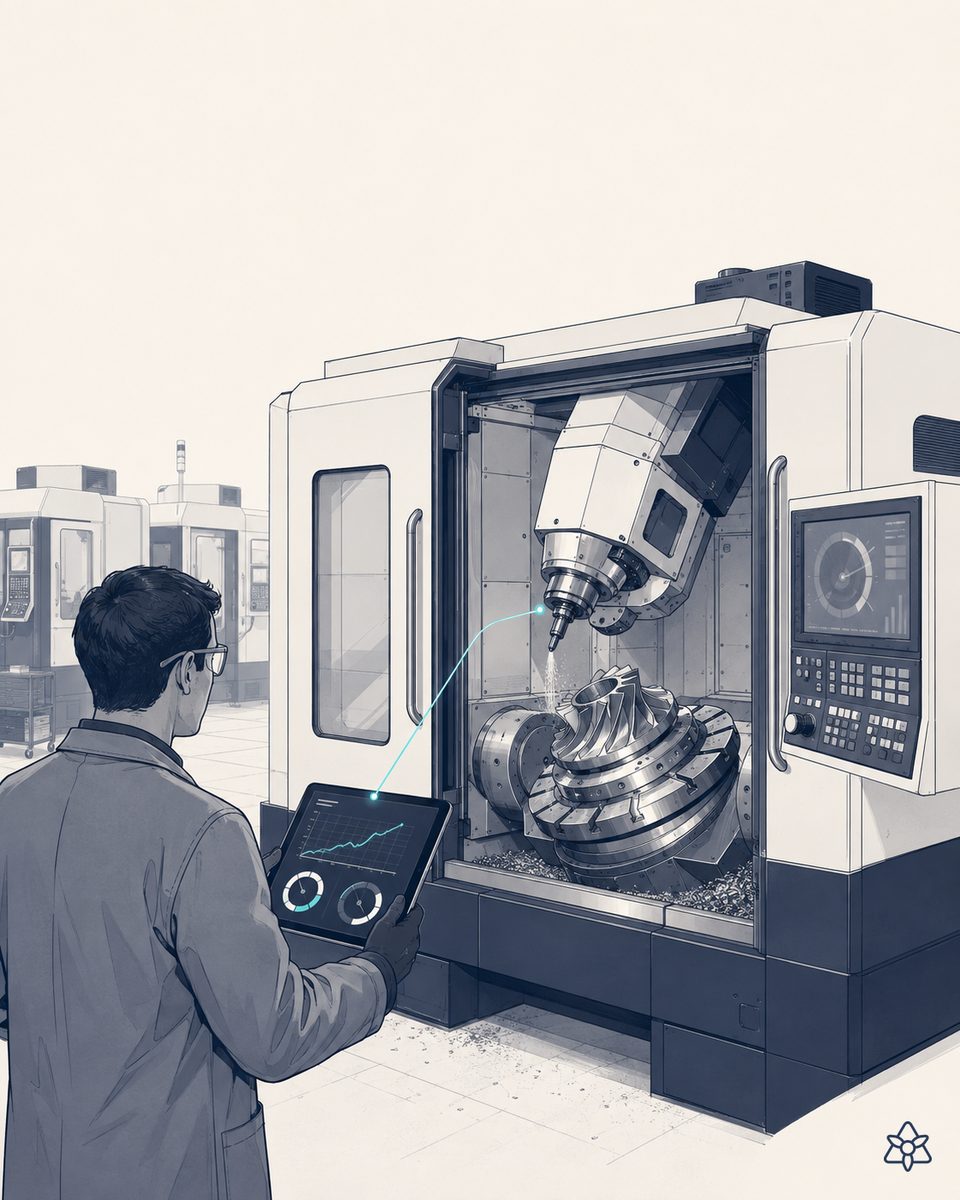
Three sources tell the story of the part — and they are almost never in the same report.
An aerospace composite part with no internal defect is the intersection of three realities that, in many plants, live in different systems:
- The lay-up — which prepreg, how many plies, in what orientation, with which heat lot. It usually sits on a process sheet signed by the laminator.
- The autoclave cycle — the real temperature, pressure and vacuum curve during cure. It lives in the autoclave SCADA, exported to PDF at the end of each cycle.
- NDT — ultrasound (A-scan, C-scan) and surface vision. It lives in the inspection equipment, with a per-part report generated after the fact.
The process engineer knows it: when porosity above the limit shows up on a part, the root cause is in the autoclave curve — but the NDT report and the autoclave log are not in the same place, and linking them by hand for every part is a couple of hours of work that almost nobody does in series production. The defect does get detected, yes. The root cause goes unattributed. And as long as the root cause stays open, the pattern repeats — more rework, more marginal parts, more composite scrap cost.
iLEAN does not add a fourth system — it stitches the lay-up, the autoclave and NDT into each part's dossier.
The problem with composite control is not a lack of information: it is information living on islands that, at the critical moment (the part comes out of the autoclave, NDT detects porosity), never reaches the person analyzing the cause already stitched together. iLEAN acts as the putty that fills those cracks, without asking you to change the autoclave, the NDT equipment or the laminator's procedure.
Edge captures the real autoclave cycle. Vision reads the surface and the C-scan. Brain correlates all three and proposes a root cause. The person signs — never the other way round.
The three iLEAN pieces applied to composite control:
- iLEAN Edge — a terminal on the autoclave that captures the thermocouples, the pressure and the vacuum per bag in real time. If the plant loses its network during a 4-hour cycle, Edge keeps capturing and links the complete log once the connection returns. With no black box on the autoclave, no later analysis is possible.
- iLEAN Vision — captures a surface image at the autoclave exit (a CNN trained to detect fiber bridging, excess resin, cosmetic defects) and also captures the C-scan from the ultrasound equipment you already have (from the screen, via camera, or by direct integration if the equipment allows it). It links it to the part through its traceability.
- iLEAN Brain (Agents) — agents that cross-reference the lay-up (prepreg heat lot, prepreg age in cold storage, ply orientation) + the real autoclave cycle + the NDT result, and identify the pattern: “the parts with porosity above 1% are the ones from prepreg lot X when the vacuum dropped below Y mbar at minute Z of the cycle”. The engineer receives the root cause; the agent never acts alone.
Classic composite control vs. cross-referenced control with iLEAN
| Aspect | Classic control (silos) | With iLEAN Edge + Vision + Brain |
|---|---|---|
| Autoclave cycle | PDF exported at the end, filed per cycle | Real-time capture, linked to each individual part |
| Prepreg traceability | Process sheet + cold storage card | Heat lot + prepreg age linked to the part |
| Surface defect | Visual inspector when the part is received | Vision in line, before it enters NDT |
| Ultrasonic C-scan | Per-part NDT report, read by the inspector | Pre-classified by Brain, the inspector validates and signs |
| Root cause of porosity | A meeting a week later, a qualitative conclusion | Pattern identified by Brain from real data |
| Per-part dossier for Part 25 / CofC | Rebuilt by hand | Alive from minute one, with evidence attached |
Impact estimate for your plant — to be validated with your numbers.
The block below is an estimate to be validated with the specific data of your plant. We put it forward so the committee has an order of magnitude; we refine it during the diagnostic.
- Tier-1 plant with manual lay-up or ATL/AFP, a large autoclave with several parts per cycle, in-house ultrasonic NDT. Volume in the order of tens to hundreds of parts/month.
- Edge pilot on the autoclave + Vision on the exit line + Brain for root cause correlation. First value expected within a few weeks: a cure dossier per individual part instead of a log per cycle.
- Indicative payback between 4 and 9 months. Levers: a reduction of parts in rework of ≥30%, a reduction of scrapped parts (the hard lever — a structural composite part is expensive), traceability ready for Part 25 with nothing to rebuild.
- First value within a few weeks: the first case of an unattributed root cause gets closed with the first month of cross-referenced data.
And the NDT lead's reasonable doubt
“What if the AI says a part is fine and it has a delamination it did not see?” — hallucination is a problem of free generation, not of anchored tasks. Brain does not “interpret” the C-scan: it pre-classifies regions by probability and proposes, and the qualified NDT operator reviews and signs. In anchored tasks, the best models brought error below 1.5% [1]. And the responsibility for the signature still belongs to the NDT operator — iLEAN's three safety rings guarantee that no agent can release a part without a person validating it. It is about assisting and simplifying, not replacing.
[1] OpenAI paper “Why Language Models Hallucinate”, 2025 — on the reliability of AI in anchored tasks.
What people ask about CFRP/GFRP composite control with AI
Does it detect delamination between plies?
Delamination is the internal defect par excellence — you cannot see it with the naked eye and it takes ultrasound (A-scan or C-scan) to identify the separation between plies. iLEAN does not replace your ultrasound equipment: it makes the most of it. Edge captures the C-scan your NDT equipment already produces, the Brain agent cross-references it with the real autoclave cycle (temperature, pressure, vacuum) and with the lay-up of that part, and tags the C-scan region with delamination probability labels. The NDT operator is still the one who signs the report — they receive the part pre-classified, they do not judge it from scratch.
What about internal porosity?
Internal porosity is the other critical defect in aerospace CFRP/GFRP — bubbles trapped during cure that pull the part's mechanical strength below the design value. The standard protocol calls for ultrasound + a coupon section + correlation with the cycle. iLEAN Brain performs exactly that correlation continuously: it cross-references the porosity percentage measured by ultrasound with the real pressure/vacuum curve during cure, identifies the pattern (a vacuum drop at minute X) and proposes the root cause to the process engineer. The part is never released with porosity above the limit — the decision is human, the analysis is the agent's.
Does it work in large autoclaves with several parts per cycle?
Yes — in fact that is where it delivers the most value, because a large autoclave cycle mixes parts from several programs with different lay-ups, and the process engineer has to analyze several reports in parallel. iLEAN Connect captures the full autoclave log per cycle (temperature per thermocouple, pressure, vacuum per bag), Brain breaks it down by the part's position inside the autoclave, and assembles a cure dossier for each individual part, not for the cycle. Every part has its own real cure evidence, not the autoclave average.
Does it comply with FAA Part 25?
FAA Part 25 (Airworthiness Standards: Transport Category Airplanes) requires you to demonstrate that composite manufacturing produces parts with the mechanical properties of the certified design — and that is demonstrated with material traceability (prepreg heat lot), cycle traceability (the real curve, not the nominal one), documented NDT and cold-storage conservation of the prepreg with continuous recording. iLEAN does not certify anything for you: it hands you the complete per-part dossier your quality system needs to sustain conformity before the FAA, EASA or an OEM customer. The signature stays human.
How much does composite rework go down?
Rework in aerospace composites is expensive: a part with porosity above the limit or with detected delamination gets inspected in detail, in many cases partially reprocessed, and sometimes scrapped (and a composite fuselage part carries a very high material and labor cost). Estimate to be validated: catching the defect pattern before the part leaves the autoclave (correcting on the next cycle) reduces the share of parts going into rework by more than 30% in most plants. The payback is built on parts not scrapped, not on operator productivity.
More cases in other sectors
- Avionics control with AI — a person still signs the board, but nothing slips past anymore.How iLEAN combines Edge vision, Connect and iLEAN Agents for inspection, traceability and the…
- An avionics failure in service costs more than any MRO investment — you avoid the AOG beforehand with cross-referenced data, not afterwards with spare-part stock.iLEAN combines BIT, shop-floor sensors and a PHM model to predict failures in avionics and structures…
- Rail bogie control with AI — the frame does not leave the shop until the file adds up.How iLEAN cross-references weld testing, frame dimensional control and critical component traceability…
- Composite wing control with AI — an internal defect only shows up in ultrasonics. iLEAN combines vision, UT and the autoclave cycle.How iLEAN combines Edge vision, ultrasonic NDT and the autoclave cycle to catch internal defects in…
- Precast concrete — CE marking stands on plant records.Documented iLEAN cases in precast concrete: steam curing, EN 13369 CE marking, prestressing and 3D…
- CE marking of EN 1916 reinforced concrete pipes — the dossier should not take two days to add up.iLEAN Writer automates CE marking and the Declaration of Performance (DoP) for reinforced concrete pipes…
Tell us your case and in 48h we'll send you the estimated ROI of this AI project for your aerospace composite plant.
We work on your plant's real data, not ours. Diagnostic with no commitment.
Request estimated ROI in 48h See aerospace