Avionics control with AI — a person still signs the board, but nothing slips past anymore.
Manufacturing embedded avionics means meeting three demands at once — visual inspection of the assembly, semiconductor batch traceability and an AS9100/AS9102 dossier ready for the auditor. iLEAN puts Edge vision on the SMT line, Connect captures the certificates and an agent prepares the file. The IPC-A-610 inspector keeps signing — and finally focuses on what matters.
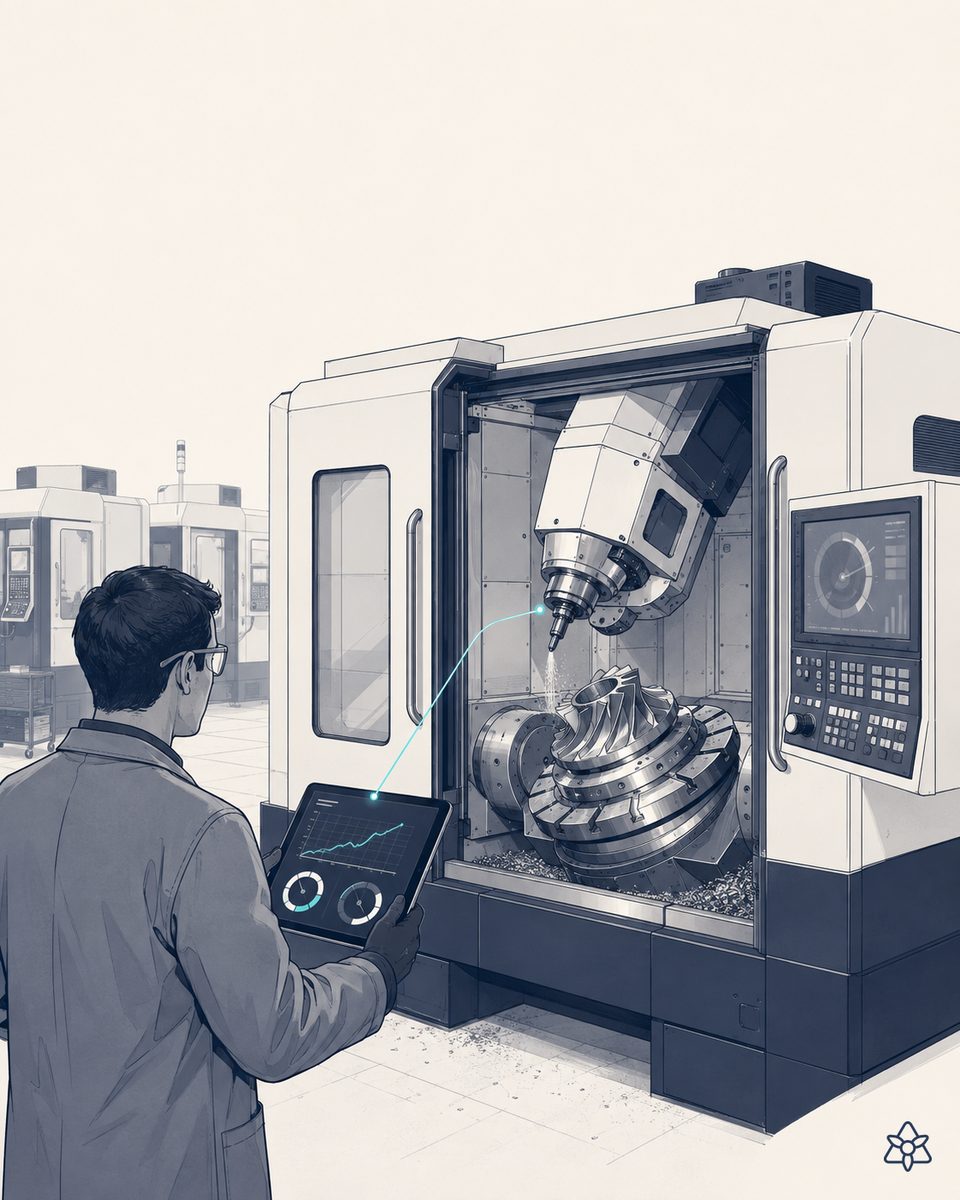
Low volume, high value, zero tolerance — and a dossier that weighs more than the part.
An embedded avionics board is nothing like a consumer board: a wide mix, short runs, components that cost more than the plant manager's car and a file that has to be ready the day the auditor walks in. The line's quality manager fights on three fronts at once:
- Visual inspection — standard AOI floods the low-volume mix with false positives because it has no statistical base per part number. The IPC-A-610 inspector ends up being the last human filter on every board, and on long shifts the expensive defects slip past (head-in-pillow under a BGA, conformal coating with the wrong window).
- Semiconductor traceability — the reel enters SMD storage with a PDF certificate from the distributor, the lot is mounted on 18 boards and fails an ATP three weeks later. Which boards share that lot? And which wafer? The Excel sheet doesn't get you there.
- AS9100 dossier and FAI/AS9102 — when a new part number comes in, the quality team spends weeks assembling the balloon drawing, the first article, Form 1/2/3 and special-process traceability. Every new part number is a sprint and, since there are many, the line is permanently running flat out.
The classic system works — but it rests on the veteran's eye and a master Excel that “knows” who edits it. The day the veteran retires or the Excel breaks, the line's traceability enters a dark zone. And in aeronautics, a dark zone is a stopped program.
iLEAN does not recertify your line — it seals the cracks between the AOI, the ERP and the MES you already have.
The avionics problem is not lack of inspection — it is disorderly inspection, layered traceability and a dossier rebuilt by hand when the auditor arrives. iLEAN acts as the putty that fills the gaps between AOI, SPI, MES and ERP without asking you to touch any certified element.
Edge watches the board after reflow. Connect captures the lot certificate however it arrives. The agent assembles the AS9102 while the part is still in line. The person signs — always.
The three iLEAN pieces applied to avionics control:
- Edge — a terminal with machine vision (CNN) above the AOI/SPI or at the final inspection station. It detects tombstoning, head-in-pillow, cold solder, conformal coating outside the window and missing components in milliseconds. Shadow mode for 2-3 weeks so your IPC-A-610 team can calibrate the confusion matrix before switching on retention. Works without a network: if the plant loses Internet, Edge keeps inspecting and retaining.
- Connect — captures the certificate of origin, the date code and the lot code of every reel, whether it arrives by email from the authorized distributor, as a manufacturer's PDF or in the purchasing manager's Excel. And it captures what comes from outside (an obsolescence notice, an AS6171 counterfeit alert, a revision change from the OEM customer) at second zero, without anyone forwarding anything.
- Agents in Central — they cross-reference the Edge images, the lot traceability, the virtual CMM measurements and the operation sequence in the MES to assemble the balloon drawing, the AS9102 Form 1/2/3 and the per-board process record. The FAI team stops transcribing and starts reviewing. The three rings guarantee that nothing critical leaves without a human signature.
Manual avionics control vs. cross-checked with iLEAN
| Aspect | Classic AS9100 line | With iLEAN Edge + Connect + Agents |
|---|---|---|
| SMT visual inspection | AOI with false positives + the certified inspector's eye | CNN trained on your boards + AOI + the inspector's eye |
| Semiconductor lot traceability | Distributor's PDF filed away, master Excel | Capture at second zero + cross-check against AS6171 counterfeit alerts |
| Defect detection under a BGA | ATP functional test three weeks later | Thermal inference + post-reflow pattern in line |
| FAI/AS9102 preparation | Weeks per part number, manual transcription | Balloon + Form 1/2/3 generated, team reviews |
| Dossier for the AS9100 auditor | Sprint during the two weeks before the audit | Live, per board, with photos and certificates linked |
| Operation without network | n/a | Edge keeps inspecting on the cabinet's own power |
Impact estimate for your plant — to be validated with your numbers.
The block below is an estimate to be validated with the specific data of your plant. We put it forward so the committee has an order of magnitude; we refine it during the immersion diagnostic.
- AS9100-certified embedded avionics SMT line, mix of 30-60 active part numbers, low volume and high unit value (Mil/Aero components).
- Edge pilot on one AOI/post-reflow station + Connect for reel certificates + an FAI agent. First value expected within a few weeks (confusion matrix closed, two or three defects caught).
- Indicative payback between 4 and 9 months, depending on the frequency of scrap from SMT defects missed by AOI and the average FAI preparation time per new part number.
- The hard lever is one Mil/Aero board recovered before the ATP + an FAI preparation time reduction ≥ 40%. One recovered board pays for weeks of pilot.
And the aerospace quality director's reasonable doubt
“What if the AI passes a board that isn't good?” — hallucination is a problem of free generation, not of anchored tasks. In tasks where the AI merely compares an image against a reference trained on your own boards, the best models brought error below 1.5% [1]. And even so, what is critical is never decided alone: iLEAN retains the board, the IPC-A-610 inspector signs, and ring 1 never accepts anything that does not arrive validated and packaged as signed JSON [2].
[1] OpenAI paper “Why Language Models Hallucinate”, 2025 — on the reliability of AI in anchored tasks.
[2] The automotive quality standard is measured at around 25 PPM — Symestic reference — and embedded avionics plays above that bar.
What people ask about avionics control with AI
What does AS9100 require for an avionics line?
AS9100 carries ISO 9001 into aerospace rigor: configuration management, product risk management, control of special processes (SMT soldering, conformal coating, ATP), serial-number traceability for every critical component and a documented First Article Inspection (AS9102) for each new part number. In embedded avionics, add DO-254/DO-178 for hardware/firmware and semiconductor batch traceability — which wafer, which foundry, which packaging lot — because one counterfeit can shut down an entire program.
How do you inspect an avionics board with AI without replacing the certified operator?
iLEAN Edge installs a camera with a convolutional neural network over the SMT line (post-reflow) or over the final inspection station. The CNN, trained on your own boards, detects tombstoning, head-in-pillow, cold solder joints, missing components and conformal coating deviations in milliseconds, before the functional test. The board is not approved on its own: the system flags the defect, the IPC-A-610 certified operator validates and signs. The AI acts as a safety net, not as a judge.
What about semiconductor traceability and counterfeit component risk?
Connect captures the certificate of origin, the date code and the lot code of every reel or tube entering SMD storage — whether it arrives by email from the authorized distributor, as a manufacturer's PDF or in an Excel sheet from the purchasing manager. An agent cross-references those lots against obsolescence and counterfeit-alert databases, and blocks the release of boards mounting a suspect lot before it gets assembled. The AS6171 audit stops being a sprint.
Does it work on an already certified line without halting production?
Yes. Edge installs as a vision layer on top of your AOI/SPI without touching PLCs or certified firmware. The first mode is shadow: the AI observes without acting for 2-3 weeks so the quality team can compare its judgment against the human inspector's. When the confusion matrix is convincing, part retention is switched on. Your CMS and your CAR are not reopened — the new capability stays outside the certified perimeter and connects through a signed mailbox (the three rings).
How much does it cut the FAI/AS9102 dossier for a new part number?
iLEAN's documentation agent assembles the balloon drawing, the ARP9162 process planning and the AS9102 Form 1/2/3 from the measurements taken in line, the Edge photos and the operation sequence in the MES. The FAI team stops transcribing and starts reviewing. The estimate to be validated is an FAI preparation time reduction ≥ 40% and the elimination of most rework caused by inconsistencies between balloon and CMM — because both now share the same source.
More cases in other sectors
- Aluminum fuselage control with AI — riveting, shot peening and coating in a single live dossier.How iLEAN combines Edge vision, traceability OCR and agents to secure riveting, shot peening and coating…
- Digital aerospace APQP/PPAP — this used to take a whole team weeks; now iLEAN does it.iLEAN keeps APQP live by phase and auto-generates the PPAP run-at-rate. Aero NPI without an entire team…
- AS9100 with AI — the audit stops being a three-month sprint and becomes living evidence.iLEAN keeps AS9100 evidence alive and first article inspection traceable. Aerospace audits without the…
- An avionics failure in service costs more than any MRO investment — you avoid the AOG beforehand with cross-referenced data, not afterwards with spare-part stock.iLEAN combines BIT, shop-floor sensors and a PHM model to predict failures in avionics and structures…
- Rail bogie control with AI — the frame does not leave the shop until the file adds up.How iLEAN cross-references weld testing, frame dimensional control and critical component traceability…
- An internal defect in an aerospace composite part only shows up under ultrasound — and almost nobody cross-references it with the real autoclave curve. iLEAN does.iLEAN combines vision, ultrasound and the autoclave cycle to guarantee an aerospace composite part with…
Tell us your case and in 48h we'll send you the estimated ROI of this AI project for your avionics line.
We work on your plant's real data, not ours. Diagnostic with no commitment.
Request estimated ROI in 48h See aerospace and defense