An avionics failure in service costs more than any MRO investment — you avoid the AOG beforehand with cross-referenced data, not afterwards with spare-part stock.
An avionics failure in service costs more than any MRO investment. iLEAN combines BIT (the aircraft's Built-In Test), shop-floor sensors and a PHM model (Prognostics and Health Management) to predict it. The airworthiness manager gets the alert before the AOG, plans the intervention into a normal slot and signs the decision.
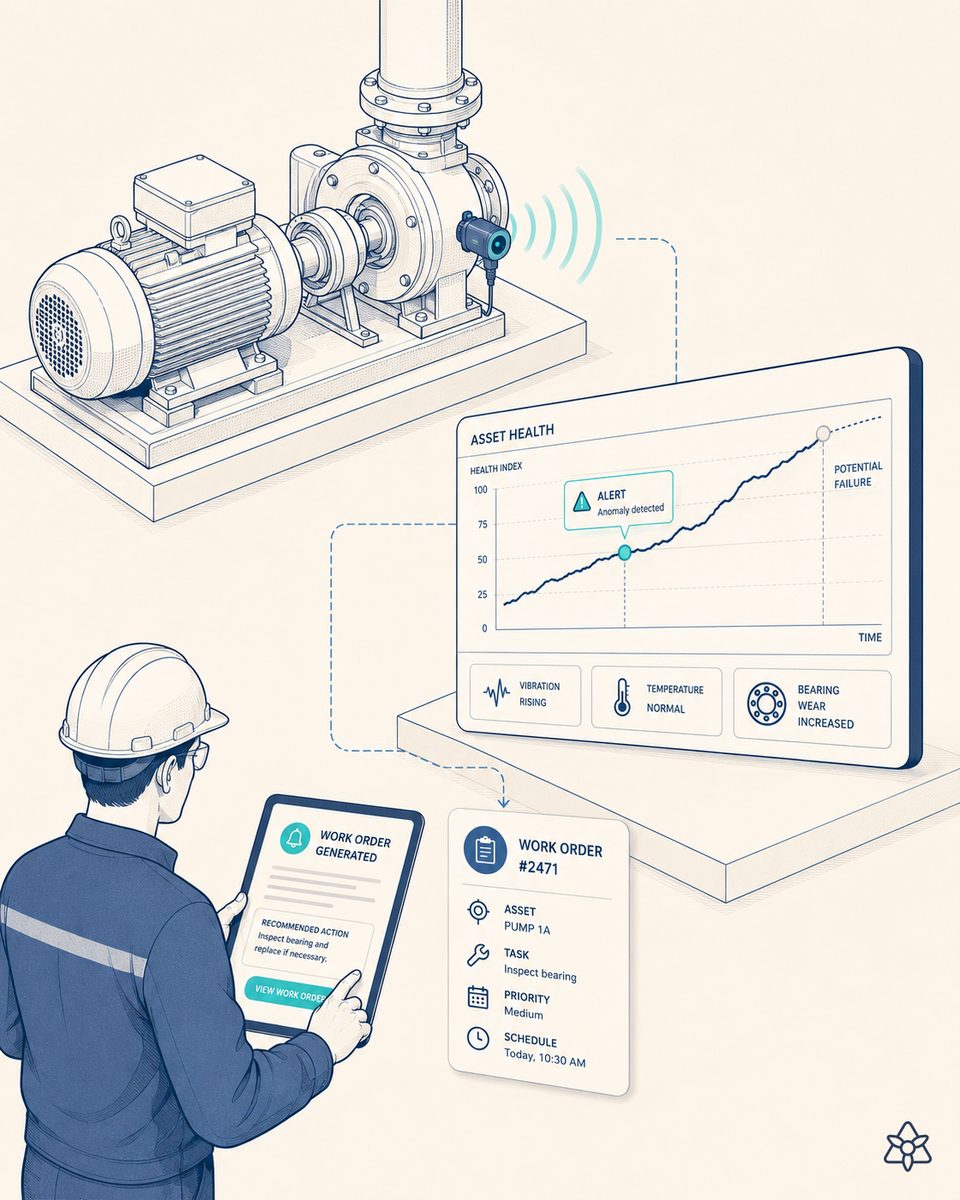
The signal of the avionics failure was there — split across three systems nobody cross-references in real time.
The airworthiness manager at an operator or a Part-145 MRO knows the pattern: when an unscheduled AOG appears, the postmortem almost always reveals that the signal was there. A BIT (Built-In Test) that tripped intermittently on the last few flights, an ACMS parameter that drifted outside the expected envelope, a report from the previous shift's technician noted down in a spreadsheet. The data existed. What was missing was the brain to cross-reference it with the individual aircraft's history and say "this is degrading".
The classic PHM model sits with the OEM, for the entire fleet. The specifics of the individual aircraft — its history, its routes, its landing severity — live with the operator. And the reality of the shop (what was replaced and when, what stock there was, which technician signed) lives in the MRO ERP. Three systems, three owners, and between the three there are cracks that AOGs slip through.
iLEAN is not another MRO IT tool — it is the putty between the OEM's BIT, the operator's telemetry and the shop's MRO ERP.
The problem in aerospace predictive maintenance is not a lack of data: it is data on three islands that do not talk to each other in time. iLEAN acts as the putty that fills the cracks between what the aircraft reports (BIT, ACMS, QAR), what the operator knows (routes, landing severity, event history) and what the shop records (interventions, stock, the technician who signs). It replaces neither the MRO ERP nor the OEM's system — it stitches them together.
Edge captures shop-floor sensors during the intervention. Brain keeps the PHM model per individual aircraft. Agent assembles the work order and the airworthiness dossier. The Part-66 person signs — never the other way round.
The three iLEAN pieces applied to predictive MRO:
- iLEAN Edge — a terminal in the hangar and at the inspection points. It captures test-bench measurements (vibration, temperature, pressure), instrument readings during the inspection, and, via OCR, the aircraft's own displays when a direct interface is not possible. It works with no network — if the hangar loses connectivity during an intervention, it keeps capturing.
- iLEAN Brain (PHM model) — a PHM model per component and per individual aircraft, fed by the aircraft's BIT (through the operator's Connect), post-flight ACMS telemetry, and data from every intervention (the shop's Connect). It maintains a remaining useful life (RUL) projection per component, raises an alert when aircraft X diverges from its fleet or when a part approaches a threshold, and proposes a maintenance slot to the shop's planning team.
- iLEAN Agent (Documentation) — an agent that assembles the work order once a predictive intervention is accepted: the ATA chapter affected, the component to replace, the qualified Part-66 technician available, stock confirmed, airworthiness dossier ready for signature. The technician does not assemble paperwork — they review it, carry out the task and sign.
Reactive + calendar MRO vs. predictive MRO with iLEAN
| Aspect | Classic MRO (calendar + reactive) | With iLEAN Edge + Brain + Agent |
|---|---|---|
| PHM model | From the OEM, for the fleet | Per individual aircraft, with real data |
| Intermittent BIT signal | Ignored until it becomes persistent | Brain cross-references it with history and raises an early alert |
| Unplanned AOG | Reactive: AOG, aircraft off the roster, delays | Anticipated: intervention in a normal slot |
| Work order | Manual, the technician hunts for documentation | Assembled by Agent, the technician reviews and executes |
| Airworthiness dossier | Rebuilt at closeout | Live from minute one, ready for signature |
| Spare-part pool cost | Over-stocked because of uncertainty | Predicted demand — stock sized to the real risk |
Impact estimate for your plant — to be validated with your numbers.
The block below is an estimate to be validated with the specific data of your operation. We put it forward so the committee has an order of magnitude; we refine it during the diagnostic.
- Part-145 MRO or operator with a fleet in the order of dozens of aircraft, ATA chapters with a history of unscheduled AOG over the last few years, a significant spare-part pool (rotable avionics components).
- Brain + Connect pilot on one ATA with AOG history (the operator's failure Pareto). First value expected within a few weeks: a PHM model per aircraft running on that ATA, early alerts on the dashboard.
- Indicative payback between 4 and 9 months. Levers: unplanned AOG down ≥30% on the ATAs covered, lower pool cost through better demand prediction, less paperwork for the Part-66 technician, an airworthiness dossier ready without rebuilding it.
- The hard lever: a single mid-sized AOG avoided per year in a mid-sized fleet pays for the whole system.
And the airworthiness Postholder's reasonable doubt
"What if the AI proposes deferring an intervention and the component fails?" — hallucination is a problem of free generation, not of anchored tasks. Brain does not decide to defer anything: it produces a RUL estimate with its confidence interval, raises an alert when it approaches a threshold, and the intervention decision still belongs to the Postholder or the qualified Part-66 technician. In anchored tasks, the best models brought error below 1.5% [1]. And iLEAN's three safety rings are designed for precisely this: the European AI Act requires human oversight in high-risk AI, and iLEAN's architecture guarantees that critical airworthiness operations are executed only by a qualified person.
[1] OpenAI paper "Why Language Models Hallucinate", 2025 — on the reliability of AI in anchored tasks.
What people ask about predictive MRO with AI in aerospace
What is PHM?
PHM (Prognostics and Health Management) is the discipline that combines sensors, aircraft telemetry (BIT, ACMS, QAR) and physical/statistical models to estimate the current health of a component and project its remaining useful life (RUL). Good PHM turns calendar-based or flight-hour-based maintenance into maintenance based on real condition, which cuts unnecessary interventions and, above all, anticipates the failure before it produces an AOG (Aircraft On Ground). The aerospace industry has run PHM on engines for decades; iLEAN extends the same approach to avionics and to structural fatigue.
How does iLEAN integrate with OEM data?
Connect captures the data through whichever channel the OEM offers: if there is a modern API portal (typical on new platforms), direct integration; if the data arrives as an ACMS report at the end of each flight, it is captured as a signed file; if the information arrives as a technical bulletin (Service Bulletin, AD) by email, that is captured too. The rule is the same as on the shop floor: the system adapts to the channel that already exists, it does not force the OEM or the shop to change anything. What Edge and Brain do is cross-reference those flows with the operator's fleet history and with the shop's own information, which in many cases lives in an MRO ERP, in spreadsheets and in folders.
And what about structural fatigue?
Structural fatigue is classically managed by landing cycles (FH/FC) and the OEM's fatigue models. What iLEAN adds is enriching that model with real data from the individual aircraft: landing severity (recorded g), operating environments (coastal routes with corrosion vs. continental ones), non-standard events (severe turbulence, hard landings). Brain keeps a PHM model per individual aircraft, not per type, and raises the alarm when the real data from aircraft X diverges from the behavior expected across the fleet. The decision on an unscheduled inspection still belongs to the airworthiness manager.
Does it comply with EASA Part-145 / Part-CAMO?
iLEAN does not replace the continuing airworthiness management system (CAMO) or the Part-145 shop — it complements them. What it delivers is traced, signed evidence to support decisions that today are taken on partial data: RUL prediction backed by real data, an inspection dossier with visual evidence, traceability of every intervention with the signature of the qualified Part-66 technician. Regulatory authority and responsibility stay exactly where they are — the European AI Act points in precisely that direction, and iLEAN's three safety rings are designed to meet that requirement for human oversight.
How much does AOG (Aircraft On Ground) go down?
An AOG costs more than any reasonable MRO investment — that is the equation the predictive business case rests on. Estimate to be validated with your fleet's data: anticipating the failure through PHM lets you plan the intervention into a normal maintenance slot rather than as an unscheduled AOG. The reduction in AOG hours per component covered by PHM is around 30% as a defensible floor in comparable fleets; the ceiling is set by how much random avionics failure stays outside the model. More important than the number: one AOG avoided per year in a mid-sized fleet pays for the whole system.
More cases in other sectors
- Digital aerospace APQP/PPAP — this used to take a whole team weeks; now iLEAN does it.iLEAN keeps APQP live by phase and auto-generates the PPAP run-at-rate. Aero NPI without an entire team…
- AS9100 with AI — the audit stops being a three-month sprint and becomes living evidence.iLEAN keeps AS9100 evidence alive and first article inspection traceable. Aerospace audits without the…
- Avionics control with AI — a person still signs the board, but nothing slips past anymore.How iLEAN combines Edge vision, Connect and iLEAN Agents for inspection, traceability and the…
- Rail bogie control with AI — the frame does not leave the shop until the file adds up.How iLEAN cross-references weld testing, frame dimensional control and critical component traceability…
- An internal defect in an aerospace composite part only shows up under ultrasound — and almost nobody cross-references it with the real autoclave curve. iLEAN does.iLEAN combines vision, ultrasound and the autoclave cycle to guarantee an aerospace composite part with…
- Composite wing control with AI — an internal defect only shows up in ultrasonics. iLEAN combines vision, UT and the autoclave cycle.How iLEAN combines Edge vision, ultrasonic NDT and the autoclave cycle to catch internal defects in…
Tell us your case and in 48h we'll send you the estimated ROI of this AI project for your MRO or your fleet operation.
We work on your operation's real data, not ours. Diagnostic with no commitment.
Request estimated ROI in 48h See aerospace