Rail bogie control with AI — the frame does not leave the shop until the file adds up.
The bogie is the most expensive and most critical part of a train: EN 15085 railway welding, NDT, dimensional control and traceability by serial number all have to line up in a single file before the part is released to the OEM. iLEAN cross-references the visual inspection of the bead, the machine parameters and the material certificates, and holds the frame if something does not add up. The person signs.
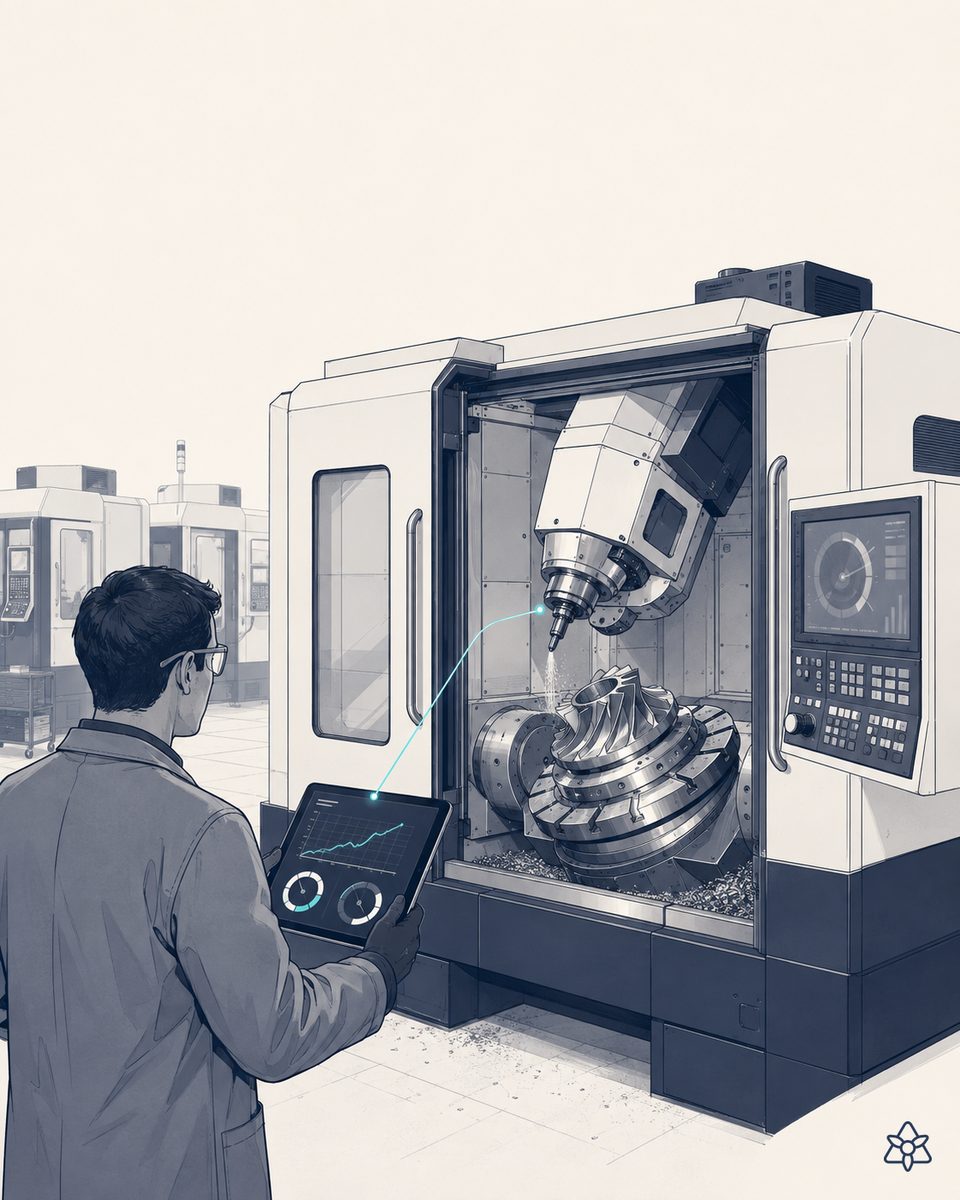
Three files that get closed late, badly and by hand.
Releasing a bogie to a rail OEM is not just welding a frame. It is closing three files at once that live in different places:
- EN 15085 welding — critical beads (CP A and CP B) require visual inspection, NDT by dye penetrant or MT, and a record of the welding parameters. The welder signs, the supervisor signs, the inspector signs. Three sheets of paper. Three signatures. And a welding machine with its own panel, integrated with nothing.
- Frame dimensional control — the geometry is measured with a CMM, a laser arm or a template. The report comes out as a PDF, travels by email and ends up in a shared folder under a name like
BOG-2025-047_FINAL_v3_reviewed.pdf. - Material and component traceability — steel heat, the supplier's 3.1 certificate, serial numbers of axles, wheels, suspension. Each one in a different spreadsheet, each one with its own owner.
The shop's quality manager knows all of it. But when the OEM asks for the file of bogie 047 because their own end customer demands it, someone has to rebuild what already exists. Days of work by an expensive quality engineer hunting for PDFs across folders, calling around to find out who signed what, re-assembling a dossier that was done properly but lives scattered. The system works — but the knowledge is fragile and expensive to prove.
iLEAN does not add another quality system — it seals the joints between the ones you already have.
The bogie problem is not a lack of information: it is information living in islands that, at the moment of closing the file for the OEM, does not arrive together. iLEAN acts as the putty that fills those gaps, without asking you to change your welding equipment, your CMM or the OEM's document system.
Edge sees the bead in line. Connect reads the aging machine panel, the CMM, the traceability spreadsheets. The agent cross-references against EN 15085 and EN 13749 and, if something does not add up, holds the frame. The person signs — never the other way round.
The three iLEAN pieces applied to rail bogie quality control:
- Edge — a terminal with machine vision (CNN) over the welding station. It reads the bead in line (geometry, undercut, apparent lack of penetration), captures the image at the end of each pass and triggers an actuator (light stack, hold) if visual quality falls below the threshold. It works with no network. In the shop, what is critical cannot depend on WiFi with interference.
- Connect — captures the welding equipment parameters even when the panel is fifteen years old (intermediate reading by screen OCR if there is no other way), reads the CMM PDF as soon as it is generated, and digitizes the steel 3.1 certificate that arrives by email from the supplier. And it captures what comes from outside: an alert from the OEM by WhatsApp about a change in the welding procedure enters at second zero, with nobody forwarding anything.
- Agent — cross-references, by bogie serial number, all of the above against the standards (EN 13749, EN 15085, EN ISO 5817) and against the OEM's procedure. At the end of the process it returns the bogie file ready to sign: a coherent dossier with the bead image, the NDT report, the dimensional, the traceability and the signatures. If something is missing, it says so before release.
Bogie control by hand vs. cross-referenced control with iLEAN
| Aspect | Today (spreadsheets + checklists + meetings) | With iLEAN Edge + Connect + Agent |
|---|---|---|
| Visual inspection of the bead | Operator signs at end of shift, no image | Image captured by Edge, linked to the serial number |
| Welding parameters | On the machine panel, not integrated | Connect reads the panel + OCR + external sensors |
| Material traceability | 3.1 certificates scattered across email | Indexed by heat and by part serial number |
| File for the OEM | Rebuilt by hand, 2-3 days per bogie | Coherent dossier at close, minutes to validate |
| The veteran welder's knowledge | Lives in their head; leaves with them | Pattern captured by Edge, stays in the system |
| Operation with no network | n/a | Edge keeps capturing on the cabinet's own power |
Impact estimate for your plant — to be validated with your numbers.
The block below is an estimate to be validated with the specific data of your shop. We put it forward so the committee has an order of magnitude; we refine it during the diagnostic.
- A bogie shop supplying a European rail OEM, X frames/month, EN 15085 welding at CP A/B level, with a release file required by the customer.
- A pilot focused on one sub-operation: visual bead inspection with Edge + closing the file by serial number with an Agent. First value expected within a few weeks.
- Indicative payback between 4 and 9 months. Hard levers: quality time saved on closing the file, fewer frames rejected by the OEM for incomplete documentation (≥30%), capacity recovered at the inspection bottleneck.
- On reliability: hallucinations are a problem of free generation, not of anchored tasks. In tasks anchored to the source (reading a bead, extracting a parameter from a screen, linking a serial number to a certificate), the best models brought error below 1.5%[1]. And even so, what is critical is never decided alone: the person signs.
[1] OpenAI paper “Why Language Models Hallucinate”, 2025 — on the reliability of AI in anchored tasks.
What people ask about rail bogie control with AI
Which standards apply to rail bogie quality control?
A train bogie is built under a demanding set of standards: EN 13749 (design and certification of bogie frames), EN 15085 (railway welding, levels CL1 to CL4), EN ISO 5817 (quality of welded joints) and the vehicle builder's own procedures. Every critical component (frame, axles, primary/secondary suspension, brakes) carries a file with NDT, dimensional, materials and traceability by serial number. What takes time is not building it — it is rebuilding the file when the customer or the notified body asks for a specific part.
How do you catch weld defects on bogie frames without stopping the line?
By cross-referencing three sources that today live in islands: the NDT report (dye penetrant, ultrasonic, MT), the welding parameters recorded by the machine (current, travel speed, gas) and the image of the bead that iLEAN Edge captures in real time. If the visual inspection finds lack of penetration or undercut, the system holds the part before it moves to the next operation and opens the non-conformance with the evidence attached. The person signs the disposition — the bogie does not move on by itself.
Can iLEAN rebuild the bogie file for an OEM customer?
Yes — that is exactly what the Agents piece is for. For every bogie serial number, the agents cross-reference material traceability (steel heat, the supplier's 3.1 certificate), the NDT performed (with a photo of the report and the inspector's signature), dimensional control (CMM or laser measurement), the welding parameters recorded by the equipment, and the static and dynamic load tests, and return them as a dossier ready to send to the OEM customer. What used to be 3 days of hunting for spreadsheets and PDFs across shared folders becomes a signed PDF in minutes.
Does Edge work in the welding shop, with fume and spatter?
Yes. Edge is designed for the real shop environment — fume, spatter, poor lighting, vibration. The cameras are installed with IP65 protection and the terminals use passive cooling so they do not depend on fans that clog up. It works with no network: if the shop loses WiFi (common in large bays with interference from the welding equipment), Edge keeps capturing the bead, reading the machine panel and holding frames. What is critical cannot depend on coverage.
What is the order of magnitude of an iLEAN pilot in a bogie shop?
An iLEAN pilot in a bogie shop focuses on one critical sub-operation (typically bead inspection on a frame, or closing the file by serial number) and delivers first value within a few weeks. Indicative payback between 4 and 9 months — the hard lever is the cost of a single bogie returned for a non-conformance found at the OEM's plant, plus the quality staff time that today goes into rebuilding files by hand. An estimate to be validated with your data. Send us your annual volume and we'll send back the ROI in 48h.
More cases in other sectors
- AS9100 with AI — the audit stops being a three-month sprint and becomes living evidence.iLEAN keeps AS9100 evidence alive and first article inspection traceable. Aerospace audits without the…
- Avionics control with AI — a person still signs the board, but nothing slips past anymore.How iLEAN combines Edge vision, Connect and iLEAN Agents for inspection, traceability and the…
- An avionics failure in service costs more than any MRO investment — you avoid the AOG beforehand with cross-referenced data, not afterwards with spare-part stock.iLEAN combines BIT, shop-floor sensors and a PHM model to predict failures in avionics and structures…
- An internal defect in an aerospace composite part only shows up under ultrasound — and almost nobody cross-references it with the real autoclave curve. iLEAN does.iLEAN combines vision, ultrasound and the autoclave cycle to guarantee an aerospace composite part with…
- Composite wing control with AI — an internal defect only shows up in ultrasonics. iLEAN combines vision, UT and the autoclave cycle.How iLEAN combines Edge vision, ultrasonic NDT and the autoclave cycle to catch internal defects in…
- Precast concrete — CE marking stands on plant records.Documented iLEAN cases in precast concrete: steam curing, EN 13369 CE marking, prestressing and 3D…
Tell us your case and in 48h we'll send you the estimated ROI of this AI project for your bogie shop.
We work on your plant's real data, not ours. Diagnostic with no commitment.
Request estimated ROI in 48h See aerospace / defense / rail