CE marking of EN 1916 reinforced concrete pipes — the dossier should not take two days to add up.
The DoP of a reinforced concrete pipe lives in four places — the steel certificate, the concrete sheet, the crushing test and the order in the ERP. iLEAN Writer stitches them together, assembles the DoP in line with EN 1916 and CPR 305/2011, and prepares the CE labeling for the line's inkjet. The person signs the DoP — Writer prepares, it never releases anything on its own.
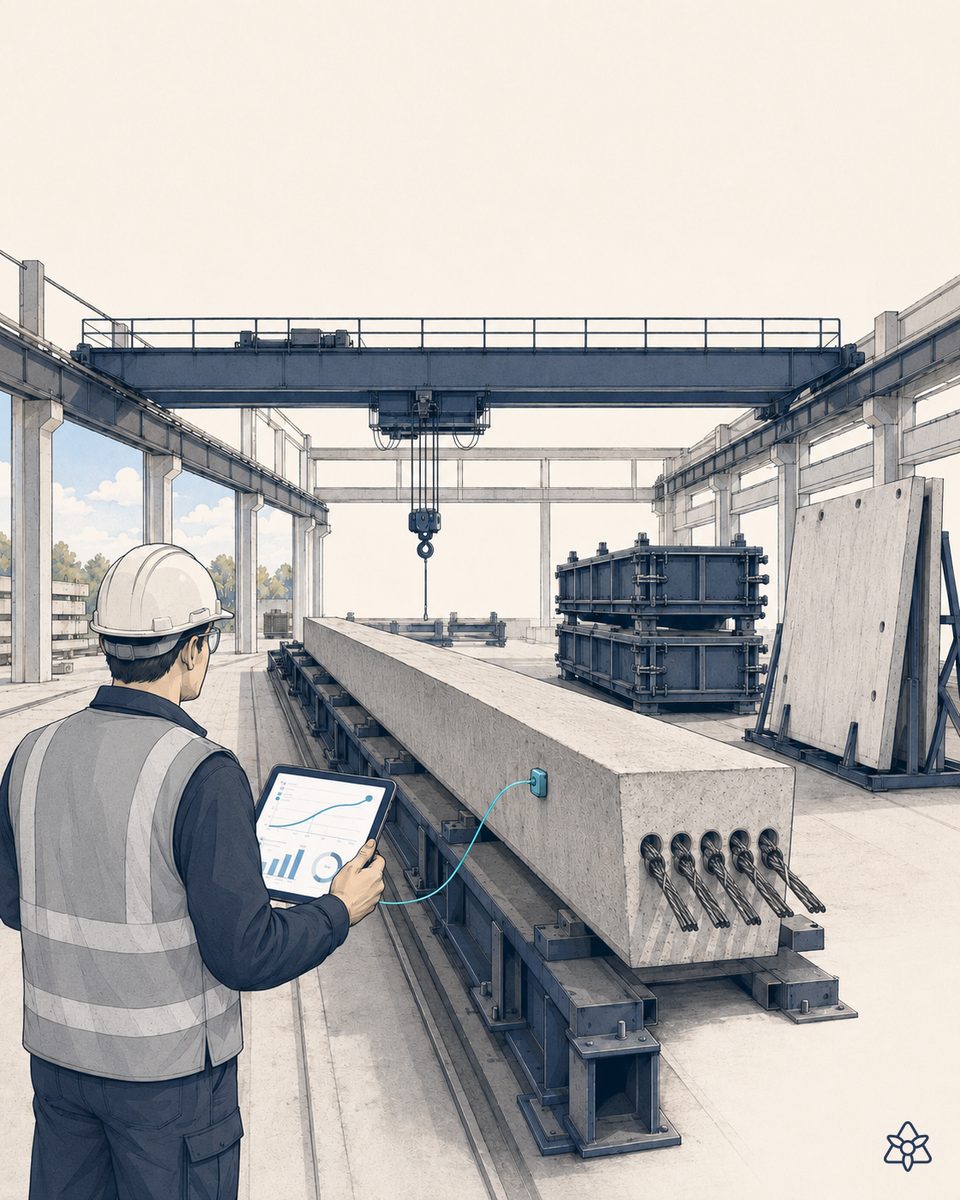
Four systems, one DoP, one Friday afternoon.
The CE marking of a reinforced concrete pipe with a flexible joint under EN 1916 is not a formality — it is the manufacturer's signature stating that the pipe meets the declared performances. And yet, in most plants the dossier that supports that signature is assembled by hand every single time:
- The steel batch certificate in a PDF that arrived from the supplier by email.
- The concrete batch sheet in the MES — if there is an MES — or in the lab spreadsheet.
- The crushing test in the test rig's notebook, typed into the computer whenever the quality manager has time.
- The order and its destination in the sales team's ERP, in yet another database.
On Friday afternoon, when the DoPs for three batches have to be signed so the crane can start on Monday, the quality manager moves from tab to tab. It gets done. But the day the notified body asks for the data for the annual FPC audit, or site inspection files a claim over a manhole that has cracked three years later, the dossier has to be rebuilt from scratch. And then it is a week's work.
iLEAN does not replace the quality manager — it takes the dumb work away and leaves the work that matters.
The CE marking problem is not one of regulatory knowledge: the quality manager knows EN 1916, CPR 305 and the ZA annexes inside out. The problem is information living in islands and hours burned joining by hand what today's AI joins almost for free. iLEAN acts as the putty that seals those cracks between the steel certificate, the concrete sheet, the test rig result and the ERP order — and leaves the manager with the decision that is genuinely his to sign: this DoP reflects what actually happened.
Connect reads the PDF certificates, the MES, the lab spreadsheet and the crushing rig. The agents verify and assemble the DoP in line with the standard. The person signs — Writer prepares, it never releases anything on its own.
The iLEAN pieces applied to CE marking of EN 1916 pipes:
- Writer (Agents + Central) — a set of specialized agents that live on top of your systems and assemble the DoP, the CE labeling for the inkjet, the technical dossier for the notified body and the traceability pack for site inspection, using the versioned EN 1916 regulatory template. An anchored task: the agent recontextualizes data from one system into another following the template — it invents nothing.
- Connect — captures the steel and cement PDF certificates, the MES if there is one, the lab spreadsheet, the crushing rig reports and the operator's reports by voice. Whatever arrives by email from the cement supplier reaches the dossier at second zero, without anyone having to forward anything.
- Three safety rings — the final DoP, the most sensitive piece of data, lives in the highest-criticality ring. The agents that prepare it sit in the outer ring; whatever enters the signing ring arrives verified and cryptographically signed. The human signature happens where it matters, and the system is designed so that it cannot be bypassed.
A DoP assembled by hand vs. a DoP prepared by iLEAN Writer
| Aspect | Manual assembly + Word template | With iLEAN Writer + Connect + Agents |
|---|---|---|
| Capture of the steel certificate | PDF saved in a folder, copied by hand | PDF read by OCR on arrival, linked to the batch |
| Crushing test | Notebook → spreadsheet → DoP | Read straight from the rig, linked to the batch |
| EN 1916 DoP template | The manager's Word file, version depends on who last updated it | Versioned template, validated against the standard in force |
| CE labeling on the pipe | Data keyed into the inkjet by hand | Data sent to the inkjet from the dossier |
| Annual FPC audit | Rebuilding folders, days of work | Dossier available per batch, hours |
| Site inspection claim (3 years later) | A week of searching | Minutes: pipe → batch → signed DoP |
Impact estimate for your plant — to be validated with your numbers.
The block below is an estimate to be validated with the specific data of your plant. We put it forward so the committee has an order of magnitude; we refine it during the diagnostic.
- A plant with several lines of reinforced concrete pipes with flexible joints, multiple diameters and series, and a per-batch DoP assembled by hand every week.
- Writer pilot on one series (OCR of certificates + integration with the MES and the crushing rig + EN 1916 DoP template + feed to the marking inkjet). First value expected within a few weeks: the first batch's DoP prepared in minutes instead of hours.
- Indicative payback between 4 and 9 months, depending on the quality manager's hourly cost, the number of DoPs per month, and the cost of the notified body's annual audit.
- The hard lever is the quality manager's hours per week recovered and the annual FPC audit resolved in hours, plus a reduction ≥ 30% in the search time triggered by a late site inspection claim.
And the quality manager's reasonable doubt
"What if the AI assembles a DoP with a wrong figure and I sign it in good faith?" — hallucination is a problem of free generation, not of anchored tasks. In tasks where the AI simply reads a PDF certificate, a concrete sheet and a test rig result and places them in the EN 1916 template, the best models brought error below 1.5% [1]. And even so, the DoP is never signed on its own: the agent prepares, the quality manager signs, with a visible receipt of where every figure came from. The three safety rings are there precisely for this.
[1] OpenAI paper "Why Language Models Hallucinate", 2025 — on the reliability of AI in anchored tasks.
What people ask about CE marking of EN 1916 concrete pipes
What do EN 1916 and the CPR require for reinforced concrete pipes?
The harmonized standard EN 1916 (pipes of plain concrete, reinforced concrete and steel-fiber concrete) defines the tests and the declarable performances: strength class, joint watertightness, crushing strength and, depending on the diameter, the crushing test. Under the Construction Products Regulation (EU) 305/2011, the manufacturer signs a Declaration of Performance (DoP) per product type and applies the CE marking on the pipe itself with the key data. Factory production control (FPC) and initial type testing are the documentary base that supports that DoP.
How does iLEAN Writer automate the generation of the DoP and the CE marking?
Writer is a set of agents that live on top of your systems — ERP, MES, lab sheets, steel and cement certificates from suppliers, crushing tests from the test rig — and assemble the dossier in line with the EN 1916 scheme and the ZA annexes. When a batch is completed, the agent prepares the DoP with the declarable data (class, diameter, joint, representative tests), the CE labeling for the line's inkjet, and the technical dossier for the notified body. The agent prepares, the person signs. The DoP does not leave the system without the quality manager's signature.
What if the batch data sits in four different places — lab, MES, spreadsheet and supplier PDF certificates?
That is exactly the typical case. iLEAN Connect captures through every channel: it reads the steel heat certificate in PDF as it arrives from the supplier, connects to the MES for the concrete batch and the line schedule, reads the lab sheets wherever they are (the manager's spreadsheet, the crushing rig's own equipment), and the operator's reports dictated by voice. All of that capture reaches the intermediate ring, where the agents verify and package it. The final DoP is generated in the maximum-power ring and returned signed to the document system. Without asking you to change the lab, the MES or the spreadsheet — the putty that fills the cracks, not the wall that gets knocked down.
What about the traceability of each CE-marked pipe?
Every marked pipe carries a unique identifier linking it to the production batch, the concrete batch, the steel batch (with its certificate), the representative test and the DoP that covers it. If three years later something goes wrong in a manhole and the customer asks for the trace of the installed pipe, the dossier comes out in minutes: pipe → batch → tests → signed DoP. That trace is exactly what site inspection asks for when a pipe fails, and exactly what the notified body reviews in the annual FPC audit.
How much does a Writer pilot cost in a concrete pipe plant?
The order of magnitude of a Writer pilot in a reinforced concrete pipe plant is close to that of any iLEAN pilot: an initial investment for the capture layer (OCR of certificates, integration with ERP/MES, reading the test rig, connection to the marking inkjet), training for the quality team, and the annual license. A reasonable payback to put in front of the committee is several months — the hard lever is the quality manager's hours per week assembling CE dossiers, which now assemble themselves, plus the notified body's annual audit resolved in hours instead of days. We ask for your plant's data and send you the estimated ROI in 48h.
More cases in other sectors
- An internal defect in an aerospace composite part only shows up under ultrasound — and almost nobody cross-references it with the real autoclave curve. iLEAN does.iLEAN combines vision, ultrasound and the autoclave cycle to guarantee an aerospace composite part with…
- Composite wing control with AI — an internal defect only shows up in ultrasonics. iLEAN combines vision, UT and the autoclave cycle.How iLEAN combines Edge vision, ultrasonic NDT and the autoclave cycle to catch internal defects in…
- Precast concrete — CE marking stands on plant records.Documented iLEAN cases in precast concrete: steam curing, EN 13369 CE marking, prestressing and 3D…
- Climbing formwork management — a module lost between site and plant is a day of concrete pouring that doesn't happen.iLEAN Connect tracks location, use cycles and maintenance of your climbing formwork fleet between site…
- EN 13369 + CPR 305/2011 compliance in a precast plant — the dossier for the auditor should not have to be rebuilt.iLEAN Agents prepare the EN 13369 + CPR 305/2011 compliance dossier (FPC, ITT, DoP) for the auditor in a…
- Blowhole inspection on GRC panels — a blowhole caught in the plant costs 100 times less than one caught on site.iLEAN Vision detects blowholes and surface defects on precast GRC panels before they are packed and…
Tell us your case and in 48h we'll send you the estimated ROI of this AI project for your pipe plant.
We work on your plant's real data, not ours. Diagnostic with no commitment.
Request estimated ROI in 48h See construction