Blowhole inspection on GRC panels — a blowhole caught in the plant costs 100 times less than one caught on site.
A GRC panel rejected by the architect on the facade means a crane standing idle, a return haul and half the job waiting. iLEAN Vision looks at the finished panel on the inspection table with a neural network trained for blowholes, cracks and stains — and flags whatever falls short before packing. The decision to pack or repair is signed by the quality manager.
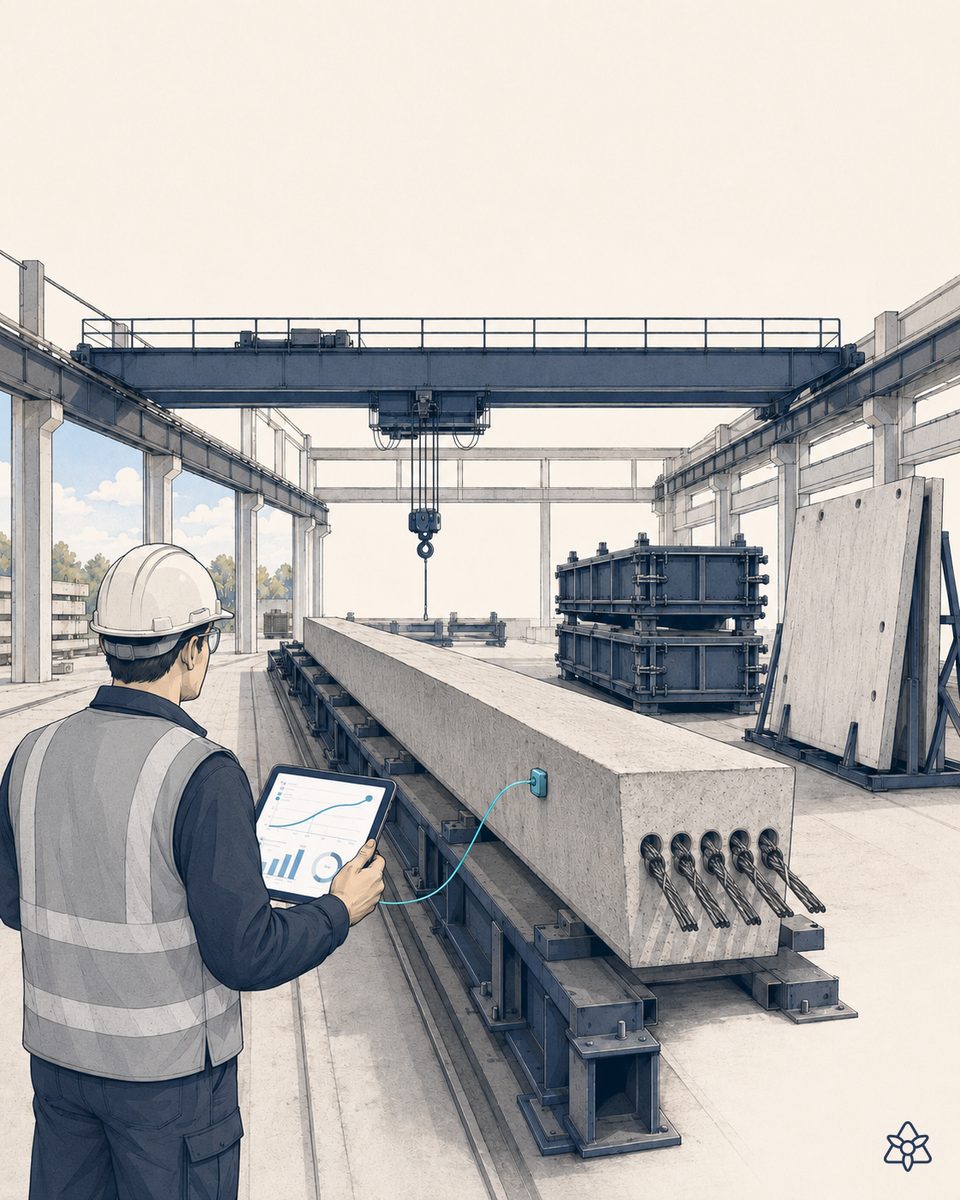
The defect that slips through the plant is the rejection that arrives on site.
A GRC panel is an exposed piece — architectural facade. The difference between a panel that passes and one the engineer of record rejects fits inside a three-centimeter circle: a blowhole, a shrinkage crack, a badly cleaned release-agent stain. When that circle is spotted in the plant, an operator fixes it in ten minutes. When it is spotted on site, with the panel already hanging from the crane, the problem multiplies:
- The panel comes back — and it comes back whole, not just the defective patch. Return haul, warehouse space, a piece that can no longer be sold.
- The job stops — the facade was waiting for that panel to close the module. Days of delay, the installation crew idle, a crane rented by the day.
- The brand wears down — the developer remembers the manufacturer for the panel that was rejected, not for the hundred that went up perfectly.
The operator's visual inspection works 95% of the time. The other 5% is what ends up on the facade and is visible from the street. What costs money is not the defect: it is not having caught it in time.
iLEAN does not replace the quality manager — it gives him a second pair of eyes that never tires.
The blowhole problem is not one of judgment: the quality manager knows perfectly well what passes and what does not. The problem is one of volume and fatigue. When the shift ends at six, the last panels of the afternoon get looked at with less patience than the first ones of the morning. And the six o'clock blowhole is the one that reaches the site. iLEAN acts as the putty that seals that crack between human visual inspection, sample-based quality control and the outbound delivery note — without asking you to change the mold, the equipment or the line.
Vision looks at the finished panel with the same patience at six as at eight. Connect captures the customer order and the mold sheet. The agent cross-references piece, order and criteria, and proposes packing or repair. The person signs — Vision does not release anything, never the other way round.
The three iLEAN pieces applied to GRC panel inspection:
- Vision (Edge) — a terminal with a camera and a neural network over the inspection table. It scans the finished panel, flags blowholes, cracks and stains with coordinates and size, and fires the traffic light in the packing area. It works with no network — if the plant loses WiFi, Vision keeps looking and flagging, because what is critical cannot depend on connectivity.
- Connect — captures the order data (customer, project, module, position on the facade), the mold sheet (texture, color, acceptance criteria agreed with the architect) and, if a change of criteria arrives from the architect by email or WhatsApp, it is folded in at second zero, without anyone having to forward anything.
- Agent — cross-references the image of the panel with the criteria of the order (a panel for a nursery school does not carry the same threshold as one for an institutional facade), proposes packing or repair, and assembles the per-piece evidence dossier for any customer who asks for it.
Visual inspection on the table vs. cross-checked inspection with iLEAN Vision
| Aspect | Visual inspection + sampling | With iLEAN Vision + Connect + Agent |
|---|---|---|
| Coverage | Sampling + the operator's eye at the end of the shift | 100% of panels before packing |
| Inspector fatigue | The last panel of the shift gets less patience | Vision looks at piece 200 exactly as at piece 1 |
| Acceptance criteria | Implicit, in the quality manager's head | Explicit per customer/project/mold, versioned |
| Traceability of the decision | Signature on the delivery note, a photo only if someone asked | Photo + defect map per piece, archived |
| Operation with no network | n/a | Vision keeps running on the panel's power alone |
| Dossier for the architect if evidence is requested | Rebuilt by hand | Automatic pack per piece |
Impact estimate for your plant — to be validated with your numbers.
The block below is an estimate to be validated with the specific data of your plant. We put it forward so the committee has an order of magnitude; we refine it during the diagnostic.
- An architectural GRC precast plant with one spray-up/casting line, an inspection table and a packing area.
- Vision pilot on the inspection table (camera + calibrated lighting + integration with the order sheet). First value expected within a few weeks: consistent detection of the type of blowhole most frequent in your production.
- Indicative payback between 4 and 9 months, depending on the documented frequency of rejections on site and the average cost of a return (transport + new piece + module delay).
- The hard lever is a single panel rejection on site avoided each month: that alone pays for the pilot. On top of that, a reduction ≥ 30% in undocumented touch-ups that are done on site today and never invoiced.
And the plant manager's reasonable doubt
"What if the AI flags something as a defect when it is not, and we pack fewer panels because it is being timid?" — hallucination is a problem of free generation, not of anchored tasks. In tasks where the AI simply compares an image against criteria trained on samples from your own plant, the best models brought error below 1.5% [1]. And even so, what is critical is never decided alone: Vision flags, the quality manager signs. The three safety rings are there precisely for this.
[1] OpenAI paper "Why Language Models Hallucinate", 2025 — on the reliability of AI in anchored tasks.
What people ask about AI inspection of GRC panels
What is a blowhole in a GRC panel and why does it matter?
A blowhole is a surface void in a glass-fiber reinforced concrete (GRC) panel, caused by air trapped during spray-up or by poor compaction. It matters because GRC is used as an exposed architectural facade element: a blowhole a few millimeters across gets past packing, reaches the site, and the engineer of record rejects the panel with the crane already hooked up. The cost of a rejection on site is between 10 and 100 times the cost of a rejection in the plant — between making another panel, the return haul, the days of delay and the crane standing idle.
How does iLEAN Vision detect a blowhole before packing?
Edge is a terminal with a camera and a convolutional neural network (CNN) trained on the surface appearance of GRC as seen on the finished panel — blowholes, cracks, stray fibers, release-agent stains. It is installed over the inspection table at the mold exit or before packing, scans every panel in seconds, and flags the areas that do not meet the plant manager's criteria. The decision to pack or repair is signed by the quality manager — Vision proposes, the person validates.
Does it work with colored or textured exposed-face panels?
Yes. The neural network is trained on samples from your own production — white panels, pigmented panels, exposed-aggregate finishes, silicone or polyurethane mold textures. What changes from one finish to another is the set of training samples, not the architecture. The more varied your production, the more samples get labeled during the pilot; the system learns your plant's acceptance criteria, not a generic one out of a catalog.
Do we have to change the inspection table or the mold?
No. iLEAN Vision is mounted on what is already there — the table, the turning crane, the pre-assembly area — with its own calibrated lighting so that the reading does not depend on the light in the bay. It does not require changing molds or mix designs. That is the underlying idea: the putty that seals the cracks between the operator's visual inspection, sample-based quality control and the delivery note to the customer, without asking you to knock down the wall.
How much does a Vision pilot cost in a GRC precast plant?
The order of magnitude of a Vision pilot on a GRC panel inspection line is close to that of any Edge pilot in precast: an initial investment for the camera, the lighting, the local compute unit and integration with the order ERP and pallet labeling; plus an annual license. A reasonable payback to put in front of the committee is several months — the hard lever is a single panel rejection on site avoided each month: that alone pays for the pilot. We ask for your plant's data and send you the estimated ROI in 48h.
More cases in other sectors
- CE marking of EN 1916 reinforced concrete pipes — the dossier should not take two days to add up.iLEAN Writer automates CE marking and the Declaration of Performance (DoP) for reinforced concrete pipes…
- Climbing formwork management — a module lost between site and plant is a day of concrete pouring that doesn't happen.iLEAN Connect tracks location, use cycles and maintenance of your climbing formwork fleet between site…
- EN 13369 + CPR 305/2011 compliance in a precast plant — the dossier for the auditor should not have to be rebuilt.iLEAN Agents prepare the EN 13369 + CPR 305/2011 compliance dossier (FPC, ITT, DoP) for the auditor in a…
- Vision inspection of MAG welds on HEB profiles — the defect that slips through the shop costs ten times more on site.iLEAN Vision inspects the MAG weld bead on HEB profiles in industrial steel structures and flags defects…
- Module-by-module traceability for PPVC bathrooms — delivery and after-sales with a living file, not a reconstructed one.iLEAN Tracer gives every PPVC bathroom module a unique identity from the plant to its slot on site —…
- Steam curing chamber control — a ramp that drifts two degrees costs three megapascals.iLEAN Edge controls the steam-curing ramp in precast concrete chambers to prevent microcracking,…
Tell us your case and in 48h we'll send you the estimated ROI of this AI project for your precast plant.
We work on your plant's real data, not ours. Diagnostic with no commitment.
Request estimated ROI in 48h See construction