Steam curing chamber control — a ramp that drifts two degrees costs three megapascals.
The 24-hour strength of precast concrete lives in the ramp of the steam curing chamber — rise, plateau, drop. iLEAN Edge tracks the actual curve against the target curve in real time, holds the ramp steady and retains the load if the expected strength falls below the threshold. The person signs — the chamber does not open on its own.
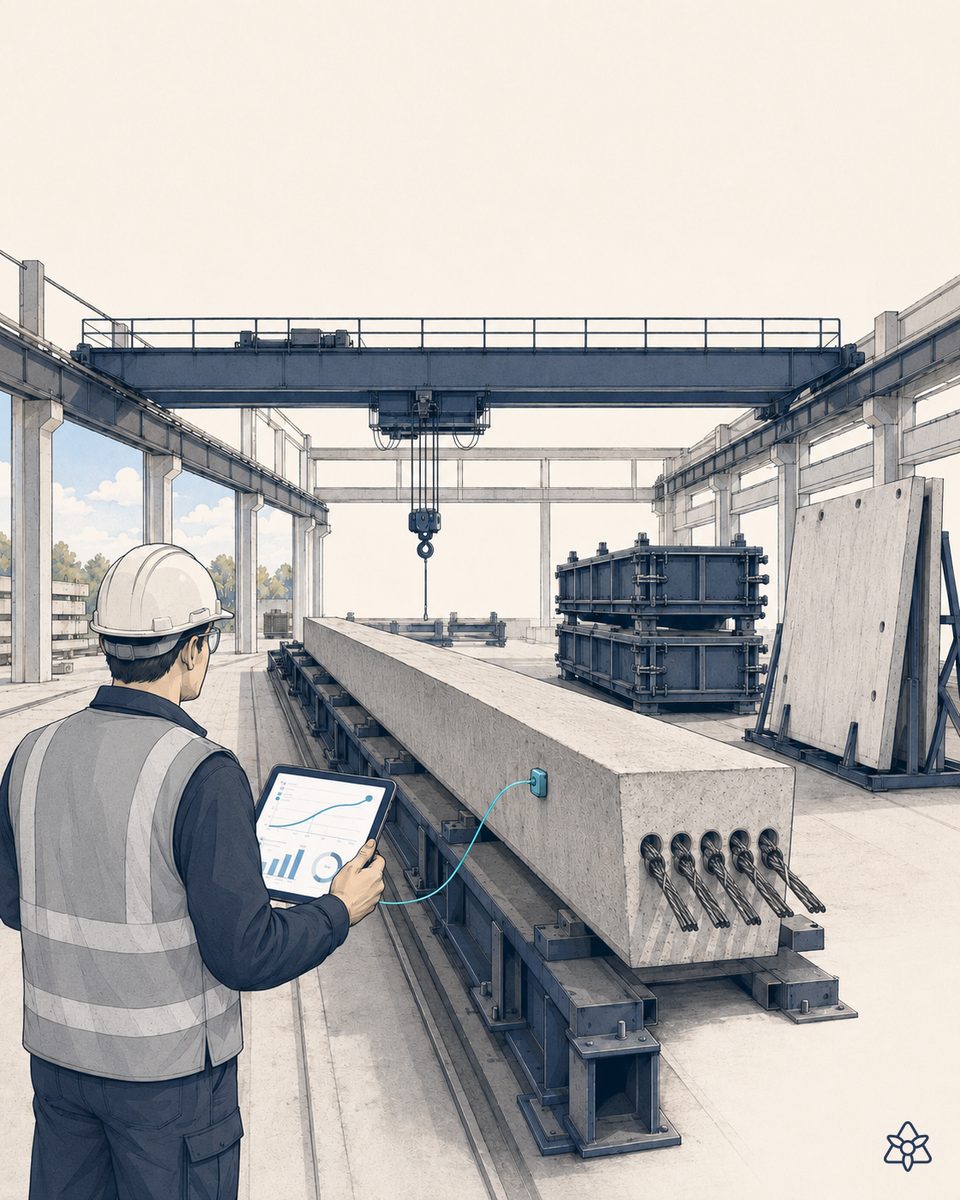
The curing curve is followed by the chamber lead's eye — and on the odd days it shows.
The ideal steam curing curve for a concrete piece is well known: EHE-08 and EN 13369 set the range, and the lab confirms it with cylinder tests at 24 hours and 28 days. But between the curve in the manual and what happens on the shop floor there is a world of difference:
- Chambers are loaded mixed — beams, slabs and joint covers in the same load. Every thickness responds differently. The "average" curve is nobody's curve.
- The shift change lands right at the critical moment — opening the valve and starting the plateau depend on the incoming operator reading the outgoing operator's handover correctly. Holiday Mondays are the odd days.
- The chamber is opened when there is a load waiting — not when the curve has finished cleanly. Thermal shock, microcracking, and a week later a non-conforming cylinder test.
The classic system works because good people watch the chamber and because cylinder tests catch the worst batches. But microcracking is not caught by the 24-hour cylinder test: it is caught by the site inspector when the piece cracks on site. What fails is not the chamber: it is knowing which curve each piece has seen.
iLEAN does not replace the chamber lead — it holds the curve with the same patience all night long.
The curing problem is not one of judgment: the chamber lead knows perfectly well how the ramp should run. The problem is one of constant presence and memory per load. Nobody can watch thermocouples for eight hours straight, nor remember the exact curve seen by Thursday's two-in-the-morning load. iLEAN acts as the putty that seals the crack between the curve in the manual, the steam solenoid valve and the piece's dossier — without asking you to change the chamber, the boiler or the MES.
Edge tracks the actual curve against the target. Connect reads the load sheet (which pieces are inside and what thickness). The agent decides whether the load is released or held. The person signs — Edge does not open the chamber on its own.
The three iLEAN pieces applied to steam curing:
- Edge — an industrial terminal connected to the chamber's thermocouples, the hygrometer and the steam solenoid valve. It tracks the actual curve, predicts the drift and proposes the correction (more steam, wait for the plateau, delay opening). It works with no network. If the plant loses WiFi, Edge keeps controlling.
- Connect — captures the load sheet (which pieces, which concrete, which mix design, which is the most sensitive thickness) from the MES or from the lab spreadsheet, plus the operator's reports dictated by voice whenever a manual adjustment is made.
- Agent — cross-references the actual curve with the expected strength threshold for that mix design, and if the curve drifted beyond the limit, it holds the load before the piece is labeled. The quality manager decides: an extra cylinder test, waiting for 28 days, or reclassification. The chamber does not open on its own.
Curing by the operator's eye vs. curing held steady with iLEAN Edge
| Aspect | Manual control + 24-hour cylinder test | With iLEAN Edge + Connect + Agent |
|---|---|---|
| Curve tracking | A one-off reading at the shift change | Actual curve logged every minute, point by point |
| Shift change | Verbal handover, lost a couple of Mondays a year | Chamber status visible, handover recorded |
| Mixed load | Average curve, most sensitive piece at the limit | Curve tuned to the most sensitive declared piece |
| Microcracking from thermal shock | Shows up on site months later | Opening held back if the drop is too abrupt |
| Dossier per load | Non-existent or rebuilt by hand | Actual curve per load + pieces inside, archived |
| Operation with no network | n/a | Edge keeps controlling on the panel's power alone |
Impact estimate for your plant — to be validated with your numbers.
The block below is an estimate to be validated with the specific data of your plant. We put it forward so the committee has an order of magnitude; we refine it during the diagnostic.
- A plant with two steam curing chambers and mixed production of beams, hollow-core slabs and joint covers — multi-SKU loads.
- Edge pilot on one chamber (terminal + calibrated thermocouples + integration with the solenoid valve and the load MES). First value expected within a few weeks: the actual curve logged per load and a preventive alert at shift changes.
- Indicative payback between 4 and 9 months, depending on how often cylinder tests come back non-conforming and how often the site inspector raises claims for late cracking.
- The hard lever is a single load held and rescued before it reaches the customer with doubtful strength, plus a reduction ≥ 30% in scrap from microcracking detected in the yard.
And the chamber lead's reasonable doubt
"What if the AI decides to open or close the solenoid valve without me knowing?" — the answer is: it does not decide alone. iLEAN's operating rule in critical OT is assist and simplify, never replace. Edge proposes the correction, the chamber lead validates it with one click, and the chamber only opens once the person signs off. In tasks where the AI simply reads thermocouples and compares them with a target curve, the best models brought error below 1.5% [1]. Safety in critical OT is not delegated: the three rings are there precisely for this.
[1] OpenAI paper "Why Language Models Hallucinate", 2025 — on the reliability of AI in anchored tasks.
What people ask about AI control of steam curing chambers
Why is steam curing so sensitive in precast?
Because concrete strength at 24 hours depends directly on the thermal ramp the piece receives — preset period, rate of rise, plateau and rate of cooling. A rise that is too fast while the concrete is still plastic creates internal microcracking that is invisible to the naked eye but lowers the characteristic strength. An abrupt drop when the piece leaves the chamber can cause thermal shock and shrinkage cracks. The target curve is set out in EHE-08 and in EN 13369; meeting it by the operator's eye is what has been done for decades — and it is what fails on days with a shift change, on public holidays, or when the chamber is loaded with pieces of different thicknesses.
How does iLEAN Edge control the curing ramp in real time?
Edge is an industrial terminal connected to the chamber's thermocouples and to the steam solenoid valve, with a model trained to recognize the actual curve against the target curve. It reads temperature point by point, humidity and time, predicts the drift if nothing is corrected (rise too fast, short plateau, abrupt drop) and proposes the correction — open the valve wider, wait for the plateau, delay opening the door. It works with no network: if the plant loses WiFi, Edge keeps controlling, because what is critical cannot depend on connectivity. The person decides the ramp; Edge holds it.
Does it work with mixed curing chambers (joint covers, beams and hollow-core slabs at once)?
Yes. A chamber loaded with pieces of different thicknesses is the hardest case, because the ideal curve is not the same for each one — a hollow-core slab and a joint cover do not respond alike to the same ambient temperature. iLEAN Edge supports several thermocouples inside the chamber, identifies how each zone behaves, and keeps the ramp within the acceptable range for the most sensitive piece declared on the load sheet. If one zone falls behind, it flags it to the chamber lead before the door is opened.
What happens to the pieces already inside the chamber when something drifts?
The chamber is never emptied without knowing which piece saw which curve. iLEAN records the actual curve followed by every load and links it to the pieces that were inside (order reference, piece number, concrete sheet). If the curve drifted and the expected strength is below the threshold, the agent holds the load before labeling and alerts the quality manager. The person decides: an extra cylinder test, waiting 28 days, or reclassification. A piece is never labeled on its own with a strength it cannot prove.
How much does an Edge pilot in a steam curing chamber cost?
The order of magnitude of an Edge pilot in a precast steam curing chamber is close to that of any Edge pilot in a plant: an initial investment for the terminal, calibrated thermocouples, integration with the steam solenoid valve and with the load MES; plus an annual license. A reasonable payback to put in front of the committee is several months — the hard lever is a single load held and rescued before it reaches the customer as a piece of doubtful strength: that alone pays for the pilot. We ask for your plant's data and send you the estimated ROI in 48h.
More cases in other sectors
- Blowhole inspection on GRC panels — a blowhole caught in the plant costs 100 times less than one caught on site.iLEAN Vision detects blowholes and surface defects on precast GRC panels before they are packed and…
- Vision inspection of MAG welds on HEB profiles — the defect that slips through the shop costs ten times more on site.iLEAN Vision inspects the MAG weld bead on HEB profiles in industrial steel structures and flags defects…
- Module-by-module traceability for PPVC bathrooms — delivery and after-sales with a living file, not a reconstructed one.iLEAN Tracer gives every PPVC bathroom module a unique identity from the plant to its slot on site —…
- Prestressing traceability for precast beams — a tensioning report should not take a week to surface.iLEAN Tracer records precast beam prestressing strand by strand for audits and the declaration of…
- 3D dimensional control of TBM segments — the defect that is free in the plant stops the whole job at the face.iLEAN Edge 3D-scans precast TBM tunnel segments and compares them against the BIM model before they…
- Mix and water-cement ratio control at the batching plant — aggregate moisture should not decide your strength class.iLEAN Brain adjusts the mix and the water-cement ratio at a precast batching plant from aggregate…
Tell us your case and in 48h we'll send you the estimated ROI of this AI project for your precast plant.
We work on your plant's real data, not ours. Diagnostic with no commitment.
Request estimated ROI in 48h See construction