Prestressing traceability for precast beams — a tensioning report should not take a week to surface.
The declaration of performance of a prestressed beam lives in three different places — the steel batch certificate, the tensioning bed report and the concrete record. iLEAN Tracer stitches them together at the line, strand by strand, batch by batch. When the site inspection asks for the evidence, it comes out in minutes. The person signs — the system never issues on its own.
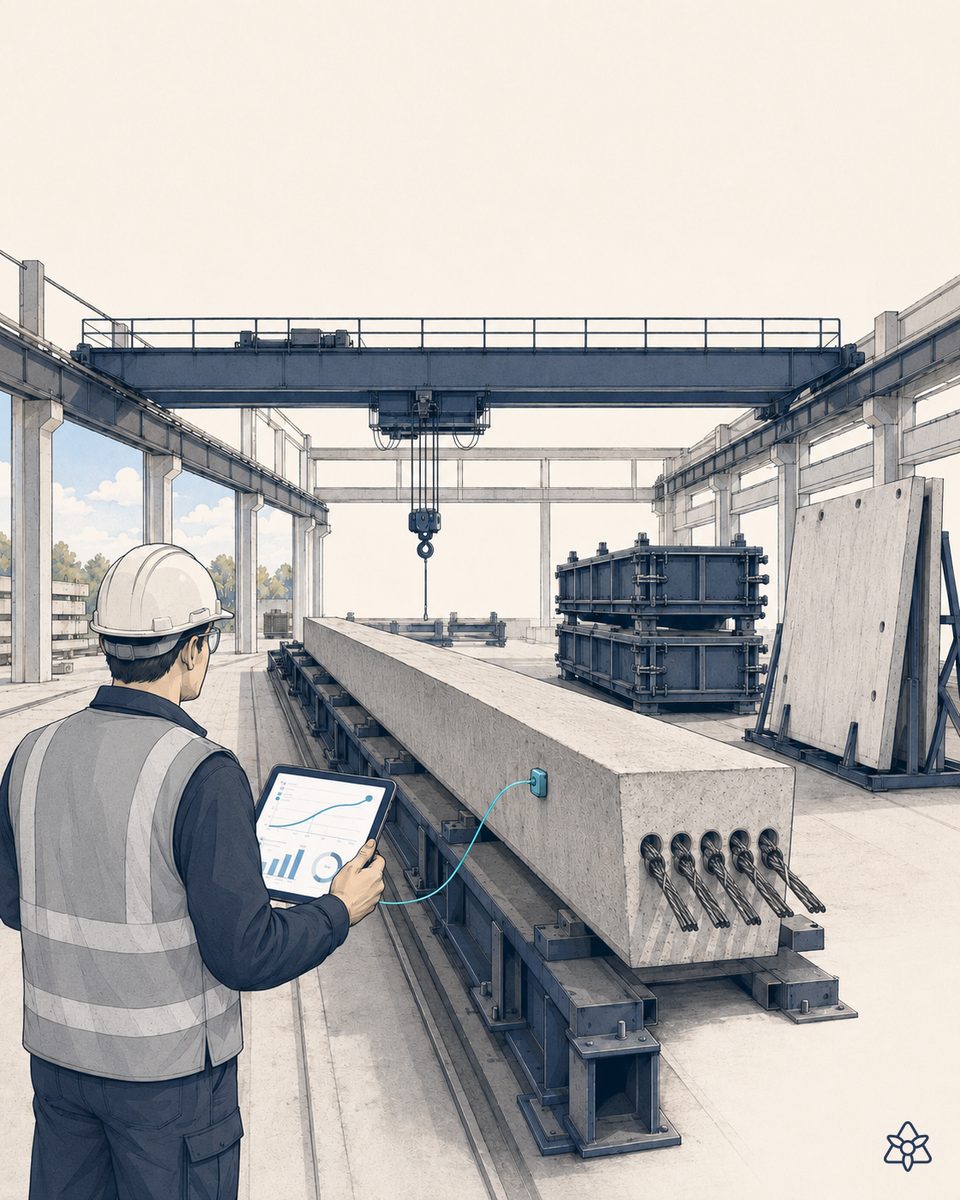
Three critical data points, three systems, one paper report at the end of the bed.
Prestressing traceability for a precast beam is not optional: it is the basis of the DoP the manufacturer signs under CPR 305/2011 and of the EHE-08 code that the site inspection can invoke at any moment. And yet, in the vast majority of plants it lives unstitched in three different places:
- The steel batch certificate — a supplier PDF, filed in the quality manager's folder.
- The tensioning bed report — paper signed by the bed lead with the applied load, the estimated losses and the date.
- The concrete and curing record — in the MES if there is one, in a lab spreadsheet if not.
When everything goes well, nobody asks for the dossier. When a crack appears in a beam installed two years ago, the site inspection asks for the evidence and a week-long search begins. And if the beam shared a tensioning run with five siblings on a long bed, you have to rebuild per beam what was recorded per tensioning run. The classic system works because good people fill in the reports and file them. The day the bed lead retires, half the plant leaves with him.
iLEAN does not add a fourth system — it stitches the three you already have so the evidence exists on its own.
The prestressing problem is not a lack of information: it is information living in islands that at the critical moment (the random audit, the claim three years later) never comes together in time. iLEAN acts as the putty that fills the gaps between the supplier's steel certificate, the tensioning bed report and the concrete record — without asking you to change the bed, the jack, or the ERP.
Connect reads the steel certificate, the jack report and the lab record wherever they live. The agent allocates the tensioning run per beam according to the production sheet. The person signs the DoP — Tracer does not sign, it prepares.
The three iLEAN pieces applied to prestressing traceability:
- Tracer (Connect + Agents) — captures through every channel you already use: the supplier's steel certificate PDF, a serial read from the hydraulic jack's console, the concrete lab record, the bed operator's report dictated by voice. It works with what is already there; it does not require changing the bed.
- Edge optional — if the bed has a critical point (anomalous load detection, strand identification passing through the reader), an Edge terminal records it in milliseconds, with or without a network, and fires the traffic light to the bed lead if the load drifts out of range.
- Agent — cross-references the tensioning run with the beam sheet (length, section, strand positions) and splits the master event among the bed siblings, associates the steel certificate with each specific strand, builds the per-beam dossier and prepares the DoP for the quality manager to sign. Tracer proposes, the person signs.
Paper reports and reconstruction vs. traceability stitched with iLEAN Tracer
| Aspect | Paper reports + PDFs in a folder | With iLEAN Tracer + optional Edge |
|---|---|---|
| Steel batch per strand | Matched by memory/date | Certificate read and linked to the physical strand |
| Jack load per tensioning run | Handwritten report signed by the bed lead | Serial read from the console, recorded in real time |
| Per-beam allocation on a long bed | Position rebuilt by hand | The agent allocates by beam sheet automatically |
| Concrete and curing | Lab spreadsheet | Integrated into the per-beam dossier |
| Signed DoP | Word template + manual work | Template generated by the agent, digital human signature |
| Time to answer an audit | Days to weeks | Minutes |
Impact estimate for your plant — to be validated with your numbers.
The block below is an estimate to be validated with the specific data of your plant. We put it forward so the committee has an order of magnitude; we refine it during the diagnostic.
- Plant with two prestressing beds, mixed production of floor beams, prestressed beams for small bridges and hollow-core slabs — multi-SKU on the same bed.
- Tracer pilot on one bed (integration with the jack console + OCR of the steel certificate + reading of the lab report + per-beam dossier). First value expected within a few weeks: a per-beam dossier issued automatically and signed by the manager.
- Indicative payback between 4 and 9 months, depending on the frequency of audits and site-inspection claims, and the hours per week currently spent hunting for reports and rebuilding certificates.
- The hard lever is a single claim resolved in hours instead of weeks (no beam held on site, no penalty), plus a reduction ≥ 30% in the quality manager's administrative time assembling dossiers.
And the quality manager's reasonable doubt
“What if the AI builds a dossier with a strand assigned to the wrong beam?” — hallucination is a problem of free generation, not of anchored tasks. In tasks where the AI merely reads a certificate PDF, a serial read from the jack and a production sheet, and joins them under an explicit rule, the best models brought error below 1.5% [1]. And even so, the DoP is never signed alone: the agent builds the dossier, the quality manager signs. The three safety rings exist precisely for this.
[1] OpenAI paper “Why Language Models Hallucinate”, 2025 — on the reliability of AI in anchored tasks.
What people ask about prestressing traceability in precast
Which prestressing data must be recorded per beam?
For each prestressing wire or strand: the steel batch with its heat certificate, the initial load applied by the hydraulic jack, the anchorage and friction losses, the load after transfer to the concrete, the curing chamber temperature and the transfer time. These data are the basis of the declaration of performance (DoP) under CPR 305/2011 and of EHE-08 in Spain, and the site inspection asks for them when a crack appears or when the project supervision team runs a random audit.
How is the steel batch linked to the specific beam that ships to site?
Today, in most plants, the steel batch certificate arrives from the supplier as a PDF, gets filed in the quality manager's folder and is matched to the beam via the tensioning date and the bed lead's memory. If the customer asks for the certificate six months later, someone rebuilds the trace from whatever they remember. iLEAN Tracer stitches it together at the line: Connect reads the certificate PDF when the reel is received, each strand carries its traceability as it passes the bed reader, the agent cross-references it with the beam's production sheet (length, section, strand positions) and keeps a live record. When the beam ships, it inherits the batch, the certificate and the tensioning data.
What if the customer or the site inspection asks for the prestressing dossier of a specific beam three years later?
It is the classic nightmare: a crack appears in a beam installed two or three years ago, the site inspection asks for the evidence, and the quality manager spends a week digging through drawings, paper tensioning reports and steel certificates. With iLEAN Tracer the answer takes minutes: the beam has a code tied to its complete file — steel batch, bed tensioning report, concrete used, recorded curing, dispatch date to site. The dossier goes out as a signed audit-ready pack, with the quality manager's human signature at the critical moment.
Does it work on long prestressing beds where several beams are cut from a single tensioning run?
Yes — and that is exactly where it delivers the most value. An 80 or 120 m bed where the strands are tensioned for four or six beams in a row is the typical case where per-beam traceability gets lost: one tensioning run, several pieces. iLEAN Tracer records the tensioning run as a master event and allocates the trace per beam according to the length and position declared in the production sheet. Every beam ships with its complete report, even though it shared the tensioning run with its bed siblings.
How much does the Tracer pilot cost in a precast beam plant?
The order of magnitude of a Tracer pilot on a precast beam prestressing bed is close to that of any iLEAN pilot in a plant: an initial investment for capture (strand reader, integration with the jack and the tensioning console, reading of the steel certificate PDF, integration with ERP/MES) and the quality team's training; plus an annual license. The reasonable payback to present to the committee is several months — the hard lever is a single site-inspection claim resolved in hours instead of weeks: it pays for the pilot. We ask for your plant's data and send you the estimated ROI in 48h.
More cases in other sectors
- Vision inspection of MAG welds on HEB profiles — the defect that slips through the shop costs ten times more on site.iLEAN Vision inspects the MAG weld bead on HEB profiles in industrial steel structures and flags defects…
- Module-by-module traceability for PPVC bathrooms — delivery and after-sales with a living file, not a reconstructed one.iLEAN Tracer gives every PPVC bathroom module a unique identity from the plant to its slot on site —…
- Steam curing chamber control — a ramp that drifts two degrees costs three megapascals.iLEAN Edge controls the steam-curing ramp in precast concrete chambers to prevent microcracking,…
- 3D dimensional control of TBM segments — the defect that is free in the plant stops the whole job at the face.iLEAN Edge 3D-scans precast TBM tunnel segments and compares them against the BIM model before they…
- Mix and water-cement ratio control at the batching plant — aggregate moisture should not decide your strength class.iLEAN Brain adjusts the mix and the water-cement ratio at a precast batching plant from aggregate…
- Defense radar with AI — a T/R module out of spec is not an incident, it is a delayed program.How iLEAN inspects T/R modules, calibration and ITAR/EAR traceability in defense radar manufacturing…
Tell us your case and in 48h we'll send you the estimated ROI of this AI project for your precast plant.
We work on your plant's real data, not ours. Diagnostic with no commitment.
Request estimated ROI in 48h See construction