Mix and water-cement ratio control at the batching plant — aggregate moisture should not decide your strength class.
At a precast batching plant the aggregate comes in with variable moisture and the standard mix knows nothing about it — the real w/c ratio moves batch after batch, and the cylinder test reveals it days later. iLEAN Brain reads aggregate moisture continuously, recalculates the mix and proposes the correction to the batching plant operator. The person signs — Brain proposes, it does not batch on its own where it is critical.
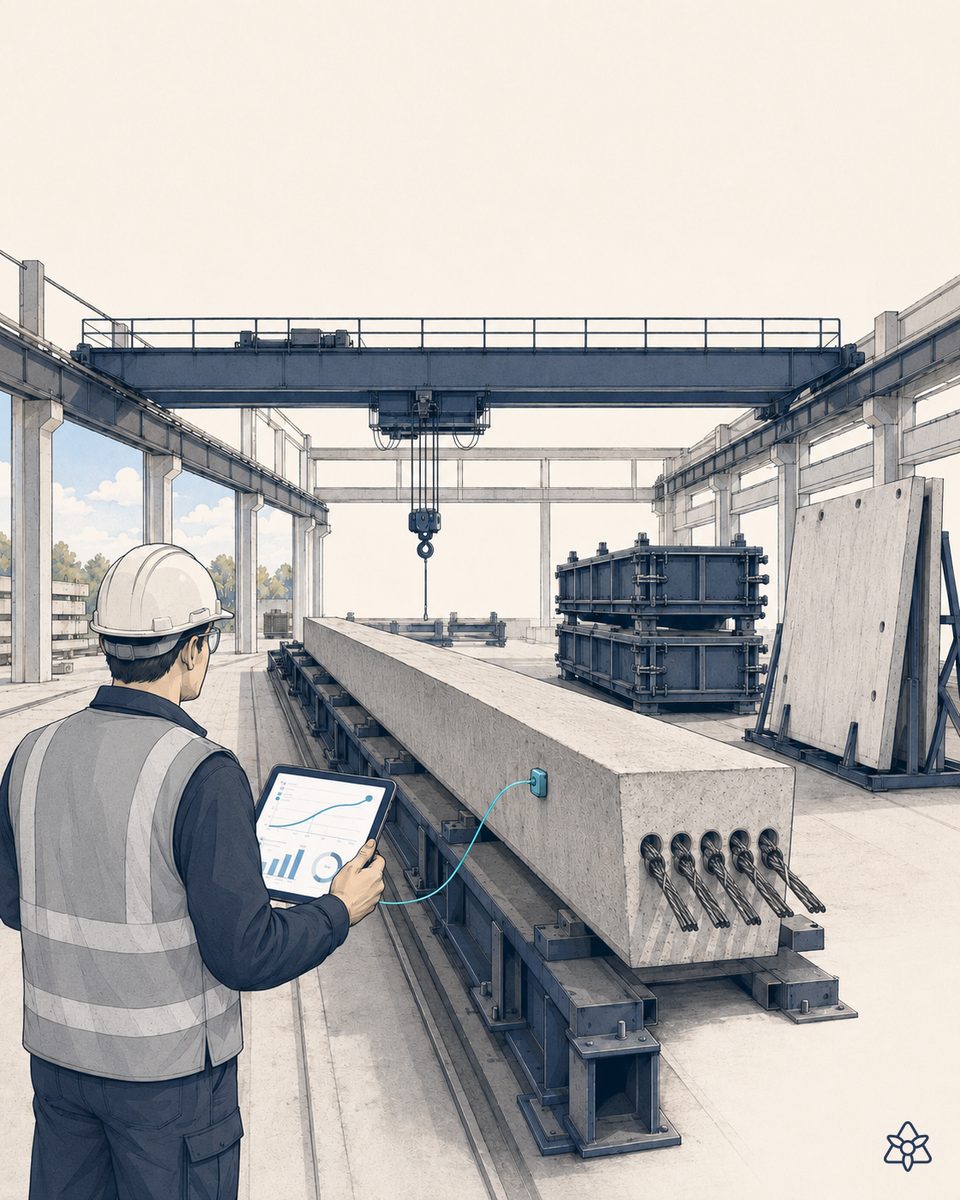
The batching plant operator knows the mix — but nature changes between one batch and the next.
The problem with mix control at a precast batching plant is not ignorance of concrete chemistry. The plant knows perfectly well what its target w/c is. The problem is what is not measured in time:
- Aggregate moisture changes with the rain, with the sun on an exposed silo, with the new load of sand that arrived this morning. If nobody corrects for it, the aggregate adds free water to the mix without the plant weighing it.
- The moisture probe, when there is one, lives disconnected from the controller or is calibrated only now and then, and the operator looks at it "if there is time".
- The batching plant controller doses the mix it has loaded — not the mix that would apply if it knew today's moisture.
- The lab tests cylinders days later, when the batch has already been picked and shipped. The defect, if there is one, arrives late.
The silent consequence: when in doubt, the batching plant operator doses defensively. More cement "just in case" — the very cost lever of a precast piece. And even then, the occasional batch comes out of spec because that day the sand arrived soaked and nobody saw it in time.
iLEAN does not replace the batching plant lead — it gives him eyes on aggregate moisture in real time.
The mix problem is not solved with yet another quality system: it is solved by connecting the data that is already in the plant. iLEAN acts as the putty that seals the cracks between the batching plant controller, the moisture sensors, the SCADA and the batch file, without asking you to change your plant or its brand.
Brain reads moisture and target mix, and proposes a correction batch after batch. Connect captures the weather and incoming aggregate. The file ends up signed by the person — Brain proposes, it does not batch on its own where it is critical.
The iLEAN pieces applied to w/c mix control at the batching plant:
- iLEAN Brain (the analytical brain) — continuously reads silo moisture, the actual weights of the last batch, the weather, silo climate control and the work order. It calculates the corrected mix batch by batch, proposes the correction to the operator and records it in the batch file. If the moisture sensor goes outside a reasonable range (dirty probe, impossible reading), it holds the batch and asks for a check. Brain proposes, the person signs — where it is critical, it does not dose on its own.
- iLEAN Connect — captures what lives outside the controller: a photo of the delivery note for the incoming aggregate (origin, moisture declared by the supplier), the batching plant operator's voice whenever something is out of the ordinary ("the sand in silo 2 came in with stones", "I changed the moisture probe"), the quality manager's report on the last probe calibration. And it captures what arrives from outside (a mix change from the R&D manager, a new exposure class on an order) at second zero.
- iLEAN Agents — cross-reference the real w/c recorded by Brain with the lab's cylinder test when it arrives, and learn the drift: if the cylinders from a given aggregate supplier come out systematically low, the agent flags it before the next purchase.
Standard mix + manual probe vs. Brain with correction batch by batch
| Aspect | Standard mix + manual correction | With iLEAN Brain + Connect + Agents |
|---|---|---|
| Aggregate moisture | Occasional probe reading or "by eye" | Continuous reading, correction per batch |
| Real w/c ratio | Approximated from the standard mix | Calculated and signed off per batch |
| Reaction to wet aggregate | After the cylinder test, days later | Before the water is loaded into the current batch |
| Hidden cost | Cement "just in case" + out-of-spec batch | The right mix + a batch in spec |
| FPC file for the batch | Rebuilt by hand for the auditor | Real w/c recorded batch after batch |
| Learning by aggregate supplier | The batching plant lead's memory | The agent cross-references with cylinder results |
Impact estimate for your plant — to be validated with your numbers.
The block below is an estimate to be validated with the specific data of your batching plant and your product mix. We put it forward so the committee has an order of magnitude; we refine it during the diagnostic.
- A concrete batching plant inside a precast factory with one or two mixers, several dozen batches per shift, and several strength and exposure classes.
- Brain pilot at the batching plant: moisture sensors in the silos if there are none, integration with the plant controller and a hook into the batch FPC file. First value expected within a few weeks: real w/c recorded batch after batch and the correction proposal to the operator up and running.
- A reduction of ≥ 30% in out-of-spec batches and a reduction in "just in case" cement within the first months, based on the documented history.
- Indicative payback between 4 and 9 months. The hard lever is twofold: out-of-spec batches avoided + cement saved by batching less defensively.
And the batching plant lead's reasonable doubt
"What if the probe gets dirty and the AI recalculates it wrong?" — hallucination is a problem of free generation, not of anchored tasks. Recalculating a mix from a moisture reading is an anchored task by definition: there are sensors, there is a target mix and there are rules. In tasks like these, the best models brought error below 1.5% [1]. And even so, Brain proposes and the batching plant operator signs; if the probe returns something impossible, the batch is held until it has been checked. The three safety rings are there precisely for this.
[1] OpenAI paper "Why Language Models Hallucinate", 2025 — on the reliability of AI in anchored tasks.
What people ask about intelligent w/c mix control at the batching plant
Why does the water-cement ratio rule the quality of precast concrete?
The water-cement ratio (w/c) is the lever that controls the strength, the durability and the workability of concrete. For a given strength class, a high w/c lowers the strength and raises porosity (worse durability, worse behavior against freeze-thaw and carbonation); a low w/c pushes the strength up but hurts workability and can cause compaction problems. In precast, where a high strength class and long durability are required, keeping the w/c in spec batch after batch is not a nice-to-have: it is what supports the Declaration of Performance you sign under CPR 305/2011.
Why does aggregate moisture ruin the mix if it is not controlled?
Because moisture in the aggregate is free water that enters the mix without the plant weighing it. Sand that has spent the night out in the rain can carry a very high moisture percentage; aggregate that has just been sprayed in the silo is drier. If the plant batches the "standard mix" with no correction, that water raises the w/c without anyone seeing it: the operator signs off a batch of strength class 45 and delivers a batch whose real strength is out of spec. The defect only shows up days later, when the cylinder is tested — and by then the batch has already been picked and shipped.
How does iLEAN Brain adjust the mix in real time?
Brain continuously reads what the batching plant already has or can have: moisture sensors in the sand and fine-aggregate silos, water pressure and temperature, weather (ambient humidity, temperature), the history of the previous batch, and the work order for the piece (strength class, exposure class, target w/c from the DoP). For every batch it recalculates the mix, correcting the added water for the real moisture of the aggregate, proposes the correction to the batching plant operator and records it in the batch file. The person signs — Brain proposes, it does not batch on its own where it is critical. And if the moisture sensor returns a value outside a reasonable range, it holds the batch for review.
Do we have to change the concrete batching plant to deploy Brain?
No. The capture design is graduated and adapts to each plant: (1) manual — the operator enters the moisture measured with a probe; (2) intermediate — a connection to the existing batching plant controller to read actual weights, dosed water and silo moisture; (3) integrated — direct integration with the batching plant brand (Sumab, Liebherr, ELBA, Skako…) and continuous moisture sensors. The metaphor from the book is clear: we are the putty that fills the cracks between your batching plant, your SCADA, your lab and your ERP — we do not demolish what works.
How much does it cost to deploy intelligent w/c mix control at a precast batching plant?
A typical pilot starts with one batching plant and one product family (segments or panels, for example), with integration into the plant controller, silo moisture sensors if there are none, and a hook into the FPC file. A reasonable payback is in the range of several months and the hard lever is the reduction in out-of-spec batches that avoids rework and recalls — plus the cement saved by batching less defensively. We ask for your batching plant's data (cement consumption, number of batches per shift, last out-of-spec batch incident) and send you the estimated ROI in 48h.
More cases in other sectors
- Steam curing chamber control — a ramp that drifts two degrees costs three megapascals.iLEAN Edge controls the steam-curing ramp in precast concrete chambers to prevent microcracking,…
- Prestressing traceability for precast beams — a tensioning report should not take a week to surface.iLEAN Tracer records precast beam prestressing strand by strand for audits and the declaration of…
- 3D dimensional control of TBM segments — the defect that is free in the plant stops the whole job at the face.iLEAN Edge 3D-scans precast TBM tunnel segments and compares them against the BIM model before they…
- Defense radar with AI — a T/R module out of spec is not an incident, it is a delayed program.How iLEAN inspects T/R modules, calibration and ITAR/EAR traceability in defense radar manufacturing…
- Drone manufacturing with AI — the prototype flew; unit 300 of the series is another story.From prototype to series production without losing control: Edge vision on electronics and assembly,…
- EASA / FAA Part 21 with AI — the evidence, alive. The pre-audit sprint, gone.iLEAN traces production under Part 21 + POA with a live TC/STC link. Certification evidence always ready.
Tell us your case and in 48h we'll send you the estimated ROI of this AI project for your precast batching plant.
We work on your batching plant's real data, not ours. Diagnostic with no commitment.
Request estimated ROI in 48h See construction