3D dimensional control of TBM segments — the defect that is free in the plant stops the whole job at the face.
An out-of-tolerance tunnel segment that reaches the face blocks the shield, and the project is then measured in days lost. iLEAN Edge 3D-scans every segment in the plant, compares it against the BIM model in seconds and holds the piece if it does not match. The person signs — the truck does not leave on its own.
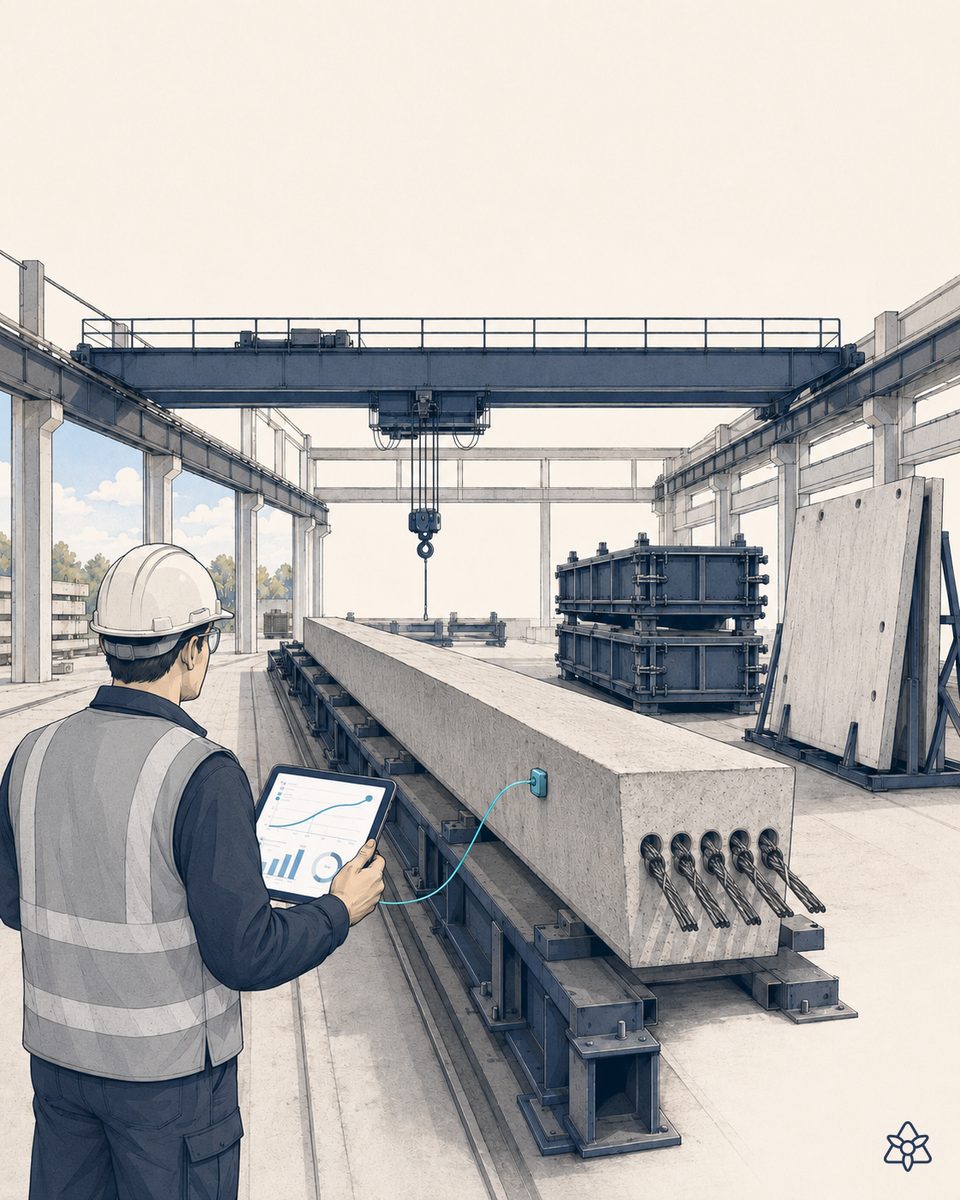
Dimensional control of segments is done well — on the day it is done.
Classic dimensional control in a precast plant is not bad practice: it is not enough for a TBM. The reasons you see on the shop floor:
- Sampling, not a full census. One piece in every N is measured with gauges, templates and, if you are lucky, a measuring arm. A manufacturing error gives no warning: it shows up in the segment that was not measured.
- 3D geometry against 2D templates. A segment is not a flat piece: it is a curved sector with machined joints, jack contact areas and gasket grooves. A template cannot capture angular deviation in the joint plane.
- The BIM model lives in another world. BIM belongs to the design team and to site control; in the precast plant it stays a design reference, not a piece-by-piece control contract.
- Feedback arrives late. A systematic defect in the mold is discovered when the face reports ring problems, two weeks later — with doubtful segments already in stock and on the road.
When a single badly measured segment blocks the shield, the cost is not the segment — it is the advance rate of the tunnel boring machine. That asymmetry is what rules.
iLEAN does not replace the control lab — it gives it eyes on every single segment.
The problem with dimensional control of segments is not a lack of procedure: it is that the BIM model, the real geometry of each piece and the mold history live in different systems that do not talk to each other. iLEAN acts as the putty that seals those cracks, without you having to change ERP, BIM software or the demolding line.
Edge scans every segment in 3D. Connect brings the BIM model down to the terminal. The agent compares, flags deviations and holds the piece when it should. The person signs — never the other way round.
The three iLEAN pieces applied to dimensional control of TBM segments:
- Edge — a terminal with 3D sensors (structured light or laser) in the demolding and curing area. It captures the complete point cloud of every segment, aligns it with the BIM/IFC model loaded on the device and draws the deviation map by zone. If a deviation exceeds the threshold, it fires the traffic light, marks the piece for hold and alerts the quality manager. It works with no network: as long as Edge has power, it keeps scanning and holding.
- Connect — captures the BIM model whether it comes from the design office, from the concession holder's software or from the PDF of the specification when there is nothing else. And it also captures what arrives from outside (a design revision from the engineer of record, a change in the ring specification from the contractor) at second zero, without anyone having to forward anything to the plant manager.
- Agent — cross-references the piece's point cloud, the BIM model, the mold history (which segments came out with a deviation in the same zone), the concrete conditions (mix designs, curing) and the product's ITT (Initial Type Testing) record. If it detects a systematic mold drift, it does not wait for the next incident: it flags the mold for inspection before the next segment comes out wrong.
Classic dimensional control vs. 3D scanning against BIM with iLEAN
| Aspect | Classic dimensional control | With iLEAN Edge + Connect + Agent |
|---|---|---|
| Coverage of the control | Sampling (1 in every N) | Full census: every segment scanned at demolding |
| Geometry measured | 2D templates, gauges, manual arm | Complete 3D point cloud against BIM/IFC |
| Defect detection | Whenever that piece happens to be measured | Straight out of the mold, before stock and truck |
| Mold drift | Seen after several bad pieces | The agent catches it on the first deviations |
| Operation with no network | n/a | Edge scans and holds on the panel's power alone |
| File for the concession holder / engineer of record | Rebuilt by hand, days of work | Automatic dossier per segment, with a 3D map |
Impact estimate for your plant — to be validated with your numbers.
The block below is an estimate to be validated with the specific data of your plant and your project. We put it forward so the committee has an order of magnitude; we refine it during the diagnostic.
- A precast plant with 1-2 segment mold batteries and a TBM tunnel a few kilometers long, at a moderate daily ring rate.
- Edge pilot with one 3D scanner in the demolding area, the BIM model loaded on the terminal and integration with the batch ERP/MES. First value expected within a few weeks: full-census coverage and the deviation map working on every segment that passes through.
- A reduction of ≥ 30% in defective segments reaching the face within the first months, based on the documented history of dimensional incidents.
- Indicative payback between 4 and 9 months. The hard lever is a single TBM stoppage from a defective ring that is avoided: the shield's hourly cost does not forgive.
And the quality manager's reasonable doubt
"What if the AI gets it wrong and lets a bad segment through?" — hallucination is a problem of free generation, not of anchored tasks. Comparing a point cloud with a BIM model is an anchored task by definition: there is a source and a reference geometry. In tasks like these, the best models brought error below 1.5% [1]. And even so, what is critical is never decided alone: iLEAN holds the segment and the person signs. The three safety rings are there precisely for this.
[1] OpenAI paper "Why Language Models Hallucinate", 2025 — on the reliability of AI in anchored tasks.
What people ask about 3D dimensional control of TBM segments
Why is a badly measured segment a critical problem in a TBM drive?
The segment ring is the tunnel wall and the thrust base for the tunnel boring machine. A single out-of-tolerance segment breaks the ring geometry, causes leaks, throws the shield's thrust jacks out of calibration and, in the worst case, forces the TBM to stop at the face — a stoppage measured in days and in figures that hurt, because a shield that does not advance earns nothing. The defect that costs you one scrapped piece in the plant costs you a stopped project at the face.
What tolerances does a precast concrete TBM segment have to meet?
Typical dimensional tolerances on tunnel segments are very tight (in the order of tenths of a millimeter for joint flatness and a few millimeters for overall geometry) and are set by the project specification, the ITA/AITES tunneling guidelines and local standards (EN 13369 as the common rules for precast concrete, plus the concession holder's product specification). The control is not optional: the Declaration of Performance (DoP) under CPR 305/2011 requires it to be backed by real data, not by the quality manager's signature.
How does 3D scanning against the BIM model work in the plant?
iLEAN Edge captures the point cloud of every segment as it comes out of the mold using 3D sensors (structured-light or laser scanner, depending on the geometry), cleans it and aligns it with the piece's BIM/IFC model. The agent calculates deviations by zone (joints, intrados, extrados, jack contact area) and draws the heat map on the piece. If a deviation exceeds the threshold, the segment is held in the stockyard and the quality manager gets the notification with the map. The person decides whether it is reworked, accepted under concession or scrapped — the truck does not leave on its own.
Does iLEAN Edge work with no network in the precast plant?
Yes. Edge is a local terminal: the neural network and the BIM model are loaded on the device itself. As long as it has power, it scans, compares and holds pieces even if the plant loses WiFi or internet. Synchronization with the ERP/MES and the evidence dossier happens when the network comes back. In a precast plant set up next to the job site this is not a luxury: it is the difference between carrying on producing and stopping.
How long does an Edge pilot for dimensional control of segments take to pay for itself?
A reasonable payback to put in front of the committee is in the range of several months, and the hard lever is a single TBM stoppage avoided: the cost of a stoppage at the face caused by a badly measured segment is far higher than a complete Edge pilot in the plant. We ask for your project's data (tunnel length, rings per day, estimated hourly cost of the shield, history of dimensional incidents) and send you the estimated ROI in 48h, with your numbers.
More cases in other sectors
- Module-by-module traceability for PPVC bathrooms — delivery and after-sales with a living file, not a reconstructed one.iLEAN Tracer gives every PPVC bathroom module a unique identity from the plant to its slot on site —…
- Steam curing chamber control — a ramp that drifts two degrees costs three megapascals.iLEAN Edge controls the steam-curing ramp in precast concrete chambers to prevent microcracking,…
- Prestressing traceability for precast beams — a tensioning report should not take a week to surface.iLEAN Tracer records precast beam prestressing strand by strand for audits and the declaration of…
- Mix and water-cement ratio control at the batching plant — aggregate moisture should not decide your strength class.iLEAN Brain adjusts the mix and the water-cement ratio at a precast batching plant from aggregate…
- Defense radar with AI — a T/R module out of spec is not an incident, it is a delayed program.How iLEAN inspects T/R modules, calibration and ITAR/EAR traceability in defense radar manufacturing…
- Drone manufacturing with AI — the prototype flew; unit 300 of the series is another story.From prototype to series production without losing control: Edge vision on electronics and assembly,…
Tell us your case and in 48h we'll send you the estimated ROI of this AI project for your segment plant.
We work on the real data of your plant and your project, not ours. Diagnostic with no commitment.
Request estimated ROI in 48h See construction