Module-by-module traceability for PPVC bathrooms — delivery and after-sales with a living file, not a reconstructed one.
A PPVC bathroom is a closed unit that will spend a decade inside an apartment wall. When a problem shows up, the question will not be “who built it?” — it will be “which module, with which batches and which sign-offs?”. iLEAN Tracer gives every module a unique identity from the first station on the plant floor to its slot on site, and keeps the file alive for after-sales. The person signs — the module does not leave on its own.
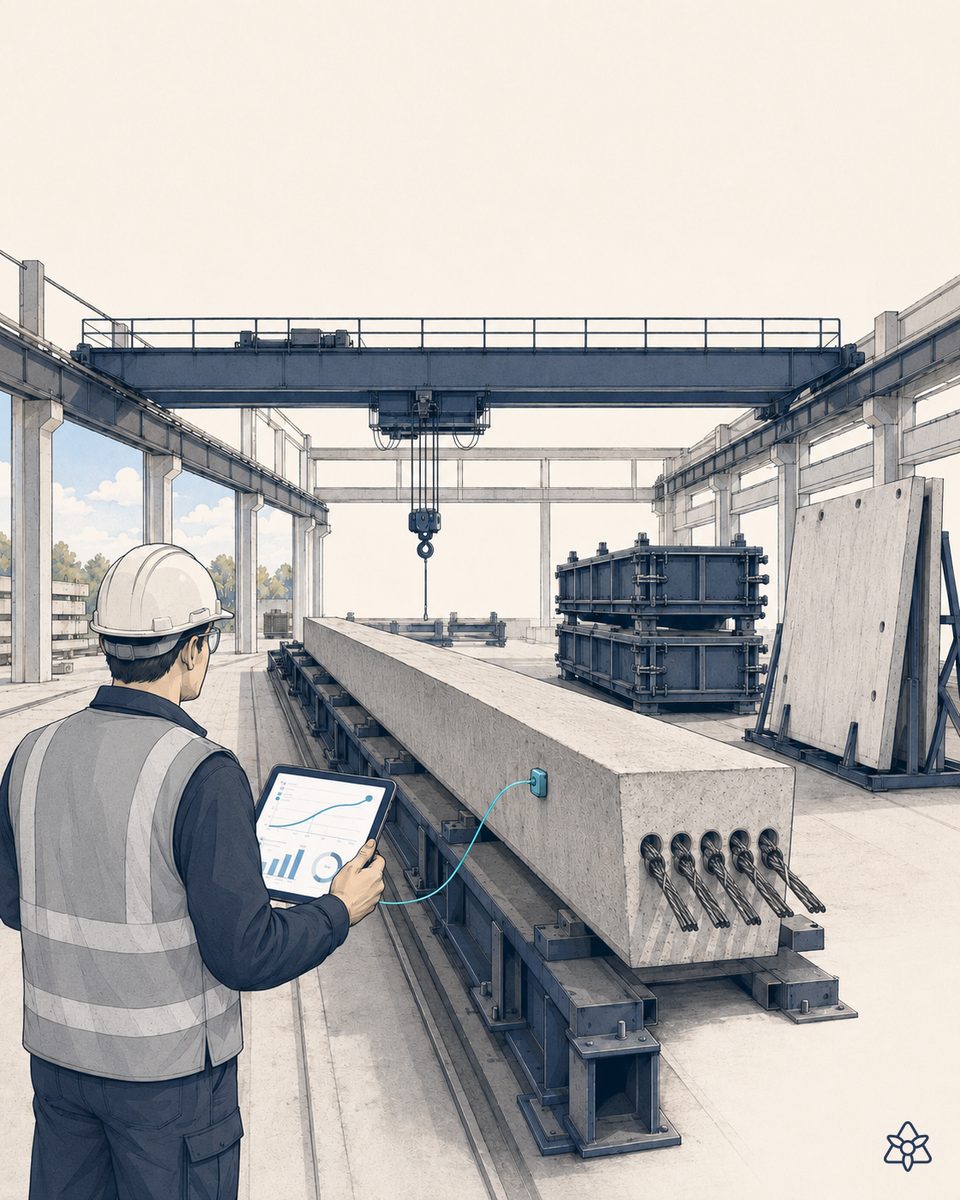
A PPVC bathroom delivered without a living file is after-sales flying blind.
The traceability problem in PPVC does not show up on delivery day — it shows up when the first incident lands. And by then the data you need lives in places that never talk to each other:
- The material batches (tiles, taps, waterproofing, sanitaryware) sit in the ERP — but at purchase-order level, not per individual module.
- The quality sign-offs in the plant (hydraulic pressure, watertightness, alignment) live on paper job sheets or in the vertical PPVC MES.
- The module is installed in one specific slot on site — but the module↔slot assignment is made by the installation lead in Monday's spreadsheet.
- After-sales is run by a different team, sometimes a different company, which picks up the claim six months later with access to none of the above.
When the customer calls, the honest answer is “we'll look into it” — and what follows is a technician sent out to site for a week, a manual reconstruction of the file and a cost that was going to be there whatever you do, simply because nobody wrote down “this module is that bathroom” in a way another person could understand six months later.
iLEAN does not add traceability — it turns it into a living file for the module.
Traceability in PPVC is not won by adding yet another system: it is won by joining the ones you already have. iLEAN acts as the putty that fills the gaps between the ERP, the MES, the plant job sheet and the installation lead's spreadsheet, and binds them all to the module's file. We do not demolish what works.
Tracer gives the module a unique identity. Connect captures every sign-off through the operator's own channel. The Agents cross-reference batches, sign-offs and the slot on site. The person signs — the module does not leave on its own, and the file is never closed: it lives.
The iLEAN pieces applied to module-by-module traceability of PPVC bathrooms:
- iLEAN Tracer — the agent that keeps every module's file alive from the first station on the line (ID assigned) through installation in its slot on site and on into after-sales. It cross-references the work order, material batches (tiles, sanitaryware, taps, waterproofing), plant tests (pressure, watertightness), operator and quality sign-offs, and the link to the slot on site. There is no moment when the file is “closed”: it is always complete and always alive.
- iLEAN Connect — captures every step through the channel the operator already uses: voice into the earpiece at the test station (“pressure OK, 6 bar, no drop”), a photo of the finished module, a QR scan as it is loaded onto the truck, a photo of the delivery note on arrival at site. And it captures what comes in from outside (a supplier email announcing a tile batch change, a WhatsApp from the installation lead reassigning a slot) at second zero.
- iLEAN Agents — cross-reference the module's file with the building model. When an after-sales claim comes in, the agent has already built the chain: “module M-1284, tile batch L-5511, waterproofing batch L-771, pressure signed off by J.L., installed by the site crew on day X in apartment 4-B”. After-sales decides on the spot, not in a week.
Purchase-order traceability vs. a living file per module
| Aspect | Classic traceability | With iLEAN Tracer + Connect + Agents |
|---|---|---|
| Module identity | Work order + serial | Unique physical ID (QR/RFID) and logical ID, from station 1 |
| Material batches | At purchase-order level | Per module: tiles, sanitaryware, waterproofing |
| Quality sign-offs in the plant | Paper job sheet / MES | Voice, photo and signature in the module's file |
| Module ↔ slot link | The installation lead's spreadsheet | Scanned on site, tied to the building drawing |
| After-sales | Technician sent to site + manual reconstruction | The module's file on screen in 30s |
| End-customer audit | Evidence pack assembled by hand | Per-module dossier, automatic |
Impact estimate for your plant — to be validated with your numbers.
The block below is an estimate to be validated with the specific data of your plant and your receiving sites. We put it forward so the committee has an order of magnitude; we refine it during the diagnostic.
- PPVC plant with one bathroom line, several hundred modules a year, several receiving sites running at once and a contractual after-sales obligation spanning several years.
- Tracer + Connect pilot on the bathroom line: unique module ID, graduated capture (QR + voice + photo) and a batch-level hook into the ERP. First value expected within a few weeks: the first after-sales claim handled with the living file on screen.
- After-sales response time cut by ≥ 30% in the first months, based on the documented incident history.
- Indicative payback between 4 and 9 months. The hard lever is a single after-sales claim that does not require sending a crew out to site to investigate: one trip to site pays for the pilot.
And the quality manager's reasonable doubt
“What if the AI mixes up one module with another or assigns the wrong batch?” — hallucination is a problem of free generation, not of anchored tasks. Linking a physical ID (QR/RFID) to a batch in the ERP is by definition an anchored task: there is a specific source and a key. In tasks of this kind, the best models brought error below 1.5% [1]. And even so, the one who signs the file is the person: Tracer prepares, the person signs. The three safety rings exist precisely for this.
[1] OpenAI paper “Why Language Models Hallucinate”, 2025 — on the reliability of AI in anchored tasks.
What people ask about module-by-module traceability in PPVC
What is PPVC and why does it demand module-by-module traceability?
PPVC (Prefabricated Prefinished Volumetric Construction) means the module is built complete — structure, services, finishes, sanitaryware — in the plant and arrives on site ready to be dropped into its slot. Every module is a closed unit, with its own tile batch, its own taps, its own plumbing, its own waterproofing and its own quality sign-off. If a module gives trouble six months later (a leak, a tile defect, sanitaryware out of spec), the question is not “who built this bathroom?” — it is “which module, in which plant, with which materials, installed in which slot?”. Without a unique identity per module, after-sales is a manual reconstruction.
How does iLEAN Tracer give each module a unique identity in the plant?
At the first station on the line, the module gets a unique identifier — physical (a plate, a QR code or an RFID tag in a concealed area) and logical, inside the file. From then on, everything that happens in the plant hangs off that ID: tile batch, cement batch for the screed, the fitter who signed off the plumbing, the pressure test, the watertightness test, the photo of the finished module. Connect captures every step through whatever channel the operator already uses (voice, app, scan), Tracer keeps the file alive, and by the time the module leaves the plant the file is already complete. There is no “closing” of the file: it stays alive for after-sales.
How is a module linked to its slot on site?
On site, the installation lead scans the module ID at the moment it is set in place and assigns it to its slot on the drawing (floor/building/apartment). Tracer cross-references the plant ID with the position on site, and the file lives on forever as “module X = the bathroom in apartment Y”. If a year later the customer reports a leak in that bathroom, after-sales opens the file, sees which waterproofing batch went in, which test was signed and by which operator, and knows within thirty seconds whether it is a defect, an installation issue or something else.
Do I need to replace my plant ERP to implement PPVC traceability?
No. iLEAN sits on top of what you already have. The metaphor from the book is clear: we are the putty that fills the gaps between the ERP, the MES, the SCADA and the spreadsheets — we do not demolish what works. Tracer integrates with your ERP by batch, with your MES by work order, and uses Connect to capture what never makes it into a system (the photo of the finished module, the voice note from the fitter on site). We start with the module and the slot; the rest connects at its own pace.
How much does module-by-module traceability cost in a PPVC plant?
The typical pilot starts with one bathroom line and one receiving site, with graduated capture (QR + voice + photo) and a batch-level hook into the ERP. A reasonable payback is in the range of several months, and the hard lever is a single after-sales claim resolved in hours instead of weeks: the cost of sending a maintenance crew out to site to investigate is far higher than the cost of a complete Tracer pilot. We ask for your plant's data (modules/year, number of receiving sites, last after-sales incident) and send you the estimated ROI in 48h.
More cases in other sectors
- EN 13369 + CPR 305/2011 compliance in a precast plant — the dossier for the auditor should not have to be rebuilt.iLEAN Agents prepare the EN 13369 + CPR 305/2011 compliance dossier (FPC, ITT, DoP) for the auditor in a…
- Blowhole inspection on GRC panels — a blowhole caught in the plant costs 100 times less than one caught on site.iLEAN Vision detects blowholes and surface defects on precast GRC panels before they are packed and…
- Vision inspection of MAG welds on HEB profiles — the defect that slips through the shop costs ten times more on site.iLEAN Vision inspects the MAG weld bead on HEB profiles in industrial steel structures and flags defects…
- Steam curing chamber control — a ramp that drifts two degrees costs three megapascals.iLEAN Edge controls the steam-curing ramp in precast concrete chambers to prevent microcracking,…
- Prestressing traceability for precast beams — a tensioning report should not take a week to surface.iLEAN Tracer records precast beam prestressing strand by strand for audits and the declaration of…
- 3D dimensional control of TBM segments — the defect that is free in the plant stops the whole job at the face.iLEAN Edge 3D-scans precast TBM tunnel segments and compares them against the BIM model before they…
Tell us your case and in 48h we'll send you the estimated ROI of this AI project for your PPVC plant.
We work on the real data from your plant and your sites, not ours. Diagnostic with no commitment.
Request estimated ROI in 48h See construction