EN 13369 + CPR 305/2011 compliance in a precast plant — the dossier for the auditor should not have to be rebuilt.
FPC, ITT and DoP are the backbone of CE marking for a precast product. Rebuilding the pack in the week before the audit is exactly where non-conformities appear. iLEAN Agents keep the dossier alive batch by batch — the quality manager reviews it and signs it, they do not build it. The person signs — iLEAN does not sign DoPs on your behalf.
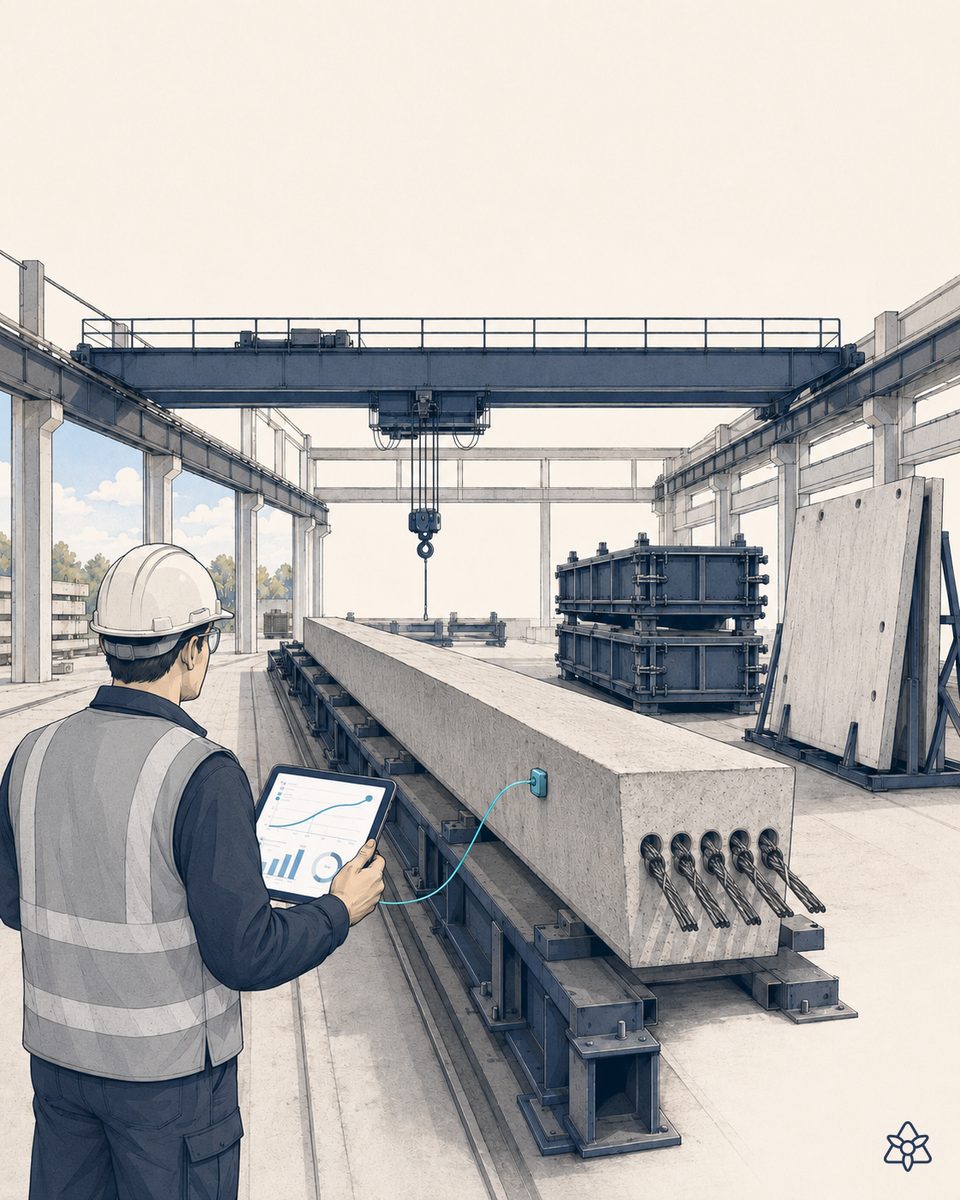
Compliance gets documented properly — on the day you have to show it.
The problem with EN 13369 + CPR 305/2011 compliance in a precast plant is not that nobody knows the standard. The plant knows perfectly well what the notified body requires. The problem is where the data lives the rest of the year:
- Factory Production Control (FPC) is integrated in theory — in practice it is concrete pour logs on paper, intermediate checks signed by the shift lead and SCADA curves nobody exports until the auditor turns up.
- The ITTs (Initial Type Tests) were run by the external lab two years ago; the PDF is in an email, the original in a folder, and nobody is quite sure which version is the current one.
- Raw material traceability (cement, steel, aggregates) lives in purchasing: the steel mill cert arrived by email, the technician accepted it and it was filed.
- The DoP is issued per product, but when there are variants (families, dimensions, exposure class) the sheets usually sit in a folder with no link to the batch produced.
When the auditor asks for the sub-file of a given batch, the quality manager knows it exists, knows roughly where, but has to hunt it down. If they find it in time, a non-conformity is avoided. If not, it is a notified body non-conformity — and that suspends CE marking.
iLEAN does not write the standard — it keeps alive the file that proves you meet it.
Compliance is not won by adding yet another system: it is won by joining up the ones you already have. iLEAN acts as the putty that seals the cracks between the ERP, the MES, the SCADA, the external lab and the quality manager's folder, without asking you to change anything. The notified body is still the one that audits; the lab is still the one that tests; the DoP is still signed by a person.
Agents assemble the dossier continuously, batch by batch. Connect captures what lives outside the systems. Edge sees what happens on the line. The quality manager reviews and signs — the file is not closed out: it lives.
The iLEAN pieces applied to EN 13369 + CPR 305/2011 compliance:
- iLEAN Agents (the compliance brain) — the swarm reads 24/7 what the ERP, the MES and the SCADA already hold, and assembles the batch's sub-file: weigh sheet, concrete pour log, curing curve from the SCADA, intermediate check log, specimen test, steel mill cert, quality manager's signature. If a piece is missing, it holds the batch before marking it conforming. The Agents work inside the three rings: the DoP is signed by a person, always.
- iLEAN Connect — captures what does not come in through a system: the PDF of the lab's ITT test that arrived by email, the supplier's steel mill cert (a photo of the document, OCR), a photo of the furnace thermograph during the ITT test, the quality manager's voice signing off an intermediate check. And it captures what comes from outside (a revision of the harmonized standard, a communication from the notified body) at second zero.
- iLEAN Edge (optional) — in the specimen area or at final dimensional control, it records the plant's reality: photo and dimensions of the specimen before it goes to the lab, geometry of the part at demolding. Data that enters the file without anyone typing it in.
Reactive compliance vs. a live dossier with iLEAN Agents
| Aspect | Reactive compliance | With iLEAN Agents + Connect |
|---|---|---|
| FPC (Factory Production Control) | Paper logs + SCADA, never cross-referenced | Live file per batch, cross-referenced automatically |
| ITT (Initial Type Tests) | PDF in an email/folder | Integrated into the product, current version traced |
| Steel mill cert / cement certificates | A photo in purchasing | OCR + link to the batch produced |
| SCADA curing curve | Exported for the auditor | Hooked to the batch in real time |
| Audit preparation | Weeks of rebuilding | The dossier is already assembled — it is only reviewed |
| Signing the DoP | Quality manager | Quality manager (iLEAN does not sign) |
Impact estimate for your plant — to be validated with your numbers.
The block below is an estimate to be validated with the specific data of your plant and your notified body. We put it forward so the committee has an order of magnitude; we refine it during the diagnostic.
- Precast plant with several product families (joists, panels, tanks, tunnel segments), typically assessment system 2+, several audits a year.
- Agents + Connect pilot on one product family: integration into the ERP/MES/SCADA + Connect capture of the ITT and the mill cert. First value expected within a few weeks: a batch's live sub-file on screen, with nobody typing.
- Audit preparation time down ≥ 30% in the first few months, based on the documented history of previous cycles.
- Indicative payback between 4 and 9 months. The hard lever is a single notified body NC that gets avoided: the cost of suspended CE marking plus rework is far higher than the cost of the pilot.
And the quality manager's reasonable doubt
"What if the AI assembles the dossier badly and the auditor finds an inconsistency?" — hallucination is a problem of free generation, not of anchored tasks. Assembling a compliance dossier is by definition an anchored task: there are specific sources (SCADA, ERP, lab) and specific rules (EN 13369, CPR 305/2011). In this kind of task, the best models brought error below 1.5% [1]. And even so, the quality manager signs the dossier before showing it and signs the DoP before issuing it. The three safety rings are there precisely for this.
[1] OpenAI paper "Why Language Models Hallucinate", 2025 — on the reliability of AI in anchored tasks.
What people ask about EN 13369 + CPR 305/2011 compliance
What do EN 13369 + CPR 305/2011 require from a precast plant?
EN 13369 sets the common rules for precast concrete: it defines Factory Production Control (FPC), Initial Type Testing (ITT) and the sampling plan. EU Regulation 305/2011 (CPR) requires every product placed on the European market to carry CE marking and a Declaration of Performance (DoP) issued by the manufacturer under the applicable assessment system (1, 1+, 2+, 3, 4). In practice, this means the plant has to keep the FPC + ITT + DoP file alive per product and per batch, and show it to the notified body when it audits.
Why is the compliance dossier always rebuilt in the days before the audit?
Because the data lives on islands and nobody has stitched it together. The concrete specimen was crushed in the lab and the report ended up in a folder. The part's curing curve is in the SCADA of the curing chamber. The steel traceability is kept by the buyer in another folder. The quality signatures are in the MES. When the auditor is a week away, somebody starts hunting for PDFs and assembling the pack by hand — and the dossier handed over is not the plant's live file, it is an approximate reconstruction of it. It works 99% of the time. The other 1% is a non-conformity.
How do iLEAN Agents prepare the compliance dossier?
The Agents live in Central and, 24/7, read what Connect captures and what the ERP/MES/SCADA already hold. For every product batch (joist, tunnel segment, panel, tank), they keep the corresponding sub-file alive: batching plant weigh sheets, concrete pour log, curing chart, specimen test results, steel mill cert, quality manager's signature. When the audit approaches, the dossier is already assembled: the manager reviews it and signs it, they do not build it. If a piece is missing (a specimen not crushed, an intermediate check not signed), the agent holds the batch before it can be marked conforming.
How do the Agents coexist with my notified body and my external lab?
Well — because they do not compete with them, they feed them. The notified body audits the FPC; the external lab issues the ITT tests; the quality manager signs the DoP. iLEAN lets each of them do their job and takes care of the boring, expensive work: having every piece of evidence in its place, alive, linked to the right batch, ready to show. The Agents work inside the three safety rings: the critical decisions (signing the DoP, CE marking) are made by a person. iLEAN does not sign DoPs on your behalf.
What does it cost to deploy compliance AI in a precast plant?
The typical pilot starts with one product family (joists or tunnel segments, for example) and its associated FPC + ITT + DoP dossier, with integration into the ERP/MES and Connect capture of whatever lives outside the systems (lab specimens, steel mill cert). A reasonable payback is in the order of several months and the hard lever is a single non-conformity avoided at audit: the cost of a notified body NC on product CE marking, counting the suspension of marking and the rework, is far higher than a complete Agents pilot. We ask for your plant's data (product families, applicable CPR assessment system, last audit cycle) and send you the estimated ROI in 48h.
More cases in other sectors
- Precast concrete — CE marking stands on plant records.Documented iLEAN cases in precast concrete: steam curing, EN 13369 CE marking, prestressing and 3D…
- CE marking of EN 1916 reinforced concrete pipes — the dossier should not take two days to add up.iLEAN Writer automates CE marking and the Declaration of Performance (DoP) for reinforced concrete pipes…
- Climbing formwork management — a module lost between site and plant is a day of concrete pouring that doesn't happen.iLEAN Connect tracks location, use cycles and maintenance of your climbing formwork fleet between site…
- Blowhole inspection on GRC panels — a blowhole caught in the plant costs 100 times less than one caught on site.iLEAN Vision detects blowholes and surface defects on precast GRC panels before they are packed and…
- Vision inspection of MAG welds on HEB profiles — the defect that slips through the shop costs ten times more on site.iLEAN Vision inspects the MAG weld bead on HEB profiles in industrial steel structures and flags defects…
- Module-by-module traceability for PPVC bathrooms — delivery and after-sales with a living file, not a reconstructed one.iLEAN Tracer gives every PPVC bathroom module a unique identity from the plant to its slot on site —…
Tell us your case and in 48h we'll send you the estimated ROI of this AI project for your plant's compliance.
We work on your plant's real data, not ours. Diagnostic with no commitment.
Request estimated ROI in 48h See construction