Climbing formwork management — a module lost between site and plant is a day of concrete pouring that doesn't happen.
A climbing formwork fleet spread across several jobsites and a maintenance plant isn't managed with Excel — it's managed with luck. iLEAN Connect tracks every module, logs every cycle and warns when it's time to rotate into maintenance, on the channel your foreman already uses. The person decides whether to send it or not — Connect transports and the Agents propose.
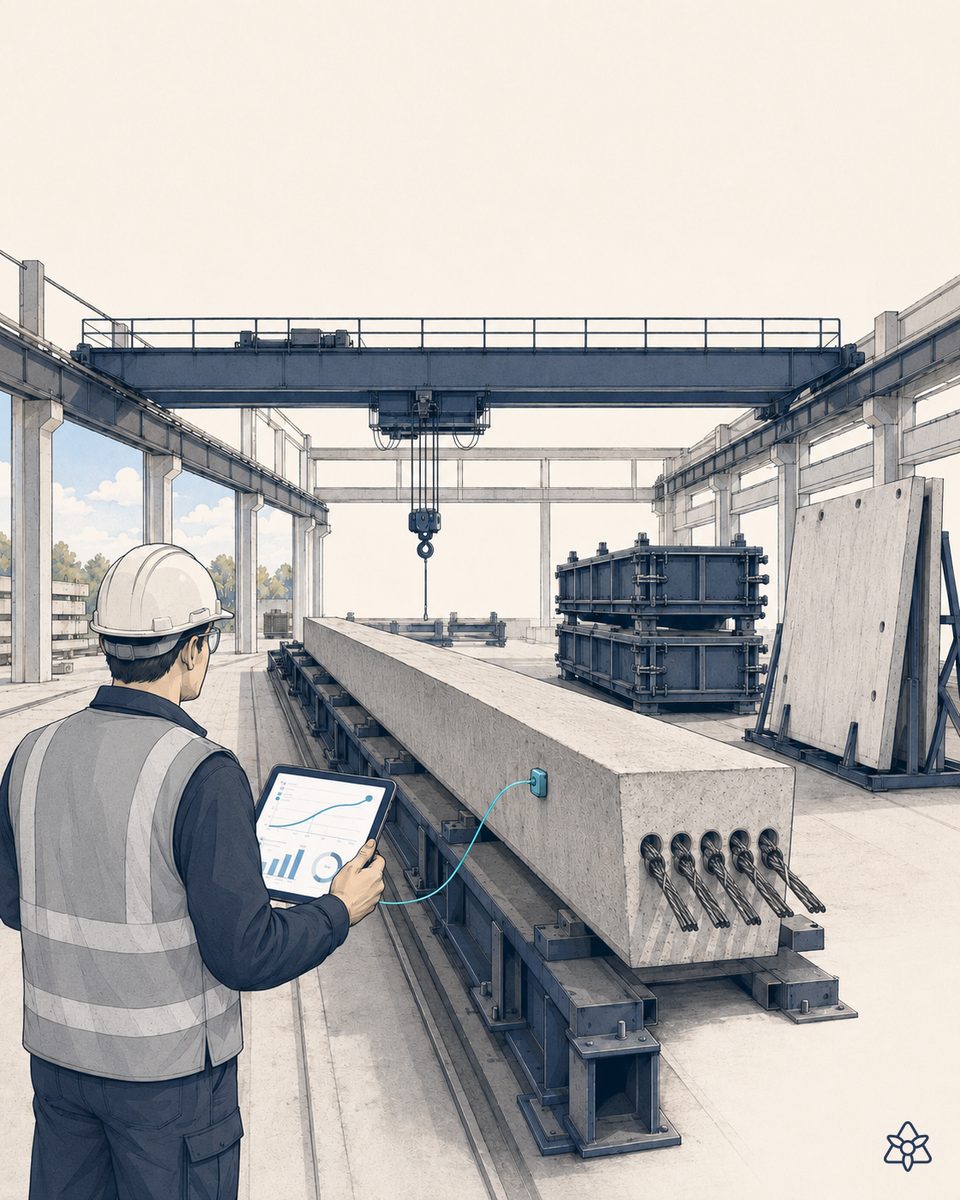
The climbing fleet lives in three places — and on the day that counts, in none of them.
Managing the climbing formwork fleet at a contractor with several simultaneous jobsites is one of the most expensive processes that nobody ever wrote into a system:
- Where each module is — site manager A knows for their site, site manager B for theirs, the fleet manager only knows "more or less," and the latest truth lives in the foreman's head.
- How many cycles it carries — modules move between sites and the cycle counter rarely travels with them. A panel that "looks new" may carry far more cycles than the last inspection shows.
- When maintenance is due — it gets decided when the deformation appears or the anchor starts making noise. Preventive maintenance is an intention, not a plan.
- What I need on Monday — the construction schedule calls for N modules at one position, and the fleet manager promises they'll be there while calling the sites to confirm.
When the system fails, it doesn't fail small: a delayed day of concrete pouring on a core drags the project's critical path with it. And nobody throws away the Excel because "it works" — until it doesn't.
iLEAN doesn't add a fourth system — it seals the crack between site, plant and fleet.
The formwork fleet's problem isn't a lack of data: it's that every movement gets logged on a different channel (the foreman in a notebook, the site manager in the WhatsApp group, the fleet manager in an Excel, the ERP only in the invoices) and nobody consolidates them. iLEAN acts as the putty that seals those gaps without asking you to change your ERP, buy vertical software, or put RFID on every panel on day one.
Connect captures every movement through the channel it already travels. The Agents cross-reference position, cycles and the construction schedule. The fleet manager sees, decides and signs — by Monday they already know whether it will arrive.
The iLEAN pieces applied to climbing formwork fleet management:
- Connect (the fleet's ear and voice) — inward listening (the foreman dictating by voice to the earpiece "module M-014 is now at the north site," a delivery-note photo, a QR read off the panel) and outward listening (the site manager's WhatsApp asking for modules, the maintenance shop's email confirming a repair). Bidirectional: it prepares replies outward through the same channel. Connect transports, the Agents decide, the person signs.
- Agents (the brain) — keep the inventory alive, count cycles per module, cross-reference with the construction schedule and warn the fleet manager when a set won't reach its next site on time (because it's at the maintenance plant, because it has run too many cycles since inspection, or because the previous site hasn't released it yet). They decide for no one: they propose and the person signs.
- Edge (optional, at the maintenance plant) — vision over the inspection line: it detects deformations, damaged anchors or parts that should be retired from the fleet and are still in circulation.
Excel + calls vs. a digital fleet with iLEAN Connect
| Aspect | Excel + WhatsApp + calls | With iLEAN Connect + Agents |
|---|---|---|
| Position of each module | "The last I heard" | Live position, updated on each movement |
| Accumulated cycles per module | Eyeball estimate | Per-module counter, cross-checked with the site cycle |
| Preventive maintenance | Reactive: when the deformation appears | Agent warning before the anchor fails |
| Weekly planning | Meeting + calls + hope | The agent cross-references schedule and availability |
| Fleet audit | Physical inventory when something fails | Live inventory, a file per module |
| Lost/misplaced module | Detected weeks later | The agent flags it at the next expected movement |
Impact estimate for your plant — to be validated with your numbers.
The block below is an estimate to be validated with the specific data of your fleet and your jobsites. We put it forward so the committee has an order of magnitude; we refine it during the diagnostic.
- Contractor with several simultaneous jobsites (3 to 8) and a fleet of several dozen climbing modules across sites, the maintenance plant and a couple of warehouses.
- Connect pilot on one site + maintenance plant: manual capture + delivery-note reading + integration with the ERP/internal rental system. First value expected within a few weeks: the fleet manager stops making calls to locate equipment.
- Reduction of "lost module" or "maintenance not done" incidents ≥ 30% in the first months, based on the documented incident history.
- Indicative payback between 4 and 9 months. The hard lever is a single day of concrete pouring that isn't delayed: the jobsite's critical path is unforgiving.
And the site manager's reasonable doubt
“What if the system says the module is on my site and it isn't?” — hallucination is a problem of free generation, not of anchored tasks. Logging a physical movement (a delivery-note photo, a QR read, the foreman's voice) and keeping a counter is by definition an anchored task: there is a source. In this kind of task, the best models brought error below 1.5% [1]. And even so, the fleet manager signs the movement, not the AI. The three safety rings exist precisely for this.
[1] OpenAI paper “Why Language Models Hallucinate”, 2025 — on the reliability of AI in anchored tasks.
What people ask about climbing formwork management with AI
Why does the Excel stop working when the formwork fleet grows?
The Excel works as long as there is one site, one fleet, one person in charge. As soon as the fleet is spread across several simultaneous jobsites, the maintenance plant and a couple of intermediate warehouses, it stops being one sheet: it becomes five sheets that never update at the same time. The question “where are the six modules I need on Monday?” doesn't have one answer — it has five, and one of them is the wrong one. The day a climbing set doesn't reach the site, the loss isn't the rental of a replacement set: it's a delayed day of concrete pouring on a core.
How do you track a climbing formwork set between two jobsites and the maintenance plant?
Without forcing high-end sensors onto every panel. iLEAN Connect captures each module's movement at the three points that already exist: warehouse check-out and check-in (plate/label reading), the site manager's signature on receiving the set (delivery-note photo, voice capture or app) and the close of each concrete-pour cycle the foreman already records. Connect consolidates those three sources and keeps every module's position and counter alive. The level of instrumentation adapts to each client: from a simple barcode to RFID tags on high-value modules.
What data does iLEAN Connect capture from the formwork's life cycle?
For each module: unique identity, current location (site, plant or in transit), movement history, accumulated concrete-pour cycles, cycles since the last cleaning/inspection, reported anomalies (bent parts, damaged anchors), maintenance checks completed and upcoming, and the operator who signed each step. The fleet stops being a bag of modules and becomes an inventory with a file per module. The Agents read those files, cross-reference cycles with the construction schedule and warn when a module needs to rotate into maintenance before it fails at an anchor.
Do you have to put a device on every panel for the system to work?
No. Connect's design is deliberately graduated: (1) manual — the foreman photographs the module's plate or dictates it by voice to the earpiece and Connect digitizes it; (2) intermediate — a barcode or QR code on the edge of each panel, read from a phone; (3) integrated — RFID or a sensor on high-value or heavily used modules. We start where your Pareto dictates and raise the level only where the cost of loss justifies it. We don't force you to buy 600 RFID tags on day one.
How much does it cost to digitize formwork fleet management?
The typical pilot starts with one jobsite and the maintenance plant, with manual capture + delivery-note reading + integration with the internal rental ERP. A reasonable payback sits in the range of several months, and the hard lever is a single day of concrete pouring that isn't delayed by a lost module or by maintenance that arrives late. We ask for your site's data (fleet size, number of simultaneous jobsites, typical cycles, last missing-module incident) and send you the estimated ROI in 48h.
More cases in other sectors
- Composite wing control with AI — an internal defect only shows up in ultrasonics. iLEAN combines vision, UT and the autoclave cycle.How iLEAN combines Edge vision, ultrasonic NDT and the autoclave cycle to catch internal defects in…
- Precast concrete — CE marking stands on plant records.Documented iLEAN cases in precast concrete: steam curing, EN 13369 CE marking, prestressing and 3D…
- CE marking of EN 1916 reinforced concrete pipes — the dossier should not take two days to add up.iLEAN Writer automates CE marking and the Declaration of Performance (DoP) for reinforced concrete pipes…
- EN 13369 + CPR 305/2011 compliance in a precast plant — the dossier for the auditor should not have to be rebuilt.iLEAN Agents prepare the EN 13369 + CPR 305/2011 compliance dossier (FPC, ITT, DoP) for the auditor in a…
- Blowhole inspection on GRC panels — a blowhole caught in the plant costs 100 times less than one caught on site.iLEAN Vision detects blowholes and surface defects on precast GRC panels before they are packed and…
- Vision inspection of MAG welds on HEB profiles — the defect that slips through the shop costs ten times more on site.iLEAN Vision inspects the MAG weld bead on HEB profiles in industrial steel structures and flags defects…
Tell us your case and in 48h we'll send you the estimated ROI of this AI project for your climbing fleet.
We work on your jobsites' real data, not ours. Diagnostic with no commitment.
Request estimated ROI in 48h See construction