Drone manufacturing with AI — the prototype flew; unit 300 of the series is another story.
A drone is two factories in one: electronics (PCBs, controllers, motors, cells) and structure (composites, arms, motor-propeller drivetrain). When production jumps from prototype to series in a few months, the first thing that breaks is not the design: it is traceability. iLEAN Edge inspects the electronic soldering and the assembly, Connect captures functional and flight tests without paper, and an agent rebuilds the genealogy battery cell → PCB → motor → drone. The responsible person signs.
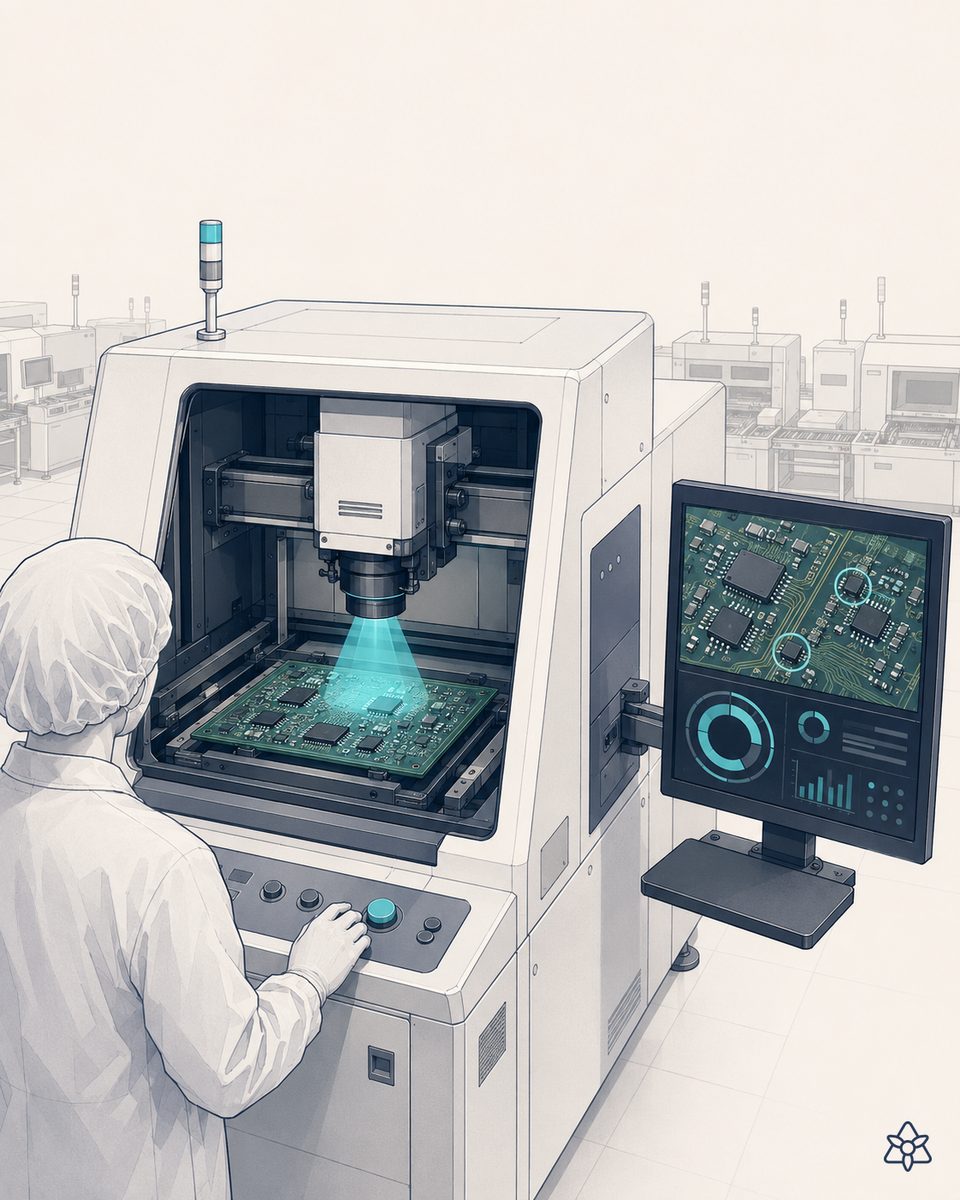
The drone does not fail on the line — it fails in the customer's first hour of flight.
Manufacturing drones/UAS has a peculiarity almost no other product shares: the volume curve climbs before the processes are mature. You go from runs of dozens to runs of hundreds in months, with the same team, the same building and the same notebook. And production mixes two natures that the plant manages with different logic:
- The electronics — control board, motor controllers, power and signal wiring, cell pack. The defects are small-scale: a cold solder joint on a controller, a bridge between traces, a half-inserted connector, two different cell batches inside the same pack. A visual check at the end of the line does not catch them; the test bench catches them sometimes, and only when the failure is clear-cut.
- The structure — composite arms and chassis, motor-propeller drivetrain, tightening torques. The defects are of another order: a delamination under the layup, a bubble, a torque below spec, a misalignment of millimeters that at 5,000 rpm turns into vibration.
- The unit's file — which cell batch, which PCB serial, which motors, which bench result, which acceptance flight. It lives scattered across labels, spreadsheets, bench logs and the memory of the technician who built it.
When the RMA arrives — and in drones it arrives — the quality team faces a simple question with an expensive answer: how many more units have the same problem? Without genealogy by serial number, the only safe answer is “we review the whole month's production”. It is not that the plant is bad — it is that traceability stayed at prototype pace while volume multiplied by ten.
iLEAN does not replace your test bench or your ERP — it seals the crack between the line, the bench and each drone's file.
The problem of a growing drone plant is not buying more equipment: it is that the electronics line, the structural assembly, the test bench, the acceptance flight and the ERP do not talk to each other in real time. iLEAN acts as putty between the systems you already have, without asking you to change the bench, the soldering station or the ERP.
Edge sees the soldering and assembly the quick check lets through. Connect captures the bench log and the acceptance flight, whether it arrives as a file, a photographed screen or a batch label. The agent chains cell → PCB → motor → drone and prepares the file by serial number — the responsible person signs.
The three iLEAN pieces applied to a drone/UAS line:
- iLEAN Edge — a terminal with computer vision (CNN) over the electronics station and the assembly table. It detects cold or bridged solder joints, shifted components, half-inserted connectors, wiring routed outside its guide and, on the structure, surface marks consistent with delamination or a bubble in the arm's layup. It flags the unit for the technician's review. It works without a network: if the building loses connectivity, Edge keeps inspecting and syncs when it recovers.
- iLEAN Connect — captures identifiers where they are already generated: the cell batch label, the PCB's laser mark, motor and controller serials, the arm's composite batch. And it captures the test results: the functional bench log file, acceptance flight telemetry, or the equipment's screen photographed when the bench is old. The sheet that today gets typed up the next day becomes usable data at second zero.
- iLEAN Agents — the agent chains cell batch ↔ PCB ↔ motor ↔ drone serial number and assembles the per-unit file that certification and after-sales ask for. It does not sign: it prepares the file and hands it to the person responsible for quality or airworthiness. The human signature is sacred; the three safety rings are there precisely to protect it.
Drone line in prototype mode vs. line traced with iLEAN
| Aspect | Visual check + spreadsheet | With iLEAN Edge + Connect + Agents |
|---|---|---|
| Solder defect in electronics | Caught only if the bench makes it fail outright | CNN flags it on the line, before assembly |
| Defect in a composite arm | Assembler's visual check, no record | Edge inspection with an image tied to the serial |
| Functional bench test | Written down by hand and typed up later | Log captured and tied to the serial number |
| Acceptance flight | Paper checklist, filed in a folder | Telemetry captured, validated by the technician |
| Genealogy cell → PCB → motor → drone | Manual reconstruction, if it exists at all | Chained at second zero, queryable |
| Scope of an RMA | “The whole month's production” | The serials actually affected by the batch |
| File for certification | Assembled when requested, in weeks | Prepared by the agent, signed by the responsible person |
Impact estimate for your plant — to be validated with your numbers.
The block below is an estimate to be validated with the specific data of your line. We put it forward so the committee has an order of magnitude; we refine it during the diagnostic.
- Drone/UAS manufacturer scaling from short runs to mid-size series, with an electronics line, a structural assembly area, a functional test bench and an acceptance flight.
- Edge pilot over the electronics station plus test bench capture. First value expected within a few weeks: a soldering or insertion defect pattern surfaces that until now only showed up in the field.
- Expected reduction of rework in electronics and assembly ≥30% and of per-unit file preparation time ≥50%. Indicative payback between 4 and 9 months, depending on monthly volume, current RMA rate and the hours spent today rebuilding traceability.
- The hard lever is the RMAs avoided or scoped down: with genealogy by serial number, a review campaign goes from “the whole month” to “these 34 serials”.
And the quality manager's reasonable doubt
“What if the CNN invents a defect or, worse, lets a real one through on a control board?” — hallucination is a problem of free generation, not of anchored tasks. Flagging candidate defects on a board and comparing them against the golden-sample reference is an anchored task: the best models brought error below 1.5% [1]. And even so, the system does not decide — it proposes, flags, records. The signature of the electronics technician, the assembly lead or the acceptance pilot stays right where it belongs. The three safety rings are there precisely for this: the decision on a unit that is going to fly is not closed by an AI, it is closed by a person.
[1] OpenAI paper “Why Language Models Hallucinate”, 2025 — on the reliability of AI in anchored tasks.
What people ask about drone manufacturing with AI
What defects appear when a drone scales from prototype to series?
The jump from prototype to series does not change the design, it changes the variance. On the electronics side you get cold solder joints and bridges on motor controllers, badly inserted connectors, signal wiring routed close to the power stage and battery cells from different batches mixed inside the same pack. On the structural side you get delaminations and bubbles in composite arms, tightening torques out of range and motor-propeller misalignment that turns into vibration. Almost none of it shows in a quick visual check at the end of the line: it shows up in the customer's first hour of flight.
How is a drone's genealogy built unit by unit?
By chaining identifiers that today live in different places: the battery cell batch number, the control PCB serial, the serial of every motor and every controller, the arm's composite batch and, finally, the drone's serial number. iLEAN Connect captures each identifier at the point where it is already generated — the supplier's label, the board's laser mark, a photographed delivery note, the test bench output — and ties it to the assembly at second zero. When an RMA arrives months later, the genealogy already exists: you query it, you do not rebuild it by hand.
Can functional and flight tests be captured without paper?
Yes, and it is where the most time is recovered. Today the bench functional test (current draw per motor, axis response, controller telemetry) and the acceptance flight are written on a sheet that someone later types up. iLEAN Connect takes the bench or flight log file, or a photo of the equipment's screen when the bench is old, and posts the values against the drone's serial number. The technician validates and signs; they stop transcribing. The unit's file is closed the same day it leaves the line.
What does this bring for certification and after-sales?
Certification and after-sales ask for the same thing from different angles: proving what was assembled, with which material and with which test result, on a specific unit. The iLEAN agent prepares that file by serial number — components and batches, Edge inspections with their image, functional test curves, acceptance flight, deviations and their closure. The agent does not sign: it prepares the dossier and hands it to the person responsible for quality or airworthiness, who is the one who signs. In an RMA, it narrows the scope to the serials actually affected by a batch, instead of the whole month's production.
How much does it cost and what payback should a drone plant expect?
The order of magnitude of an Edge pilot on a mixed electronics and drone assembly line is that of any Edge pilot in a plant making a complex product of mid-to-high unit value: an initial investment covering terminals + cameras + integration with the test bench, plus an annual license. The hard levers are the rework avoided in electronics and assembly and the RMAs avoided or scoped down thanks to per-unit genealogy. Indicative payback between 4 and 9 months — estimate to be validated with your numbers. We send you the estimated ROI in 48h with your line's data.
Related: Avionics with AI · CFRP/GFRP composites with AI vision · Satellite components with AI
More cases in other sectors
- 3D dimensional control of TBM segments — the defect that is free in the plant stops the whole job at the face.iLEAN Edge 3D-scans precast TBM tunnel segments and compares them against the BIM model before they…
- Mix and water-cement ratio control at the batching plant — aggregate moisture should not decide your strength class.iLEAN Brain adjusts the mix and the water-cement ratio at a precast batching plant from aggregate…
- Defense radar with AI — a T/R module out of spec is not an incident, it is a delayed program.How iLEAN inspects T/R modules, calibration and ITAR/EAR traceability in defense radar manufacturing…
- EASA / FAA Part 21 with AI — the evidence, alive. The pre-audit sprint, gone.iLEAN traces production under Part 21 + POA with a live TC/STC link. Certification evidence always ready.
- Electrical equipment — a test that is not recorded does not exist for the notified body.Documented iLEAN cases in electrical equipment: EN 61439 testing, CPR cable traceability, windings and…
- Dynamic balancing of an async motor rotor — the workshop pays for the trial and error, and the veteran's intuition retires with him.How iLEAN Edge assists on the dynamic balancing machine for async motor rotors: it proposes…
Tell us about your drone line and in 48h we'll send you the estimated ROI of this AI project for your plant.
We work on your line's real data, not ours. Diagnostic with no commitment.
Request estimated ROI in 48h See other industries