Dynamic balancing of an async motor rotor — the workshop pays for the trial and error, and the veteran's intuition retires with him.
Hitting the balance grade of an async motor rotor on the first run is not what the balancing machine says — it is what the veteran knows how to correct on top of what the machine says. As long as it is done by trial and error, every rotor takes two, three, five runs; as long as that intuition lives in one person, the day he retires half the plant goes with him. iLEAN Edge assists the operator, learns from your own workshop, and proposes mass and position right the first time. The person signs — the balancing machine does not decide alone.
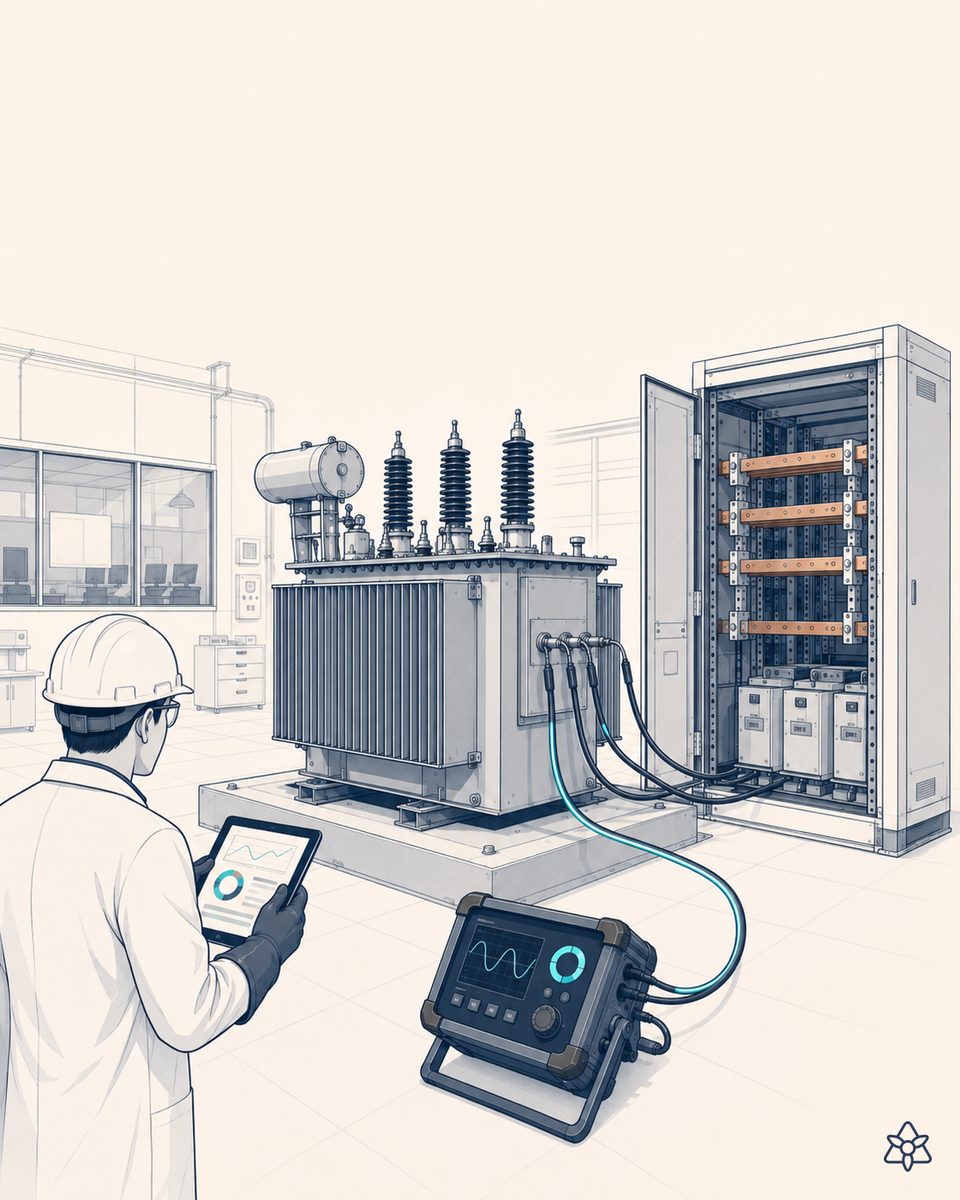
Trial and error does not compete with the big Asian producers.
A badly balanced async motor rotor vibrates, heats up bearings and shortens the motor's life. To reach a G2.5 or G6.3 grade (ISO 21940) you have to place a counterweight mass at an exact position. And that is where the problem starts:
- The balancing machine calculates with an ideal model — a mass and angle that assume a geometrically perfect rotor. Real rotors are not: fans with damaged blades, cages with irregular welds, uneven paint, previous balancing attempts that were badly removed.
- The operator runs it, measures the residual, recalculates, runs it again — every run is set-up + start-up + measurement. On large rotors that is two, three, five runs to reach the grade.
- The veteran corrects by eye what the machine proposes — “this rotor with that fan needs less mass and a different angle”. That intuition is the difference between balancing right the first time and grinding through trial and error. And it lives in one person.
- The day the veteran retires, the workshop's real capacity drops — and nobody had documented why.
The plant manager knows it. The problem is not the person, it is that the most valuable knowledge in the workshop lives in heads, not in systems. And meanwhile, every extra balancing run is fixed cost that cannot compete with someone producing motors at a lower hourly cost.
iLEAN Edge does not replace the operator or the veteran — it learns from them and puts them both on every rotor.
Balancing capacity does not fail for lack of machinery, it fails because the fine judgment lives in the veteran's head and is lost with him. iLEAN acts as the putty that fills that gap between the balancing machine and the person — it captures the judgment as a learned pattern, without replacing anyone.
Edge learns from every rotor that goes through. Connect ties the rotor to the motor model and to the work order. The agent proposes mass and position right the first time. The person signs — the balancing machine does not decide alone.
The iLEAN pieces applied to async rotor dynamic balancing:
- Edge — a terminal next to the balancing machine. It captures the machine's initial calculation, what the operator decides to do, the extra runs, the final residual. It learns a pattern per rotor type (power, number of poles, fan geometry). It works with no network. If the plant loses its connection, it keeps capturing.
- Connect — captures the motor model from the ERP/MES and the work order. If the rotor comes from rewinding, it also captures its history (what has been done before, how many times it has been balanced). On older balancing machines it reads the local PC even if it runs XP, or photographs the display.
- Balancing agent — proposes mass and position on top of what the machine says, based on what it has learned from similar rotors in your own workshop. This is not a generic recommendation from a manual: it is what your veteran used to do on your rotors. The operator decides. The person signs.
Balancing by trial and error vs. assisted balancing with iLEAN Edge
| Aspect | Balancing machine alone + operator judgment | With iLEAN Edge (an assistant that learns from the workshop) |
|---|---|---|
| Runs needed to reach the grade | 2–5 depending on rotor complexity | Trending to 1–2, with the agent's proposal |
| The veteran's judgment | In the veteran's head | Captured as a pattern per rotor type |
| Traceability per rotor | Operator's sheet, filed in a folder | Digital dossier with mass, position, residual |
| The day the veteran retires | The workshop's real capacity drops | The pattern stays alive in the system |
| Repeat rotor (rewound) | Balanced as if it were brand new | Its history is used — we already know how it behaves |
| Dossier for the end customer | Generic certificate | Grade achieved, mass and position, per rotor |
Impact estimate for your plant — to be validated with your numbers.
The block below is an estimate to be validated with the specific data of your workshop. We put it forward so the committee has an order of magnitude; we refine it during the diagnostic.
- Workshop manufacturing and/or rewinding async motors (up to 500 kW or above), with an existing Schenck/CEMB/Hofmann/Balco balancing machine and a mid-range volume of rotors per month.
- Edge pilot on one balancing machine (terminal + Connect integration with the machine's PC + capture of the motor model from the ERP). First value expected within a few weeks.
- Indicative payback between 4 and 9 months, depending on rotor volume per month and the hourly cost of the balancing machine with its assigned operator.
- Hard levers: ≥ 30% reduction in average balancing time per rotor; fewer extra runs; the veteran's judgment captured before retirement; better competitiveness against imported production.
And the quality manager's reasonable doubt
“What if the agent proposes the wrong mass and the operator accepts it without thinking?” — the decision still belongs to the person. Hallucination is a problem of free generation, not of anchored tasks. In tasks where the AI merely proposes a correction on top of what the balancing machine already calculated, comparing it against similar cases from your own workshop, the best models brought error below 1.5% [1]. And even so, what is critical is never decided alone: iLEAN proposes and the operator signs. The three safety rings exist precisely for this.
[1] OpenAI paper “Why Language Models Hallucinate”, 2025 — on the reliability of AI in anchored tasks.
What people ask about assisted dynamic balancing of async rotors
Why is dynamic balancing of an async motor rotor a bottleneck in the workshop?
Because an unbalanced rotor vibrates, heats up bearings and shortens the motor's service life — but reaching the balance grade (G2.5, G6.3 per ISO 21940) on the first run of the balancing machine is an art. The balancing machine (Schenck, CEMB, Hofmann, Balco) gives you an approximate mass and angle; the operator runs it, measures the residual, recalculates, runs it again. On large rotors or complex geometries, that trial-and-error loop can be two, three, five runs — each with its own set-up. In a workshop doing hundreds of motors a month, that is man-hours you cannot afford against the big Asian producers.
Why isn't what the balancing machine already calculates enough?
Because the balancing machine's calculation assumes an ideal geometric model of the rotor — and real rotors have fans with damaged blades, vanes with uneven paint, cage welds with non-uniform mass, and previous balancing attempts that were badly removed. The machine says “put 12 g at 47°”; the veteran knows that this particular rotor calls for “10 g at 52° because the front fan has an odd protrusion”. That veteran's intuition is not in the machine — it is in him, and it leaves with him the day he retires.
How does iLEAN Edge assist the operator without replacing the balancing machine?
The Edge sits next to the balancing machine and learns from every rotor that goes through. It captures the machine's initial calculation, what the operator does next, the extra runs, the final residual. Over time (weeks, depending on the workshop's volume) the system proposes a correction on top of what the balancing machine says: “for this type of rotor with a centrifugal fan, the real mass is usually 15% lower than the machine asks for; try 10 g at 52°”. The operator decides; there is no obligation to accept. It assists and simplifies — it does not replace.
Does it work on old balancing machines such as a Schenck with an ancient PC?
Yes — that is the typical case. iLEAN Connect has three capture modes: direct integration with modern balancing machines that offer an API or OPC-UA; reading the balancing machine's local PC even if it runs Windows XP; capture by camera on the display plus a microphone next to the operator if the equipment is fully analog. It does not force you to replace the balancing machine — the putty fills the gaps, it does not tear out the tiles.
What do you gain in a workshop manufacturing or rewinding async motors?
Three concrete levers: (1) fewer balancing runs per rotor, which frees up real workshop capacity without hiring more people; (2) capturing the veteran's judgment before retirement — that fine adjustment the old hand makes without thinking stays in the system as a learned pattern; (3) a balancing dossier per rotor with the grade achieved, counterweight mass and position, ready to hand to the end customer (industry, rail, utility).
More cases in other sectors
- Drone manufacturing with AI — the prototype flew; unit 300 of the series is another story.From prototype to series production without losing control: Edge vision on electronics and assembly,…
- EASA / FAA Part 21 with AI — the evidence, alive. The pre-audit sprint, gone.iLEAN traces production under Part 21 + POA with a live TC/STC link. Certification evidence always ready.
- Electrical equipment — a test that is not recorded does not exist for the notified body.Documented iLEAN cases in electrical equipment: EN 61439 testing, CPR cable traceability, windings and…
- Busbar-to-cell weld inspection in BESS battery packs with AI — a bad module is not an incident, it is a thermal risk.How iLEAN Edge inspects busbar-to-cell welds in stationary BESS battery packs and holds the module…
- Drum-to-site cable traceability with AI — the day a switchboard burns on site, you don't want to be digging through spreadsheets.How iLEAN Tracer ties copper batch, actual length, tests and destination site of each cable drum into…
- Laser marking verification on circuit breakers — one wrongly engraved digit is a different product, and another claim.iLEAN Vision validates the laser marking (In, Icu, curve) of miniature circuit breakers before packing.…
Tell us your case and in 48h we'll send you the estimated ROI for your motor workshop.
We work on your plant's real data, not ours. Diagnostic with no commitment.
Request estimated ROI in 48h See industrial electrical equipment