Busbar-to-cell weld inspection in BESS battery packs with AI — a bad module is not an incident, it is a thermal risk.
In a stationary BESS battery pack, the weld between busbar and cell is the most critical joint in the module: if a weld has out-of-range resistance, it heats up in service and that is the start of thermal runaway. iLEAN Edge looks at every joint in the welding booth itself, in milliseconds, holds the module before testing, and the technician decides. The person signs — the line does not move on by itself.
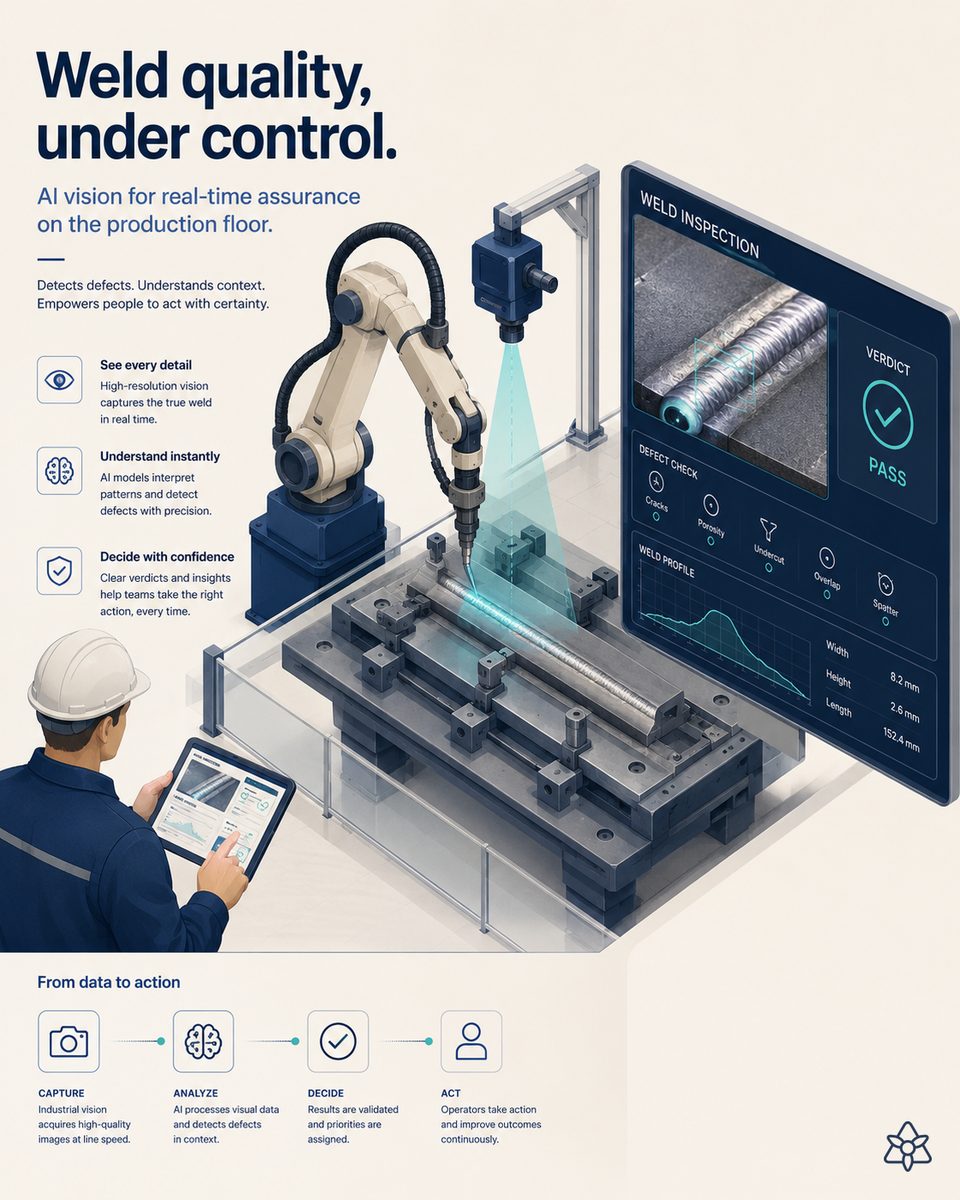
A BESS module carries hundreds of critical welds, and a single bad spot is a runaway risk.
A battery pack for stationary storage (BESS) is a chain of cells — usually prismatic or large-format cylindrical LFP — joined by aluminum or copper busbar with laser welding, wire bonding or resistance welding. A typical module has hundreds of welded joints, and every one of them is critical for the same reason:
- A bad weld has out-of-range electrical resistance — the current heats it up in service.
- A hot spot ages faster — the adjacent cell suffers, and the joint degrades in a loop.
- Thermal runaway starts at a hot spot — not in the whole cell, in the joint.
The module's electrical test catches the gross failures (very high resistance, open circuit, short circuit). It does not catch the latent failure — the weld with shallow penetration, with porosity, with spatter — that shows up at 500 or 1,000 cycles. Once the module is mounted in the cabinet and the cabinet in the BESS container, replacing a defective joint costs orders of magnitude more than redoing it in the booth. And the risk is not just cost: a module with a defect nobody saw is a fire risk in a stationary storage installation.
iLEAN Edge does not replace the electrical test — it seals the gap between the welding booth and the assembled module.
The busbar-to-cell weld problem is not a lack of technology — lasers and wire-bonding systems keep getting better. The problem is that quality control arrives late: the operator eyeballs only what happens to pass in front of them, and the module's electrical test runs once the latent defects are already sealed in. iLEAN acts as the putty that fills that gap between the welding booth and the test bench, without asking you to change the laser, the wire bonder or the MES.
Edge looks at the weld in the booth. Connect reads the laser parameters and the module's serial number. An agent cross-references geometry, parameters and recipe, and holds the module if something does not add up. The person signs — never the other way around.
The iLEAN pieces applied to busbar-to-cell weld inspection in BESS:
- iLEAN Edge (with CNN) — a terminal with high-speed cameras and calibrated lighting inside or above the welding booth. It looks at every bead or every spot in milliseconds: geometry, surface defects, relative position. It signals the PLC to flag the module and hold it before the next step. It works without a network. What is critical does not depend on WiFi.
- Connect — captures the laser parameters (power, speed, focus) or the wire bonder's, the module's serial number and the product recipe, whether they come from a modern MES or the booth's old HMI. It also captures the certificate for the cell and busbar batch at second zero.
- Agent — cross-references the weld image, the laser parameters, the recipe and the raw-material certificates. If there is a deviation, it sends the module to selective destructive testing or alerts the technician for rework. It also assembles the module's weld dossier, tied to the serial number, for life-cycle traceability.
Classic BESS weld inspection vs. a booth with iLEAN Edge.
| Aspect | Classic inspection | With iLEAN Edge inline |
|---|---|---|
| Moment of detection | Final electrical test, module closed | In the booth, milliseconds after welding |
| Control coverage | Operator's visual sample | 100% of the module's welds |
| Latent defect (porosity, shallow penetration) | Shows up at 500-1,000 cycles in service | Surface detection + queue for deep control |
| Traceability per joint | Per module, manual | Per joint, tied to the module's serial |
| Operation without network | n/a | Edge keeps inspecting and holding locally |
| Rework in the booth vs. cabinet teardown | Defect reaches the cabinet, costly teardown | Fast rework before the module is closed |
Impact estimate for your plant — to be validated with your numbers.
The block below is an estimate to be validated with your plant's specific data. We put it forward so the committee has an order of magnitude; we refine it during the diagnostic.
- Stationary BESS battery pack assembly plant (prismatic or large-format cylindrical LFP) with a busbar-to-cell laser welding booth, standard MES, module electrical testing on a downstream bench.
- iLEAN Edge pilot in one welding booth: terminal + cameras + lighting + integration with the laser's PLC and the module's MES. First value expected within a few weeks, in assist mode first, with automatic holds once the quality manager gives the OK.
- Indicative payback between 4 and 9 months, depending on module volume per month, the current rate of defects caught at the bench or in the cabinet, and the average cost of a returned module.
- Expected reduction in defects reaching the cabinet ≥ 30%, with a conservative floor. The hard lever is avoiding the teardown of a cabinet to replace a module, which costs orders of magnitude more than redoing the weld in the booth — not counting the thermal risk if the defect had stayed in service.
And the plant manager's reasonable doubt
“What if the AI gets it wrong and lets a latent weld through or, worse, holds a good one?” — hallucination is a problem of free generation, not of anchored tasks like this one — comparing the image of a bead against the pattern learned in that same booth with that same busbar and that same cell. In anchored tasks, the best models brought error below 1.5%[1]. And even so, what is critical is never decided alone: iLEAN flags and holds, the welding technician signs. The system starts in assist mode (it warns, it does not stop), and only moves up to automatic holds once the team sees the detections match reality. The three IRIS safety rings exist precisely for this.
[1] OpenAI paper “Why Language Models Hallucinate”, 2025 — on the reliability of AI in anchored tasks.
What people ask about busbar-to-cell weld inspection with AI
What kind of weld joins busbar to cell in a BESS battery pack?
It depends on the cell format and the manufacturer: laser welding (the most common for prismatic and pouch cells, and increasingly for premium cylindricals), ultrasonic wire bonding (typical for 18650 / 21700 cylindricals with thin aluminum busbar), and resistance welding (in simpler architectures). In stationary BESS, where the cell is usually prismatic or large-format cylindrical LFP, laser welding with aluminum or copper busbar dominates. These are the most critical joints in the module: if a weld has out-of-range electrical resistance, it heats up in service, and a hot spot in a BESS module is the start of thermal runaway.
Why isn't the module's electrical test enough to catch a bad weld?
Because a weld can pass the initial electrical test (resistance within range when cold) and degrade afterwards: a joint with shallow penetration, with porosity, with an excessive HAZ (heat-affected zone) or with thermal damage to the cell's foil ages faster. The electrical test catches the gross failures — it does not catch the latent failure that will show up at 500 cycles. That is why the only honest way to guarantee weld quality is to inspect it in the booth right after it is made, when the geometry and appearance of the bead tell you what the electrical test cannot see until much later.
What does iLEAN Edge see in the busbar-to-cell weld?
iLEAN Edge looks at three things on every joint, in the booth, in milliseconds: (1) bead or spot geometry — length, width, continuity for laser; diameter and shape for wire bonding; (2) surface defects — visible porosity, aluminum spatter, lack of fusion, holes; (3) relative position — the bead lands where it has to land relative to the edge of the busbar and to the cell terminal. If something does not add up, it signals the PLC to flag the module, hold it and alert the technician. It works without a network — if the plant loses WiFi, Edge keeps inspecting and holding.
What if the defect is inside the weld (internal porosity, lack of penetration) and doesn't show on the surface?
Fair question. CNN surface inspection does not replace periodic destructive testing (sectioning and micrograph) or nondestructive testing where you have it (active thermography, hot resistance testing). What iLEAN Edge does in the booth is catch the 80-90% of visible defects that slip through today, and queue the doubtful welds for the more expensive destructive or nondestructive control. The combination (fast booth + selective deep control) is what lowers the total cost of quality — not swapping one control for another, but aiming the expensive control at exactly the right place.
How much does an AI inspection pilot in a BESS welding booth cost and return?
The typical pilot is one laser welding booth (or wire-bonding station) with iLEAN Edge — terminal + cameras + lighting + integration with the machine's PLC and with the MES that tracks the module's serial number. The hard lever is the cost of a BESS module with a defective weld that reaches testing or, worse, the cabinet: tearing down a cabinet to replace a module is orders of magnitude more expensive than redoing the weld in the booth. The payback presented to the committee is a matter of months. Ask us for an estimated ROI with your plant's real data and we'll send it to you within 48 hours.
More cases in other sectors
- EASA / FAA Part 21 with AI — the evidence, alive. The pre-audit sprint, gone.iLEAN traces production under Part 21 + POA with a live TC/STC link. Certification evidence always ready.
- Electrical equipment — a test that is not recorded does not exist for the notified body.Documented iLEAN cases in electrical equipment: EN 61439 testing, CPR cable traceability, windings and…
- Dynamic balancing of an async motor rotor — the workshop pays for the trial and error, and the veteran's intuition retires with him.How iLEAN Edge assists on the dynamic balancing machine for async motor rotors: it proposes…
- Drum-to-site cable traceability with AI — the day a switchboard burns on site, you don't want to be digging through spreadsheets.How iLEAN Tracer ties copper batch, actual length, tests and destination site of each cable drum into…
- Laser marking verification on circuit breakers — one wrongly engraved digit is a different product, and another claim.iLEAN Vision validates the laser marking (In, Icu, curve) of miniature circuit breakers before packing.…
- CPR traceability for electrical cable — a meter without a class does not go on site.iLEAN Tracer links reaction-to-fire class, DoP and batch to every meter of CPR cable made and shipped to…
Tell us your case and within 48h we'll send you the estimated ROI of AI inspection in your BESS booth.
We work on your plant's real data, not ours. Diagnostic with no commitment.
Request estimated ROI in 48h See electrical equipment