Aircraft propeller control with AI — a live dossier per serial number, not a folder thrown together at the last minute.
A certified propeller demands cross-referencing three realities — blade geometry, dynamic balancing and material traceability — that are almost never in the same system. iLEAN puts Edge vision over the blade, Connect reads the balancing machine however old it is, and an agent assembles the dossier by serial number. The NDT inspector is the one who signs.
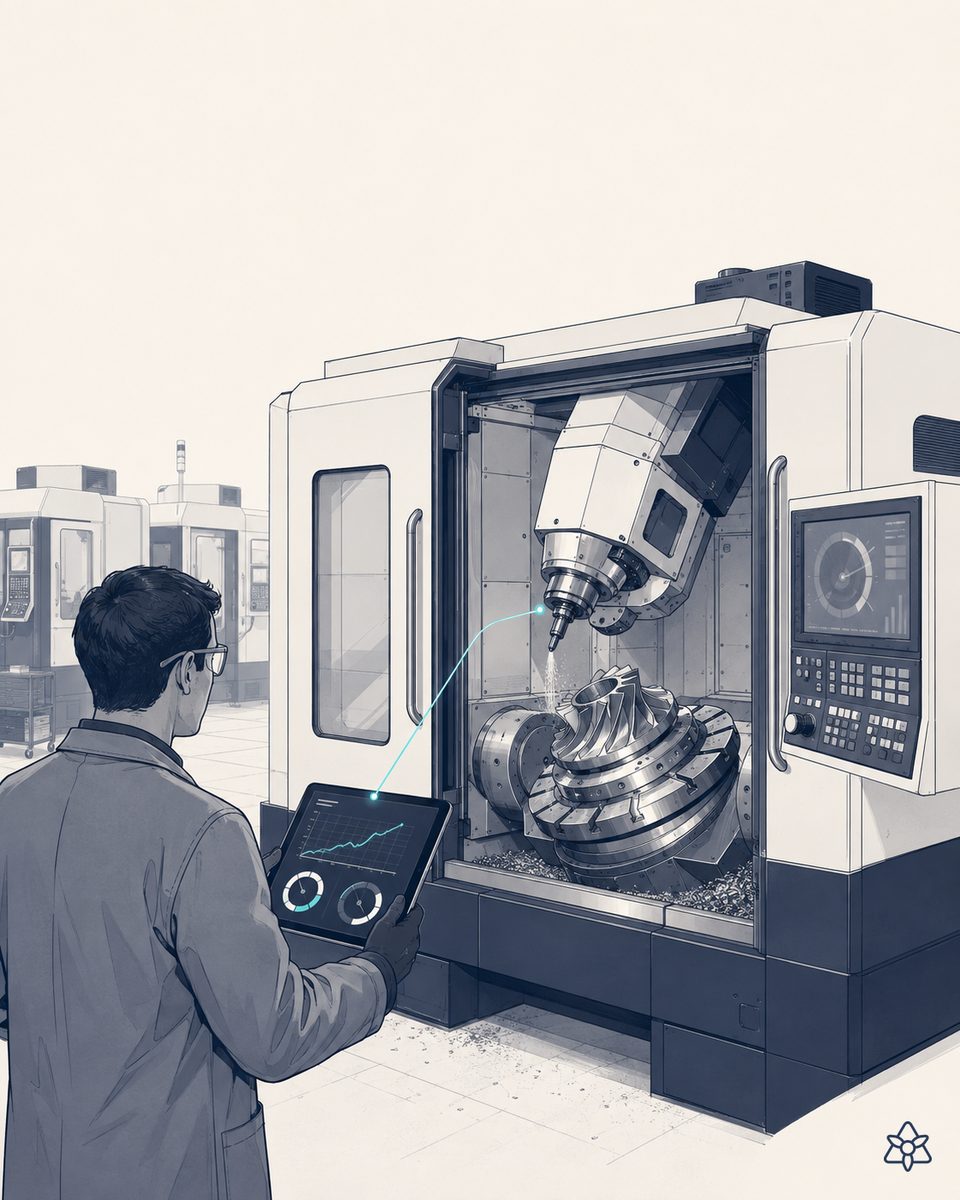
A certified propeller is not a part, it is a file — and the file lives in four places.
The quality control manager of an aerospace shop knows that every propeller that leaves with his signature on it is a personal responsibility. And he also knows that the file he has to sign is scattered:
- The blade — its geometry, its finish, the absence of microcracks. Today it is inspected by hand, with a gauge, a magnifier and a veteran's craft.
- The balancing — the machine reading. Sometimes on an old piece of equipment with its own panel that nobody ever integrated because “it costs more than it is worth”.
- The material — the aluminum melt or the composite lot, with its certificate. It lives in the ERP, in a supplier PDF or in a lost email.
- The veteran's knowledge — the “this blade vibrates oddly” that no system captures, and that walks out the door with him the day he retires.
The classic system works 99% of the time. And even so, the audit always arrives at the worst possible moment: the inspector asks you to rebuild the dossier of a propeller made two years ago and the quality team spends weeks assembling a PDF that should have been alive from day one.
iLEAN does not add a fifth system — it seals the cracks between the ones you already have.
The problem with propeller control is not a lack of information: it is information in islands that, at the moment of signing, never quite lands in the same file. iLEAN acts as the putty that fills those gaps, without asking you to change your CMM, your balancing machine, your ERP or your product PDM.
Edge sees the blade before and after every operation. Connect reads the balancing machine however old it is. The agent assembles the dossier by serial number and, if something does not add up, it holds the part. The person signs — never the other way round.
The three iLEAN pieces applied to aircraft propeller control:
- Edge — a terminal with machine vision (CNN) over the blade inspection station. It detects machining marks out of range, missing coating, hub off-center. Actuator at 45 ms when the part has to be held. It works with no network. The record is kept with photo, time and operator.
- Connect — captures the balancing machine reading whether it comes from modern equipment (direct integration) or old equipment (panel reading by vision, or a serial reading from the port it already has). It also captures the supplier's material certificate whether it arrives by email or as a PDF, and leaves it indexed by melt/lot number.
- Agent — cross-references geometry, balancing, material, heat-treatment batch, NDT evidence and the inspector's signature. It assembles the dossier by propeller serial number; if any step is missing, it holds the part before assembly and alerts the person in charge. The person signs; the line does not release itself.
Manual control with a checklist vs. cross-referenced control with iLEAN
| Aspect | Manual control + checklist | With iLEAN Edge + Connect + Agent |
|---|---|---|
| Blade inspection | Gauge + veteran's eye + paper record | Edge vision at every step, photo filed by serial number |
| Balancing machine reading | Operator writes the values on a report | Connect captures the machine log (even isolated) |
| Material traceability | Supplier PDF in a shared folder | Melt/lot indexed to the propeller dossier |
| Veteran's knowledge | Leaves with retirement | Pattern learned by Edge — a permanent capability |
| Operation with no network | n/a | Edge keeps running on the panel's own power |
| Dossier for the EASA Part 21 auditor | Rebuilt by hand, weeks of work | Live dossier by serial number, automatic |
Impact estimate for your plant — to be validated with your numbers.
The block below is an estimate to be validated with the specific data of your plant. We put it forward so the committee has an order of magnitude; we refine it during the diagnostic.
- EASA Part 21 / FAA Production Approval shop with mixed production — general aviation propellers + variable-pitch turboprop blades. In-house NDT inspection and a balancing machine several years old.
- Edge pilot at the blade inspection station (camera + actuator) + Connect over the balancing machine + a dossier agent by serial number. First value expected within a few weeks.
- Indicative payback between 4 and 9 months, depending on how often defects are caught late and force rework, and on the quality hours spent rebuilding audit dossiers over recent years.
- Reduction in rework hours caused by defects detected late: conservative estimate ≥ 30%. The hard lever is not the hours saved; it is the live dossier that protects the inspector's signature.
And the quality data point for the committee
“What if the AI gets it wrong and lets a defective blade through?” — hallucination is a problem of free generation, not of anchored tasks. In tasks where the AI merely compares an image with a learned pattern and recontextualizes a machine reading into a file, the best models brought error below 1.5% [1]. And even so, a critical part is never signed off alone: iLEAN holds and the person signs. The three safety rings exist precisely for this.
[1] OpenAI paper “Why Language Models Hallucinate”, 2025 — on the reliability of AI in anchored tasks.
What people ask about aircraft propeller control with AI
What does the AI check on an aircraft propeller?
The AI checks the three critical dimensions that today live in different systems: blade geometry (profile, pitch angle, surface finish), dynamic balancing (the machine reading) and material traceability (aluminum melt or composite lot, raw-material certificates). iLEAN Edge looks at the blades with vision (CNN) before and after every operation; Connect captures the balancing machine reading even from old, isolated equipment; the agent cross-references the three data points with the recipe for that propeller family and assembles the dossier by serial number.
How are cracks or surface defects detected on the blades?
iLEAN Edge installs machine vision over the blade inspection station after machining, after heat treatment and after painting. It detects machining marks out of range, visible microcracks, missing coating, hub off-center. If something does not match the learned pattern, it holds the part before it moves on to balancing. It works with no network — if the plant loses WiFi, Edge keeps inspecting and holding, because what is critical cannot depend on connectivity. Final validation is signed by the NDT inspector, not by the AI.
How does iLEAN integrate an old balancing machine?
Connect handles old machines at three levels: if the machine only has an analog panel, a person photographs the reading and Connect digitizes it; if it has an isolated local computer (Windows 2000 included), Connect reads from the serial port or from the folder where the equipment drops its log; if it has a modern interface, direct integration. The result: the balancing machine reading enters the propeller dossier at second zero, without asking you to replace the machine.
Does it work for light aircraft propellers and for turboprop blades?
Yes. The architecture is the same; what changes is the pattern learned by the vision model and the tolerance range. Edge is trained on real parts from your product family — a light-alloy general aviation blade, a composite turboprop blade, a variable-pitch hub-and-blade assembly. The initial immersion measures the baseline of each family, and the mixed team (your people + an embedded engineer) defines the tolerances together with the quality control manager. This is not a generic off-the-shelf model.
What dossier is left at the end for each propeller?
A file per serial number with: raw-material certificates for the batch, machining and heat-treatment parameters, Edge inspection images at every step, the balancing machine reading, the NDT inspector's signature, NDT evidence (dye penetrant, ultrasonics) and the final assembly. It is the “boring, concrete agent” — the dossier the EASA Part 21 or FAA Production Approval auditor would ask you for too late, and that would take weeks to rebuild by hand. With iLEAN it comes out automatically and the person signs.
Cross-links: aircraft turbine control · landing gear control · predictive maintenance in avionics
More cases in other sectors
- Vehicle armor with AI — a badly welded bead is not a quality defect, it is the occupant's life.How iLEAN inspects weld beads, captures ballistic tests and builds the per-vehicle dossier in armored…
- 5-axis aerospace machining with AI — a titanium part with forty machine hours on it cannot be scrapped over a data point nobody cross-referenced.iLEAN cross-references the machining log, the CNC panel and CMM measurement into an AS9100 genealogy per…
- Aerospace heat treatment with AI — quality cannot be verified afterwards: you have to prove the curve was THE curve.How iLEAN captures the real furnace curve without touching it, links load ↔ curve ↔ part and prepares…
- Aero turbine manufacturing with AI — the FAI is not rebuilt; it is generated while you build.How iLEAN combines vision, heat-number OCR and evidence-pack agents to build aero turbine parts to…
- Aeronautical configuration with AI — Mod Status and effectivity per aircraft, without aircraft 247 living in a spreadsheet.iLEAN manages Mod Status and ECN/ECO effectivity per aircraft or batch. Traceable configuration from…
- An aerospace claim years down the line demands knowing which heat lot was used — and only whoever kept the link from day one can answer that.iLEAN traces every aerospace part back to its original heat lot, with the mill cert and the RMA linked…
Tell us your case and in 48h we'll send you the estimated ROI of this AI project for your aerospace shop.
We work on your plant's real data, not ours. Diagnostic with no commitment.
Request estimated ROI in 48h See aerospace