Vehicle armor with AI — a badly welded bead is not a quality defect, it is the occupant's life.
Building armor demands three things at once that today live in scattered paperwork: every weld bead verified at the station, every ballistic test and material certificate captured without transcription, and an auditable dossier per vehicle that ties material → plate → weld → test → chassis number. iLEAN Edge sees the joint, Connect captures the certificate and the test, and an agent assembles the dossier. The certified person signs.
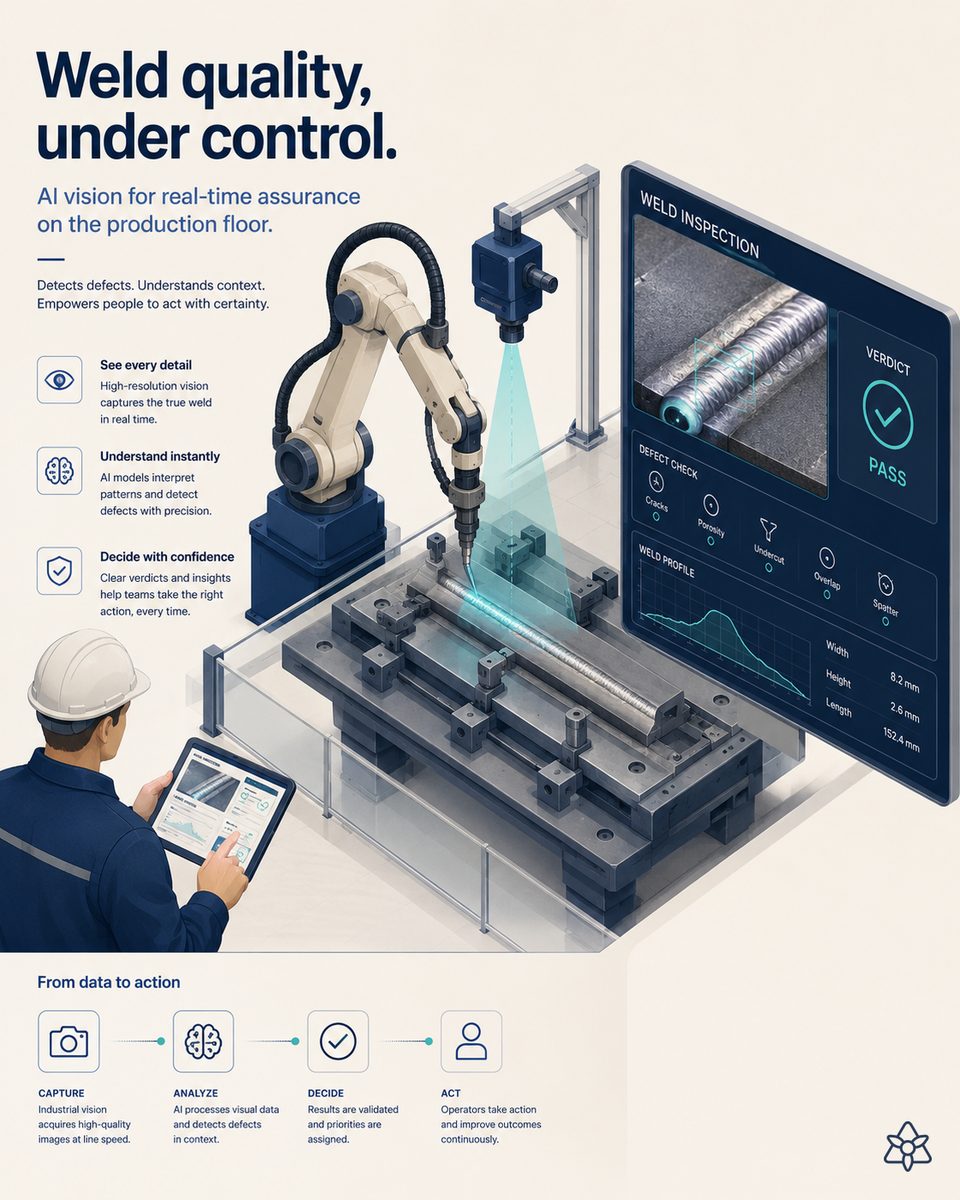
The vehicle leaves armored, but the proof that it is lives in four different filing cabinets.
An armored vehicle — civil or defense — is an assembly of ballistic steel, aramid or composite plates, cut, folded, overlapped and joined by weld beads that have to hold exactly what the protection level promises. Manufacturing combines three realities that in the shop each live on their own:
- The welding — high-hardness steel is unforgiving of heat input. Lack of fusion, cold cracking in the heat-affected zone, porosity, undercut at the plate edge. Today the control is the certified welder's eye and a sampled visual inspection. Whatever slips through moves on, and once the vehicle is painted it can no longer be seen.
- The material and the test — the steelmaker's heat certificate, the plate hardness, the result of the ballistic test on the coupon. Each arrives in its own format: a PDF by email, a hand-signed sheet, an external lab report. They are filed separately and cross-referenced by hand whenever someone asks.
- Traceability per vehicle — which heat went into which plate, which plate was fitted to which door, which welder ran which bead, which test backs that batch. Rebuilding that chain for a specific chassis number is detective work that can take days.
The quality manager lives between the three, and when a customer or an authority asks for the file of a vehicle delivered two years ago, the excavation through folders begins. It is not that the shop works badly — it is that the evidence that it works well is scattered across paper.
iLEAN does not change your welding process or your lab — it seals the crack between them and the vehicle dossier.
The problem in armoring is not buying more test equipment: it is that the welding station, the lab, the ERP, the steelmaker's certificate and the quality folder do not talk to each other in real time. iLEAN acts as putty between the systems you already have, without asking you to change your welding equipment, your test provider or your ERP.
Edge sees the bead and flags the suspect joint before the vehicle moves on. Connect captures the heat certificate and the ballistic test report whether they arrive by email, as a PDF or as a photographed report. The agent ties them to the chassis number and prepares the dossier — the certified person signs.
The three iLEAN pieces applied to an armoring shop:
- iLEAN Edge — a terminal with computer vision (CNN) over the welding stations and over the joint inspection bench. It detects beads with apparent lack of fusion, surface porosity, undercut and misaligned plate overlaps, and flags the joint for review by the certified inspector. It works with no network: if the bay is cut off, Edge keeps inspecting and recording reports, and syncs when it recovers.
- iLEAN Connect — captures the steelmaker's heat certificate whether it arrives by email, EDI or a photo of the delivery note; collects the weld report signed on the terminal instead of on paper; and digitizes the lab's ballistic test report at second zero. The folder of PDFs nobody ever opens again becomes usable data.
- iLEAN Agents — the agent cross-references heat ↔ plate ↔ bead ↔ test ↔ chassis number and assembles the auditable vehicle dossier that the customer, the authority or the insurer asks for. It does not sign: it prepares the dossier and hands it to the quality manager, who is the one who signs. The human signature is sacred; the three safety rings exist precisely to protect it.
A paper-based armoring shop vs. a shop traced with iLEAN
| Aspect | Manual + visual inspection + paper | With iLEAN Edge + Connect + Agents |
|---|---|---|
| Weld bead defect | Visual sampling; after paint it is invisible | The CNN flags the joint at the station, the inspector confirms |
| Weld report | Paper sheet and later transcription | Signed on the terminal, linked to the bead |
| Material heat certificate | PDF in the buyer's folder | Captured by Connect, linked to the plate |
| Ballistic test | Lab report filed separately | Digitized and tied to the plate batch |
| Per-vehicle dossier | Rebuilt by hand, days or weeks | Generated by the agent from the chassis number |
| Quality manager's signature | On a file rebuilt by hand | On a dossier prepared by the agent |
Impact estimate for your plant — to be validated with your numbers.
The block below is an estimate to be validated with the specific data of your shop. We put it forward so the committee has an order of magnitude; we refine it during the diagnostic.
- An armored vehicle manufacturer working in short or one-off runs, with two or three plate welding stations, a joint inspection bench and an engineering office that assembles each vehicle's dossier.
- Edge pilot on one welding station plus paperless capture of reports, certificates and tests. First value expected within a few weeks: the system flags a bead defect pattern that today is only caught by sampling.
- Expected reduction of joint rework ≥30% and of the time spent assembling the per-vehicle dossier ≥50%. Indicative payback between 6 and 12 months, depending on vehicle volume and on the engineering-office hours spent today rebuilding traceability.
- The hard levers are the rework hours on already-assembled bodies that get avoided and the quality hours won back for improving the process instead of digging through filing cabinets.
And the quality manager's reasonable doubt
“What if the CNN invents a defect or, worse, ignores a real lack of fusion?” — hallucination is a problem of free generation, not of anchored tasks. Flagging candidate beads on a joint and comparing them against the reference part is an anchored task: the best models brought error below 1.5% [1]. And even so, the system does not decide — it proposes, flags, records. The certified welding inspector's signature and the quality manager's signature stay exactly where they belong. The three safety rings exist precisely for this: the call on a part the occupant's life depends on is not closed by an AI, it is closed by a certified person.
[1] OpenAI paper “Why Language Models Hallucinate”, 2025 — on the reliability of AI in anchored tasks.
What people ask about vehicle armor with AI
What critical defects appear when welding armor plate?
Ballistic steel and high-hardness plate are unforgiving: badly controlled heat input produces cold cracking in the heat-affected zone, and on top of that come lack of fusion in the bead, porosity, undercut at the plate edge and misaligned overlaps between panels. On an armored vehicle, a bead with lack of fusion is not a cosmetic defect: it is the point where the assembly stops protecting. Edge vision trained with a CNN flags the suspect bead at the station, before the body moves on to paint and the defect is covered up for good.
How do you get full traceability for each armored vehicle?
The chain you have to be able to rebuild is always the same: material heat → plate → weld bead → test → vehicle. Today it lives in pieces: the steelmaker's certificate as a PDF, the shop's cutting sheet, the paper weld report and the ballistic test report in yet another filing cabinet. iLEAN Connect captures every link at second zero — the supplier certificate by email, a photo of the plate label, the weld report signed on the terminal — and the agent ties them to the chassis number. When someone asks about a specific vehicle, the dossier comes out in minutes, not weeks.
Does AI replace ballistic testing and the welding inspector?
No, and it should not. Ballistic testing on coupons and the judgment of the certified welding inspector remain the reference. What iLEAN does is take the paper out of the middle: Edge vision proposes and flags beads that are candidates for review, the inspector confirms or dismisses them with one tap on the terminal, and the test result is recorded with no intermediate transcription. The system does not decide on a safety part — it prepares the evidence and leaves it ready for the certified person to sign.
Does iLEAN work if the armoring shop has no stable network?
Yes. The iLEAN architecture rests on three safety rings designed for plants where the OT network is isolated by policy, or simply does not reach the welding bay properly. Ring 1 — PLCs, cutting equipment and the primary database — accepts no inbound connections; it only reads from a signed mailbox. Inference lives in ring 3, outside. If the shop loses connectivity, the Edge terminal keeps inspecting beads and recording reports locally, and syncs when the network comes back. No vehicle goes unrecorded because of a WiFi outage.
What does it cost and what payback should an armoring manufacturer expect?
The order of magnitude of an Edge pilot in an armoring shop is close to that of any Edge pilot in high unit-value manufacturing: an initial investment covering terminals + cameras over the welding stations + integration with the ERP and the certificate archive, plus the annual license. For an armoring manufacturer the hard levers are the rework hours saved on already-assembled bodies and the engineering-office hours saved when assembling the per-vehicle dossier. Indicative payback between 6 and 12 months — an estimate to be validated with your numbers. We send you the estimated ROI in 48h with your shop's data.
Related: Shipbuilding with AI · Non-destructive testing with AI · Material traceability by heat lot
More cases in other sectors
- REACH SVHC in textile dyes and finishes — the dossier should not cost a technician a whole week.How iLEAN Writer builds the REACH/SVHC file per roll and per supplier (dyes, finishes), audit-ready,…
- The lab confirms your basis weight complies — four hours after it stopped complying.How iLEAN Edge controls spunbond nonwoven g/m² in line, roll by roll, with sensors and AI agents that…
- UDI traceability for surgical hernia mesh under MDR — the implant file, ready when EUDAMED asks for it.iLEAN Tracer builds UDI traceability for surgical hernia mesh under MDR: batch file and chain of custody…
- 5-axis aerospace machining with AI — a titanium part with forty machine hours on it cannot be scrapped over a data point nobody cross-referenced.iLEAN cross-references the machining log, the CNC panel and CMM measurement into an AS9100 genealogy per…
- Aerospace heat treatment with AI — quality cannot be verified afterwards: you have to prove the curve was THE curve.How iLEAN captures the real furnace curve without touching it, links load ↔ curve ↔ part and prepares…
- Aircraft propeller control with AI — a live dossier per serial number, not a folder thrown together at the last minute.How iLEAN combines Edge vision, balancing machine readings and agents to certify every aircraft…
Tell us about your armoring shop and in 48h we'll send you the estimated ROI of this AI project for your plant.
We work on your shop's real data, not ours. Diagnostic with no commitment.
Request estimated ROI in 48h See other sectors