UDI traceability for surgical hernia mesh under MDR — the implant file, ready when EUDAMED asks for it.
Surgical hernia mesh is implanted for decades and controlled under MDR with a UDI per unit. If a surgeon's alert or a post-market notification arrives years later, the manufacturer has to close the chain of custody within hours. iLEAN Tracer assembles the UDI file per batch and maintains traceability all the way to the implanting hospital. The person signs.
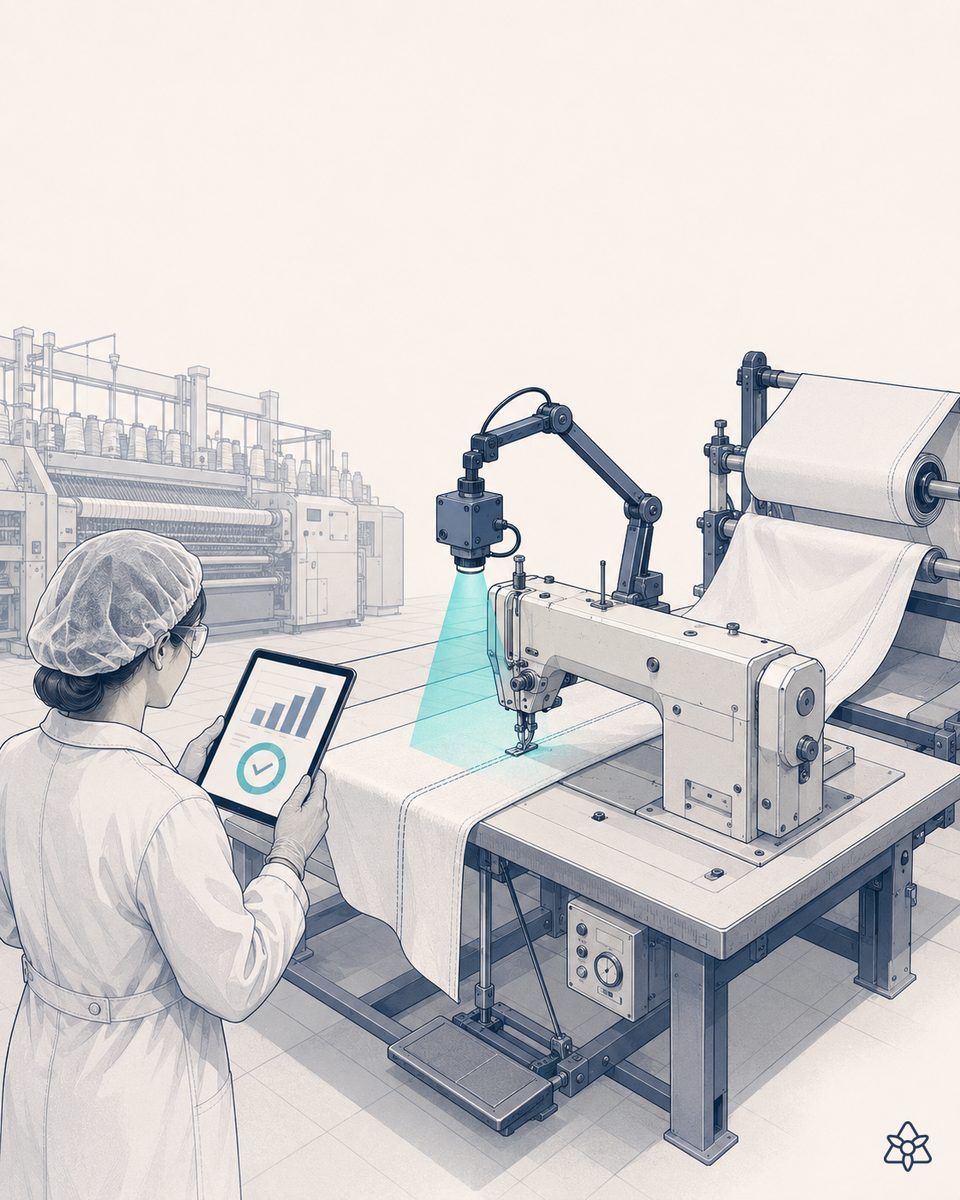
Five worlds that do not talk to each other, and one UDI that has to close them all.
The surgical hernia mesh chain crosses at least five links that almost never share a system:
- Raw material — implantable polymer (polypropylene, PVDF or PTFE) with a supplier certificate and traceability back to the resin batch.
- Knitting and cutting — warp knitting machine, pattern, areal weight, internal batch. In the MES, or on a sheet kept by the shift lead.
- Biocompatibility — ISO 10993 testing at an external laboratory, repeated whenever there are significant changes. In the LIMS, or in loose PDFs.
- Sterilization — ethylene oxide (ISO 11135) or gamma radiation (ISO 11137), often at an external provider. Certificate and cycle parameters in yet another system.
- Packaging, export and implantation — cleanroom, primary packaging, delivery note to the distributor, ASN to the hospital, confirmation from the supply manager.
While everything runs smoothly, the UDI is just a label. The day an FSCA or a post-market vigilance notification arrives, the UDI has to return that entire chain, closed, within hours — and normally the chain is not closed in any single system, but spread across five. The company is not being negligent: integrating those five worlds by hand was, until now, simply too expensive.
iLEAN Tracer does not add a sixth system — it seals the cracks between the five you already have.
The lack of MDR traceability is not an oversight: it is a real problem that went without a good solution for decades. Joining heterogeneous formats —the laboratory's PDF, the external provider's sterilization certificate, your own MES, the logistics ERP, the hospital's ASN— cost more than it returned. iLEAN acts as the putty that fills those joints at an affordable cost, without asking you to change ERP, MES, LIMS or sterilizer.
Connect captures every certificate wherever it lives. Tracer closes the UDI per unit and keeps the chain alive all the way to the hospital. When the FSCA arrives, the dossier goes out in minutes. The person signs.
The iLEAN pieces applied to MDR traceability of hernia mesh:
- Connect — captures, at second zero, whatever comes in by email (the implantable polymer certificate, the laboratory's ISO 10993 biocompatibility report, the ethylene oxide cycle certificate from the external sterilizer), by WhatsApp (an incident about a change of resin supplier), by API (receipt of the distributor's ASN) and by operator photo (cleanroom packaging parameters when the old machine has no export function). It leaves it all available to the agent.
- Tracer (the traceability agent) — lives in Central and cross-references every internal batch with the UDI registered in EUDAMED, with the raw material certificate, with the biocompatibility result, with the sterilization cycle and with the logistics destination. It hangs the whole technical dossier off the UDI — ready whenever the competent authority asks for it.
- Legacy integrations — ERP, MES and LIMS plug in exactly as they are. Connect resolves the external providers without asking them to change anything on their side.
And the safety boundary: Tracer assembles the dossier; the regulatory affairs manager signs the response to the authority. The three rings of the IRIS system guarantee that no response to EUDAMED or to an FSCA goes out without human validation — and that sensitive patient information, where it exists, is handled in the appropriate ring.
MDR traceability reconstructed by hand vs. a live chain with iLEAN Tracer
| Aspect | MDR traceability reconstructed by hand | With iLEAN Connect + Tracer |
|---|---|---|
| UDI of the unit | A label with no live dossier behind it | UDI with a file updated batch by batch |
| Implantable polymer certificate | In the buyer's inbox, in the supplier's format | Captured by Connect, linked to the internal batch |
| Biocompatibility result | PDF in the external laboratory's folder | Linked to the model and to the batch versions |
| External sterilization cycle | Provider's certificate, checked at close | Associated with the UDI from packaging onward |
| Chain up to the hospital | ASN and delivery note, with no link to the UDI | UDI ↔ hospital, ready for an FSCA |
| Response to EUDAMED / FSCA | Days or weeks reconstructing by hand | Complete, signed dossier in minutes |
Impact estimate for your plant — to be validated with your numbers.
The block below is an estimate to be validated with the specific data of your plant. We put it forward so the committee has an order of magnitude; we refine it during the diagnostic.
- Manufacturer of class IIb surgical hernia mesh under MDR, implantable polymer (PP/PVDF), outsourced EtO sterilization, hospitals in the EU plus exports.
- Tracer pilot connecting ERP + MES + LIMS + supplier mailboxes + the distributor's ASN. First automated UDI dossier within a few weeks.
- Indicative payback between 4 and 9 months, depending on UDI volume per year, PMS frequency and the hours spent today reconstructing files.
- Expected reduction in response time to an FSCA or to EUDAMED of ≥ 30% from the first month.
- The hard lever is a single FSCA closed in hours instead of weeks, and the difference between defending the model's CE marking or exposing it to suspension.
And the regulatory affairs director's reasonable doubt
“What if Tracer assembles the dossier with a sterilizer data point that does not belong there?” — hallucination is a problem of free generation, not of anchored tasks. Tracer invents nothing: it recontextualizes data that already exists (the polymer batch, the sterilizer load number, the ASN to the hospital) into the format of the UDI file. On anchored tasks, the best models brought the error below 1.5% [1]. And even so, the response to the authority never goes out without a human signature.
[1] OpenAI paper “Why Language Models Hallucinate”, 2025 — on the reliability of AI in tasks anchored to the source.
What people ask about MDR traceability of surgical mesh
What does the MDR require regarding UDI traceability of a surgical hernia mesh?
EU Regulation 2017/745 (MDR) classifies surgical hernia mesh as a long-term implantable medical device. It requires a UDI (Unique Device Identifier) per unit, registration of the manufacturer in EUDAMED, a technical file with ISO 10993 biocompatibility, sterilization validation (typically ISO 11135 for ethylene oxide or ISO 11137 for radiation) and documented traceability from raw material through to the implanting hospital, in case the device ever enters a post-market vigilance (PMS) notification or an FSCA.
Why does surgical mesh traceability break exactly when you need it?
Because the surgical mesh chain crosses five different worlds that do not talk to each other: polymer knitting (PP, PVDF, PTFE), cutting and heat-setting, laboratory biocompatibility, sterilization (sometimes outsourced), primary packaging in the cleanroom, export and, finally, the hospital customer. Every link uses its own system and its own spreadsheet. When a PMS notification or a surgeon's alert arrives years later, the UDI has to reconstruct that entire chain within hours — and usually it cannot.
What does iLEAN Tracer do for MDR traceability of hernia mesh?
Tracer is the iLEAN traceability agent — it lives in Central, feeds on Connect (which captures the polymer supplier's raw material certificates, the laboratory's biocompatibility reports, the sterilization certificates from the ethylene oxide or gamma provider, the cleanroom packaging records and the shipments to hospitals) and assembles the UDI file per unit. When a UDI comes up in EUDAMED, the dossier goes out automatically, complete and signed.
How is the chain of custody maintained all the way to the implanting hospital?
Connect captures the delivery note and the hospital's receipt confirmation (email, the distributor's ASN, acknowledgment from the supply manager), and Tracer matches the physical UDI of the unit with the implant recorded at the hospital. If a surgeon's alert about device XYZ arrives years later, the manufacturer closes the loop in minutes — which batch it was, which raw material it carried, which sterilizer it went into, which hospital it shipped to and which patient it was implanted in (when the hospital data is available).
How much does it cost to deploy Tracer for surgical mesh under MDR?
The Tracer pilot does not require touching the production line: it starts by connecting ERP, MES, LIMS and the buyer's mailboxes (polymer, external sterilizer and biocompatibility certificates), and delivers the first automated UDI dossier within a few weeks. A reasonable payback to present to the committee is in the order of several months; the hard lever is the difference between closing an FSCA in days or not being able to close it at all. We ask for your data and send you the estimated ROI in 48h.
More cases in other sectors
- PU sole defect detection in safety footwear with AI — the bubble shows up at demolding, not at the customer.How iLEAN Vision detects bubbles, insole debonding and off-shade color in injected polyurethane soles…
- REACH SVHC in textile dyes and finishes — the dossier should not cost a technician a whole week.How iLEAN Writer builds the REACH/SVHC file per roll and per supplier (dyes, finishes), audit-ready,…
- The lab confirms your basis weight complies — four hours after it stopped complying.How iLEAN Edge controls spunbond nonwoven g/m² in line, roll by roll, with sensors and AI agents that…
- Vehicle armor with AI — a badly welded bead is not a quality defect, it is the occupant's life.How iLEAN inspects weld beads, captures ballistic tests and builds the per-vehicle dossier in armored…
- 5-axis aerospace machining with AI — a titanium part with forty machine hours on it cannot be scrapped over a data point nobody cross-referenced.iLEAN cross-references the machining log, the CNC panel and CMM measurement into an AS9100 genealogy per…
- Aerospace heat treatment with AI — quality cannot be verified afterwards: you have to prove the curve was THE curve.How iLEAN captures the real furnace curve without touching it, links load ↔ curve ↔ part and prepares…
Tell us your case and in 48h we'll send you the estimated ROI of UDI traceability for surgical mesh in your plant.
We work on your plant's real data, not ours. Diagnostic with no commitment.
Request estimated ROI in 48h See technical textiles