REACH SVHC in textile dyes and finishes — the dossier should not cost a technician a whole week.
Complying with REACH and the retailer's MRSL in dyeing and finishing means cross-referencing the supplier's SDS, the dyeing lot, the lab test and the applicable standard — roll by roll. iLEAN Writer builds that file with an agent, holds the roll when an SVHC goes over the limit, and the person signs. The audit stops being a quarterly project.
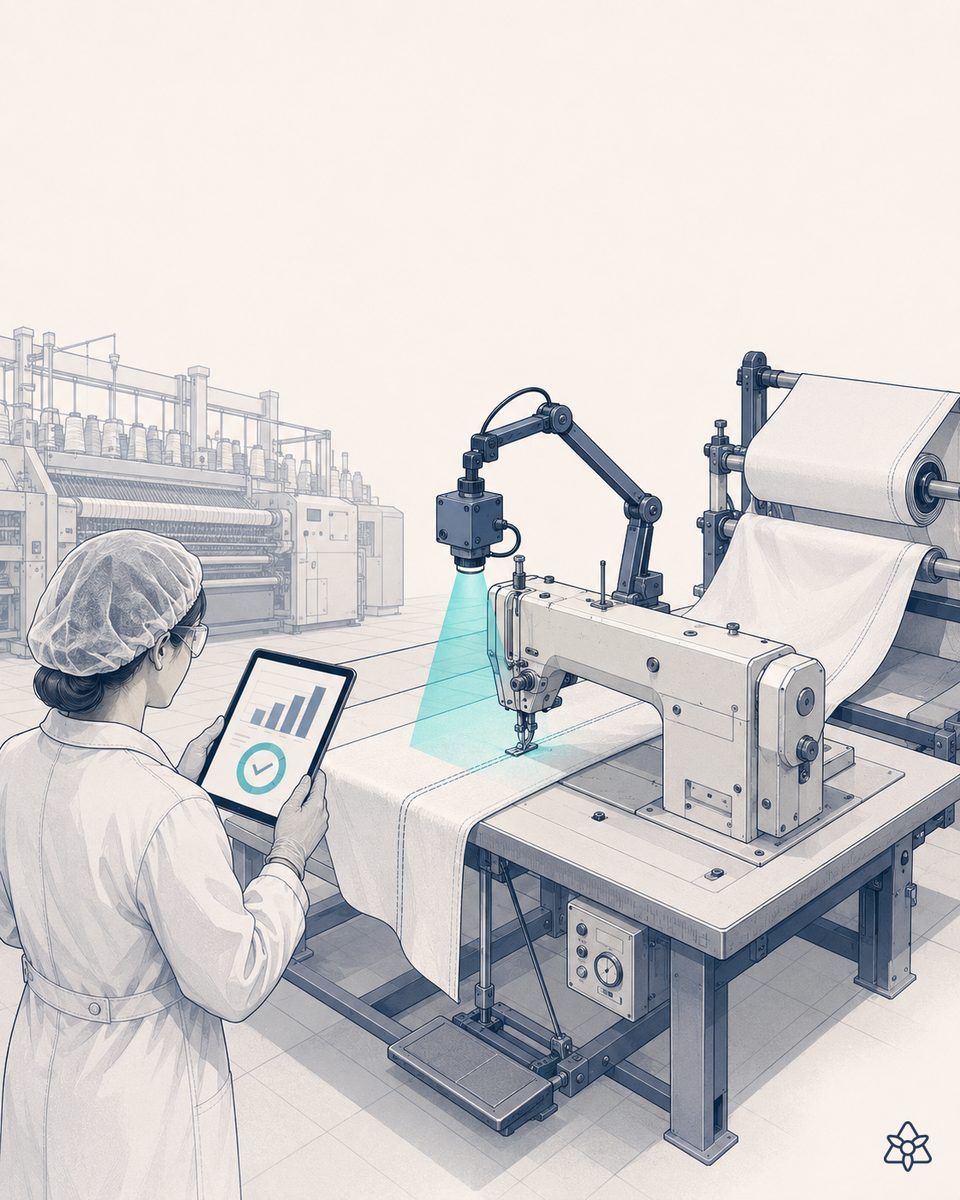
Four documents that are almost never in the same place — and a roll that ships anyway.
The REACH file of a dyed roll is the cross-reference of four pieces of data, each of which lives on a different island:
- The dye supplier's SDS — a PDF that arrived by email, that purchasing filed away in a folder, and that gets updated whenever the supplier reformulates. Almost always after the lot has already gone into production.
- The dyeing lot and the finishing auxiliaries — they live in the MES, on the shift lead's control sheet, or on both. Sometimes the quantity actually applied differs from the standard and nobody records why.
- The third-party test — the external lab sends yet another PDF with the results. If the result sits right on the limit, someone files it away “in case the customer asks”.
- The end customer's MRSL — the retailer's restriction list (ZDHC plus their own) that arrived by email six months ago with a spreadsheet attached. If the customer changed it mid-season, there is no guarantee the information ever reached the dyeing floor.
The quality manager knows the system works 99% of the time. That 1% is the container customs holds, or the roll the customer returns. A single SVHC-driven return pays for the whole year's dossier — and the brand damage weighs more than the hard cost.
iLEAN Writer does not add a fifth system — it seals the cracks between the four you already have.
The problem with the REACH file is not a lack of information: it is information living on islands that, at the critical moment (shipping the roll, the customer's MRSL change), does not reach the decision-maker in time. iLEAN acts as the putty that fills the gaps between ERP, MES, external lab and supplier email — without asking you to change anything.
Connect reads the SDS wherever it is — PDF, email, the supplier's WhatsApp message. Writer cross-references dye, lot, test and MRSL roll by roll. If a substance goes over the limit, it holds the shipment. The person signs — never the other way round.
The iLEAN pieces applied to the REACH/SVHC file in dyeing and finishing:
- Connect — captures the dye supplier's SDS whether it comes from email, from the chemical safety portal or from a PDF saved in a shared folder. It also captures the external lab test and the MRSL change the customer sent by email at 10 pm. Connect carries the data to the agent at second zero, with nobody having to forward anything.
- iLEAN Writer (Agents) — the agent that cross-references, roll by roll, the dye SDS, the dyeing lot from the MES, the lab result and the applicable MRSL, and builds the file with the declared concentrations against the limits. If an SVHC exceeds the threshold or an SDS has expired, it holds the roll and alerts the quality manager through the channel they already use.
- The three safety rings — the signed file lives in ring 1 (the OT network and the critical document system). The agent works in ring 3 at full speed; ring 2 validates that the declared substances match the supplier's; ring 1 only accepts the file once the person has signed it. The external audit enters ring 1 to read, not to operate.
Manual file vs. file cross-referenced with iLEAN Writer
| Aspect | Manual file + shared folders | With iLEAN Writer + Connect + Agents |
|---|---|---|
| Source of the SDS | PDFs in folders, updated by hand whenever someone remembers | Captured at second zero from the supplier's email/portal/WhatsApp |
| Cross-reference with the customer's MRSL | Sales rep's spreadsheet, copied by hand to the quality department | Automatic cross-reference roll by roll against the MRSL in force |
| Supplier formulation change | Detected when the complaint or the audit arrives | The agent cross-references it with the lots already produced and separates the affected ones |
| Time to build the dossier per roll | Hours of a technician's time for every audit | Ready the moment the lot closes, signed by the person |
| File for the external auditor | Rebuilt by hand in the preceding weeks | A dossier per roll, automatic, with SDS and test linked |
| Hold before shipping | Sampling inspection, risk of letting a nonconforming lot through | The agent holds the roll before the final file if something does not add up |
Impact estimate for your plant — to be validated with your numbers.
The block below is an estimate to be validated with the specific data of your plant. We put it forward so the committee has an order of magnitude; we refine it during the diagnostic.
- Mid-sized dyehouse + finishing operation, ~20-40 suppliers of dyes and auxiliaries, exporting to a European brand with a live ZDHC MRSL and retailer audits every 6-12 months.
- iLEAN Writer pilot on one dye family (the Pareto one: the group that accounts for the bulk of the rolls). First value expected within a few weeks: the dossier per roll ready when the lot closes, without waiting for the audit.
- Indicative payback between 4 and 9 months, depending on how often the customer changes the MRSL, the number of dye suppliers and the average cost of a returned roll or a container held at customs.
- Reduction in dossier preparation time per audit ≥ 30% (a defensible floor; the hard lever is a single SVHC-driven return avoided, which pays for the pilot).
And the compliance manager's reasonable doubt
“What if the AI misreads an SDS and lets a roll through with an SVHC in it?” — hallucination is a problem of free generation, not of anchored tasks. Here the agent invents nothing: it reads the SDS, extracts the substance, normalizes it to REACH vocabulary and compares it against an MRSL. On that class of task, the best models brought the error below 1.5% [1]. And even so, what is critical is not decided by the agent: iLEAN holds the file when there is doubt and the person signs. The three rings exist precisely for this.
[1] OpenAI paper “Why Language Models Hallucinate”, 2025 — on the reliability of AI in anchored tasks (reformatting/comparing/recontextualizing a piece of data from one system to another).
What people ask about REACH SVHC in textile dyeing and finishing
What does REACH require regarding SVHC substances in textile dyes and finishes?
The REACH Regulation (Annex XVII and the SVHC list in Annex XIV) requires you to declare and, in many cases, restrict the use of substances of concern —aromatic amines from azo dyes, phthalates, APEO, long-chain PFAS, free formaldehyde, chromium VI— in dyes and finishes that end up in contact with the consumer's skin. Retailers add their own MRSL (ZDHC and similar) with even stricter limits. When a roll travels from the dyehouse to the garment maker without the dossier proving those limits are met, the shipment can be held at customs or returned by the customer — and the brand pays for the damage.
Why does SVHC traceability break between the dye supplier and the shipped roll?
Because the information lives in four places that do not talk to each other: the dye supplier's safety data sheet (SDS) —a PDF last updated years ago—, the dyeing lot the operator wrote down on a control sheet, the third-party lab result that arrived as another PDF, and the customer's MRSL list that came in by email. When the audit comes around, someone reconstructs the cross-reference of all four by hand. And sometimes it does not add up, because the supplier changed the formulation and nobody updated the internal SDS.
How does iLEAN Writer build a REACH/SVHC file per roll?
iLEAN Writer is an agent that cross-references the dye supplier's SDS (captured by Connect even when it arrives as a PDF), the dyeing/finishing lot (captured from the MES or from the shift lead's spreadsheet), the external lab test and the end customer's MRSL. It builds the dossier roll by roll with the declared concentrations against the applicable limits and, if an SVHC exceeds the threshold or a dye's SDS has not been updated, it holds the file and alerts the quality manager. The dossier goes out signed by the person, never by the agent.
Does iLEAN Writer work even if every supplier sends the SDS in a different format?
Yes — this is precisely what modern AI does exceptionally well with very low hallucination: recontextualizing a piece of data from one format into another. Connect captures the PDF (or the email, or the supplier's WhatsApp message with the new sheet) and an agent extracts the declared substances, normalizes them to REACH vocabulary and cross-references them with your internal MRSL. It is an anchored task — the AI does not invent, it reads and compares — which is why reliability is high and the person validates in seconds instead of hours.
What happens if the customer changes their MRSL mid-season?
Connect captures it at second zero, whether it arrives by email, through a web portal or attached to the order. The agent re-evaluates the rolls in stock against the new MRSL and separates the ones that no longer comply before they reach shipping. That removes the classic situation: finding out about a limit change when the truck is already loaded, or when the container is sent back from the customer's warehouse. The customer sets the rule; iLEAN keeps the traceability; the person signs the final decision.
More cases in other sectors
- Outdoor membrane lamination control with AI vision — the bubble the eye cannot see is found by the customer's first wash.iLEAN Vision detects delamination, bubbles and poorly bonded areas in the waterproof-breathable membrane…
- The OEKO-TEX 100 audit is not won during the audit — it is won in the live file of every batch.How iLEAN Writer keeps the OEKO-TEX Standard 100 file always ready, cross-referencing batch, tests,…
- PU sole defect detection in safety footwear with AI — the bubble shows up at demolding, not at the customer.How iLEAN Vision detects bubbles, insole debonding and off-shade color in injected polyurethane soles…
- The lab confirms your basis weight complies — four hours after it stopped complying.How iLEAN Edge controls spunbond nonwoven g/m² in line, roll by roll, with sensors and AI agents that…
- UDI traceability for surgical hernia mesh under MDR — the implant file, ready when EUDAMED asks for it.iLEAN Tracer builds UDI traceability for surgical hernia mesh under MDR: batch file and chain of custody…
- Vehicle armor with AI — a badly welded bead is not a quality defect, it is the occupant's life.How iLEAN inspects weld beads, captures ballistic tests and builds the per-vehicle dossier in armored…
Tell us your case and in 48h we'll send you the estimated ROI of this AI project for your dyeing and finishing operation.
We work on your plant's real data, not ours. Diagnostic with no commitment.
Request estimated ROI in 48h See textile