Accelerated stability of the pigment batch — evidence tied to the batch, not a loose sheet.
An accelerated stability test — 50 °C oven, UV chamber, sedimentation — is worth exactly what its record is worth. Today specimens go into the oven with a marker-pen label, intermediate readings land in someone's personal spreadsheet, and when the complaint arrives six months later, tying that result to that batch is archaeology. iLEAN Tracer ties every specimen to its batch from minute zero and Writer composes the dossier from readings captured in the moment. The person signs the conclusion — the test stops being a loose sheet.
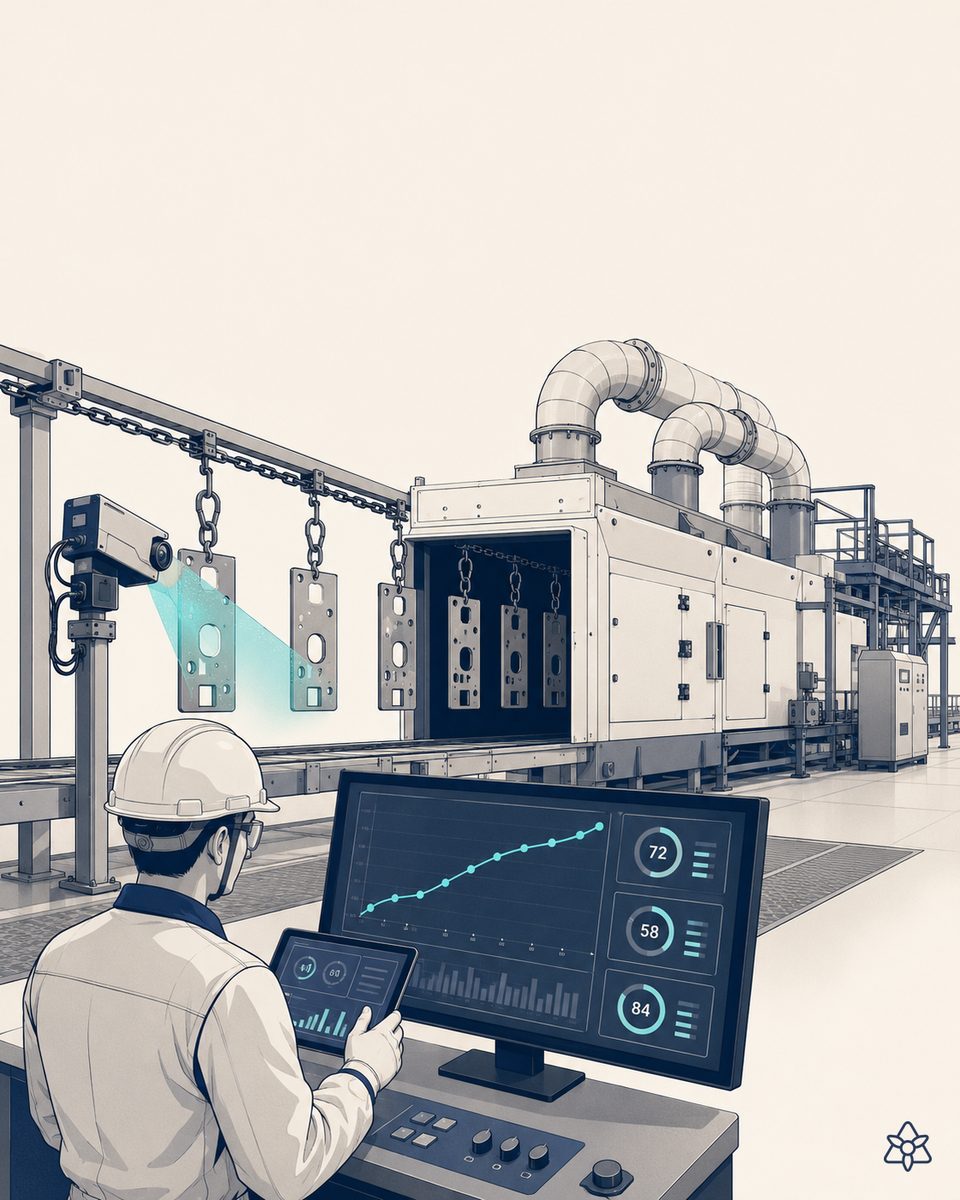
Marker-pen labels, personal spreadsheets — and the complaint arrives six months later.
The test itself is done well; what fails is everything that should outlive it:
- Specimens identified by marker pen — after three weeks in the oven among dozens of jars, nobody can guarantee which batch each one belongs to.
- Intermediate readings in personal files — color ΔE, viscosity change, sediment height, syneresis: written on sheets or in one person's spreadsheet. A checkpoint skipped over a weekend, and nobody knows.
- The result arrives after the batch has shipped — accelerated tests take days or weeks; if something goes wrong, the batch is already at the customer, and the finding rarely makes it back to the batch record.
- A claim or a customer audit means archaeology — reconstructing the stability test of one specific batch from folders, sheets and memory takes days, and what cannot be reconstructed does not count as evidence.
An accelerated test exists for two things: anticipating problems and standing as evidence. A result that cannot be tied to its batch does neither.
iLEAN does not change your protocols — it ties every specimen, reading and conclusion to the batch.
Stability does not fail for lack of an oven or a protocol; it fails because the record does not survive the three weeks of the test. iLEAN acts as the putty between the lab, the batch record and the quality archive, without touching the test method.
Tracer identifies the specimen. Edge captures each reading in the moment. The agent watches the checkpoint calendar and Writer composes the dossier — the person signs the conclusion.
The iLEAN pieces applied to accelerated stability:
- Tracer — every specimen is born with a QR tied to the batch and to the test protocol (40/50 °C oven storage, UV cycles, sedimentation standing time). No more marker pen.
- Edge — at each checkpoint, the technician scans the specimen and dictates or photographs the reading (colorimeter, viscometer, sediment ruler). The data lands tied to specimen, batch, time and author. It works without a network.
- Stability agent — watches the checkpoint calendar: if a reading does not arrive, it chases it the same day. If a ΔE or a sedimentation reading crosses the limit, it warns the manager in the moment, not at the close of the test. Writer composes the per-batch test dossier — and the person signs the conclusion.
Loose-sheet stability testing vs. batch-tied with iLEAN
| Aspect | Oven + loose sheets and spreadsheets | With iLEAN Tracer + Edge (per specimen and batch) |
|---|---|---|
| Specimen identification | Marker pen or generic label | QR tied to batch and protocol |
| Intermediate readings | Sheet or personal spreadsheet | Captured in the moment, with time and author |
| Skipped checkpoint | Nobody finds out | Chased by the agent the same day |
| Out-of-limit result | Seen when the test is closed | Manager warned in the moment |
| Test dossier | Assembled by hand if requested | Composed by Writer, per batch |
| Complaint six months later | Archaeology across folders | The batch's history in one click |
Impact estimate for your plant — to be validated with your numbers.
The block below is an estimate to be validated with the specific data of your plant. We put it forward so the committee has an order of magnitude; we refine it during the diagnostic.
- Manufacturer of pigment pastes, dispersions or preparations running oven, UV or sedimentation stability tests per batch or per campaign.
- Pilot: Tracer + Edge in the QC lab, on one test protocol. First value expected within a few weeks.
- Indicative payback between 6 and 12 months, depending on the cost of complaints and the lab hours currently spent recording and reconstructing.
- Hard levers: zero lost checkpoints; complaint response in hours instead of days; out-of-limit readings known weeks earlier, while something can still be done.
And the quality manager's reasonable doubt
"What if a dictated reading is captured wrong?" — it can happen, and that is why nothing is concluded alone. Hallucination is a problem of free generation, not of anchored tasks: where the AI merely records an instrument reading against a limit, the best models brought error below 1.5% [1]. Every reading stays reviewable next to its photo, and the conclusion of the test is signed by the lab manager — never by the system.
[1] OpenAI paper “Why Language Models Hallucinate”, 2025 — on the reliability of AI in anchored tasks.
What people ask about batch-tied stability testing
Which accelerated stability tests are run on a pigment batch or dispersion?
The usual battery combines heat storage (oven at 40–60 °C for days or weeks, watching viscosity, color ΔE and syneresis), UV or weathering exposure for lightfastness, and sedimentation tests (standing time or centrifuge, reading sediment height and how easily it redisperses). Each protocol has scheduled checkpoints with instrument readings — and the value of the whole exercise depends on those readings being recorded, on time, tied to the batch.
Why do these test records end up as loose sheets?
Because the test outlives the shift. A batch is made in a day; its stability test runs for weeks and passes through several hands. The specimen gets a marker-pen label, each checkpoint lands wherever its reader can write it, and the final conclusion — if the batch turned out fine — often never gets written at all. It is not negligence; it is that no system follows the specimen across three weeks. That is exactly the gap iLEAN fills.
How does iLEAN tie each specimen to its batch without changing the test protocol?
The protocol stays as it is: same ovens, same chambers, same checkpoints, same instruments. What changes is identification and capture: the specimen is born with a Tracer QR tied to batch and protocol; at each checkpoint the technician scans it and dictates or photographs the reading, and Edge stores it with time and author. The effort per checkpoint drops — scanning and dictating is faster than writing — and the record becomes evidence.
What happens if a checkpoint is skipped or a reading crosses the limit?
The agent watches the calendar of every specimen under test. If a checkpoint's reading has not arrived on its scheduled day, it chases the lab that same day — no more discovering the hole three weeks later. If a reading crosses the protocol's limit (a high ΔE, sediment above the mark), it warns the quality manager in the moment, when the batch may still be in the warehouse and something can be done. The person decides what follows — the agent never closes a test on its own.
What is this worth in a complaint or a customer audit?
Everything, because it turns the test from an internal exercise into evidence. When a customer claims six months later that the product settled or shifted color, you answer with the batch's stability dossier: specimens, readings with time and author, photos, and the signed conclusion — in one click, not after days of archaeology. In customer audits, showing batch-tied stability data with a complete checkpoint trail is the difference between an observation and a finding.
More cases in other sectors
- Satellite component control with AI — the part flies only once. So does the file.iLEAN combines Edge inspection, ECSS/AS9100 traceability and dossier agents to build satellite…
- Shipbuilding with AI — one badly finished seam on the slipway is a month of delay.How iLEAN inspects hull weld seams, block alignment and anticorrosion coating in shipyards, with Edge…
- Specialty chemicals — the batch you cannot repeat is the one nobody measured while it was being made.20 industrial AI cases in specialty chemicals: measured ink color, pigment dispersion, coating…
- Verification evidence in ATEX classified zones — AI documents and warns; protection and the work permit still rule.How iLEAN keeps evidence of every verification and every piece of equipment used in a chemical plant's…
- Exotherm during addition — see the trend before the reactor runs away. AI warns; the SIS rules.How iLEAN cross-references temperature and feed rate to anticipate an exotherm trend in specialty…
- CLP/GHS label verification with machine vision — this SKU's pictograms and H/P statements, not last batch's.How iLEAN Vision verifies the CLP/GHS label of every chemical container in line: pictograms, H and P…
Tell us your case and in 48h we'll send you the estimated ROI for your QC lab.
We work on your plant's real data, not ours. Diagnostic with no commitment.
Request estimated ROI in 48h See specialty chemicals