Exotherm during addition — see the trend before the reactor runs away. AI warns; the SIS rules.
In a semi-batch reactor running an exothermic reaction, safety is guaranteed by the SIS and the interlocks — and that must not change. What is missing today is margin: the operator sees the instantaneous temperature, not the trend crossed with the feed rate and with the cooling capacity that remains. iLEAN follows that trend read-only and warns minutes before the absolute value approaches the alarm, so the person can moderate the feed with room to spare. iLEAN does not replace the SIS and does not promise to prevent a thermal runaway: it assists and anticipates, underneath the safety layer.
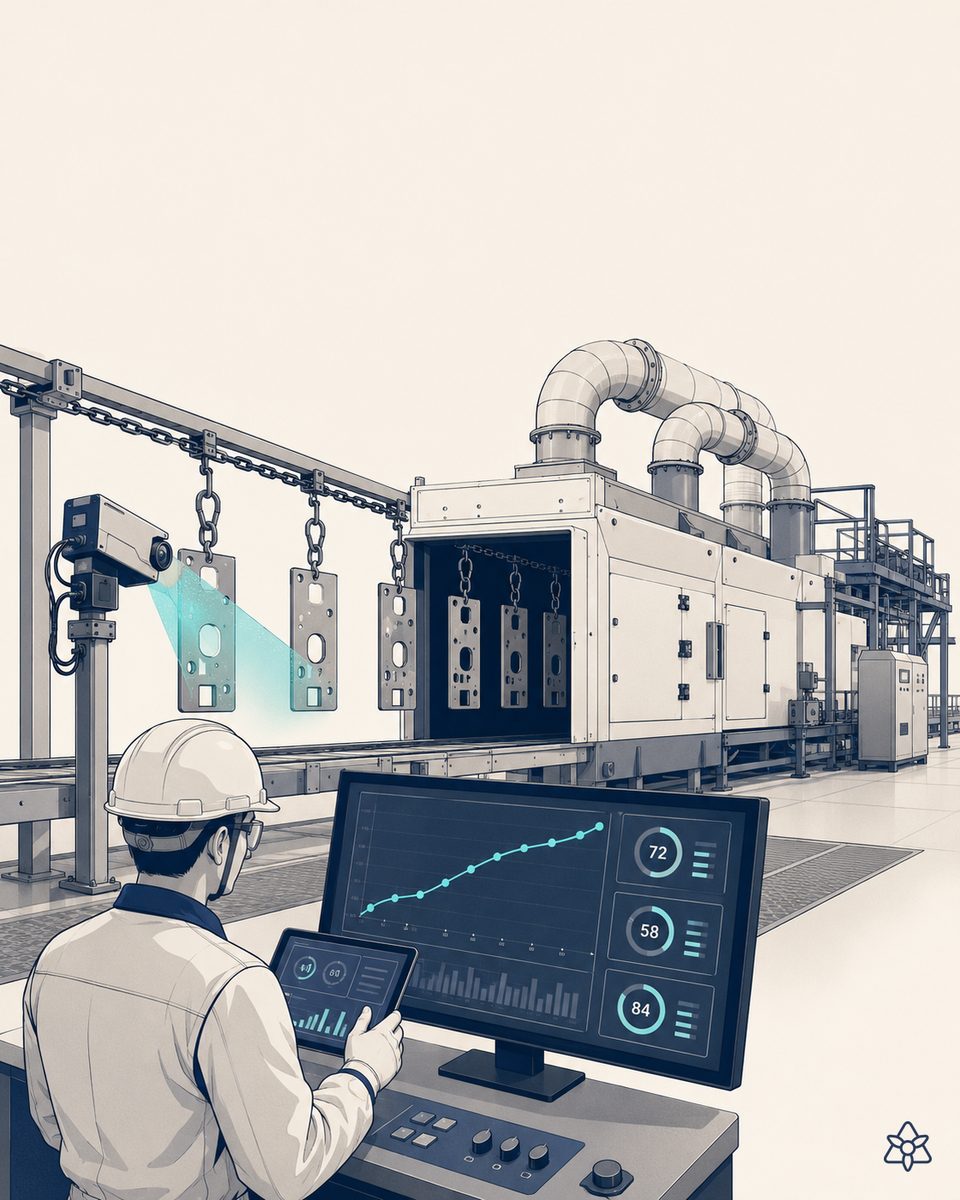
Between “all normal” and the DCS alarm there is a trend zone only the veteran can read today.
In a feed-controlled exothermic reaction, the classic risk is accumulation of unreacted reagent: the feed runs faster than the reaction consumes it, the inventory builds up and, when conversion kicks in, it releases its heat all at once. If that heat exceeds what the jacket can remove, the temperature takes off. The plant is protected — SIS, interlocks, rupture disc — but operationally:
- The operator sees values, not crossed trends — 78 °C is a calm number; 78 °C climbing at 2 °C/min with the jacket already maxed out is a different story. The DCS shows the first; only the twenty-year veteran reads the second.
- The alarm fires on the absolute value — by the time temperature reaches the threshold, the room to maneuver is down to scarce minutes, with feed still going in.
- Every interlock trip costs a batch — the SIS does its job, and that is exactly its purpose, but behind it come the aborted batch, cleaning, downtime and investigation.
- The close call leaves no usable record — the near miss is told at shift handover and lost; the full curve of what happened is rarely analyzed recipe by recipe.
The safety layer is not the problem — it is the last line, and it is not touched. The gap is earlier: nobody watches the shape of the curve while there is still ample margin to moderate the feed without drama.
iLEAN never enters the safety loop — it assists the operator underneath it, read-only.
The architecture is deliberately conservative: iLEAN connects to the DCS/SCADA read-only, writes nothing to the process, operates no valves or pumps and takes part in no safety function. The SIS and the interlocks (IEC 61511, at their SIL level) always rule, exactly as they would without iLEAN. The iLEAN layer is informational: the putty between the data the DCS already has and the decision the operator needs to make with margin.
Connect reads the DCS signals. The agent crosses temperature trend, feed rate and jacket-to-batch delta. Edge alerts the operator with context. The person moderates the feed; the SIS keeps ruling — never the other way round.
The iLEAN pieces applied to exotherm assistance:
- Connect — OPC UA/Modbus read-only from the DCS or SCADA: batch and jacket temperature, feed rate and cumulative feed, pressure, agitation. No writes, outside every control and safety loop.
- Exotherm agent — watches the shape of the curve: rise rate versus dosed feed, jacket-to-batch delta as the remaining-cooling indicator, cumulative feed with no thermal response as the accumulation signature. It compares against the normal behavior of that recipe and warns when the trend bends the wrong way.
- Edge — delivers the warning to the control-room or field operator with full context, and archives the episode's curve tied to the batch: every near miss stays documented for the process team and the next HAZOP.
Watching absolute values vs. trend assistance with iLEAN
| Aspect | DCS + threshold alarm | With iLEAN (trend assistance) |
|---|---|---|
| What the operator sees | Instantaneous temperature value | Trend crossed with feed and jacket-to-batch delta |
| Accumulation detection | Veteran's experience, if he is on shift | Feed-without-thermal-response pattern, live |
| Room to moderate the feed | Scarce minutes once the alarm fires | Early warning, with operating margin |
| Safety layer (SIS, interlocks) | Always rules | Always rules — iLEAN neither touches nor replaces it |
| Batches aborted by trips | Whatever the year brings | Fewer, because the person moderates before the threshold |
| Near-miss record | Verbal account at handover | Full curve archived per batch and recipe |
Impact estimate for your plant — to be validated with your numbers.
The block below is an estimate to be validated with the specific data of your plant. We put it forward so the committee has an order of magnitude; we refine it during the diagnostic. The reduction in trips comes from people moderating the feed earlier — never from touching the safety layer.
- Specialty synthesis plant with semi-batch exothermic reactors, DCS/SCADA running and an SIS validated to IEC 61511.
- Pilot on one reactor and its most delicate recipes (read-only Connect + trend patterns validated with the process team). First value expected within a few weeks.
- Indicative payback between 6 and 14 months, depending on the history of batches aborted or downgraded by exotherm episodes and their full cost (product, cleaning, downtime, investigation).
- Hard levers: fewer batches aborted by threshold approaches; every near miss documented with its full curve; the veteran's judgment available on every shift.
And the process safety manager's reasonable doubt
“What if the model is wrong?” — it can be, and that is why the architecture gives it no authority. A false warning costs a two-minute check; a correct one buys the margin that saves the batch. The asymmetry is favorable precisely because iLEAN sits outside the loop: no safety function depends on it. On the anchored task — comparing measured signals against the recipe's pattern — the best models brought error below 1.5% [1]. And even so, what is critical is never decided alone: iLEAN warns, the person decides and the SIS rules. The three safety rings exist precisely for this.
[1] OpenAI paper “Why Language Models Hallucinate”, 2025 — on the reliability of AI in anchored tasks.
What people ask about AI exotherm assistance in reactors
Why is the addition phase the critical exotherm moment in a semi-batch reactor?
Because in a feed-controlled exothermic reaction, the classic risk is accumulation of unreacted reagent: if the feed runs faster than the reaction consumes it — low temperature, spent catalyst, poor agitation — the reagent builds up. When conversion finally kicks in, all of that accumulated material releases its heat at once, and if the heat generated exceeds the cooling capacity of the jacket, the temperature takes off. The window to slow the feed exists, but it is measured in minutes, and you have to see it coming in the trend, not in the instantaneous value.
Does iLEAN replace the SIS or the reactor safety interlocks?
No, and it must not. Emergency shutdown, high-temperature feed cutoff, quench and venting are functions of the safety instrumented system (SIS) and the interlocks, designed and validated to IEC 61511 at their SIL level. That layer always rules and is never touched. iLEAN works underneath it, as an operator-assist layer: it connects read-only, writes nothing to the process, sits inside no safety loop, and none of its warnings substitutes for a safety function. iLEAN does not prevent a thermal runaway: it gives the operator minutes of anticipation to moderate the feed and stay away from the interlock threshold.
Which signals does iLEAN cross-reference to anticipate an exotherm trend?
The ones the DCS already logs, read read-only: the rate of rise of batch temperature (not just its value), actual and cumulative feed, the thermal delta between jacket and batch (which says how much cooling capacity is left), pressure and agitation. The dangerous pattern is recognizable: temperature climbing faster than the dosed feed justifies, or cumulative feed growing with no thermal response — the signature of accumulation. The agent compares the batch trend with the normal behavior of that recipe and warns when the shape of the curve goes wrong, minutes before the absolute value reaches the DCS alarm.
What does the operator do when iLEAN flags an abnormal trend?
What the operating procedure already prescribes — but with margin: slow or pause the feed, verify cooling, check agitation and catalyst, call the shift supervisor. The warning arrives with context — “temperature rise does not match the dosed feed; jacket-to-batch delta near its limit” — so the decision is fast and grounded. The decision always belongs to the person and the procedure; iLEAN operates no valves and no pumps. And if the situation ever reached the safety threshold, the SIS acts exactly as it would without iLEAN: that layer depends on no model.
If the SIS already protects the reactor, what does the iLEAN assist layer add?
The SIS protects people and plant, but every trip has a cost: an aborted or downgraded batch, cleaning, downtime, investigation and, over the years, the normalization of close calls. The assist layer works in the zone between “all normal” and “interlock threshold”: (1) fewer aborted batches, because the operator moderates the feed before getting near the threshold; (2) every close call documented — the full near-miss curve archived per batch, gold for the process team and the next HAZOP; (3) the veteran's nose made explicit — the trend he recognizes becomes a pattern available on every shift. The impact estimate is validated against your plant's own history of trips and aborted batches.
More cases in other sectors
- Specialty chemicals — the batch you cannot repeat is the one nobody measured while it was being made.20 industrial AI cases in specialty chemicals: measured ink color, pigment dispersion, coating…
- Accelerated stability of the pigment batch — evidence tied to the batch, not a loose sheet.How iLEAN ties every accelerated stability test — oven, UV, sedimentation — to its batch, with readings…
- Verification evidence in ATEX classified zones — AI documents and warns; protection and the work permit still rule.How iLEAN keeps evidence of every verification and every piece of equipment used in a chemical plant's…
- CLP/GHS label verification with machine vision — this SKU's pictograms and H/P statements, not last batch's.How iLEAN Vision verifies the CLP/GHS label of every chemical container in line: pictograms, H and P…
- Coating resin batch traceability — from the supplier's certificate to the finished product, with claims you can bound.How iLEAN Tracer ties every resin lot and its certificate of analysis to every finished product batch,…
- Net weight and closure control in drum and jug filling — every container verified before it hits the pallet.How iLEAN verifies net weight and closure on every drum and jug in a specialty chemical filling line:…
Tell us your case and in 48h we'll send you the estimated ROI for your exothermic synthesis reactors.
We work on your plant's real data, not ours. Diagnostic with no commitment.
Request estimated ROI in 48h See specialty chemicals