CLP/GHS label verification with machine vision — this SKU's pictograms and H/P statements, not last batch's.
The label error is the most treacherous defect in chemical packaging: the label is well printed, well applied and perfectly legible — it just belongs to another SKU, to the previous revision, or to the wrong language. Nobody stops it, because it does not look like a defect. iLEAN Vision reads every label in line and compares it against what the system expects for that batch: pictograms, H and P statement codes, destination-country language, batch number and trade name. If anything does not match, the container is set aside before palletizing. The person signs — the batch never ships on its own.
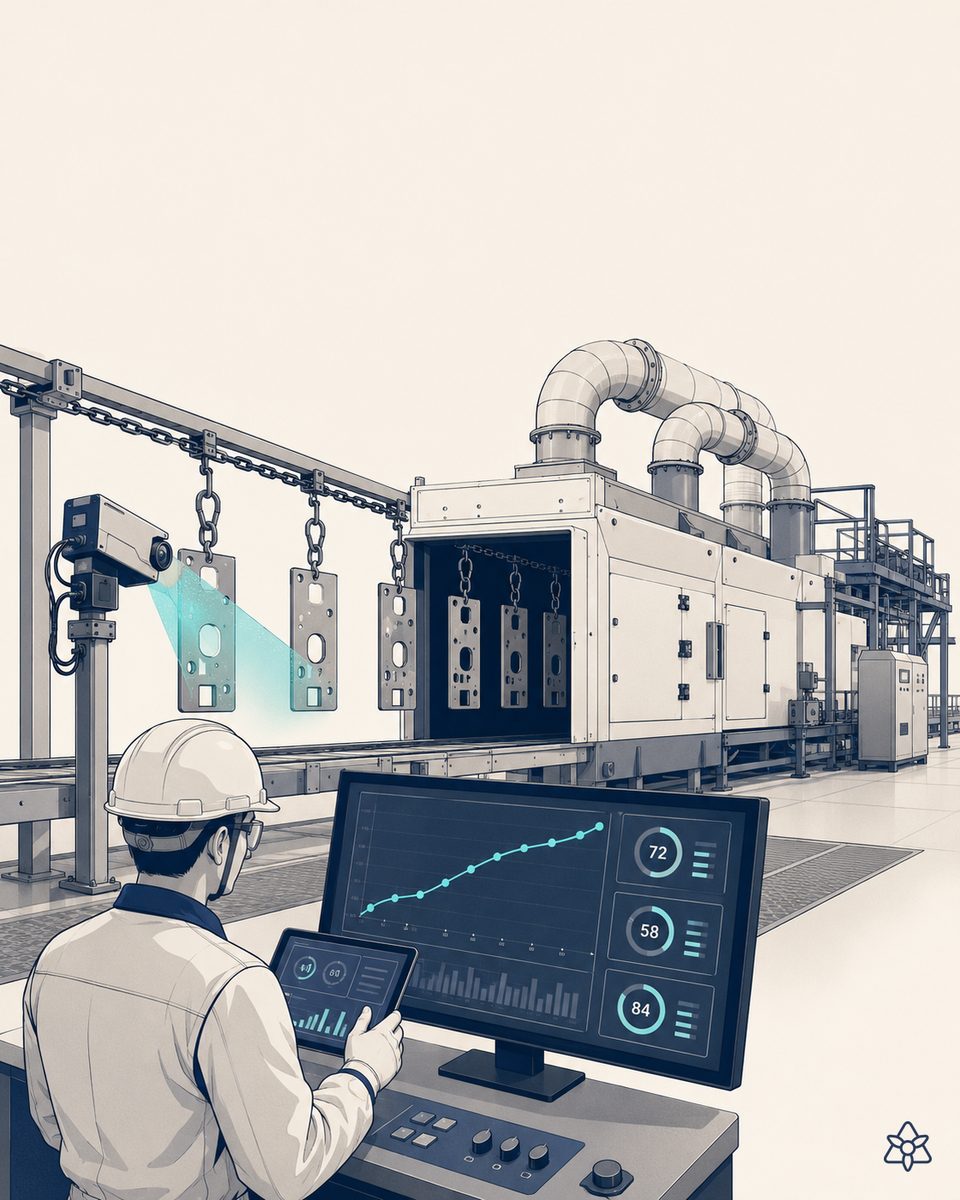
The wrong label does not look like a defect — which is exactly why nobody stops it.
A specialty chemicals plant juggles hundreds of SKUs, several classification revisions per SKU and export orders in half a dozen languages. The printer pulls its data from the system, yes — but between the system and the container climbing onto the truck there are gaps:
- Previous batch's labels left in the applicator — after a changeover, labels remain on the roll or in the tray, and the first containers of the new batch go out dressed as the previous SKU.
- Outdated template — the SKU's classification changed, the label template did not. The whole batch ships with the previous revision's H and P statements, impeccably printed.
- Destination language — the order goes abroad and ships with the plant's usual language. At destination, that label says nothing to the person who needs to read it.
- Twin SKUs — two products with nearly identical trade names and different classifications share a line. The operator grabs the roll next door and nobody notices, because the label "looks right".
The classic control is the operator's eye at line speed, and a correct label for the wrong SKU is precisely what the eye does not catch. The defect travels all the way to the customer's receiving dock, the inspection or the incident — the three most expensive places to discover it.
iLEAN does not redefine your labels — it verifies that the container leaving the line wears the one your technical team defined.
The classification of each product and the content of its label are defined by your technical or regulatory team under the CLP/GHS framework that applies to your markets. iLEAN does not interpret regulations: it acts as the putty between that definition, the labeling line and the order, and verifies the match unit by unit.
Vision reads every label in line. The agent compares it against the SKU, the revision and the destination of that batch. If anything does not match, the container is set aside. The person signs — never the other way round.
The iLEAN pieces applied to CLP/GHS labeling:
- Vision — a camera over the labeling line. It reads pictograms, H and P statement codes, language, batch number and trade name from every applied label, with a photographic record per container. No need to stop the line.
- Edge — a terminal at the line. It identifies the batch and the order in progress, and shows the operator the expected-versus-read comparison when something is off. It works without a network: if the plant loses its connection, it keeps capturing locally.
- Label agent — cross-references what was read against what is defined for that SKU, revision and destination country. An isolated failure sets the container aside; a repeated failure is treated as a source failure (roll or template) and holds the batch until the supervisor reviews and signs. The person decides — the batch never ships on its own.
Eyeball check at line speed vs. label verified with iLEAN Vision
| Aspect | Operator's visual check | With iLEAN Vision (unit by unit) |
|---|---|---|
| SKU pictograms | Checked "at a glance" | Compared against that SKU's definition, container by container |
| H and P statements | Illegible at line speed | Codes read and compared against the current revision |
| Destination-country language | Depends on someone checking the order | Automatic comparison against the order's destination |
| Previous batch's label after changeover | The first containers slip through | Caught on the first container of the new batch |
| Evidence of what shipped | None, or an archived sample | Photo of every container's label, tied to the batch |
| Repeated failure (roll/template) | Discovered after the batch has shipped | Flagged as a source failure, batch held |
Impact estimate for your plant — to be validated with your numbers.
The block below is an estimate to be validated with the specific data of your plant. We put it forward so the committee has an order of magnitude; we refine it during the diagnostic.
- Specialty chemicals plant with a broad catalog (hundreds of SKUs), multilingual CLP/GHS labeling and frequent changeovers on the filling lines.
- Pilot on one labeling line (Vision camera + Edge at the line). First value expected within a few weeks.
- Indicative payback between 3 and 9 months, depending on containers/day, number of languages served and the average cost of a label incident (relabeling at destination, returns, holds at inspection).
- Hard levers: label errors caught in line rather than at destination; a per-container photographic record that turns any labeling dispute into a lookup; an end to twin-SKU risk at changeovers.
And the quality manager's reasonable doubt
“What if the vision system confuses a pictogram?” — false positives exist, and that is why the system never decides alone. Hallucination is a problem of free generation, not of anchored tasks. In tasks where the AI merely compares the pictograms and codes it reads against a list defined for that SKU, the best models brought error below 1.5% [1]. And even so, what is critical is never decided alone: iLEAN warns and the operator or the quality manager sign. The three safety rings exist precisely for this.
[1] OpenAI paper “Why Language Models Hallucinate”, 2025 — on the reliability of AI in anchored tasks.
What people ask about CLP/GHS label verification with vision
Why is a label error the most expensive defect in a specialty chemicals plant?
Because the CLP/GHS label is what tells the carrier, the warehouse and the end user what they are handling and how to protect themselves. A container wearing another SKU's pictograms, H and P statements that do not match the product, or the wrong language is not a cosmetic defect: it is a container that fails to communicate the real hazard of what it holds. And unlike a product defect, nobody stops it: the label is well printed, well applied and perfectly legible — it just belongs to something else. It gets discovered at the customer's receiving dock, in an inspection or, in the worst case, in an incident.
How does a wrong label slip through if the printer pulls its data from the system?
Through the gaps between systems, and in chemical labeling there are many: labels from the previous batch left in the applicator after a changeover; a label template that was never updated with the latest revision of that SKU's classification; an export order shipping with the plant's usual language instead of the destination country's; or two SKUs with nearly identical trade names and different classifications sharing the same line. In every case the printing is correct — what is wrong is what got printed or what got applied. That is why the check has to look at the container leaving the line, not at the print order.
What exactly does iLEAN Vision check on each label?
The camera over the line reads every label and compares it against what the system expects for that specific batch: that the pictograms present are the ones defined for that SKU (none missing, none extra), that the printed H and P statement codes match that SKU's file, that the language is the destination country's for that order, and that batch number, trade name and supplier details are legible and correct. The definition of which pictograms and statements belong to each SKU comes from your technical team — the classification of your products is yours, not the AI's; iLEAN verifies that what leaves the line matches that definition.
What happens when a label does not match what is expected for that batch?
The agent catches it container by container, in line. If a pictogram does not belong, a statement is missing or the language is not the order's destination, it warns the operator at second zero through the earpiece or on the panel, and the container is set aside before palletizing. If the failure repeats — the classic signature of an outdated template or the wrong roll in the applicator — the agent flags it as a source failure rather than isolated ones, and holds the batch until the supervisor reviews it. The person decides and signs; the system contributes the photo of every label as evidence of what shipped and what was set aside.
Does this replace the regulatory review of labels by the technical team?
No, and it matters to say it plainly: the classification of each product and the regulatory content of its label are defined by your technical or regulatory team under the CLP/GHS framework that applies to your markets — iLEAN does not interpret regulations or decide which pictograms a product carries. What iLEAN removes is the gap between that definition and what physically leaves the line: the correct label defined in the system is worth nothing if the container went out wearing the previous batch's. The vision check verifies the match, unit by unit, and keeps a photographic record of every container shipped.
More cases in other sectors
- Accelerated stability of the pigment batch — evidence tied to the batch, not a loose sheet.How iLEAN ties every accelerated stability test — oven, UV, sedimentation — to its batch, with readings…
- Verification evidence in ATEX classified zones — AI documents and warns; protection and the work permit still rule.How iLEAN keeps evidence of every verification and every piece of equipment used in a chemical plant's…
- Exotherm during addition — see the trend before the reactor runs away. AI warns; the SIS rules.How iLEAN cross-references temperature and feed rate to anticipate an exotherm trend in specialty…
- Coating resin batch traceability — from the supplier's certificate to the finished product, with claims you can bound.How iLEAN Tracer ties every resin lot and its certificate of analysis to every finished product batch,…
- Net weight and closure control in drum and jug filling — every container verified before it hits the pallet.How iLEAN verifies net weight and closure on every drum and jug in a specialty chemical filling line:…
- Gravimetric dosing of minor additives — what went in and how much, signed in the moment.How iLEAN captures from the scale which additive was dosed and how much, checks it against the formula…
Tell us your case and in 48h we'll send you the estimated ROI for your labeling line.
We work on your plant's real data, not ours. Diagnostic with no commitment.
Request estimated ROI in 48h See specialty chemicals