Car air conditioning control with AI — an R-1234yf leak is not an incident, it is a regulated cost.
A car's A/C brings together three different physics — joints and O-rings, tightness and refrigerant charge and compressor function — in separate systems. iLEAN Edge sees the seals before close-out, Connect cross-references the charging bench with the compressor/condenser/evaporator batch, and the agents hold any assembly that does not add up before it ships to the OEM. The person signs.
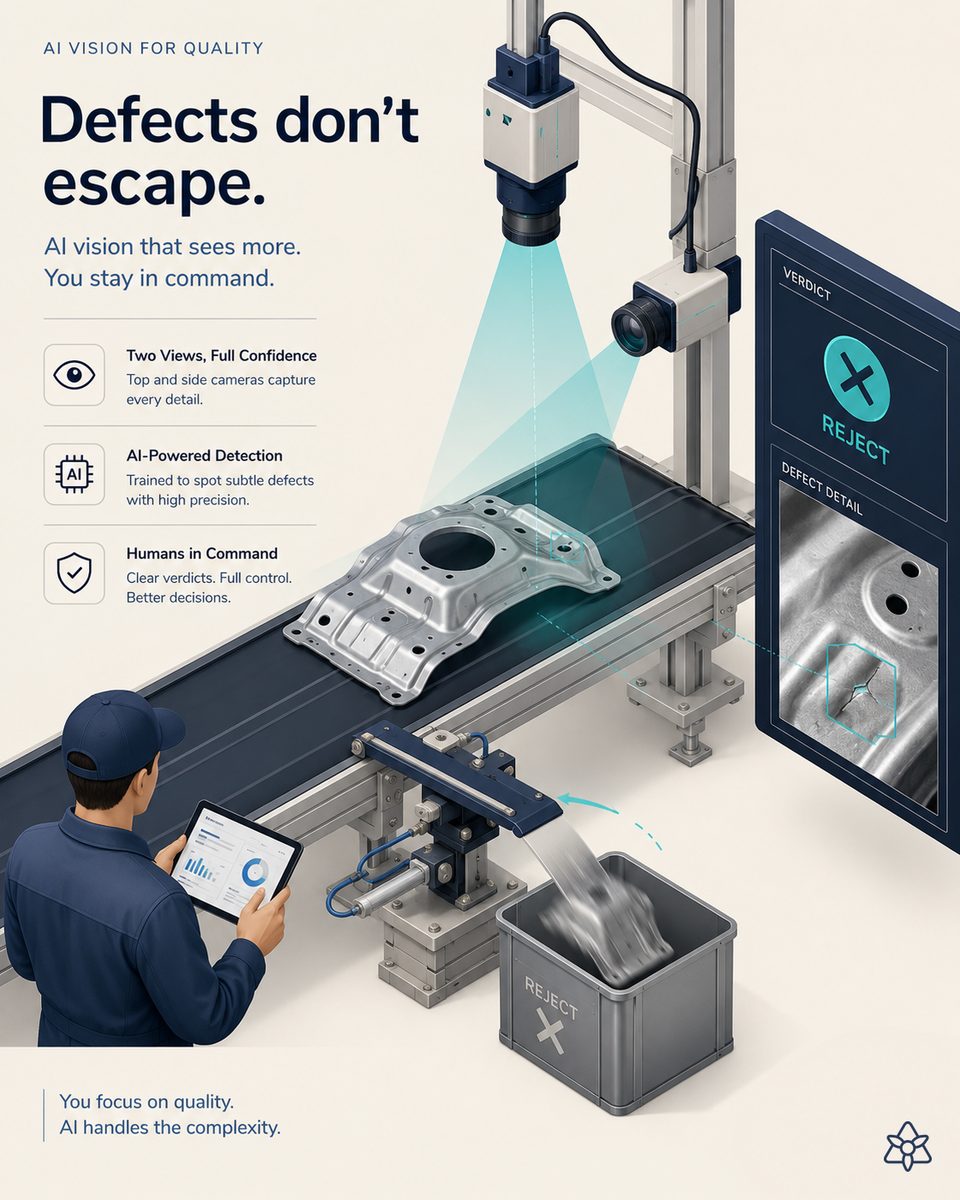
The A/C that charges perfectly on the bench and loses refrigerant in the customer's car.
A cabin A/C system brings together a compressor, a condenser, an evaporator, an expansion valve, pipework and a handful of O-rings. The refrigerant leak is almost never in the new component: it is in the joint, in the seal twisted on the final tightening, in the connection badly indexed before the dashboard is closed up.
The realities of control live on separate islands:
- Assembly — smart nutrunners with their own software, O-rings arriving on a tray, SKU changeovers several times a shift.
- The charging bench — helium for tightness, R-1234yf for charging, functional test. An industrial PC with proprietary software.
- Refrigerant compliance — R-1234yf has a GWP regulated in the EU; every gram lost counts and leaves a documentary trail.
The quality manager knows that the leak pattern repeats on specific O-ring batches or when a nutrunner has drifted out of calibration. What they do not have is a way to cross-reference it in real time with every assembly. By the time the OEM sends a batch back, the pattern had been there since a night shift.
iLEAN does not replace your nutrunner or your helium bench — it seals the cracks between them.
The problem is not a lack of information: the nutrunner has it, the bench has it, the ERP stores the component batch. It is information in islands that is never cross-referenced by assembly number in real time. iLEAN acts as the putty between assembly, bench and compliance, without asking you to change any equipment.
Edge sees the seal before close-out. Connect reads the bench and the nutrunner at second zero. The agent correlates the leak pattern with the seal batch and holds the assembly before shipping.
The three iLEAN pieces applied to car A/C control:
- Edge — a terminal with machine vision (CNN) over the joining station and before the dashboard is closed up. It verifies the presence and orientation of every O-ring, the position of the connector and the geometry of the joint. It fires a light or an ejector in milliseconds. It works without a network.
- Connect — captures the nutrunner torque, the log from the helium + R-1234yf bench, the compressor/condenser/evaporator/seal batches from the ERP and the supplier notices that arrive by email or WhatsApp. All of it cross-referenced with the assembly number.
- Agent — correlates leak patterns with O-ring batches and with the history of returns. When a pre-failure pattern appears (a suspect batch from a specific supplier), it warns the shift lead and proposes holding the affected assemblies. The person validates and signs; the line does not restart by itself.
Classic control vs. cross-referenced control with iLEAN
| Aspect | Classic control | With iLEAN Edge + Connect + Agent |
|---|---|---|
| O-ring inspection | Operator's eye before close-out | CNN on every joint, ejection in milliseconds |
| Nutrunner torque | Log in proprietary software | Captured and cross-referenced by assembly no. |
| Helium + R-1234yf bench | CSV at the end of the shift | Integrated with assembly in real time |
| O-ring batch traceability | Separate ERP, manual cross-check | Automatic cross-check with every assembly |
| Refrigerant compliance (GWP) | Monthly spreadsheet | Automatic dossier per unit |
| Operation without a network | n/a | Edge keeps inspecting on the panel's own power |
Impact estimate for your plant — to be validated with your numbers.
The block below is an estimate to be validated with the specific data of your plant. We put it forward so the committee has an order of magnitude; we refine it during the diagnostic.
- Tier 1 plant with a cabin A/C assembly line (compressor + condenser + evaporator + pipework), helium bench + R-1234yf charging, IATF 16949 / OEM level 3 PPAP.
- Edge pilot on the joining and close-out station (vision over the O-rings + integration with the nutrunner and the bench). First value expected within a few weeks.
- Reduction in leak PPM of the order of 30% or more, depending on the starting point and the discipline of the current control plan.
- Indicative payback between 4 and 9 months. The hard lever is a single return for a leak: OEM penalty, rework, recharging a regulated refrigerant, brand damage.
And the quality manager's reasonable doubt
“What if the AI fails and lets a displaced O-ring through?” — hallucination is a problem of free generation, not of anchored tasks. In tasks where the AI merely recontextualizes a piece of data from one system into another (seeing the seal, comparing the torque, cross-referencing with the bench), the best models brought error below 1.5%[2]. And even so, what is critical is never decided alone: iLEAN holds the assembly and the person signs. The three safety rings exist precisely for this.
[1] Automotive quality standard of the order of 25 PPM — Symestic.
[2] OpenAI paper “Why Language Models Hallucinate”, 2025 — on the reliability of AI in anchored tasks.
What people ask about AI control of car air conditioning
Which defects come back again and again in a car A/C system, and how are they caught on the line?
Three defects keep coming back: an R-1234yf refrigerant leak from a badly tightened joint or a displaced O-ring, a condenser or evaporator with a damaged fin, and a compressor with a torque or pressure deviation on first start-up. Today they are caught at the refrigerant charging bench or, worse, on the OEM's assembly line. With iLEAN Edge, CNN vision inspects joints and seals before close-out, Connect cross-references the tightness bench log with the component batch, and the agent holds the assembly before shipping. The person signs.
How is the refrigerant charging test cross-referenced with system traceability?
Today, badly. The charging bench (helium for tightness + R-1234yf for charging + functional test) usually has its own PC; the ERP holds the batch of the compressor, the condenser and the evaporator; PPAP requires traceability by VIN or assembly number. iLEAN Connect captures the bench log at second zero and links it to the assembly number. The agent correlates leak patterns with component batches, and when a pre-failure pattern appears (an O-ring batch under suspicion), it warns the shift lead before the next assembly.
What does the OEM require for A/C under IATF 16949 / PPAP?
The OEM requires traceability per assembly, a tightness and charge record per unit, control of batch changes for O-rings and compressors, a signed control plan and a refrigerant compliance dossier (R-1234yf, with GWP regulated in the EU). The quality standard sits around 25 PPM. iLEAN Connect generates the dossier per assembly automatically — the auditor opens the file instead of asking for a spreadsheet reconstruction.
Can iLEAN Edge inspect the O-rings and joints before close-out?
Yes. Edge is a terminal with machine vision (CNN) over the joining station and before the assembly is closed out. It inspects the presence and position of every O-ring, the torque applied by the nutrunner cross-referenced with the plan, and the geometry of the connector. If something does not add up, it fires a light or an ejector in milliseconds. It works without a network: as long as Edge has power, the cycle continues. Traceability syncs when the network comes back.
How much does an Edge pilot for a car A/C line cost?
The order of magnitude is in line with any Edge pilot in automotive Tier 1: an initial investment covering vision terminals + actuator + integration with the charging bench and the ERP/MES, plus the annual license. A reasonable payback of a few months — the hard lever is the cost of a single leak found at the OEM's plant (penalty + rework + recharging a regulated refrigerant). We ask for your plant's data and send you the estimated ROI in 48h.
Related: water pump · radiator / heat exchanger · instrument panel.
More cases in automotive
- Visual defects on body panels — deflectometric light, an eye that never tires, on every part.iLEAN Vision detects dents and scratches on body panels with deflectometric lighting. 100% inspection,…
- Torque traceability by bolted joint — a badly tightened fastener is not a penalty, it is a mass recall.iLEAN stores the torque and angle value of every critical bolted joint together with its part and its…
- Brake disc and caliper control with AI — the part that cannot afford a single escape.How iLEAN cross-references Edge vision on the disc machining line, critical caliper torque and VIN…
- Car hydraulic lines with AI — a line that passes the leak test can be a leak six months from now.How iLEAN cross-checks bending vision, leak testing and batch traceability to certify automotive…
- Car upholstery with AI — the shade and the stitching are caught the first time, or they are caught at the dealership.How iLEAN inspects leather, fabric and stitching in car upholstery with AI vision, anticipates shade and…
- KTL/cataphoresis control with AI — the bath drifts hours before the paint fails; finding out in the touch-up booth is too late.iLEAN keeps the KTL bath in spec — pH, temperature, conductivity — and warns you before paint quality…
Tell us your case and in 48h we'll send you the estimated ROI of this AI project for your A/C line.
We work on your plant's real data, not ours. Diagnostic with no commitment.
Request estimated ROI in 48h See automotive