Car hydraulic lines with AI — a line that passes the leak test can be a leak six months from now.
A correct hydraulic line is the intersection of four things — the actual bend, the weld, the flare and the leak test. iLEAN sees every step and cross-references the image with the batch and the test, assembling the PPAP / IATF 16949 file on the fly. When something does not add up, the part is held and the person signs — you do not contain a whole batch out of fear.
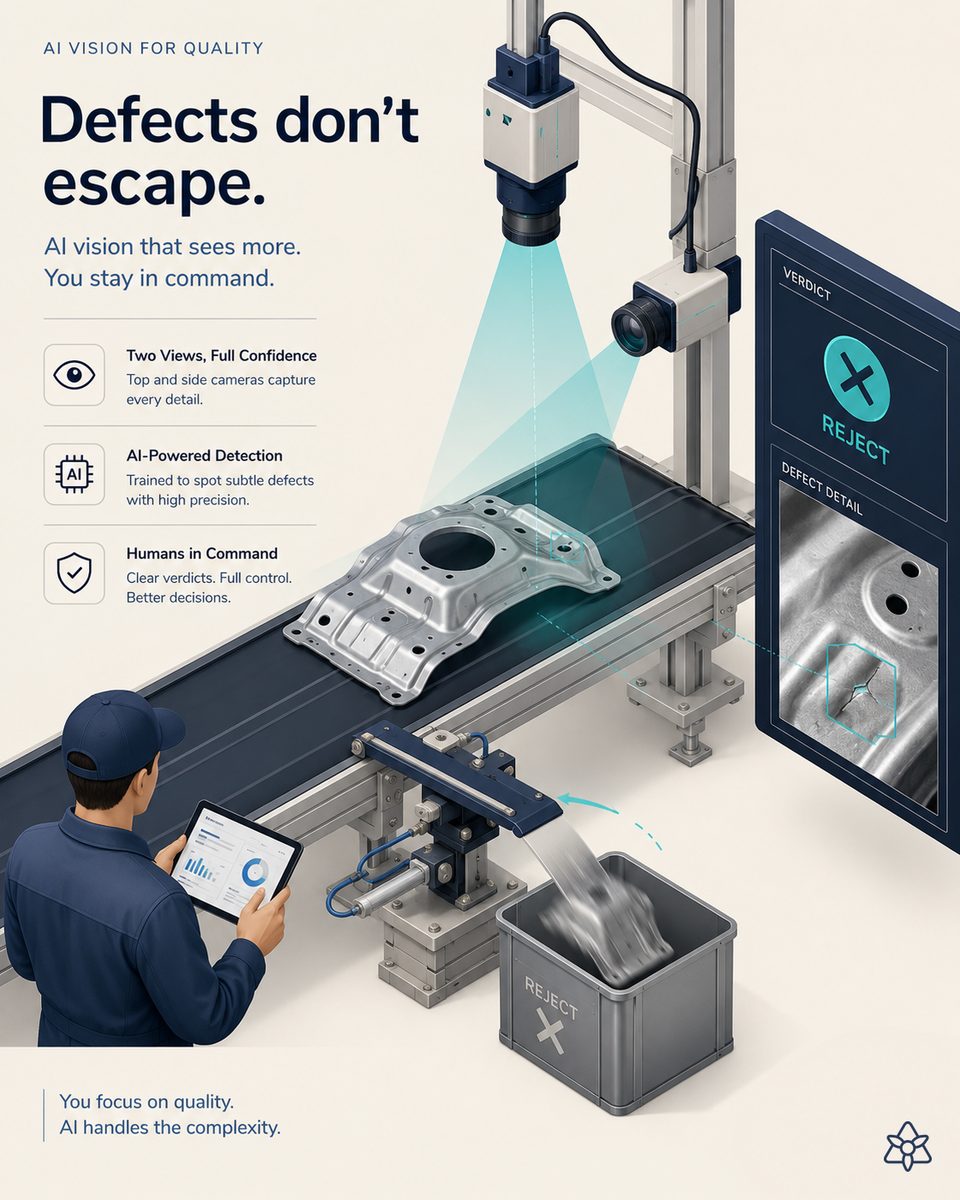
Three critical steps and a final test that detects too late.
Anyone manufacturing hydraulic lines for brakes, power steering, transmission or cooling lives with three pains:
- Bending — ovalization at the bend, internal wrinkles, a microscopic crack in the outer fiber. The part passes visually and the defect stays hidden.
- The connector weld — a bead with lack of penetration holds the pressure of the test bench and fails under real vibration in the car.
- The flare — geometry out of tolerance that the operator forces into place and that ends up as a slow leak. The customer finds it months later.
The leak test detects the gross leak, but not the root cause nor the defects that will show up with mileage. When the customer returns a batch, you contain a thousand units because classic traceability is by the hour, not by the part. The classic system runs on fear: contain just in case, contain everything, contain late.
And the OEM customer is demanding PPM levels on the order of 25 parts per million [1]. At that figure, there is no room for "it passed the test, we're done".
iLEAN does not replace your leak test bench — it puts an eye on every step and links the result to the part.
The problem with hydraulic lines is not a lack of a final test, it is blind spots at every intermediate step that nobody watches part by part. iLEAN acts as the putty that fills those blind spots — Edge on bending, welding and flaring; Connect reads the bender's PLC and the test bench; the agent cross-references with the batch and assembles the file.
Edge sees every step. Connect reads the actual program, not the setpoint. The agent cross-references batch, test and operator; when there is a return, it contains by the part, not by the batch. The person signs — the file comes out on its own, the critical decision does not.
The three iLEAN pieces applied to hydraulic line control:
- Edge — machine vision terminals (CNN) on bending (ovalization, external wrinkles), welding (bead, apparent penetration) and flaring (geometry, symmetry). It triggers the actuator before the next step — the suspect part never reaches the final test, and the test is not the first time anyone looks at it. It works with no network.
- Connect — captures the bending program actually executed (real angle, radius, PLC parameters), the welding parameters, the leak test bench result, the incoming tube batch. If the machine is old and isolated, it reads its screen by vision; it does not force you to replace it.
- Agent — cross-references images, parameters, test and batch. It spots that bender 3 is drifting on ovalization shift after shift, before rejects pile up. It assembles the PPAP / IATF 16949 file per part. When the customer raises an 8D, containment is by the part, not by the whole batch.
Classic control vs. cross-referenced control with iLEAN
| Aspect | Leak test + self-inspection | With iLEAN Edge + Connect + Agent |
|---|---|---|
| Bending defect | Passes the leak test, fails months later | Edge catches it as it leaves the bender |
| Lack of penetration in the weld | Holds on the bench, not under vibration | Edge sees the abnormal bead, pulls the part |
| Traceability facing an 8D | Containment by the hour — a thousand parts | By the part — only the affected ones |
| Machine drift | Discovered with a rejected batch | Pattern tracked by the agent, early warning |
| PPAP / IATF file | Manual reconstruction weeks later | Ready on the fly, per part |
| Operation with no network | n/a | Edge keeps inspecting on the light from the panel |
Impact estimate for your plant — to be validated with your numbers.
The block below is an estimate to be validated with the specific data of your plant. We put it forward so the committee has an order of magnitude; we refine it during the diagnostic.
- Automotive hydraulic line plant with several benders, several welding stations and a shared leak test bench.
- Edge pilot on one critical bender + the flaring station + integration with the MES and the test bench. First value expected within a few weeks.
- Expected reduction of customer PPM of ≥ 30% within the pilot scope.
- Indicative payback between 4 and 9 months, dominated by finer containment when an 8D hits + fewer field returns + the PPAP file being ready.
And the CAIO's reasonable doubt
“Is AI reliable enough for a safety part?” — hallucination is a problem of free generation, not of anchored tasks. In tasks where the AI simply classifies an image against a known pattern or reads a value from one system and writes it into another, the best models brought error below 1.5% [2]. And even so, what is critical is never decided alone: iLEAN's three safety rings guarantee that a held part is validated by a person, and that the file going out to the customer carries a human signature.
[1] Automotive quality standard on the order of 25 PPM. Symestic.
[2] OpenAI paper “Why Language Models Hallucinate”, 2025 — on the reliability of AI in anchored tasks.
What people ask about hydraulic line control with AI
Which critical defects can an automotive hydraulic line have?
The main ones are ovalization at the bend, internal wrinkles in the bend, a microscopic crack in the bend area, a defective flare, weld failure at tube-to-connector joints and geometry out of tolerance that makes assembly on the OEM line impossible. Any of them compromises the service pressure (brakes, power steering, transmission, cooling) and ends up as a leak, a return and a very fat 8D.
Why is the leak test on its own not enough?
Because the leak test detects the leak, but not the cause. A line that passes today with margin may have an internal wrinkle that shortens its service life — it will leak months later. And the test does not tell you which bend or which weld of the shift created it. Classic traceability is by the hour, not by the part, so when a customer returns a batch you contain a thousand units out of fear of not knowing which ones failed. What is missing is not the final test; it is seeing every line at every step and leaving a record linked to the test.
How does iLEAN Edge see the bending, the welding and the flaring?
With a machine vision terminal (CNN) at every critical step: a camera over the bender detects ovalization and external wrinkles; another over the welding area inspects the bead; another over the flaring station reads geometry and symmetry. The CNN is trained on good and bad samples from the plant itself. When something does not add up, Edge triggers the actuator (light stack, ejector, diversion to rework) in milliseconds. The suspect part does not move on to the next step, nor to the final leak test.
How is the PPAP / IATF 16949 file assembled per line?
The iLEAN agents assemble the file on the fly by cross-referencing: incoming tube batch (supplier + batch), the bending program actually executed (angle, radius, real PLC parameters, not the setpoint), the Edge image at every step, the welding parameters, the leak test result, the line's serial number and the signature of whoever validated it. When the customer asks for PPAP, the file is there. When there is an 8D, containment is by the part, not by the whole batch. The same method we use for evidence packs in aerospace.
How much does it cost and how quickly does the investment pay back?
A pilot line with Edge cameras on bending + welding + flaring + integration with MES, ERP and the leak test bench has an order of magnitude close to other Edge pilots in automotive. The hard lever is very large: a single containment avoided (an 8D that is never triggered, a batch contained by the part instead of by the hour) pays for the pilot. We ask for your plant's data and send you the estimated ROI in 48h.
More cases in automotive
- Torque traceability by bolted joint — a badly tightened fastener is not a penalty, it is a mass recall.iLEAN stores the torque and angle value of every critical bolted joint together with its part and its…
- Brake disc and caliper control with AI — the part that cannot afford a single escape.How iLEAN cross-references Edge vision on the disc machining line, critical caliper torque and VIN…
- Car air conditioning control with AI — an R-1234yf leak is not an incident, it is a regulated cost.How iLEAN joins Edge vision, refrigerant tightness and compressor/condenser/evaporator traceability to…
- Car upholstery with AI — the shade and the stitching are caught the first time, or they are caught at the dealership.How iLEAN inspects leather, fabric and stitching in car upholstery with AI vision, anticipates shade and…
- KTL/cataphoresis control with AI — the bath drifts hours before the paint fails; finding out in the touch-up booth is too late.iLEAN keeps the KTL bath in spec — pH, temperature, conductivity — and warns you before paint quality…
- Crankshaft machining with AI — the spindle says it long before the metrology room does.How iLEAN anticipates tool wear, spindle vibration and dimensional drift in crankshaft machining —…
Tell us your case and in 48h we'll send you the estimated ROI of this AI project for your hydraulic line plant.
We work on your plant's real data, not ours. Diagnostic with no commitment.
Request estimated ROI in 48h See automotive