Torque traceability by bolted joint — a badly tightened fastener is not a penalty, it is a mass recall.
A badly tightened critical joint turns into a recall campaign. iLEAN stores the torque and angle value of every tightening with its part, its VIN and its operator — reading from Atlas, Bosch or Cleco tools — and holds the vehicle if one is missing. The person signs; the line does not restart on its own.
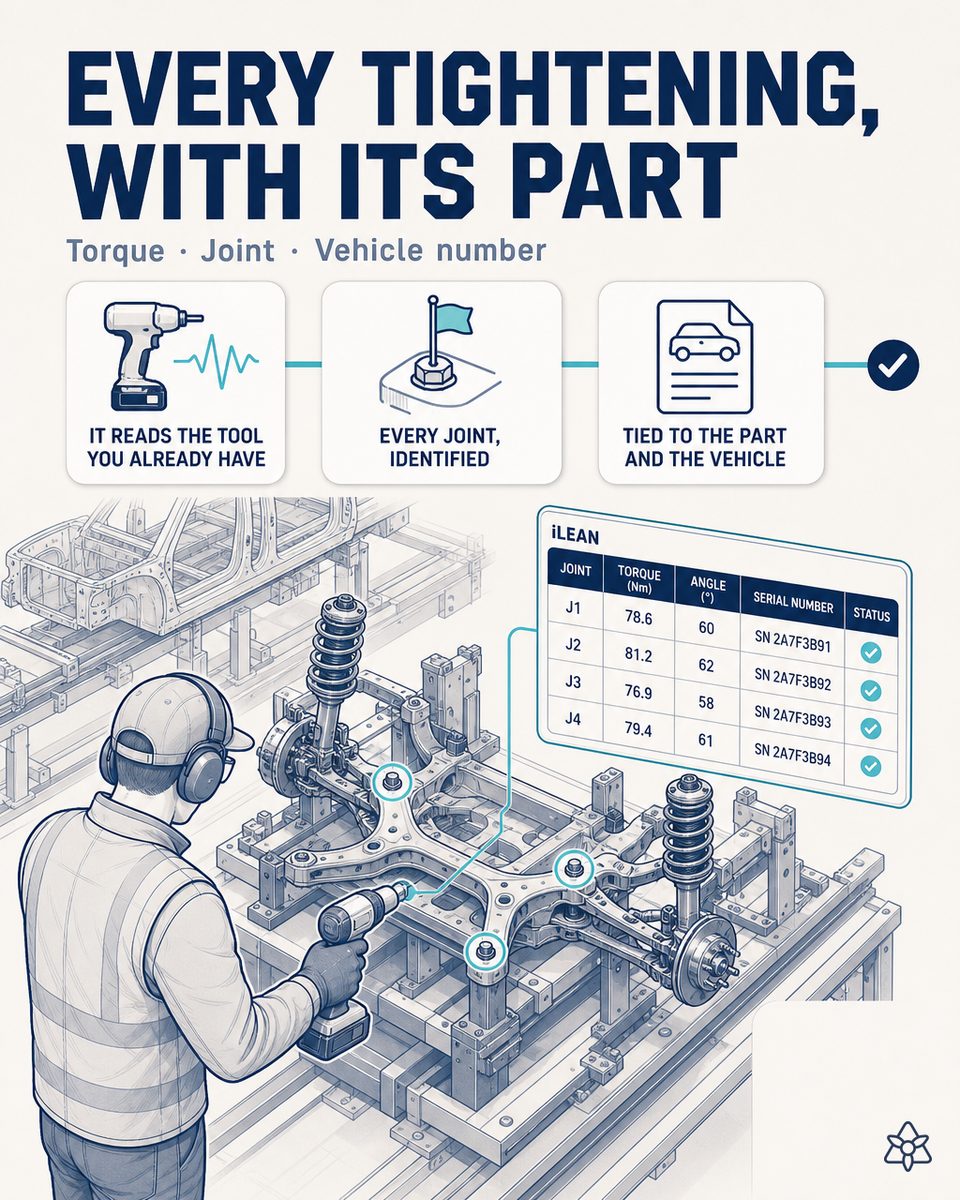
You have the fastener's torque; what you do not have is the car's file.
The quality manager of an assembly plant lives with a curious fact: the tools already measure the torque, the angle and the time of every tightening. Atlas, Bosch or Cleco controllers spit out miles of log every day. The problem is not the measurement — it is that nobody closes the loop:
- The tool controller stores the torque, but does not know which VIN it was applied to.
- The MES knows which vehicle entered the station, but not which specific fastener was tightened.
- The operator knows everything, in their head, during the shift — and by the next day it is gone.
- The file for the auditor or for the 8D is rebuilt by hand, cross-checking a printed ticket, the controller log and a paper signature.
When a complaint about a loose joint comes in from a dealership on the other side of the Atlantic, or when IATF 16949 asks you to trace the torque of the fifth joint on the subframe of VIN XXXXXX, the team starts searching. Three days, four people. And sometimes the answer is: “we cannot prove it was tightened correctly” — which, legally, is the same as not having tightened it.
iLEAN does not change your tools — it seals the cracks between the controller, the MES and the VIN.
The torque data is not the problem; it is there. The problem is that it lives in islands: the controller log, the car's identity in the MES, the model's tightening recipe on a process sheet. iLEAN acts as the putty that fills those gaps, without asking you to change your tool brand or your MES.
Edge reads the VIN when the car enters the station. Connect reads the torque and angle from the tool. The agent cross-references it with the model's recipe and, if a joint is missing, holds the vehicle. The person signs — never the other way round.
The three iLEAN pieces applied to torque traceability:
- Edge — a terminal at the station that reads the vehicle's VIN (label, RFID or data from the MES) and opens the context window. If the tool is old and only prints a ticket, Edge captures the ticket with vision + OCR. If there are manual tightenings, it leaves a signed record of operator + station + VIN. It works without a network.
- Connect — captures the tightening stream from Atlas Copco, Bosch Rexroth, Cleco and Desoutter controllers over OPC UA, Profinet or Ethernet/IP, at second zero. And it also captures what arrives from outside (a customer recipe change, an alert from the fastener supplier) without anyone forwarding anything.
- Agents — cross-reference each tightening with the model's recipe (which critical joints, what torque, what sequence), compare it with the VIN at the station, generate the signed file and, if a joint is missing or the torque is out of window, hold the vehicle before it moves on. The person validates; the line does not restart on its own.
Bolting with printed tickets vs. traceability fastener by fastener with iLEAN
| Aspect | Bolting with tickets + spreadsheets | With iLEAN Edge + Connect + Agents |
|---|---|---|
| Tightening ↔ VIN association | Manual, or by timestamp in the log | Automatic by station window, signed |
| Missing tightenings (forgotten fasteners) | Found at end of line or at the customer | Vehicle held at the station, in seconds |
| Mixed tooling (powered + manual) | Two systems, two spreadsheets | Connect unifies controllers; Edge captures manual ones |
| File for 8D / IATF | Rebuilt by hand, 2-3 days | Generated by an agent in seconds |
| Model changeover on the line | A new spreadsheet, risk of human error | Model recipe loaded automatically on SKU change |
| Operation without a network | n/a | Edge keeps capturing and holding locally |
Impact estimate for your plant — to be validated with your numbers.
The block below is an estimate to be validated with the specific data of your plant. We put it forward so the committee has an order of magnitude; we refine it during the immersion diagnostic.
- Assembly line with 80-150 critical joints per vehicle, a mix of powered tools with controllers (Atlas, Bosch, Cleco) and manual torque wrenches.
- Edge + Connect pilot at one critical station (front subframe, chassis, steering). First value expected within a few weeks: part-to-VIN traceability closed and the batch file automated.
- Indicative payback between 4 and 9 months, depending on the number of torque-related 8Ds per year, the person-hours spent today rebuilding files and your exposure to recall costs.
- The hard lever: a single recall avoided or a single 8D accelerated at an OEM customer. One recall campaign for a loose joint pays for the pilot and frees up new capacity in the quality team.
The standard that measures whoever audits you
Automotive quality runs at levels around 25 PPM (parts per million) of admissible defect [1]. With a three-digit population of critical joints per vehicle, that is a margin of error only a system that records every single tightening can close — not one that assumes it. And the CAIO's reasonable doubt (“what if the AI gets the ticket wrong when it reads it?”) is defused: the AI here invents nothing — it recontextualizes a piece of data that already exists (torque + angle + VIN). On anchored tasks, the best models bring error below 1.5% [2]. And even so, what is critical is never decided alone: iLEAN holds, the person signs.
[1] 25 PPM automotive quality standard — Symestic.
[2] OpenAI paper “Why Language Models Hallucinate”, 2025 — on the reliability of AI in anchored tasks.
What people ask about torque traceability in automotive
Is it compatible with Atlas Copco, Bosch Rexroth and Cleco tools?
Yes. iLEAN Connect captures the data from every tightening (torque, angle, time, program code) over OPC UA, Profinet, Ethernet/IP or from the cordless tool's controller, depending on the model. It supports Atlas Copco PowerFocus/PowerMACS, Bosch Rexroth Nexo, Cleco mPro, Desoutter Connect and similar. If the tool is old and only spits out a printed ticket, Edge reads the ticket at the station itself with vision + OCR. No protocol forces you to change the tool — the traceability comes out just the same.
What about manual tightenings, or torque wrenches with no electronics?
For manual torque wrenches there are two routes. If the wrench takes an IoT module (increasingly common), Connect reads it just like an electric tool. If it is purely mechanical, iLEAN Edge captures the event with vision over the station: it detects the operator, the tool and the part, and leaves a signed record with the VIN of the vehicle in progress. It is not the same as a measured torque — and this page says so plainly — but it closes the documentary traceability gap that IATF audits.
How is a tightening linked to the VIN?
The moment the vehicle enters the station, iLEAN Edge reads the VIN (label, RFID, or data from the MES) and opens the context for that unit. Every tightening the tool reports during that window is automatically associated with the VIN, with the specific part (front subframe, suspension arm, driveshaft joint…) and with the operator. Connect leaves it all in the signed data lake, ready to rebuild the vehicle's file whenever a customer, an authority or an IATF auditor asks for it — without rebuilding it by hand.
Does it detect missing tightenings (forgotten fasteners)?
Yes, and it is one of the strongest returns. The agent compares the model's tightening recipe (how many critical joints, in what sequence, with what target torque) with what the tool actually delivered in that window. If one is missing, it holds the vehicle before the line moves it on and alerts through the team leader's channel. The person decides; iLEAN does not restart on its own. It is jidoka applied to bolting — the car does not reach the end of the line one fastener short.
Does it make an IATF 16949 audit faster?
A great deal. The auditor asks for the file of one critical joint on one specific VIN and, today, whole teams spend three days rebuilding it from a printed ticket, a controller log and an operator signature. With iLEAN, the Agents generate the file in seconds: VIN, part, torque, angle, sequence, operator, tool, time. It has already happened in aerospace with landing gear — the evidence dossier is the most boring agent of them all, and the one that closes the conversation with the auditor.
More cases in automotive
- EU Battery Passport — from lithium to the final pack, without rebuilding the data by hand the night before the audit.iLEAN covers the EU Battery Passport 2027 from cell to final pack, integrating lithium origin,…
- Bi-color wheel painting with AI — a mist on the transition is the most expensive part of the day.How iLEAN cross-references masking vision, booth parameters and the color transition line to avoid…
- Visual defects on body panels — deflectometric light, an eye that never tires, on every part.iLEAN Vision detects dents and scratches on body panels with deflectometric lighting. 100% inspection,…
- Brake disc and caliper control with AI — the part that cannot afford a single escape.How iLEAN cross-references Edge vision on the disc machining line, critical caliper torque and VIN…
- Car air conditioning control with AI — an R-1234yf leak is not an incident, it is a regulated cost.How iLEAN joins Edge vision, refrigerant tightness and compressor/condenser/evaporator traceability to…
- Car hydraulic lines with AI — a line that passes the leak test can be a leak six months from now.How iLEAN cross-checks bending vision, leak testing and batch traceability to certify automotive…
Tell us your case and in 48h we'll send you the estimated ROI of this AI project for your assembly line.
We work on your plant's real data, not ours. Diagnostic with no commitment.
Request estimated ROI in 48h See automotive