Visual defects on body panels — deflectometric light, an eye that never tires, on every part.
Small dents in sheet metal demand deflectometric light and a trained eye — two things human inspection can only sustain for a few minutes at a time. iLEAN Vision combines both in a continuous inspection: the deflectometric pattern reveals the defect, a CNN trained in your plant classifies it, and the system flags the part for touch-up before the next station. The person signs.
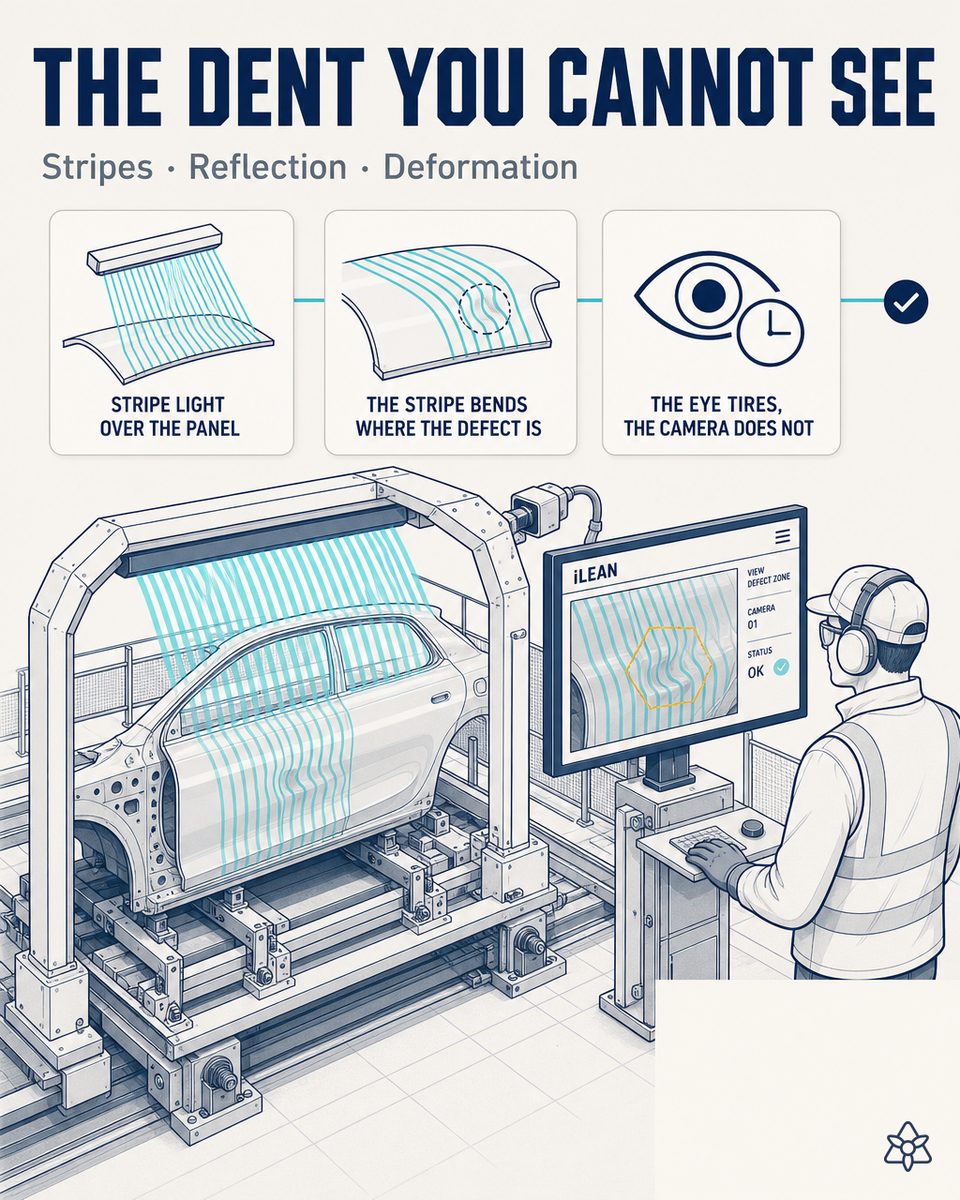
The light tunnel dazzles the human eye before it spots the scratch.
Inspecting body panel defects is one of the most demanding tasks there is for the human eye. Three reasons why it is so hard:
- The defect is optical, not tactile — a half-millimeter dent cannot be felt with your hand and is almost invisible under flat light. It only shows when a line of light reflects off the part and “breaks” at the point of the defect.
- The eye adapts — an inspector in a light tunnel, looking at cars of the same color for an hour straight, stops picking up the fine stuff. It is not a lack of professionalism — it is physiology.
- Dark cars are a trap — dark finishes (black, anthracite grey) hide fine defects from the human eye and reveal them to the end customer the day the sun hits the side of the car. Precisely when it is too late.
When the defect is found at the dealership or by the end customer, the cost multiplies by ten: repair at a specialist shop, collecting the car, brand damage. The classic setup (inspector + light tunnel) works at the limit of human physiology. AI does not get tired.
iLEAN does not replace the inspector — it gives them back their head for what only they can do.
The problem with sheet metal inspection is not missing information — it is a difficult visual condition sustained over time. iLEAN acts as the putty that fills the gap between the right light (which the booth already has) and an eye that never tires (which no human can be). Without touching the booth, without reworking the line.
Edge sees every part under controlled deflectometric light. The agent cross-references it with the model in production and alerts the touch-up station with the exact coordinate of the defect. The person repairs and signs — the line does not release the car on its own.
The iLEAN pieces applied to detecting body panel defects:
- Edge + Vision — a terminal with an industrial camera (multi-camera for curved areas) and lighting matched to the finish (specular for glossy paint, diffuse for bare sheet metal, structured for plastic). The CNN, trained on real samples from your plant (not on renders or a generic dataset), detects dents, scratches, clearcoat runs, handling marks and sink marks in plastic. It works with no network: if the plant loses WiFi, Edge keeps inspecting and flagging parts.
- Connect — captures the model and color of the car in production (MES / line PLC) so the CNN knows which palette to expect, and also captures the historical defect pattern by position (on this side panel, on this model, at this stage, which defect is typical?). If the car is a dark color, it adjusts sensitivity.
- Agent — cross-references the detection with the model, decides in-line touch-up / diversion to the specialist booth / release, and sends the touch-up station the photo + exact coordinate of the defect on the outline of the part. If a dent repeats shift after shift in the same position on the same part, it opens a root-cause alert (worn die, badly adjusted conveyor) — it is not bad luck, it is a pattern.
Light tunnel inspection vs. deflectometric inspection with iLEAN
| Aspect | Inspector + light tunnel | With iLEAN Vision + deflectometric Edge |
|---|---|---|
| Coverage | Sampling or partial coverage; depends on the shift | 100% of parts, 100% of the car |
| Light adaptation / fatigue | Significant after 30-60 min in the booth | Not applicable; the CNN does not get tired |
| Dark vs. light cars | Dark shades hide defects from the human eye | Sensitivity tuned by model and color |
| Locating the defect for touch-up | “Around here, more or less” | Exact coordinate + photo sent to the station |
| Root cause of a recurring defect | You have to cross-reference lists by hand | The agent spots the position/model/shift pattern |
| Defect traceability on the car | A sheet signed by the inspector | Dossier per VIN with photo, position and repair operation |
Impact estimate for your plant — to be validated with your numbers.
The block below is an estimate to be validated with the specific data of your plant. We put it forward so the committee has an order of magnitude; we refine it during the immersion.
- Final inspection booth with 2-4 inspectors per shift, a palette of 5-10 active colors, current detection based on the eye plus a light tunnel that is already installed.
- Edge pilot in one booth (multi-camera + deflectometric lighting adapted to the finish + integration with the touch-up station). First value expected within a few weeks: detection above 90% on scratches and fine dents for dark colors (the ones that most often slip past the eye).
- A reasonable reduction in escapes to the end customer of ≥ 30% during the pilot. Less time for the touch-up operator (who no longer searches, but goes straight to the spot) and for the inspector (who validates instead of searching).
- Indicative payback between 4 and 9 months, depending on the historical frequency of dealership complaints and the average cost of post-delivery repair. A single returned delivery pays for a good part of the pilot.
And the quality manager's reasonable doubt
“What if the camera flags false positives and we clog the line with touch-ups that aren't needed?” — classifying an optical defect on a specific part is a textbook anchored task, not free generation. In that kind of task the best models brought error below 1.5% [1]. And even so, what is critical is never decided alone: the system flags, the inspector validates, the person signs. If the sensitivity is badly calibrated, it gets corrected in the plant with real samples from the shift — it is not argued about in theory.
[1] OpenAI paper “Why Language Models Hallucinate”, 2025 — on the reliability of AI in anchored tasks.
What people ask about detecting body panel defects with AI vision
What lighting is used to detect fine defects on sheet metal?
Deflectometric lighting — line or stripe patterns projected onto the reflective surface. A fine dent or a scratch distorts the reflected line in a characteristic way; where the human eye has to turn the part under the light until it finds the right angle, the camera with a CNN detects the distortion of the pattern as the part goes past. For bare sheet metal, deflectometry with diffuse white light; for painted sheet metal with a glossy finish, specular deflectometry; for areas with complex curvature, multi-camera with structured light.
Does it detect dents below 0.5 mm?
Yes, depending on the geometry of the area and the lighting installed. Detecting small defects on reflective sheet metal is not a camera-resolution problem — modern industrial cameras resolve well below half a millimeter — it is an optical contrast problem. With properly set-up deflectometry you see defects below the thresholds a human inspector picks up by eye. The challenge is repeatability shift after shift; that is where a CNN trained on real samples from your plant beats the human eye: it does not get tired, it does not adapt to the light, it does not vary between the morning and the afternoon shift.
Does it work on the car's final paint?
Yes, and it is one of the highest-return cases. Final inspection of the painted car — the light tunnel — is where the end customer catches the most escapes, and where the human eye tires fastest because the booth is dazzling. With specular deflectometry plus a CNN trained on samples from your own color palette (dark shades teach the model faster than light ones), iLEAN Vision detects scratches, handling marks, clearcoat runs and dents that slip past the inspector in the light tunnel once they have spent half an hour looking at cars of the same color.
Does it integrate with the touch-up booth?
Yes. iLEAN Edge sends the touch-up station, in real time, the exact position of every defect detected (photo + coordinates on the outline of the part). The touch-up operator no longer hunts with a raking light by eye; they go straight to the spot, repair it and release it. The system closes the loop: the repaired part is inspected again and the result stays in the car's dossier. If one specific dent repeats shift after shift in the same position, the agent detects it and alerts the shop — it is probably a worn die or a badly adjusted conveyor, not a part that was “unlucky”.
Does it also work on plastic parts (bumpers, fenders)?
Yes, with two adjustments. The lighting moves from specular deflectometry to diffuse deflectometry or structured light, depending on the finish (matte, satin, textured). The CNN is trained separately because defect modes in plastic are different (sink marks, weld lines, mold marks, thermal deformation). What does not change is the architecture: same Edge, same platform, same way of returning OK/NOK to the station's PLC. The mixed sheet-metal + plastic parts of a car are covered by the same system.
More cases in automotive
- SOC and degradation control for EV battery packs — catching the weak pack before the OEM finds it.iLEAN measures real SOC at end of line and detects packs with premature degradation before they ship to…
- EU Battery Passport — from lithium to the final pack, without rebuilding the data by hand the night before the audit.iLEAN covers the EU Battery Passport 2027 from cell to final pack, integrating lithium origin,…
- Bi-color wheel painting with AI — a mist on the transition is the most expensive part of the day.How iLEAN cross-references masking vision, booth parameters and the color transition line to avoid…
- Torque traceability by bolted joint — a badly tightened fastener is not a penalty, it is a mass recall.iLEAN stores the torque and angle value of every critical bolted joint together with its part and its…
- Brake disc and caliper control with AI — the part that cannot afford a single escape.How iLEAN cross-references Edge vision on the disc machining line, critical caliper torque and VIN…
- Car air conditioning control with AI — an R-1234yf leak is not an incident, it is a regulated cost.How iLEAN joins Edge vision, refrigerant tightness and compressor/condenser/evaporator traceability to…
Tell us your case and in 48h we'll send you the estimated ROI of this AI sheet metal inspection project for your plant.
We work on your plant's real data, not ours. Diagnostic with no commitment.
Request estimated ROI in 48h See automotive