SOC and degradation control for EV battery packs — catching the weak pack before the OEM finds it.
An EV pack delivering less than its nominal capacity is a hidden cost at the OEM: warranties, claims, brand damage arriving six months late. iLEAN measures real SOC at end of line, correlates it with each cell's history and diverts packs with premature degradation before they ship. The person signs the rejection; the rest carry on their way.
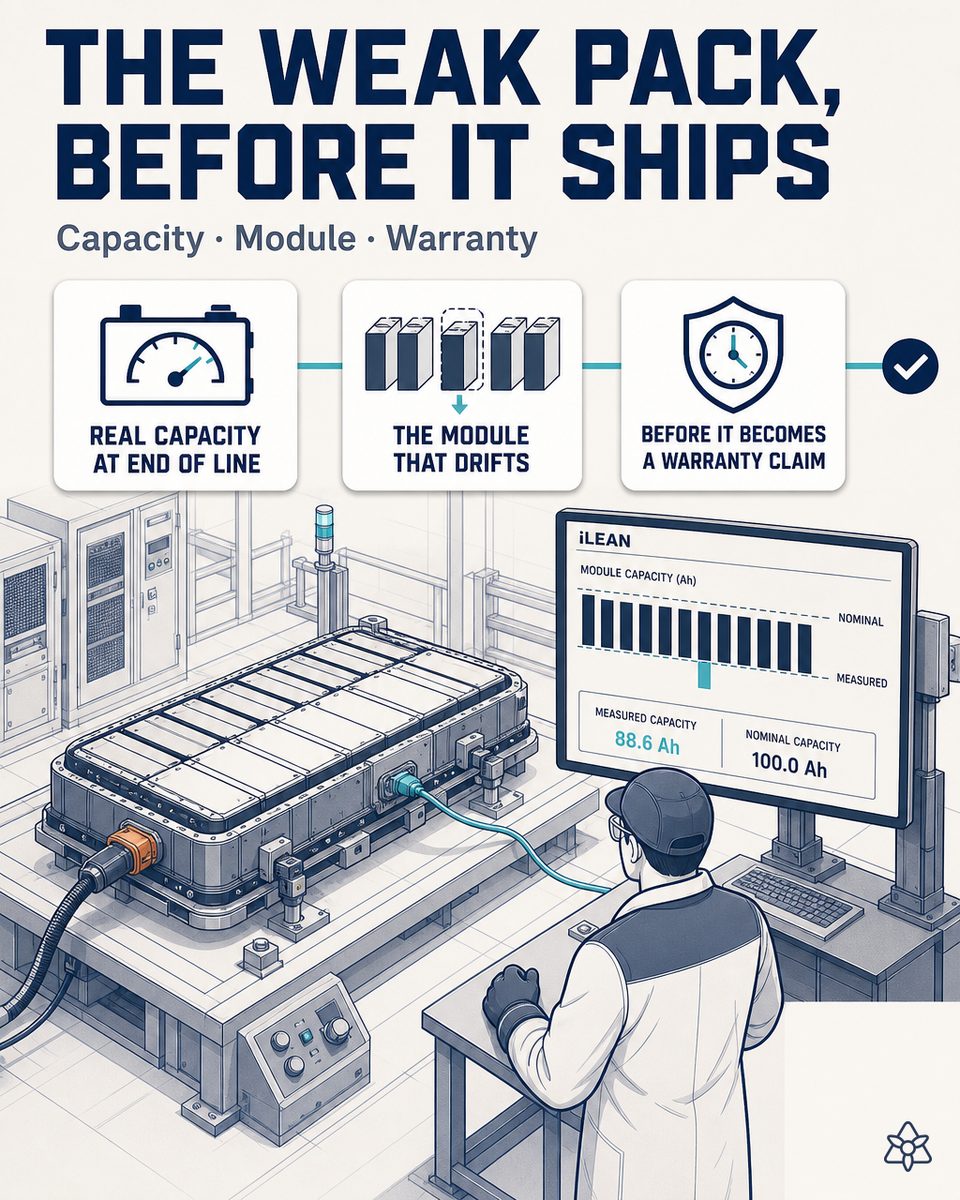
EOL tells you whether the pack charges. It does not tell you whether it will last.
The end-of-line test on an EV pack measures nominal capacity and checks that the cells talk to the BMS. It passes the test and goes out the door — and from six months onward the data that actually mattered starts coming back:
- Packs that lose capacity faster than expected. The BMS SoH falls early and the customer files a warranty claim.
- Packs with one deviant cell that the aggregate test never caught. The bad cell drags the rest down in the first months.
- Warranty returns, which in economic terms are the worst cost in the process: product built, shipped, returned, disassembled, recycled or reprocessed.
The demanding standard automotive aims at is in the order of 25 PPM [1] — and in battery packs, 25 PPM is not met if EOL only looks at aggregates. You have to cross-reference what the cycler measures with what each cell has been carrying since it left its supplier.
iLEAN does not replace the cycler — it gives it the context it lacks.
The problem with SOC and degradation is not a lack of measurement: it is measurement without context. The cycler measures well, but it does not know that cell 47 of module 3 came from a supplier batch with slightly high impedance and from a weld whose thermogram sat right at the edge of the window. iLEAN acts as the putty between the cycler, the pack MES, the per-cell process history and the BMS, without asking you to change any of them.
Edge captures the cycler curve and the per-cell impedance. Connect reads the batch history of every cell. The Brain correlates them and, if the signature smells of premature degradation, diverts the pack — before shipping.
The two iLEAN pieces applied to SOC and degradation control:
- Edge — a terminal over the EOL station that captures the cycler's voltage-current-time curve, the per-cell impedance at the end of the charge and the pack's thermography during the test. A CNN over the curves trained on your own baseline — what a “clean” curve looks like, what a curve with suspicious spread looks like. If the signature does not add up, it fires the actuator (diverting the pack to manual inspection) in milliseconds. It works with no network: if the plant loses WiFi, Edge keeps classifying packs and holding back the doubtful ones.
- Connect — captures each cell's history from its supplier batch, its laser weld (bead by bead), its sealing thermogram and its exact chemistry. It also captures what arrives from outside: a supplier's email alert about a deviant batch, an OEM specification change. The putty between MES, supplier and line.
- Brain (Agent + Central) — correlates the cycler signature with the per-cell history and learns, batch by batch, which signature anticipates which type of failure. It is not magic: it is the Deming cycle (plan-do-check-act) turning at a speed and a consistency one person alone could not sustain. The person brings the judgment; the agent keeps the cycle turning.
Aggregate EOL vs. EOL with per-cell context using iLEAN
| Aspect | Classic EOL | With iLEAN Edge + Brain |
|---|---|---|
| Measurement | Aggregate capacity and BMS diagnostics | Full curve + per-cell impedance + thermography |
| Context | Only what the cycler sees at that moment | Process and batch history for every cell |
| Deviant cell inside the pack | Invisible — the aggregate masks it | Flagged by name, with its historical footprint |
| Anticipating degradation | Arrives as a customer claim | Signature caught on the line, pack diverted |
| Learning across batches | Manual, reactive, in a spreadsheet | A model trained on your own baseline |
| Initial SoH for the Battery Passport | BMS data with no context | SoH signed and chained to the pack's history |
Impact estimate for your plant — to be validated with your numbers.
The block below is an estimate to be validated with the specific data of your plant. We put it forward so the committee has an order of magnitude; we refine it during the diagnostic.
- EV pack plant with 1-3 EOL stations, NMC or LFP chemistry, and a tier-1 OEM demanding initial SoH figures and per-cell traceability.
- Pilot: Edge on one EOL station (curve capture + per-cell impedance + thermography) + Connect with the per-batch cell history + Brain with the first baseline. First value expected within a few weeks: the first wave of packs that are “good per the cycler, doubtful per the history” usually shows up in the first days of capture.
- Reduction in packs returned under warranty for low initial SoH in the order of ≥ 30% by the end of the pilot, depending on the current rate of claims documented in recent years.
- Indicative payback between 4 and 9 months, depending on the real cost of a warranty return in your chain and the pack volume per month.
- The hard lever is the cost per pack returned by the customer, always the worst cost in the chain: a single batch of returns avoided pays for the pilot comfortably.
And the quality manager's reasonable doubt
“What if the AI flags good packs as suspect and we hold product that was selling?” — the false-positive risk is bounded by the iLEAN rule: the agent proposes, the person signs. And the reliability of AI in anchored tasks (correlating a cycler curve with a per-batch impedance history) is a long way from the free-generation problem — the best models are below 1.5% error on anchored tasks [2]. The pilot is calibrated over the first weeks on real packs from your line; the threshold is set by your quality team, not by us.
[1] Symestic, automotive quality standard in the order of 25 PPM.
[2] OpenAI paper “Why Language Models Hallucinate”, 2025 — on the reliability of AI in anchored tasks.
What people ask about SOC and degradation control on battery packs
How is SOC measured at end of line?
With the EOL cycler running a controlled partial charge/discharge and measuring the real capacity delivered against the pack's nominal figure. iLEAN Edge captures the voltage-current-time curve and cross-references it with the temperature of every module. The datasheet's nominal capacity is an anchor; what the OEM is going to see under warranty is the real measured curve — that is the one iLEAN stores against the pack's unique identifier.
What about the quality of each cell inside the pack?
This is where the lever is. The pack's aggregate capacity can look fine while one or two deviant cells inside drag the rest down in the first month of use. iLEAN cross-references the cycler measurement with the per-cell impedance at EOL and with that cell's process history (supplier batch, specific weld, thermography during sealing). If a cell is pulling the pack down, the agent flags it by name — it is not “generic pack NOK”, it is “cell X of module Y with impedance outside the window”.
Does it detect packs with premature degradation before shipping?
Yes. The signature of a pack that is going to degrade early shows up as a pattern in the EOL curve: faster voltage drop under partial load, incomplete recovery after rest, cell-to-cell spread above the window. A single measured pack does not say much; the agent accumulates your own line's history by chemistry, supplier and batch, and learns which signature anticipates which type of failure. What reaches the OEM today and comes back as a claim in 6-12 months gets flagged on the line, before shipping. The person signs the rejection.
Does it work with every chemistry (NMC, LFP, others)?
Yes. The physics of EOL is the same; what changes are the thresholds and the windows. LFP has a flatter voltage-SOC curve, which makes the capacity measurement less sensitive to voltage and more sensitive to the current integral; NMC is the other way round. The agent is trained per chemistry and per supplier on the baseline we measure on your own line in the first days — there is no generic model that works for everything, and iLEAN does not pretend otherwise.
Does it integrate with the pack MES and with the BMS?
Yes, through the three usual routes depending on what the line has: direct integration with a modern MES, reading local files from an older cycler, or reading the panel by vision when the equipment exposes nothing at all. The conversation with the BMS at EOL happens over the pack's own diagnostic bus, capturing the initial SoH (state of health) the BMS starts counting from. That initial SoH is the first data point of the per-pack Battery Passport.
More cases in automotive
- Industrial AI in automotive wire harness plantsTwelve industrial AI cases landed on wire harness plants: shop-floor capture, in-line vision and agents…
- Automotive wiring with AI vision — the intermittent field fault is born in a connector position the tester cannot see.How iLEAN inspects automotive wire harnesses with multi-camera vision, checks wire color, cavity…
- Battery pack laser welding with AI — a bad weld is not rework, it is a thermal risk.iLEAN combines vision, thermography and current to verify every battery pack laser weld. One defect =…
- EU Battery Passport — from lithium to the final pack, without rebuilding the data by hand the night before the audit.iLEAN covers the EU Battery Passport 2027 from cell to final pack, integrating lithium origin,…
- Bi-color wheel painting with AI — a mist on the transition is the most expensive part of the day.How iLEAN cross-references masking vision, booth parameters and the color transition line to avoid…
- Visual defects on body panels — deflectometric light, an eye that never tires, on every part.iLEAN Vision detects dents and scratches on body panels with deflectometric lighting. 100% inspection,…
Tell us your case and in 48h we'll send you the estimated ROI of SOC and degradation control for your EOL line.
We work on your plant's real data, not ours. Diagnostic with no commitment.
Request estimated ROI in 48h See automotive