Battery pack laser welding with AI — a bad weld is not rework, it is a thermal risk.
A failed laser weld in an EV pack is thermal risk downstream: dendrites, local heating and, in the worst case, thermal runaway. iLEAN verifies every weld with vision + thermography + current in real time, correlates it with the cell history and, if the three signals do not converge, diverts the pack before it is closed. The person signs.
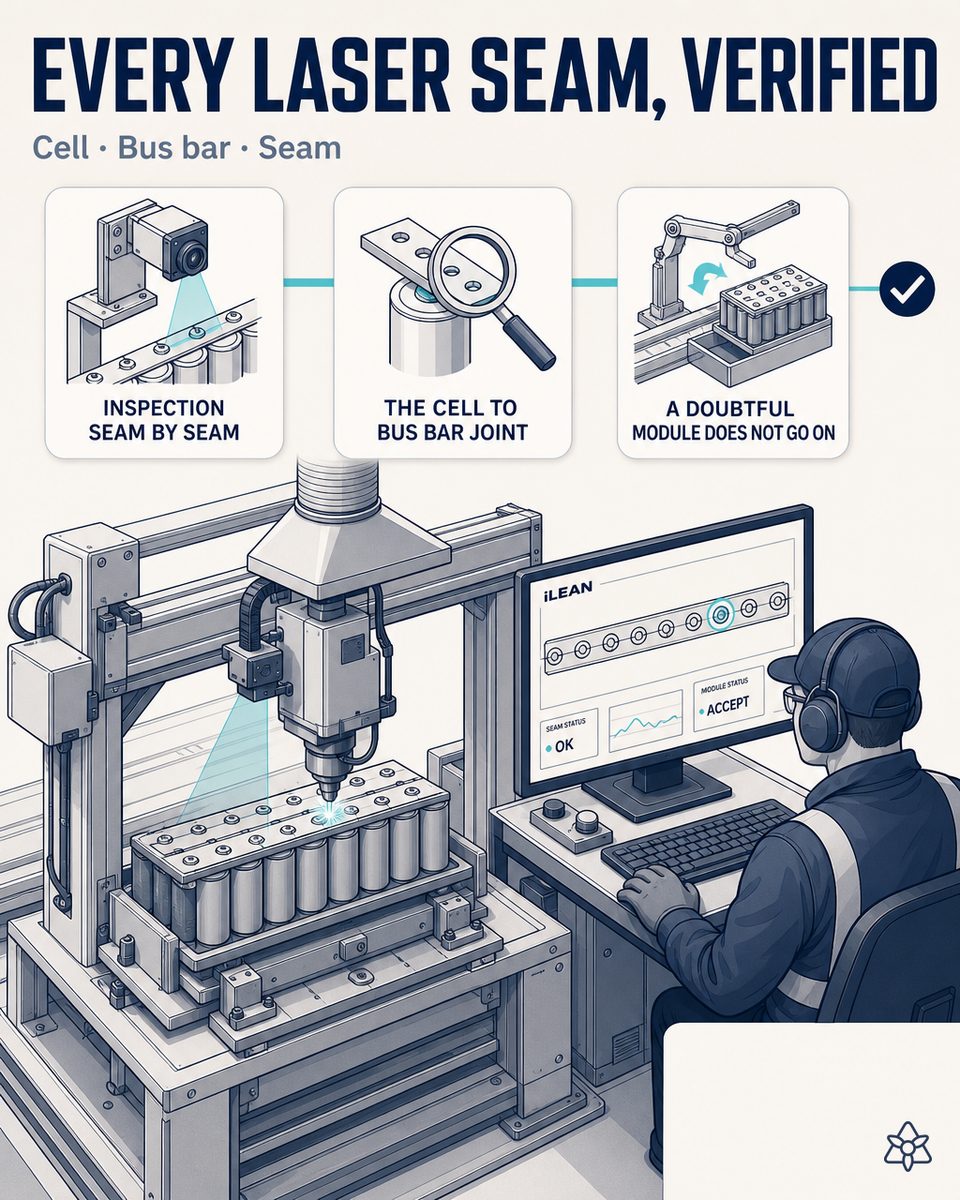
The laser weld is the point where a perfect cell turns into a doubtful pack.
An EV pack assembly line moves cells whose behavior was measured and traced at the cell factory. Uncertainty enters exactly at the moment of the weld: irregular fill, spatter, unstable keyhole, subsurface porosity. Any one of the four turns a correct connection into a parasitic resistance — and a parasitic resistance in an EV pack means a hot spot, degraded cycling and, in the bad percentile, thermal runaway.
Classic control stacks up three lines of defense that never talk to each other:
- The laser equipment itself — it logs power and time, but it does not know whether the weld came out right.
- Post-process vision — a camera at a downstream station detects geometric defects, but it arrives late: there are already 6 welds ahead of it.
- Sample destructive testing — cut open one pack per batch and measure. It finds the pattern after 50 packs have shipped.
The consequence is the same as in every process where information arrives late: the OEM demands zero defects, the cost of a pack diverted at final line is high and the cost of a pack returned by the customer is far higher. The automotive standard is in the order of 25 PPM [1] — and at battery pack takt, 25 PPM on welds means every weld counts.
iLEAN replaces neither the laser nor the MES — it seals the crack between the two.
Your laser logs what it did. Your MES logs what was planned. Between them there is a crack: what actually happened to every weld. That crack is where doubtful packs are born, and it is where iLEAN acts as putty: without asking you to change the laser, the MES, or the cell that is already validated by the OEM.
Edge sees the weld as it forms. Thermography measures how it cools. Connect reads the laser current and the cell history. The agent cross-references the three signals with your process window and, if they do not add up, diverts the pack — before closing.
The three iLEAN pieces applied to battery pack laser weld control:
- Edge + Vision — a terminal with a camera and a thermographic module over the laser head. A CNN trained with good and bad welds from your line, synchronized with the laser pulse. It reads geometry, spatter and thermal map on every weld. If the signature falls outside the window, it triggers the actuator (divert the pack or mark it for inspection) in milliseconds. It works with no network: if the plant loses connectivity, Edge keeps inspecting and holding packs, because what is critical cannot depend on WiFi.
- Connect — captures the current and power of the laser itself through whatever channel it has (a modern interface, a local file, a scan of the old panel) and unifies it with the cell history coming from the MES. It also captures whatever arrives from outside (an OEM specification change by email, an alert from the cell supplier over WhatsApp) at second zero, without anyone having to forward anything.
- Agent — cross-references the three signals with the process window, the cell batch history and the OEM rule (customer-specific requirements). If the three converge, it records the weld signed and packaged as evidence for the Battery Passport. If they do not, it diverts the pack and notifies the quality manager on whatever channel they use. The person validates and signs — the pack never goes back onto the line by itself.
Classic inspection vs. laser welding verified with iLEAN
| Aspect | Classic inspection | With iLEAN Edge + Vision + Agent |
|---|---|---|
| Signals used | Only laser power/time; post-process vision | Vision + thermography + current, cross-referenced and synchronized |
| Moment of detection | Downstream station or sample destructive testing | On the pulse itself, before the next weld |
| Subsurface porosity | Destructive testing only; the pack is already built | Thermal signature + power curve → flagged in line |
| Weld traceability | "Pack OK / Pack NOK" as an aggregate | Every weld signed with image, thermal data and curve |
| Operation with no network | n/a (it goes down with the MES) | Edge keeps diverting packs on its own panel light |
| Evidence for OEM / Battery Passport | Rebuilt by hand, pack by pack | Automatic dossier per pack and per weld |
Impact estimate for your plant — to be validated with your numbers.
The block below is an estimate to be validated with the specific data of your plant. We put it forward so the committee has an order of magnitude; we refine it during the diagnostic.
- EV pack assembly plant, 1-2 active laser lines, a mix of cell-to-busbar and busbar-to-tap welds.
- Edge pilot on one laser head (vision + thermography + current/power reading + integration with the pack MES). First value expected within a few weeks.
- Reduction of packs diverted on "reasonable doubt" in the order of ≥ 30% by the end of the pilot, against the baseline we measure in the first days.
- Indicative payback between 4 and 9 months, depending on the real cost of a diverted pack on your line (raw material + pack time + retest) and on the current frequency of weld incidents.
- The hard lever: every pack returned by the OEM costs far more than an entire pilot. The conservative business case stands up without counting the reputational lever with the customer.
And the quality manager's reasonable doubt
"What if the AI flags a weld that was fine and we stop good packs?" — the false-positive risk is mitigated by the iLEAN rule: the agent proposes, the person signs. And the reliability of AI in anchored tasks (cross-referencing image + thermography + curve against a defined window) is a long way from the problem of free generation: in anchored tasks the best models brought error below 1.5% [2]. The pilot is calibrated over the first weeks with real welds from your line, until the window sits exactly where your quality team wants it.
[1] Symestic, automotive quality standard in the order of 25 PPM.
[2] OpenAI paper "Why Language Models Hallucinate", 2025 — on the reliability of AI in anchored tasks.
What people ask about battery pack laser welding with AI
Which signals are combined to verify the laser weld?
Three in parallel and synchronized with the laser pulse: vision (a CNN over the image of the weld — geometry, spatter, lack of fill), thermography (thermal map during and after the pulse — keyhole, abnormal cooling) and laser current/power as logged by the equipment itself. No single one signs off a weld; the three cross-referenced do. iLEAN Edge closes the loop in milliseconds and, if the three do not converge, flags the weld as suspect before moving on to the next cell.
Does it work with cylindrical and prismatic cells?
Yes. Visual and thermal inspection of the weld is the same physics on cylindrical cells (18650/21700/4680, welding on the tab or the cap) and on prismatic ones (busbar on terminal). What changes is the geometry of the weld and the fill pattern — that is trained per family with samples from your own line. The iLEAN piece is the same; the model adapts to your product.
Does it detect internal porosity that is invisible from the outside?
Pure subsurface porosity cannot be seen in a photo — but its thermal signature and its footprint in the power curve are detectable, and correlating the three signals raises the probability of catching it far above visual inspection alone. For critical porosity in safety welds, it is complemented with sample destructive testing and the result feeds back into the model. Whatever cannot be detected today is labeled as a "weld with deviation" and the pack is diverted to manual inspection — the person signs.
What about ultrasonic tab welding?
Same principle, different signals. In ultrasonic welding you combine pulse energy/time, impedance and vision of the nugget after the weld. The Edge captures all three and the agent correlates them with the cell history and the busbar batch. What matters is not the welding technology: it is that every weld ends up traced, verified in line and signed by a person if it falls outside the window.
Does it comply with the EU Battery Passport?
Verifying every weld is one of the records the EU Battery Passport will require: multi-tier traceability per cell, process data, quality evidence per pack. iLEAN leaves every weld signed and packaged as evidence, with the image, the thermal curve and the current — ready to upload to the European register when it is asked for. The regulation is still fine-tuning the detail; iLEAN already stores the data in the most widely used format.
More cases in automotive
- Industrial AI in automotive wheel plants12 real AI cases for steel and aluminium wheel plants: paperless capture, in-line vision inspection and…
- Industrial AI in automotive wire harness plantsTwelve industrial AI cases landed on wire harness plants: shop-floor capture, in-line vision and agents…
- Automotive wiring with AI vision — the intermittent field fault is born in a connector position the tester cannot see.How iLEAN inspects automotive wire harnesses with multi-camera vision, checks wire color, cavity…
- SOC and degradation control for EV battery packs — catching the weak pack before the OEM finds it.iLEAN measures real SOC at end of line and detects packs with premature degradation before they ship to…
- EU Battery Passport — from lithium to the final pack, without rebuilding the data by hand the night before the audit.iLEAN covers the EU Battery Passport 2027 from cell to final pack, integrating lithium origin,…
- Bi-color wheel painting with AI — a mist on the transition is the most expensive part of the day.How iLEAN cross-references masking vision, booth parameters and the color transition line to avoid…
Tell us your case and in 48h we'll send you the estimated ROI of this AI project for your battery pack line.
We work on your plant's real data, not ours. Diagnostic with no commitment.
Request estimated ROI in 48h See automotive