Automotive wiring with AI vision — the intermittent field fault is born in a connector position the tester cannot see.
A harness continuity test proves that electricity gets through — not that the yellow-red wire is in the right cavity of the connector. That defect shows up months later in the field, as an intermittent fault. iLEAN Edge watches the board with several cameras, cross-references wire position and crimp with the BOM and the variant of the OEM order, and holds the harness before it is closed out. The person validates.
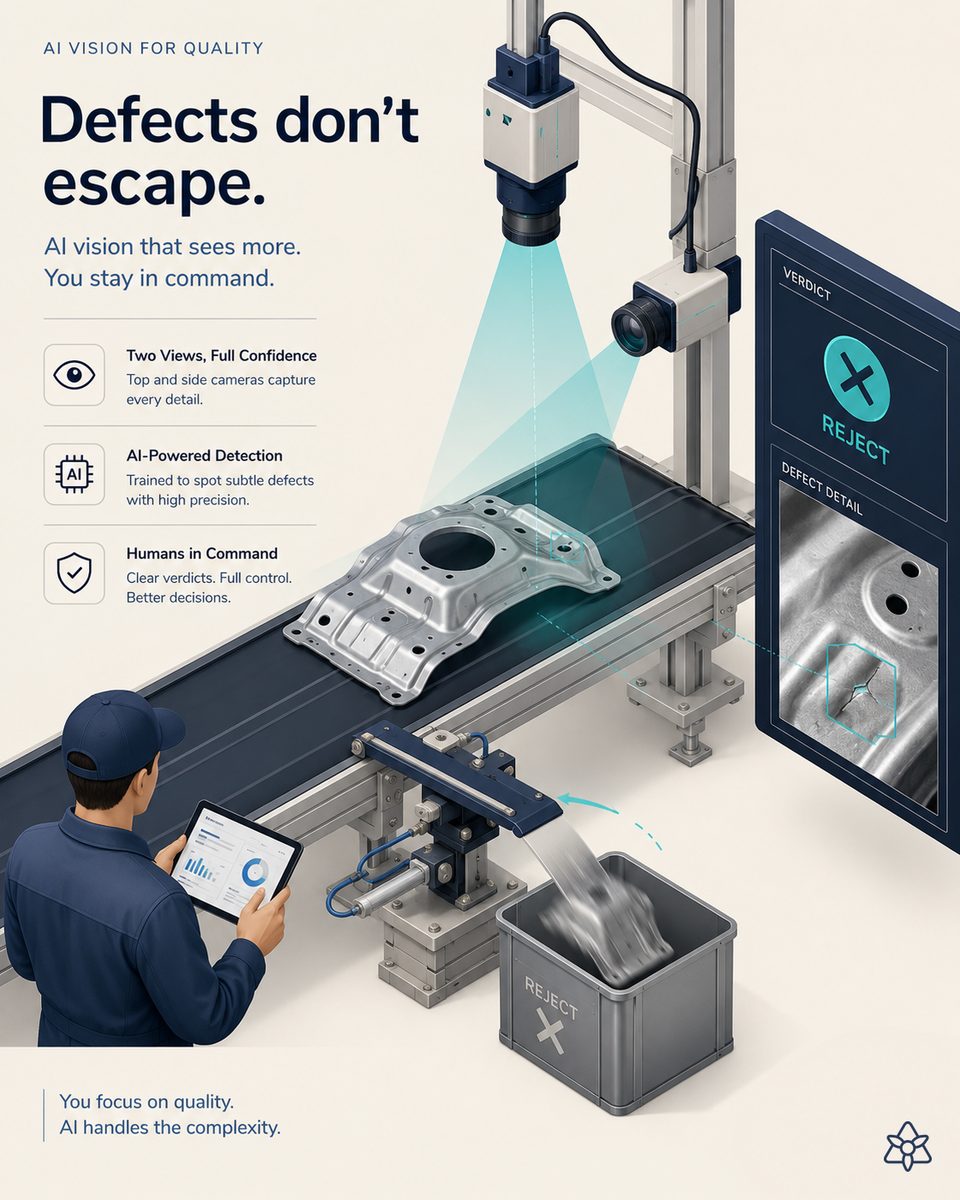
The electrical test does not see the defect that costs the most in the field.
A car wire harness is hundreds of wires, dozens of connectors, a dozen variants per model. The traditional filter is the electrical continuity test at the end of the board: if electricity gets from A to B, the harness passes.
- What the tester sees: continuity, short circuits, out-of-range resistance.
- What the tester does not see: that the yellow-red wire is in cavity 7 of the connector and not in cavity 8. Continuity may be perfectly correct — but the assembled car does strange things months later.
- What the tester does not see: that the terminal is properly crimped and not loose (continuity is fine when new, and the contact works itself loose with vehicle vibration → intermittent field fault).
- What the tester does not see: that the sleeve is present, that the textile wrap is where it should be, that the fuse box carries the right markings for the variant of the OEM order.
The position/crimp/variant defect is not discovered in the plant: it is discovered months later as an intermittent breakdown in the field, with warranty cost, a call from the OEM's SQA and reputational damage. The veteran operator at the end of the board catches plenty of defects — but not the same number every day, and not the same in every shift.
iLEAN does not replace the electrical test — it adds the filter the test cannot provide.
The wiring problem is not a lack of information: it is information split into islands (the BOM in the PLM, the order in the MES, the crimp curve inside the Schleuniger, the image of the board nowhere at all). iLEAN is the putty that seals those joints without asking you to change the board or the tester.
Edge sees the board with several cameras. Connect reads the BOM, the OEM order, the crimper. The agent cross-references position ↔ BOM ↔ variant and holds the harness before the final test. The person validates.
The three iLEAN pieces applied to automotive wiring:
- Edge — several cameras around the assembly board, with controlled lighting. CNNs trained to recognize the wire color in every cavity of every connector, the presence of the sleeve, the fuse box markings, the completeness of the textile wrap. They compare against the pattern of the specific BOM of the variant in production. Verdict in milliseconds. It works without a network.
- Connect — captures the BOM from the PLM (Teamcenter, Windchill, ENOVIA) and the work order from the MES with the exact variant. Captures the crimp curve of every terminal on modern machines (Schleuniger, Komax) through their native interface, or reads the legacy local PC on older machines. Captures the OEM SQA notices with spec changes at second zero.
- Agent — cross-references the image of the board with the variant's BOM, with the crimp curve of the terminal batch and with the defect history of the sub-assembly supplier. When it detects a wrong position, a crimp outside the envelope or a mixed-up variant, it holds the harness before the final test. It does not move the crimping press on its own — the person validates and signs.
Electrical test + visual inspection vs. AI vision + BOM cross-check
| Aspect | Continuity tester + inspector | With iLEAN Edge + Connect + Agent |
|---|---|---|
| Electrical continuity | Validated 100% | Validated 100% (unchanged) |
| Wire position in the cavity | Human eye against a mock-up only | Multi-camera vision against the specific BOM |
| Crimp quality | OK/NOK verdict from the machine | Learned envelope + cross-check with terminal batch |
| Wrong variant from a mix-up | Caught on the OEM's final line (bad) | Caught on the board, before the final test |
| Intermittent field fault | SQA call months later | Filtered at source, before shipping |
| File for IATF 16949 / OEM | Rebuild by harness number by hand | Dossier per harness number with images + crimp curve |
Impact estimate for your plant — to be validated with your numbers.
The block below is an estimate to be validated with the specific data of your plant. We put it forward so the committee has an order of magnitude; we refine it during the diagnostic.
- Harness plant supplying 1-2 OEMs, a mix of models with 5-15 variants each, assembly board + Schleuniger/Komax crimpers + 100% electrical test + final visual inspection.
- Edge pilot on 1-2 critical boards (the ones with the most variants and the most mixing) + Connect integration with the PLM, the crimpers and the MES. First value expected within a few weeks.
- Indicative payback between 4 and 9 months, depending on the current frequency of field claims for intermittent faults and the average warranty cost.
- Hard levers: intermittent field fault avoided (the most expensive one) + harness rework avoided + automatic dossier per harness number for IATF 16949 audits and OEM SQA.
- The automotive standard of the order of 25 PPM [1] does not hold up in wiring with electrical testing alone — the position defect passes the test.
And the quality manager's reasonable doubt
“What if the AI mistakes a glare on the connector for a misplaced wire and rejects a good harness?” — hallucination is a problem of free generation, not of anchored tasks. In tasks where the AI compares an image against the specific BOM of the variant in production, the best models brought error below 1.5% [2]. And even so, what is critical is never decided alone: the system holds the harness and the person validates. iLEAN's three safety rings exist precisely for this.
[1] Symestic — automotive quality standard of ~25 PPM.
[2] OpenAI paper “Why Language Models Hallucinate”, 2025 — on the reliability of AI in anchored tasks.
Related processes: automotive PCB defects · assembly poka-yoke with vision · coil traceability in stamping.
What people ask about automotive wiring control with AI vision
What does iLEAN check on a wire harness line?
What the continuity test sees and what it does not. What the tester sees: electrical continuity of every circuit. What the tester does not see: that the yellow-red wire is in cavity 7 of the connector and not in cavity 8 (correct continuity, wrong position — an intermittent fault in the field), that the terminal is properly crimped and not loose, that the sleeve is present, that the fuse box carries the right markings, that the textile wrap is where it should be. iLEAN Edge covers the harness assembly board with several cameras, reads every connector against the BOM and the order variant, and holds the harness if a single wire position does not match.
How is vision cross-referenced with the BOM and the variant?
A modern car harness is hundreds of wires, dozens of connectors and many variants (diesel vs. gasoline engine, with vs. without ADAS, 2WD vs. 4WD…). The BOM says which wire color goes in which cavity of which connector, depending on the variant. iLEAN Connect captures that BOM from the PLM (Teamcenter, Windchill, ENOVIA) or from the ERP, cross-references it with the work order and with the variant of the OEM order, and the agent hands Edge the expected pattern for every connector. The camera compares — not against a generic model, but against the specific BOM of the harness in front of it. If a cavity expects yellow-red and sees green-white, it holds the harness.
How is the terminal crimp validated?
The crimp is the point where a wire becomes reliable or becomes intermittent. Modern crimping machines (Schleuniger, Komax) record crimp force and crimp height per terminal — and that is gold: any curve outside the learned envelope is a sign of a badly seated terminal, a worn press or a terminal batch out of spec. iLEAN Connect captures that data through the machine's native interface, the agent cross-references the curve with the terminal batch and with the press, and warns before the harness has 100 terminals from the same shift with the same drift. For older crimpers with no interface, Connect reads the isolated legacy local PC and captures it all the same.
What about multi-variant harnesses on a mixed line?
That is the normal case, and where the system pays for itself fastest. A single board produces harnesses for 4-10 variants of the same model, and the risk of fitting the variant A connector into a variant B harness is high, especially at SKU changeovers. iLEAN cross-references the variant of the OEM order (in JIS sequence) with the connector Edge sees at every board position — if the fuse box connector carries a label that does not match the variant, it holds the harness before the final board check. The human inspection at the end of the board stops being the only mix-up filter.
How much can it cut intermittent wiring faults in the field?
It depends on the current level of control and on the complexity of the harness. A plant with 100% electrical testing and partial vision already has part of the filter; a plant with electrical testing only and a veteran operator as the position filter has plenty of room. As a defensible floor to take to the committee: a reduction in position/crimp/variant defects of ≥30% in the first months, with the hard lever of an intermittent field fault avoided (the most expensive one in warranty and in reputation). The automotive standard of the order of 25 PPM does not hold up in wiring with electrical testing alone. We send you the estimated ROI in 48h with your line's data.
More cases in automotive
- Industrial AI in automotive seating plantsTwelve industrial AI use cases grounded in plants that build automotive seating just-in-time and…
- Industrial AI in automotive wheel plants12 real AI cases for steel and aluminium wheel plants: paperless capture, in-line vision inspection and…
- Industrial AI in automotive wire harness plantsTwelve industrial AI cases landed on wire harness plants: shop-floor capture, in-line vision and agents…
- Battery pack laser welding with AI — a bad weld is not rework, it is a thermal risk.iLEAN combines vision, thermography and current to verify every battery pack laser weld. One defect =…
- SOC and degradation control for EV battery packs — catching the weak pack before the OEM finds it.iLEAN measures real SOC at end of line and detects packs with premature degradation before they ship to…
- EU Battery Passport — from lithium to the final pack, without rebuilding the data by hand the night before the audit.iLEAN covers the EU Battery Passport 2027 from cell to final pack, integrating lithium origin,…
Tell us your case and in 48h we'll send you the estimated ROI of this AI project for your harness line.
We work on your plant's real data, not ours. Diagnostic with no commitment.
Request estimated ROI in 48h See automotive