Coil-to-stamped-part traceability — without the link, you pay for the claim against the steel supplier yourself.
A steel defect discovered 3 months later requires knowing which coil brought it in. iLEAN keeps that link alive part by part with Tracer + Vision + Edge from the uncoiler on, integrated with your work order. The claim gets paid; it does not get swallowed.
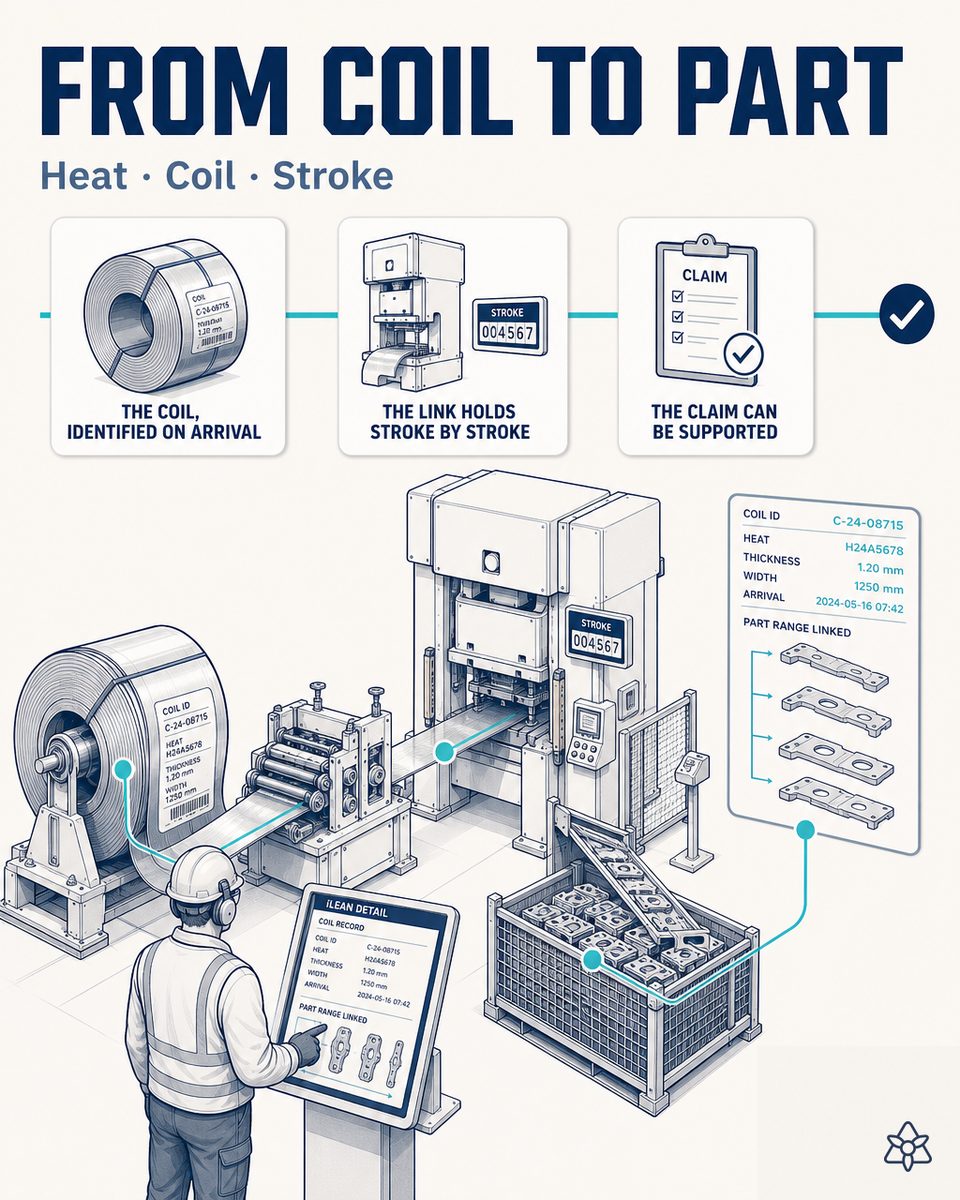
The claim arrives three months later — and the link broke at the uncoiler.
The quality manager at an automotive stamper always tells it the same way: the OEM or the Tier-1 customer files a claim over a steel defect (delamination appearing after drawing, an inclusion visible when painting, a mechanical property out of spec in a later test). The question is always the same — "which coil did this part come from?" — and in most plants the answer follows this painful route:
- Look for the part's delivery note to find the production batch.
- Look for that day's press log and work out which coil was on the line.
- Cross-reference by hand with the steel mill's delivery note to pull the heat certificate.
- If the coil marking was lost or somebody linked it wrongly, there is no way to close the loop.
When the loop does not close, there is no claim against the steel supplier — and the cost stays at home. Without a live coil-to-part link, any defect of origin is paid for by you. And the link does not break at the press: it breaks in the first meters of uncoiling, when nobody made sure to link the physical coil, the certificate and the work order.
iLEAN does not add a new traceability system — it seals the link where it breaks.
The problem is not a lack of information: the mill delivers its certificate, your MES has the work order, the press logs what it did. The link between the three breaks at the physical moment — the coil entering the uncoiler — because nobody ever had time to make the link by hand every single time. iLEAN acts as the putty that fills that exact crack.
Vision identifies the physical coil as it comes in. Edge verifies that it matches what was planned. Tracer keeps the coil → part link from that second on, batch by batch, for the whole life of the part.
The three iLEAN pieces applied to coil-to-part traceability:
- Vision — a terminal with a camera and a convolutional neural network in the uncoiling area. It reads the coil's face marking (QR, label, mark painted on the edge) in milliseconds and links it to the heat certificate. If the marking was lost, Vision raises a flag before start-up and requires a link signed by the operator — the coil is never processed on its own without traceability closed.
- Edge — cross-references the ID of the identified coil with the work order in the ERP/MES. If it does not match (the wrong coil on the uncoiler), it holds the start-up and triggers the actuator (stack light, controlled stop). It works with no network: if the plant loses WiFi, Edge keeps verifying and holding, because what is critical cannot depend on connectivity.
- Tracer — keeps the link from the coil to every part that leaves the press, batch by batch, for the whole life of the product. When the claim arrives three months later, nothing has to be rebuilt by hand: the quality manager asks Tracer for the list of coils used in the customer's batch, the heat certificate for each one, and sends the claim to the steel mill with the data attached.
Traceability rebuilt by hand vs. a live link with iLEAN
| Aspect | Classic traceability (delivery note + log) | With iLEAN Tracer + Vision + Edge |
|---|---|---|
| Coil identification on entry | Operator reads it and writes it down by hand | Vision reads the marking and links the certificate |
| Coil ↔ work order match | Assumed to be correct | Edge verifies and holds if it does not add up |
| Coil → outgoing part link | Rebuilt by hand when a claim comes in | Live, batch by batch, for the life of the product |
| Response to an OEM claim | Days or weeks, sometimes unsuccessful | Hours, heat certificate included |
| Claim against the steel mill | Hard to prove — you swallow it | Documented coil by coil — it gets paid |
| Operation with no network | n/a | Edge keeps identifying on its own panel light |
Impact estimate for your plant — to be validated with your numbers.
The block below is an estimate to be validated with the specific data of your plant. We put it forward so the committee has an order of magnitude; we refine it during the diagnostic.
- A stamper with 3-6 presses, buying from 3-5 steel mills, one or two steel-defect claims a year that today never get closed.
- Vision + Edge pilot in the uncoiling area of one main line, integrated with the ERP/MES for the work order. First value expected within a few weeks: the first month of operation produces closed traceability from day one, without rebuilding the past.
- Indicative payback between 4 and 9 months, with a hard measurable lever: a single claim collected from the steel mill instead of swallowed pays for the pilot. Real claims in automotive are not small.
- Expected reduction of over 30% in response time to an OEM claim, automatic dossier included.
- A recurring benefit that does not enter the ROI but carries weight: the change in the relationship with the steel mill — knowing there is traceability coil by coil changes the commercial terms and the discipline of whoever delivers to you.
And the plant manager's reasonable doubt
"What if the camera misreads the marking and the part goes out with no traceability?" — Vision never decides alone. If the reading is not clear, it holds the start-up and requires a link signed by the operator from the app. Hallucination is a problem of free generation, not of anchored tasks: in tasks where the AI simply reads a marking and compares it with a certificate, the best models brought error below 1.5%[2]. And even so, what is critical is never decided alone — Edge holds, the person signs. The three safety rings exist precisely for this.
[1] Reference automotive quality standard in the order of 25 PPM (parts per million). Symestic.
[2] OpenAI paper "Why Language Models Hallucinate", 2025 — on the reliability of AI in anchored tasks.
What people ask about coil-to-stamped-part traceability
How is the coil identified?
iLEAN Vision reads the face marking on every coil as it enters the uncoiling line: mill certificate, coil number, heat number. The marking can be a QR sticker, a printed label or a mark painted on the edge — the Edge's convolutional neural network recognizes all three formats without forcing you to standardize anything. If the marking has been lost, Vision raises a flag before the coil enters the press, and the operator links the certificate manually from the app — the coil is not processed until the link is made and signed. Traceability closed at the source, not rebuilt afterwards.
What about across different presses?
The coil → part link does not break when the press changes. iLEAN Tracer keeps tracking from the uncoiler: how many meters went in from each coil, on which press they were transformed, under which work order. If one coil feeds two different presses (part of it into stamped shoulders, part of it into small parts on a progressive press), the link is kept as a tree. The operational question that now answers itself: "from coil B-2745, which parts came out and which customer did they go to?" — in seconds, not in a week of hunting through delivery notes.
Does it work with multiple steel mills?
Yes, and that is where it delivers most value. When a plant buys from 4 or 5 different mills, each with its own marking system, its own certificate format and its own way of packaging the information, the risk lies precisely in the heterogeneity. iLEAN Connect captures the heat quality certificate in whatever format it arrives — a PDF emailed by the sales rep, an EDI integration with the big mill, a photo of the document traveling with the carrier. Vision identifies the physical coil; Connect ties the certificate to the ID; Tracer keeps the link from there on. Putty between heterogeneous suppliers.
How is it cross-referenced with the work order?
iLEAN does not replace the ERP or the MES — it integrates with the work order your system already issues. The difference: today the order says "process a coil of type X"; with iLEAN it says "process coil ID B-2745, certificate C-839/24" and the Edge verifies at the entry point that the physical coil matches what was planned. If it does not match (the wrong coil on the uncoiler), it holds the start-up and alerts the shift lead. The link is signed on the spot, not rebuilt after the fact when the OEM files a claim.
Does it reduce the cost of claims?
That is the main saving. When a steel defect shows up (delamination, an inclusion, a mechanical property out of spec) three months after stamping, without traceability the plant cannot prove that the responsibility lies with the steel supplier and ends up absorbing the cost itself. With a live coil-to-part link, the quality manager sends the mill the exact ID, the original certificate and the list of affected parts within hours — and the claim gets paid. The standard demanded in automotive is in the order of 25 PPM: at that level of demand, having no traceability of origin is not a disadvantage, it is a gift to the steel mill.
More cases in automotive
- AI control of seat belts — the failure does not show up until the day of the crash.iLEAN combines Edge vision over the webbing, load test data captured by Connect and VIN traceability,…
- Automotive seat manufacturing with AI — a silent module at end of line is a broken JIS sequence at the OEM.How iLEAN cross-references vision, tightening torque, electronic testing and traceability to build…
- Stamping dimensional control with 3D vision — die drift can be seen coming strokes ahead; finding it in the scrap bin is too late.iLEAN measures the critical dimensions of 100% of stamped parts in line with 3D vision and sees die…
- Suspension damper control with AI — the tolerance does not show on the bench, it shows in the curve.iLEAN applies Edge vision to damper assembly, captures the dynamic test and the force-velocity curve,…
- Tier 1 tire quality control with AI — uniformity, curing and OEM approval in a single file.How iLEAN cross-references Edge vision over curing and uniformity, rubber compound data and mold…
- Digital Hoshin Kanri in tier-1 automotive — the X-matrix that actually lives on the line.iLEAN turns the Hoshin X-matrix into live KPIs by plant, shift and workstation. No spreadsheet, no…
Tell us your case and in 48h we'll send you the estimated ROI of this AI project for your stamping plant.
We work on your plant's real data, not ours. Diagnostic with no commitment.
Request estimated ROI in 48h See automotive