Tier 1 tire quality control with AI — uniformity, curing and OEM approval in a single file.
A Tier 1 tire is not a product, it is an approval signed by the OEM. iLEAN cross-references Edge vision over curing, compound data, uniformity testing and mold traceability, and holds the tire before it moves on to packing. The quality manager signs — the line does not restart on its own.
Tire quality is born in the compound and signed off at the test bench — and nobody connects the two.
A tire plant is a multi-machine system whose root causes live upstream: in the compound. When the uniformity machine rejects a tire three hours after it was cured, the bench's data lives on an island, and the mixing lead has no way of knowing (in time) what he did differently on his shift.
- The compound — rubber mixed with carbon black, silica and an accelerator system. A small variation in viscosity or in one component's lot changes the behavior of a whole series of tires. The signal is in the mixing MES, on an extruder panel, or in a lab Excel sheet. Each one on its own island.
- Curing — the press closes the mold and applies pressure, temperature and time. Every mold has its own history. A worn mold starts leaving marks and the operator notices too late.
- Inspection — visual in line (sampling), an off-line uniformity machine (force variation, conicity), dimensional inspection. Every stage documents at its own pace and none of it gets cross-referenced with the compound of the rejected tire.
- The OEM — asks for low PPM, a file by batch and by VIN, and zero surprises. When a pattern shows up on its vehicle assembly line, it comes down to audit the Tier 1 and the conversation is what it is.
The classic setup (lab + sampling + a bench at the end) works because the veteran operator knows which machine to nudge and how. The day that operator retires, half the plant leaves with him. The biggest island of all is in no system at all — it is in his head.
iLEAN does not add one more MES — it gets the compound talking to curing and to the test bench.
The problem in tire quality control is not a lack of equipment — the plant already has presses, a uniformity machine and a lab. It is a lack of connection between the compound data and the test result. iLEAN acts as the putty that fills that crack without asking you to change the MES, the press or the bench.
Edge sees every tire after demolding. Connect reads the compound, the extruder panel and the uniformity bench at second zero. The agent cross-references with the batch and builds the file by VIN. The person signs — never the other way round.
The three iLEAN pieces applied to Tier 1 tire quality control:
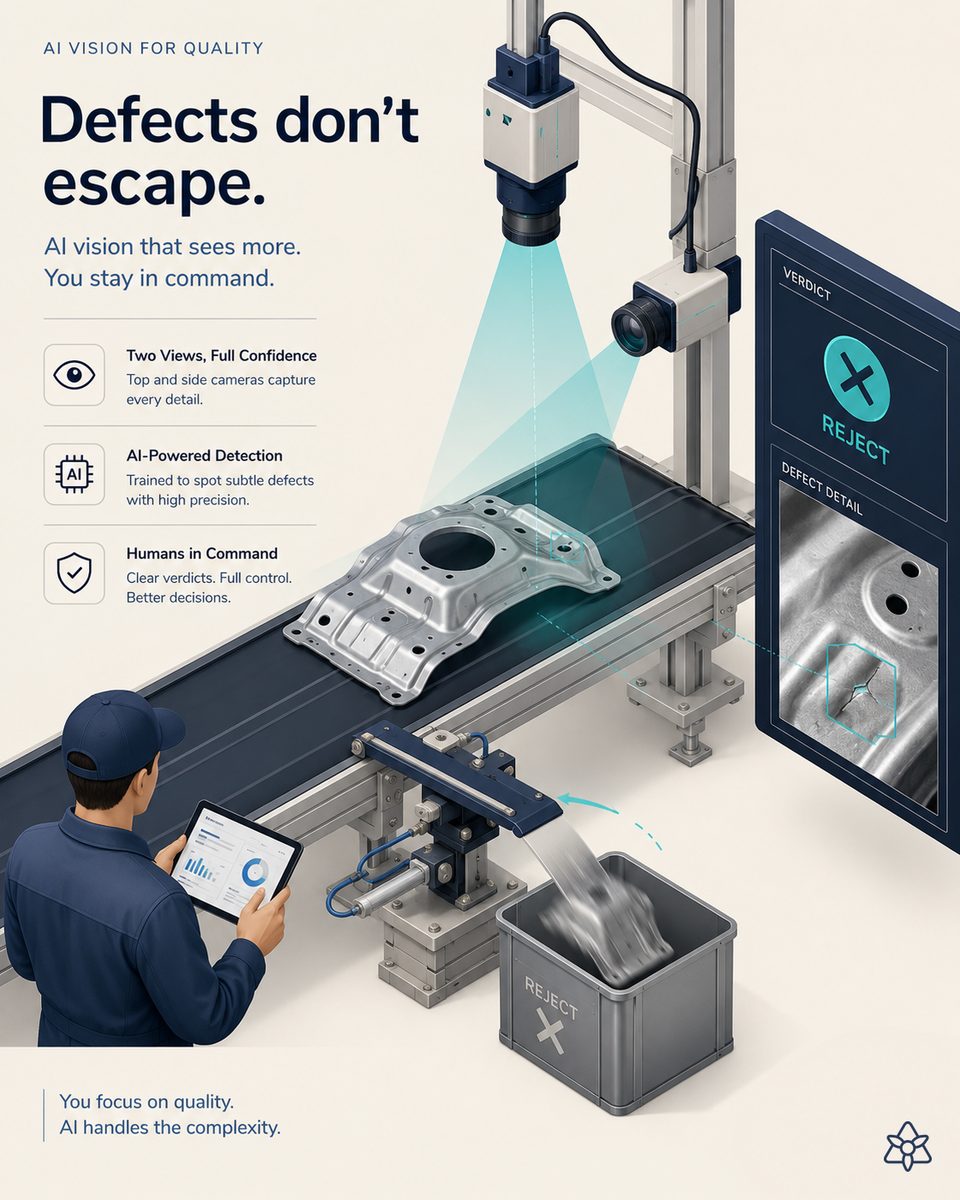
- Edge — a terminal with machine vision (CNN) after demolding and before labeling. It detects blisters in the tread, tread pattern irregularity, marks from a mold that did not close properly, compound residue. It drives the ejector in milliseconds. It works with no network.
- Connect — captures the compound data (MES, extruder panel, lab Excel), the delivery note from the carbon black or silica supplier arriving by email/WhatsApp, and the uniformity bench result. It unifies it all at second zero, without anyone re-sending anything.
- Agents — continuously cross-reference compound, press, mold, bench and Edge result. They spot patterns no single system could spot on its own (lumps from the compound dispenser creeping up again, mold 12 leaving fine marks for three shifts running). And they build the file by batch and by VIN, ready for IATF 16949 and for any OEM audit.
Classic control vs. cross-referenced control with iLEAN
| Aspect | Classic control (sampling + bench at the end) | With iLEAN Edge + Connect + Agents |
|---|---|---|
| Inspection after demolding | Operator's visual sampling | 100% inspected in line, milliseconds |
| Linking compound to a tire defect | Days, a root-cause meeting | Continuously, before the batches pile up |
| The veteran operator's knowledge | In his head, gone the day he retires | Captured by Connect and learned by the agents |
| Traceability by mold and by VIN | Rebuilt by hand when an incident hits | Automatic file, kept up continuously |
| Operation without network | n/a | Edge keeps inspecting with its own light |
| IATF 16949 / OEM audit | Days of the quality engineer | Dossier ready, minutes |
Impact estimate for your plant — to be validated with your numbers.
The block below is an estimate to be validated with the specific data of your plant. We put it forward so the committee has an order of magnitude; we refine it during the diagnostic.
- Tier 1 plant with several dozen curing presses and an off-line uniformity machine, European OEM under IATF 16949.
- Edge pilot after demolding on 2-4 presses + Connect reading the compound and the bench + an agent that cross-references with the Edge result and builds the file by batch/VIN. First value expected within a few weeks.
- Indicative payback between 4 and 9 months. The hard lever is the drop in OEM returns and, where it applies, avoiding an active customer escalation — either one pays for the pilot.
- Reduction of late-caught defects against the baseline typically ≥30% — to be confirmed once the "before" is measured.
And the OEM standard
The automotive quality standard for critical components sits on the order of 25 PPM[1]. Holding it with a human audit at the end of the line is not viable; with 100% in-line inspection, it is. AI on anchored tasks (classifying a defect against the customer's catalog, comparing the compound with the recipe) has error rates below 1.5% in the best models[2], and even so it does not decide alone — it holds the part and asks for a human signature.
[1] Symestic — automotive quality standard on the order of 25 PPM for critical components.
[2] OpenAI paper “Why Language Models Hallucinate”, 2025 — on the reliability of AI in anchored tasks.
What people ask about Tier 1 tire quality control with AI
Which critical defects can AI detect in a Tier 1 tire?
In the building and curing stage: blisters in the tread, poor adhesion between plies, tread pattern irregularity, marks from a mold that did not close properly, compound residue. In the testing stage: uniformity deviation (force variation, conicity, ply steer), circumference variation, out-of-tolerance balance. iLEAN Edge inspects in line after demolding, before labeling and before packing. Any tire outside the OEM catalog is pulled aside and documented for the quality engineer.
How is the rubber compound cross-referenced with defects found on the finished tire?
The root cause of many defects travels hidden in the compound — compound viscosity, extrusion temperature, carbon black lot, silica lot, the exact moment of the mixer batch changeover. iLEAN Connect captures all that data wherever it lives (the mixing MES, the extruder panel, the lab's Excel sheet, the supplier delivery note captured from an email), and an Agent cross-references it with the Edge inspection result on the finished tire. When a defect pattern climbs on one particular compound, it catches it before the batches pile up — and the quality manager adjusts the cause instead of counting bad parts.
How does iLEAN help with OEM approval and PPM escalation?
The OEM works with targets on the order of 25 PPM on critical components and keeps an active escalation open whenever a Tier 1 drifts. iLEAN Agents continuously builds the file by batch and by VIN — which compound, which mold, which machine, which uniformity test, which Edge measurement. If an incident or an IATF 16949 audit lands tomorrow, the dossier is ready and the conversation with the OEM changes tone: instead of defending yourself cold, you walk in with data.
Can iLEAN be integrated with curing presses and test benches that are already installed?
Yes — that is the putty metaphor. iLEAN does not force you to replace the curing press or the uniformity machine. Connect reads what is already there (OPC-UA and Modbus signals, local files, HMI panels photographed by the operator on older machines) and puts it into the system. Edge is installed as one additional terminal. It works with no network: if the plant loses WiFi, the Edge inspection cycle keeps running, because what is critical cannot depend on WiFi.
How long does it take to see the first savings from a pilot in a tire plant?
On comparable in-line quality projects in automotive, first value shows up within a few weeks — a real capability running, not a demo. Estimated payback, to be validated with your data, sits between 4 and 9 months. The hard lever is the drop in OEM returns, the improvement in cost per PPM and, if it fits your business, avoiding an active customer escalation. We ask for your plant's real data and send you the estimated ROI in 48h.
Related topics in automotive: Alloy wheel quality control · Suspension and damper control · IATF 16949 — continuous auditing with AI.
More cases in automotive
- Stamping dimensional control with 3D vision — die drift can be seen coming strokes ahead; finding it in the scrap bin is too late.iLEAN measures the critical dimensions of 100% of stamped parts in line with 3D vision and sees die…
- Coil-to-stamped-part traceability — without the link, you pay for the claim against the steel supplier yourself.iLEAN keeps the coil → stamped part link alive so claims against the steel supplier are covered.
- Suspension damper control with AI — the tolerance does not show on the bench, it shows in the curve.iLEAN applies Edge vision to damper assembly, captures the dynamic test and the force-velocity curve,…
- Digital Hoshin Kanri in tier-1 automotive — the X-matrix that actually lives on the line.iLEAN turns the Hoshin X-matrix into live KPIs by plant, shift and workstation. No spreadsheet, no…
- Part-to-VIN traceability in tier-1 — from the material batch to the car, without adding one more scan on the line.iLEAN joins batch, part and the final car's VIN. Full IATF 16949 traceability, from material receipt to…
- AI control of vehicle rear camera modules — the module passes the functional test, fails in the field, and the OEM returns the whole batch.iLEAN checks optical alignment and seal quality on 100% of rear camera modules at end of line and ties…
Tell us your case and in 48h we'll send you the estimated ROI of this AI project for your tire plant.
We work on your plant's real data, not ours. Diagnostic with no commitment.
Request estimated ROI in 48h See automotive