Digital Hoshin Kanri in tier-1 automotive — the X-matrix that actually lives on the line.
A Hoshin X-matrix ends up in a drawer if it does not live on the plant floor. iLEAN turns it into live KPIs by shift and workstation, cascades the corporate objective all the way down to the operator, and brings the committee data instead of hindsight. The person decides — the spreadsheet layout work simply stops existing.
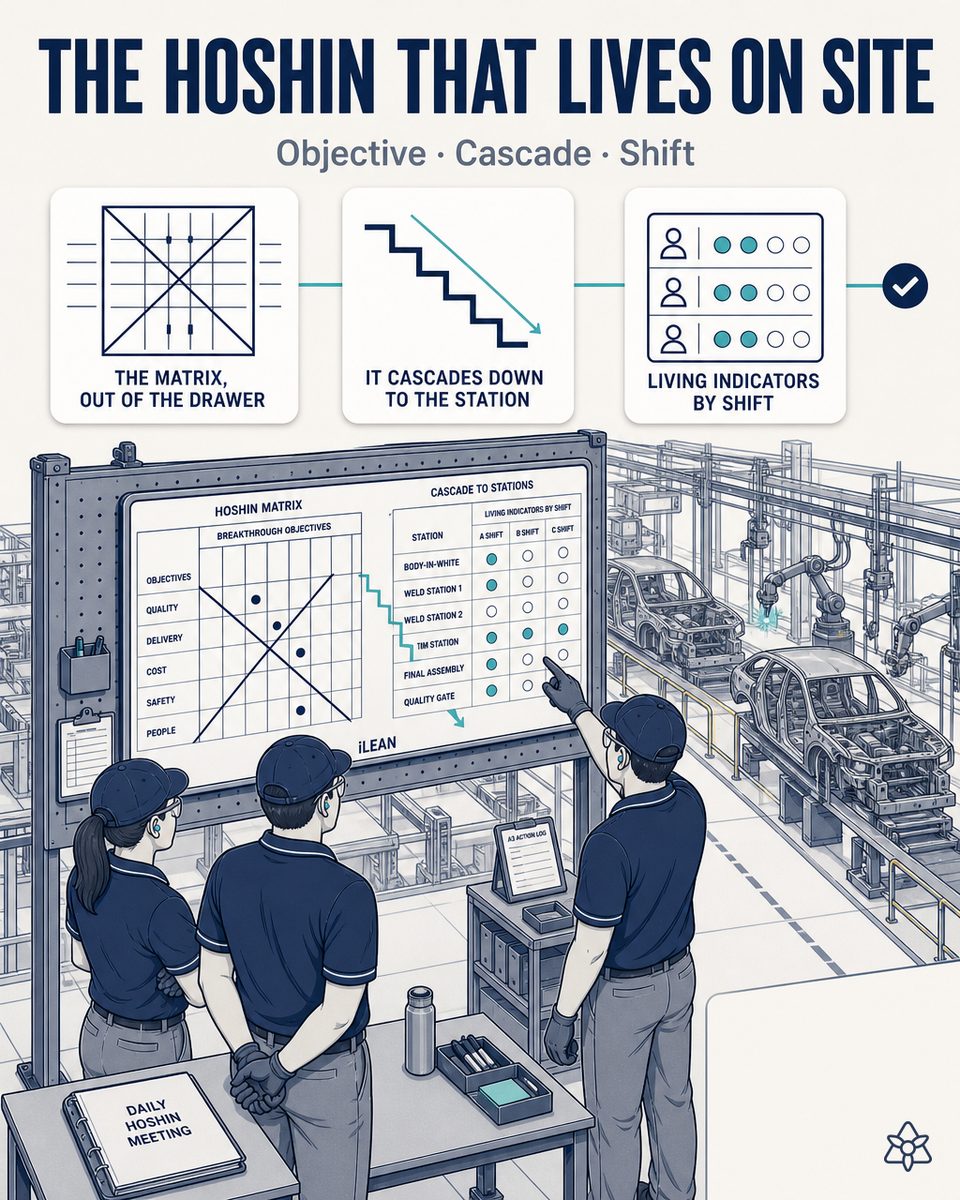
The X-matrix that reaches the drawer before it reaches the line.
Every operational excellence manager in a tier-1 plant knows the pattern: each Hoshin cycle starts with a beautifully drawn X-matrix in a meeting room, gets pinned to the quality board, and a month later lives in a spreadsheet that only three people know where to find in its updated version. Meanwhile, on the stamping, welding, paint or assembly line, the operator keeps looking at their shift KPI as if the OEM corporate breakthrough objective did not exist.
- The breakthrough objective — quality PPM, OEE, scrap, cost per part — lives in one layer: the plant manager's and corporate's.
- The operational KPI — line stoppages, defects, changeover time — lives in another: SCADA, a vertical MES, or an andon board that nobody cross-references with the X-matrix.
- The cascade between the two — the very reason Hoshin exists — is done by hand, in a monthly meeting, and dies between reviews.
The result: the committee arrives at the review with hindsight from three weeks ago, deviations get discussed as history, and the operator never got to see how their shift connects to the annual plan. Hoshin without a nervous system works 80% of the time. The remaining 20% is where you lose the whole cycle.
iLEAN does not replace your Hoshin — it gives it a nervous system.
The X-matrix is not the problem: it is a proven tool. The problem is that the information needed to keep it alive is spread across the corporate ERP, the MES, SCADA, andons and spreadsheets — and no human can be in five places at once. iLEAN acts as the putty that fills those cracks, without asking you to throw away the X-matrix or change your ERP.
Brain keeps the X-matrix alive. Writer cascades every change down to shift and workstation without opening a spreadsheet. The Agent detects the deviation against the breakthrough objective and alerts whoever decides — before the monthly meeting, not after.
The three iLEAN pieces applied to Hoshin Kanri in a tier-1 plant:
- iLEAN Brain — the X-matrix model lives here: breakthrough objectives → strategies by area → KPIs by shift and workstation. Each level inherits from the one above. When corporate changes an objective, the change propagates; when a workstation KPI moves, Brain connects it to the objective it is dragging.
- iLEAN Writer — turns every change to the X-matrix into the right piece of communication for each level: a dashboard for the committee, a weekly report for the area manager, a simple screen for the workstation. The person validates; Writer drafts. No more laying out spreadsheets on Sundays.
- iLEAN Agent — watches live KPIs against the objective, identifies deviations before they reach the monthly review and proposes the action to the manager at the relevant level. It proposes; the person signs. The Agent does not change the X-matrix or close actions on its own: it brings well-prepared data to whoever has to decide.
Hoshin in a spreadsheet vs. Hoshin with iLEAN
| Aspect | X-matrix in a spreadsheet + monthly meeting | With iLEAN Brain + Writer + Agent |
|---|---|---|
| Official version of the X-matrix | “The one Carlos has” — frozen a month ago | A single live one, accessible by level |
| Cascade to shift and workstation | Manual, on static screens | Automatic, with a live KPI per workstation |
| Deviation detection | In the monthly meeting, after the fact | Continuously, before it escalates |
| Committee review | Discussing history from 3 weeks ago | Deciding on data from the current shift |
| Change to the breakthrough objective | Re-send the spreadsheet, wait for it to stick | Immediate propagation to every level |
| Dossier for the OEM audit (IATF 16949) | Rebuild the cycle by hand | Native traceability, ready for the auditor |
Impact estimate for your plant — to be validated with your numbers.
The block below is an estimate to be validated with the specific data of your plant. We put it forward so the committee has an order of magnitude; we refine it during the diagnostic.
- Tier-1 plant with 2-4 production lines, 3 shifts, an annual Hoshin X-matrix with a monthly review with OEM corporate and IATF 16949 reporting.
- Brain + Writer pilot on one line (X-matrix cascade + live dashboards by level + deviation Agent). First value expected within a few weeks.
- Indicative payback between 4 and 9 months, depending on the hours per month spent today maintaining the X-matrix spreadsheet and preparing the monthly meeting, and on the weight of deviations that reach the committee late.
- Hard lever: cut the time area managers spend laying out reporting by ≥30%, and bring decisions to the committee instead of hindsight.
And the plant manager's reasonable doubt
“What if the AI proposes the wrong actions and derails the Hoshin?” — hallucination is a problem of free generation, not of anchored tasks. When the AI simply recontextualizes a piece of data from one system to another (cascading an X-matrix objective down to a workstation KPI, detecting a deviation against target), the best models brought error below 1.5% [1]. And even so, the Agent proposes; the person signs. Hoshin is still yours — it just stops dying in a spreadsheet.
[1] OpenAI paper “Why Language Models Hallucinate”, 2025 — on the reliability of AI in anchored tasks.
What people ask about digital Hoshin Kanri in tier-1 plants
How is the objective cascaded from plant down to workstation?
The Hoshin X-matrix starts from the tier-1 plant's breakthrough objectives (quality PPM, OEE, scrap, cost per part), translates them into strategies by area (stamping, welding, paint, assembly) and from there into KPIs by shift and by workstation. iLEAN automates the last mile: the operator sees on screen only the KPIs for their workstation on their shift, already cascaded down from the plant objective. If line OEE drops, the Agent identifies which workstation or shift is dragging it down and proposes the action to the line supervisor — without asking the shift lead to open a master spreadsheet every hour.
Who maintains the X-matrix with iLEAN?
The same person who does it today — the operational excellence manager or the plant manager — but no longer in a spreadsheet. iLEAN Writer turns every change to the X-matrix (a new breakthrough objective from corporate, a new metric for an OEM customer) into an automatic cascade down to shifts and workstations. The person validates; the system propagates. The monthly review meeting does not disappear — it stops being “who has the good version of the spreadsheet?” and becomes “what do we decide with the live data?”.
Does it integrate with KPIs that already exist in the ERP or MES?
Yes. iLEAN Connect reads the KPI wherever it lives: corporate ERP, the tier-1's vertical MES, line SCADA, or the quality manager's spreadsheet that gets updated every morning. It does not force you to migrate anything. The putty fills the cracks between the systems you already have; it does not demolish them. If the KPI lives on an old machine with an isolated local computer, Connect hooks in through an intermediate path and pulls the data without touching the machine.
How often is the X-matrix reviewed with iLEAN?
The formal review keeps whatever cadence you decide (typically monthly with corporate, weekly with area managers, daily on the plant floor). What changes is that between reviews the X-matrix does not freeze: the KPIs run continuously, the Agent detects deviations against the objective and alerts the manager at the relevant level before that deviation lands in the monthly meeting as a surprise. Hoshin stops being a document and becomes a nervous system.
When does a tier-1 plant see the impact?
First value shows up within a few weeks — usually the automatic cascade to a pilot line, with the operational excellence manager finally seeing their KPIs without laying out spreadsheets on Sundays. The impact on the full (annual) Hoshin cycle shows in the first cycle: the plant committee arrives at the review with live data instead of hindsight. Estimate to be validated with your numbers: payback between 4 and 9 months depending on the current cost of maintaining the X-matrix by hand and the weight of deviations that arrive late.
More cases in automotive
- Coil-to-stamped-part traceability — without the link, you pay for the claim against the steel supplier yourself.iLEAN keeps the coil → stamped part link alive so claims against the steel supplier are covered.
- Suspension damper control with AI — the tolerance does not show on the bench, it shows in the curve.iLEAN applies Edge vision to damper assembly, captures the dynamic test and the force-velocity curve,…
- Tier 1 tire quality control with AI — uniformity, curing and OEM approval in a single file.How iLEAN cross-references Edge vision over curing and uniformity, rubber compound data and mold…
- Part-to-VIN traceability in tier-1 — from the material batch to the car, without adding one more scan on the line.iLEAN joins batch, part and the final car's VIN. Full IATF 16949 traceability, from material receipt to…
- AI control of vehicle rear camera modules — the module passes the functional test, fails in the field, and the OEM returns the whole batch.iLEAN checks optical alignment and seal quality on 100% of rear camera modules at end of line and ties…
- Automotive water pump control with AI — the coolant leak starts in the second of assembly.How iLEAN cross-references Edge vision, flow testing and vibration signature to catch leaks, faulty…
Tell us your case and in 48h we'll send you the estimated ROI of digital Hoshin for your tier-1 plant.
We work on your plant's real data, not ours. Diagnostic with no commitment.
Request estimated ROI in 48h See automotive