Suspension damper control with AI — the tolerance does not show on the bench, it shows in the curve.
An out-of-tolerance damper does not show up in the go/no-go if nobody cross-references the curve with the batch recipe — it shows up when the car reaches the first corner. iLEAN joins Edge vision over rod and seal assembly, the force-velocity curve from the dynamic test bench and VIN traceability, and holds the unit before it ships when it falls outside the model's envelope. The person signs.
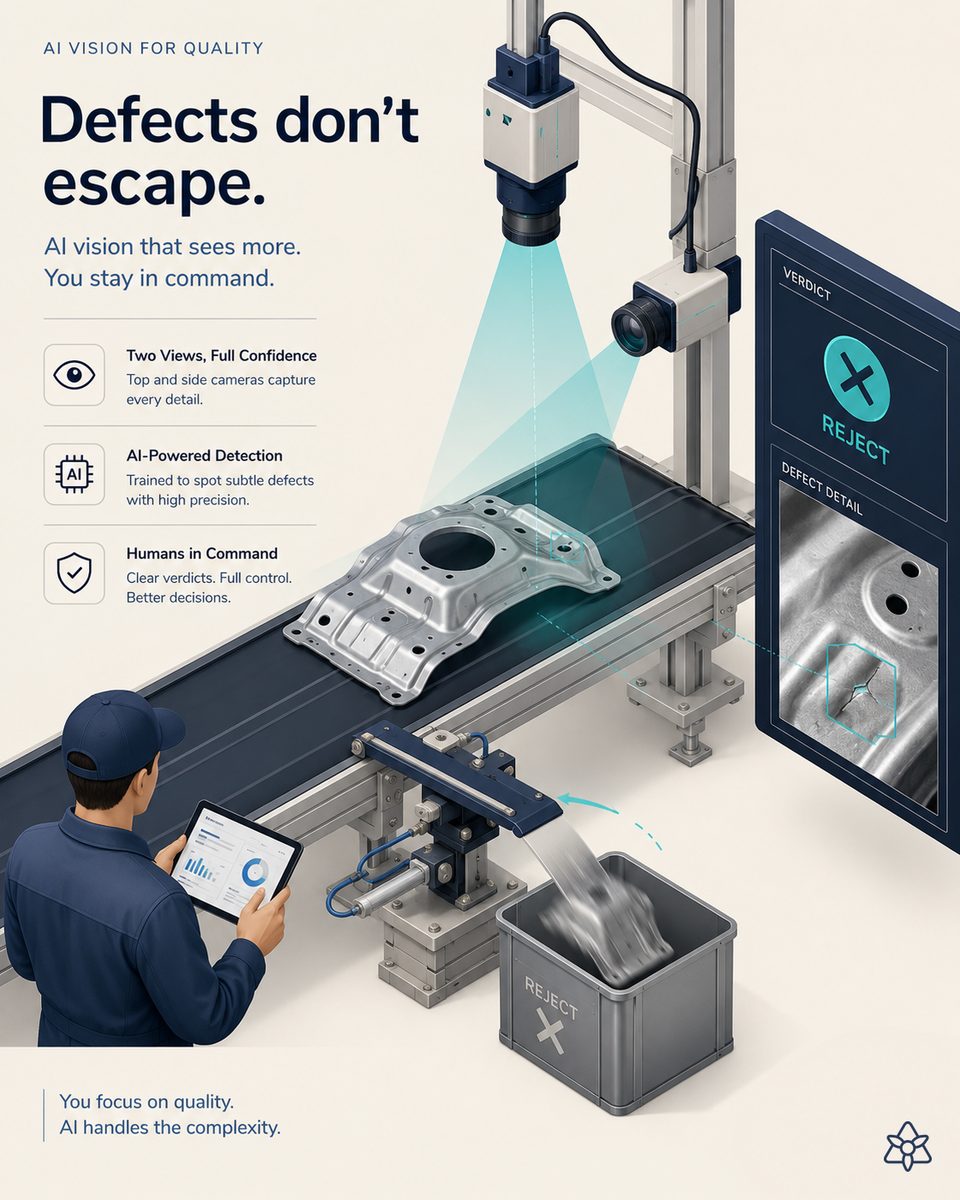
The bench says OK, the driver says the car floats through corners.
A damper combines five sources of variability that a generic end-of-line bench cannot separate:
- The chrome-plated rod — micro-scratches, straightness, plating finish. A sub-millimeter defect destroys the seal after a few thousand kilometers and opens a warranty claim.
- The internal valve assembly — it defines the model's force-velocity curve. It changes with the vehicle version (standard, Sport, off-road) and is assembled at high cadence.
- The hydraulic oil and gas charge — viscosity and pressure specific to each model, captured (or not) at the filling station.
- The gaskets and seals — different supplier, different batch, prone to contamination or misplacement.
- The target model recipe — which curve each VIN requires. The generic bench measures a common envelope, not the model-specific curve.
The quality manager knows it. The bench gives a go/no-go against an envelope, not against the model-specific curve. A unit can pass the go/no-go and still fail the ride comfort the OEM demands. The comfort-related return arrives months after manufacturing, when it can no longer be tied back to the batch.
iLEAN does not replace the bench — it puts the bench curve next to the model recipe.
The damper problem is not a missing test bench: it is information in islands (the curve on the bench PC, the rod image in another system, the oil batch on a delivery note, the model recipe in the MES). At the critical moment — when the unit ships — those five sources are never cross-referenced. iLEAN acts as the putty that fills those gaps without touching the bench or the filling station.
Edge sees the rod, the seal and the gasket. Connect reads the full bench curve and the model recipe. The agent cross-references the envelope expected for that model and holds the unit. The person signs — never the other way round.
The three iLEAN pieces applied to damper control:
- Edge — a terminal with machine vision (CNN) over the critical stations: the chrome-plated rod (micro-scratches, straightness), gasket and seal assembly before closing, the oil trace after the first bench cycle (an incipient leak), and the damper's laser marking. It triggers the actuator (stack light, diverter) in milliseconds. It works without a network: if the plant loses WiFi, Edge keeps reading and holding units.
- Connect — captures the complete force-velocity curve from the dynamic test bench (not just the go/no-go), whether it comes from the bench's modern bus or from an old PC. It captures the oil and gas batch from the supplier's delivery note (a PDF if that is what there is) and the model recipe from the ERP/MES. Whatever arrives from outside (an email from the oil supplier flagging a viscosity change) enters at second zero.
- Agent — cross-references the measured curve with the curve expected for the target VIN, the rod image, the oil batch and the model recipe. If the measured curve falls inside the generic envelope but outside the model envelope, it holds the unit and alerts the quality manager. The person validates and signs; the line does not restart on its own.
Generic go/no-go bench vs. in-line control with iLEAN
| Aspect | Today (generic end-of-line bench) | With iLEAN Edge + Connect + Agent |
|---|---|---|
| Acceptance criterion | An envelope shared across several models | The curve specific to the target VIN |
| Rod defects | Visual inspection of the plating, by sampling | CNN vision on 100%, before seal assembly |
| Leaks after the first cycle | Caught by a visible trace at the next station | Edge looks for the oil trace at second zero |
| Oil / gas batch | Trust in the delivery note, no cross-reference | Batch linked to every unit built |
| Ride-comfort returns | No traceability — scattered returns | A detectable pattern: which batch, which model, which VIN |
| File for PPAP/8D | Rebuilt if an incident hits, weeks of work | Per-unit dossier, automatic, with curve and photo |
Impact estimate for your plant — to be validated with your numbers.
The block below is an estimate to be validated with the specific data of your plant. We put it forward so the committee has an order of magnitude; we refine it during the diagnostic.
- Multi-model damper assembly line, with a rod plating/inspection station, gasket assembly, oil and gas filling and a force-velocity dynamic test bench at the end.
- Edge pilot on one line (camera over the rod + camera over seal assembly + integration with the full bench curve). First value expected within a few weeks.
- Indicative payback between 4 and 9 months, depending on the frequency of ride-comfort returns and OEM rejects for curves outside the envelope over the last few years.
- The hard lever is the reduction in ride-comfort returns, which today arrive months later with no traceability, plus a single batch avoided in OEM sorting.
And the quality manager's reasonable doubt
"What if the AI accepts a curve that sits right on the edge of the envelope?" — hallucination is a problem of free generation, not of anchored tasks. In tasks where the AI simply compares a measured curve against an envelope declared per model, the best models brought error below 1.5% [1]. And even so, what is critical is never decided alone: iLEAN holds the unit and the person signs. An automotive quality standard on the order of 25 PPM [2] cannot be sustained with sampling on a generic bench: it is sustained by comparing against the model envelope, unit by unit.
[1] OpenAI paper "Why Language Models Hallucinate", 2025 — on the reliability of AI in anchored tasks.
[2] Symestic — automotive quality standard on the order of 25 PPM.
What people ask about suspension damper control with AI
What critical defects can vision + AI detect on a damper?
Rod defects (micro-scratches, poor chrome plating, straightness out of tolerance that destroys the seal within a few thousand kilometers), tube defects (porosity in the bottom weld, dents from stamping), gasket and seal errors (badly positioned, dirty, wrong supplier batch), leaks (an oil trace after the first bench cycle) and marking or identification errors. iLEAN Edge sees all four groups on the line; Connect captures the force-velocity curve from the dynamic test bench; the agent cross-references it with the model recipe.
Why doesn't an out-of-tolerance damper show up on the test bench?
Because the end-of-line bench typically captures the force-velocity curve as a go/no-go against one envelope, but never cross-references that curve with the model recipe (which valve, which oil, which gas pressure it should carry) or with the image of the rod and the seals. A unit can pass the generic go/no-go and still fall outside the specific curve for its target model — and the customer notices on the first corner or the first pothole. iLEAN cross-references the measured curve with the curve expected for that model, not with a generic one.
Can the existing dynamic test bench be integrated without replacing it?
Yes. iLEAN Connect has a sliding scale of capture per machine: if the bench has a modern bus, direct integration with the full curve; if it has an old, isolated local PC, Connect connects and extracts the curve without touching the equipment; if the curve comes out on a printer or only the go/no-go appears on a display, a camera or OCR digitizes it. We do not force you to replace the bench — what changes is that the curve stops living on paper and enters the per-unit dossier.
How is each damper linked to the VIN of the target vehicle?
Edge reads the damper's laser/DataMatrix marking and the agent cross-references it with the MES production order and the target VIN. The per-unit dossier — measured force-velocity curve, image of the rod and seals, oil and gas batch, closing torque — stays linked permanently. Ready for PPAP, for an OEM 8D and for answering a possible warranty call without rebuilding anything.
How much does a damper control pilot with iLEAN cost?
The order of magnitude of an Edge pilot on a damper line is similar to that of any Edge pilot on chassis components: vision terminals + integration with the dynamic test bench + an annual license. A reasonable payback to present to the committee is several months — the hard lever is the reduction in ride-comfort returns plus a single batch avoided in OEM sorting for a curve outside the envelope. We ask for your plant's data and send you the estimated ROI in 48h, with your numbers.
More cases in automotive
- Automotive seat manufacturing with AI — a silent module at end of line is a broken JIS sequence at the OEM.How iLEAN cross-references vision, tightening torque, electronic testing and traceability to build…
- Stamping dimensional control with 3D vision — die drift can be seen coming strokes ahead; finding it in the scrap bin is too late.iLEAN measures the critical dimensions of 100% of stamped parts in line with 3D vision and sees die…
- Coil-to-stamped-part traceability — without the link, you pay for the claim against the steel supplier yourself.iLEAN keeps the coil → stamped part link alive so claims against the steel supplier are covered.
- Tier 1 tire quality control with AI — uniformity, curing and OEM approval in a single file.How iLEAN cross-references Edge vision over curing and uniformity, rubber compound data and mold…
- Digital Hoshin Kanri in tier-1 automotive — the X-matrix that actually lives on the line.iLEAN turns the Hoshin X-matrix into live KPIs by plant, shift and workstation. No spreadsheet, no…
- Part-to-VIN traceability in tier-1 — from the material batch to the car, without adding one more scan on the line.iLEAN joins batch, part and the final car's VIN. Full IATF 16949 traceability, from material receipt to…
Tell us your case and in 48h we'll send you the estimated ROI of this AI project for your damper line.
We work on your plant's real data, not ours. Diagnostic with no commitment.
Request estimated ROI in 48h See automotive