Stamping dimensional control with 3D vision — die drift can be seen coming strokes ahead; finding it in the scrap bin is too late.
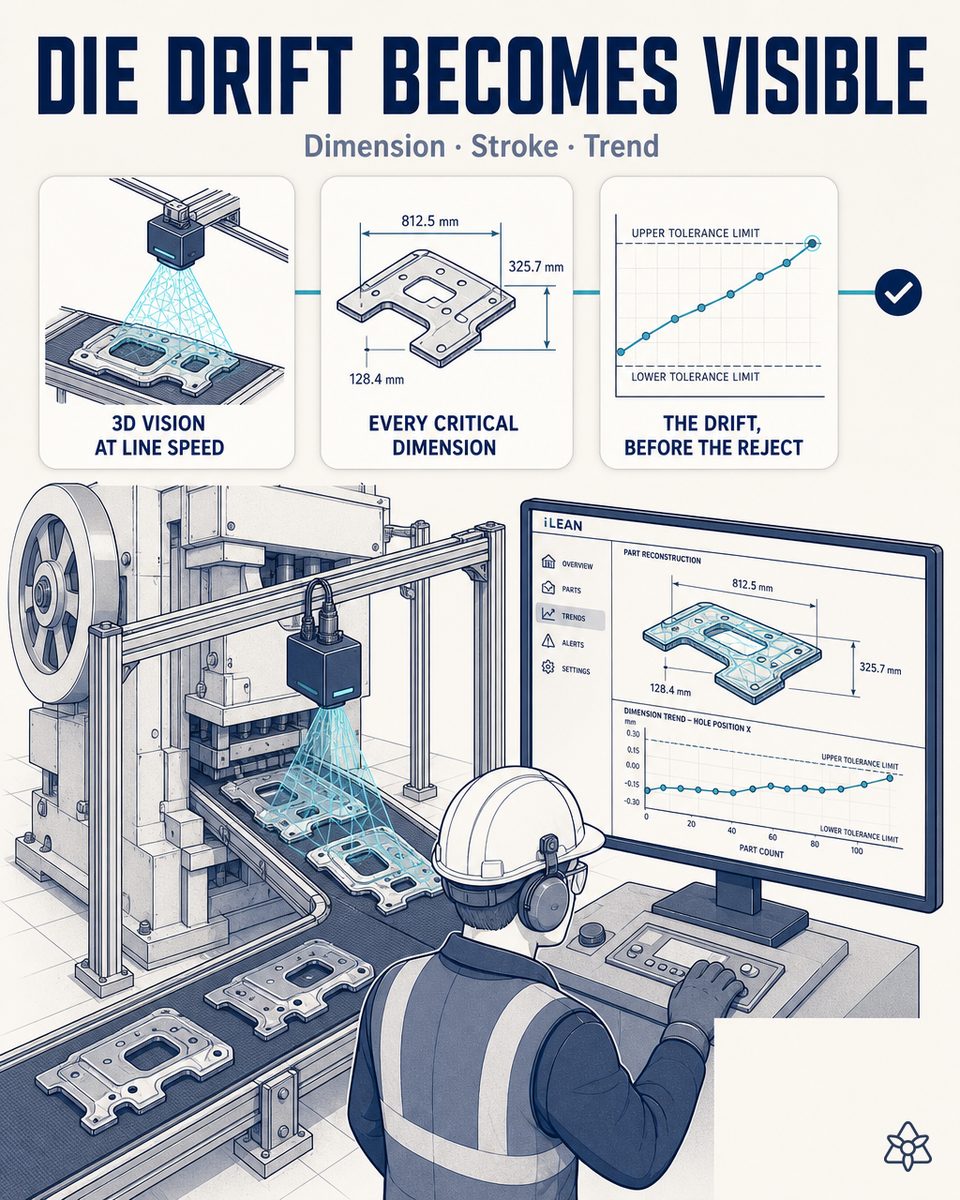
One part every N strokes measured on the CMM does not protect you from die drift. iLEAN measures the critical dimensions of 100% of the parts at press rate with in-line 3D vision and tracks their trend in live statistical control. JIDOKA AI holds the flow if a dimension goes out of band. The person decides.
The die drifts stroke by stroke — and sampling finds out containers later.
The press shop supervisor tells the same story in every plant: the sample part came out good this morning, the CMM confirmed it at midday — after its hours of queuing in metrology — and the press kept running at full rate. And the next day, containment: a sidewall dimension out of tolerance, three containers on hold, and nobody knows at which exact stroke the drift started. The die did not fail suddenly — it had been drifting for thousands of strokes.
Three things happen at once on a real stamping line and sampling sees none of them:
- Die drift is slow and continuous — wear on radii and draw beads shifts the dimensions a tenth at a time. Between one sample part and the next there are hundreds or thousands of strokes in which nobody measures anything.
- Springback changes with the coil — same part number, same die, but a new heat or a change of supplier moves the elastic recovery. The sample part from the previous coil no longer says anything about the current one.
- The die setter works blind between samples — correcting on experience, tonnage and by ear. By the time the CMM returns the result, the window for a fine adjustment has passed and it becomes a big call: stop, rework or cross your fingers.
The outcome is always the same: scrap is discovered by the container, not by the part — or worse, the customer discovers it when the part does not fit at assembly and the complaint arrives with an audit behind it. The knowledge that anticipates drift lives in the head of the veteran die setter; the day they retire, it goes with them.
iLEAN does not replace your metrology — it measures where your metrology cannot reach: on every stroke.
The problem in stamping is not a lack of measuring capability: the CMM measures better than anyone. The problem is when and how much it measures — one part every N strokes, with hours of queuing, once the drift has already done its work. iLEAN puts the measurement where the process is: non-contact 3D vision on the line itself, measuring the critical dimensions of every part at the rhythm of the press, and cross-referencing that series with strokes, coil and adjustments — without asking you to change the press, the die or the CMM.
Edge measures the critical dimensions of 100% of the parts at press rate. The trend of every dimension lives in statistical control. JIDOKA AI holds the flow if something goes out of band. The person decides.
The iLEAN pieces applied to stamping dimensional control:
- Edge — a local terminal with laser profilometry or stereo vision mounted at the press exit or in the transfer. It measures the control plan's critical dimensions on every stroke, without contact and without touching cycle time, and keeps a live statistical control chart for each dimension. It runs locally: if the plant loses the network, Edge keeps measuring, recording and holding anything that goes out of band. What is critical does not depend on WiFi.
- JIDOKA AI — if a dimension leaves the control band, the flow is held at that point: the doubtful part does not move on, the press does not keep making scrap, and the decision — adjust, segregate, continue — is taken by the person with the data in front of them, not on intuition. It is classic jidoka taken down to the dimension: stop the defect where it is born.
- Agents — agents that correlate the drift of each dimension with the die's stroke count, the coil in production (heat, supplier, thickness) and the logged adjustments. With that cross-reference, die maintenance stops being scheduled by calendar or by scare and starts being anticipated on data: which die will need work, in how many strokes, and which dimension is giving the warning. The agents propose — the plant manager decides.
Dimensional control by sampling vs. control with iLEAN
| Aspect | Sampling + CMM in the metrology room | With iLEAN Edge + 3D vision |
|---|---|---|
| Control coverage | 1 part every N strokes | 100% of parts, at press rate |
| Detecting die drift | Once the scrap is already in the container | Trend per dimension, strokes of warning |
| Time to result | Hours of queuing in metrology | In line, stroke by stroke |
| The die setter's work | Blind between samples, on experience | Live trend of every dimension on the panel |
| Die maintenance | By calendar or by scare | Anticipated from strokes, coil and drift |
| Traceability in a customer complaint | Rebuilt from whatever samples exist | Dimensional history per stroke, automatic |
Impact estimate for your plant — to be validated with your numbers.
The block below is an estimate to be validated with the specific data of your plant. We put it forward so the committee has an order of magnitude; we refine it during the diagnostic.
- Tier-1 stamping line, transfer or progressive, control by sampling (one part every N strokes measured on the CMM with hours of queuing), documented episodes of scrap from drift or of a customer complaint about a dimension that does not close.
- Edge pilot with 3D vision on the critical dimensions of one problem part number + live control charts from day one; the agents need 4-6 weeks of strokes, coils and adjustments before they start anticipating die maintenance. First value expected within a few weeks: the automatic hold of anything out of band works before the predictive model is fine-tuned.
- Expected reduction in scrap from undetected drift of ≥30% — a defensible floor, an estimate to be validated against your containment history.
- Indicative payback between 5 and 12 months, an estimate to be validated. The hard levers: every container that does not fill with scrap, every containment that is not opened and every CMM hour that goes back to what adds value — approving and validating, rather than acting as a traffic light for the press.
- A recurring benefit that does not go into the ROI but weighs: the pattern of each die — how it drifts, with which coil, after how many strokes — stays as a permanent capability of the plant, not of the person who retires.
And the quality manager's reasonable doubt
“What if the system mismeasures a dimension and holds my press for no reason?” — two answers. The measurement itself is deterministic metrology: the 3D vision is correlated against your CMM during commissioning and re-correlated on a schedule, so its uncertainty is characterized, not assumed. And the AI part — the agents correlating drift with strokes, coil and adjustments — never acts on the press alone: it proposes, the manager decides, the intervention happens or it does not. Hallucination is a problem of free generation, not of anchored tasks: in tasks where the AI cross-references real measurements with history and line context, the best models brought error below 1.5%[1]. And even so, what is critical goes to the safety rings — the agents live in the outer ring, propose inward, and the decision about the press and the die is signed by a person. Never the other way round.
[1] OpenAI paper “Why Language Models Hallucinate”, 2025 — on the reliability of AI in anchored tasks.
What people ask about stamping dimensional control with 3D vision
Which dimensions can it measure in line?
The ones the control plan marks as critical: openings and sidewall angles (where springback bites), hole position and diameter, draw depths and flange profiles. The iLEAN Edge uses non-contact laser profilometry or stereo vision, mounted at the press exit or in the transfer, and measures those dimensions on 100% of the parts at line rate. It does not set out to capture the full GD&T of the part — that is still CMM territory — but to have the dimensions that really predict the problem measured on every stroke, not once every N.
Can it keep up with the press rate?
Yes — the measurement is non-contact and the processing runs on the local Edge, at the line, so the cycle time of the measurement keeps pace with the press, whether transfer or progressive. At very high rates the strategy is to prioritize: the 5-10 dimensions that give the earliest warning of drift are measured on every stroke and the rest are automatically sub-sampled. And because everything runs locally, if the plant loses the network the Edge keeps measuring, recording and holding anything that goes out of band. What is critical does not depend on WiFi.
Does it replace the CMM and the metrology room?
No, and it should not. The CMM remains the reference for full GD&T, PPAP approvals and periodic correlation — in fact the system is correlated against your CMM during commissioning and re-correlated on a schedule. What changes is the role of sampling: it stops being the only defense against die drift and goes back to doing what adds value — validating, approving, arbitrating doubtful parts. The hours of queuing in metrology just to know whether the press can keep running disappear: the line answers that on every stroke.
How does it anticipate die drift?
Because it does not look at the individual value but at the trend. Every critical dimension has its own live statistical control chart: when the mean shifts or the spread widens, the drift can be seen coming strokes before it touches the tolerance limit. The iLEAN agents cross-reference that trend with the die's stroke count, the coil in production (heat, supplier, thickness within tolerance — springback changes with the coil) and the adjustments logged at the press. If a dimension goes out of band, JIDOKA AI holds the flow and the person decides; if the trend points to wear, die maintenance is planned on data, not on a scare.
What payback is realistic?
It depends on the starting point — a line with documented drift scrap every month is not the same as a plant with young dies and dense sampling. As an order of magnitude, and always as an estimate to be validated with your numbers: indicative payback between 5 and 12 months, with a reduction in scrap from undetected drift of ≥30% as a defensible floor. On top of that come levers that do not always enter the ROI: fewer hours queuing at the CMM, fewer suspect parts held in containment and no container assembled at the customer's plant with a dimension that does not close. We send you the estimated ROI in 48h with your line's real data.
More cases in automotive
- REACH/ELV material traceability — an undeclared SVHC is not an incident, it is a suspended order.iLEAN links the supplier declaration, the BOM and the finished product to keep REACH and ELV covered on…
- AI control of seat belts — the failure does not show up until the day of the crash.iLEAN combines Edge vision over the webbing, load test data captured by Connect and VIN traceability,…
- Automotive seat manufacturing with AI — a silent module at end of line is a broken JIS sequence at the OEM.How iLEAN cross-references vision, tightening torque, electronic testing and traceability to build…
- Coil-to-stamped-part traceability — without the link, you pay for the claim against the steel supplier yourself.iLEAN keeps the coil → stamped part link alive so claims against the steel supplier are covered.
- Suspension damper control with AI — the tolerance does not show on the bench, it shows in the curve.iLEAN applies Edge vision to damper assembly, captures the dynamic test and the force-velocity curve,…
- Tier 1 tire quality control with AI — uniformity, curing and OEM approval in a single file.How iLEAN cross-references Edge vision over curing and uniformity, rubber compound data and mold…
Tell us your case and in 48h we'll send you the estimated ROI of this AI project for your stamping line.
We work on your plant's real data, not ours. Diagnostic with no commitment.
Request estimated ROI in 48h See automotive