REACH/ELV material traceability — an undeclared SVHC is not an incident, it is a suspended order.
REACH/ELV means knowing which substances are in every component. iLEAN joins the supplier declaration, the BOM and the finished product part by part with Tracer + Connect + Writer, and raises the alert before an IMDS datasheet goes out with stale data. The person signs.
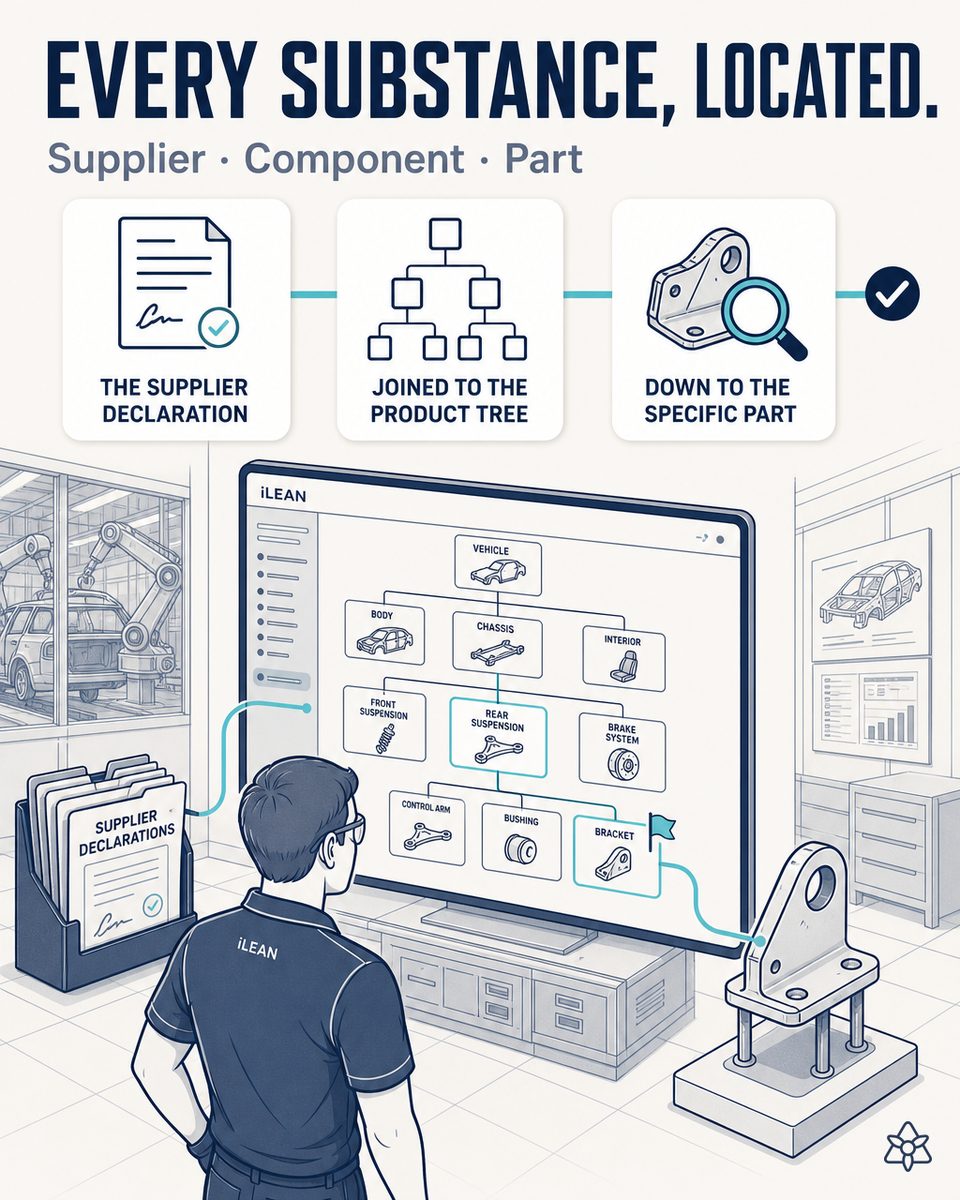
The right declaration is the intersection of three data sets that are almost never in the same place.
The quality manager at an automotive supplier knows it by heart: the IMDS datasheet sent to the OEM is the intersection of three realities that live in three parallel worlds.
- The supplier's declaration — a PDF that arrived by email, an IMDS form, an Excel sheet the sales rep updated last week and nobody forwarded to quality.
- The BOM of the finished product — the bill of materials that lives in the ERP or the PLM, with its revisions, its equivalent alternates and its emergency substitutions.
- The actual plant record — which part number was bought and assembled in each batch, which almost never matches 100% what the list said, because of silent supplier changes.
The classic system (a PDF in a folder, a person cross-checking it by hand every time the OEM asks) works 99% of the time. That 1% is the one that reaches the OEM portal as a non-conformity — and every non-conformity means the order is held until it is closed. And the SVHC candidate list grows twice a year: every update turns a once-correct declaration into an insufficient one.
iLEAN does not add a fourth system — it seals the cracks between supplier, BOM and plant.
The REACH/ELV problem is not a lack of information: it is information split into islands and declarations arriving in mixed formats that nobody ever had time to unify. iLEAN acts as the putty that fills those gaps, without asking you to change your ERP, your PLM or the OEM's IMDS portal.
Connect captures every declaration through whichever channel the supplier uses. Tracer keeps the batch-by-batch link with the BOM. Writer prepares the IMDS datasheet, signed by a person — never the other way round.
The three iLEAN pieces applied to REACH/ELV traceability:
- Connect — listens to everything coming in from suppliers. A PDF by email, a photo of the datasheet over WhatsApp, a web form, an IMDS declaration. It digitizes it at second zero and extracts the declared substances into a structured field. If a supplier writes “coating change on the M6 screw”, iLEAN sees the new datasheet and triggers the cross-check without anyone forwarding anything.
- Tracer — maintains the link supplier declaration ↔ purchased part ↔ batch ↔ finished product. When a substance enters the candidate list, Tracer walks up the tree and flags every product where that substance appears. Nothing has to be rebuilt by hand when the OEM asks about a batch from two years ago.
- Writer — an agent that prepares the IMDS datasheet or the SCIP declaration when it is due, using the freshest data Connect has captured and the cross-reference Tracer maintains. The person validates and signs; nothing goes out without a human signature. If the agent detects an inconsistency (an SVHC present in a purchased component that is not declared further up), it holds the submission and raises the alert.
Manual declaration vs. cross-referenced traceability with iLEAN
| Aspect | Manual declaration + PDF in a folder | With iLEAN Tracer + Connect + Writer |
|---|---|---|
| Capturing the supplier declaration | Manual email, forwarded when someone remembers | Email/WhatsApp/IMDS read at second zero |
| Cross-check with the BOM | A spreadsheet rebuilt whenever the OEM asks | Live batch-by-batch link, always up to date |
| Change in the SVHC candidate list | Discovered when the datasheet is rejected | Automatic walk up the tree, alert before submission |
| Silent supplier change | Discovered by chance | Connect sees the new PDF, triggers the cross-check |
| Preparing the IMDS datasheet | Quality does it by hand, nervously | Writer prepares, the person signs |
| File for the OEM audit | Rebuilt by hand, weeks | Per-product dossier, automatic |
Impact estimate for your plant — to be validated with your numbers.
The block below is an estimate to be validated with the specific data of your plant. We put it forward so the committee has an order of magnitude; we refine it during the diagnostic.
- Tier-1 with 50-150 active suppliers, a mix of mature IMDS declarants and small suppliers sending PDFs by email. Multi-OEM (at least two customers with different CSRs).
- Connect + Tracer pilot on one product family and its 10-20 main suppliers. First value expected within a few weeks — the first time saving is measured on the next IMDS datasheet you prepare.
- Indicative payback between 4 and 9 months, depending on the average cost of an IMDS non-conformity and on the hours quality spends rebuilding files by hand.
- Hard lever: avoiding a single order suspension caused by a documentation failure. One suspension pays for the pilot, before counting the recurring saving in quality hours.
- Expected reduction in the time needed to prepare each IMDS datasheet and SCIP entry of over 30%, recurring.
And the quality director's reasonable doubt
“What if the AI gets the declared substance wrong when it reads the supplier's PDF?” — hallucination is a problem of free generation, not of anchored tasks. In tasks where the AI merely recontextualizes a piece of data from one system into another (reading the supplier datasheet and populating the IMDS format), the best models brought error below 1.5%[2]. And even so, what is critical is never decided alone: the agent prepares, iLEAN holds the submission if there is an inconsistency, and the person signs. The three safety rings exist precisely for this.
[1] Reference automotive quality standard on the order of 25 PPM (parts per million). Symestic.
[2] OpenAI paper “Why Language Models Hallucinate”, 2025 — on the reliability of AI in anchored tasks.
What people ask about REACH/ELV traceability in automotive
What does REACH require in automotive?
REACH (EU Regulation 1907/2006) requires the manufacturer of an automotive component to declare the substances of very high concern (SVHC) on the candidate list that are present above 0.1% by weight of the article, to communicate them to recipients along the supply chain and to register them in ECHA's SCIP database. For a plant that means three things: keeping an up-to-date SVHC declaration from every supplier (with every new revision of the candidate list), knowing where each purchased part number sits inside the BOM of the finished product, and being able to rebuild the file when the OEM asks. The sentence “contains no SVHC” only holds if a system backs it up with live supplier data, not with a datasheet that arrived three years ago.
And ELV (End of Life Vehicle)?
The ELV Directive (2000/53/EC) bans the use of lead, mercury, cadmium and hexavalent chromium in new vehicles above minimum thresholds, except for the exemptions in Annex II. Anyone manufacturing a component for an OEM has to prove — through IMDS (International Material Data System) — that every declared material fits the ELV table in force. The operational problem: Annex II exemptions expire, suppliers change alloy without warning, and the quality manager finds out when the OEM rejects the IMDS datasheet. iLEAN cross-references the declaration received with the ELV version in force and raises an alert before the datasheet is ever submitted.
How are SVHCs cross-referenced with the BOM?
By joining three sources that today almost never talk to each other: the supplier's SVHC declaration (PDF, IMDS form, email), the BOM of the finished product (which lives in the ERP or the PLM) and the plant record (which part number was actually used in which batch, not which part number the list said). iLEAN Connect captures the declarations whatever format they arrive in, iLEAN Tracer keeps the batch-by-batch link with the BOM, and an agent verifies that no SVHC present in a purchased part is left undeclared further up the tree. The person signs the final declaration.
What about suppliers with no system at all?
That is the normal case with a small supplier or one from a third country. iLEAN Connect comes in through whichever channel each one uses — email with a PDF attached, WhatsApp with a photo of the datasheet, a web form the sales rep fills in — and digitizes the declaration at second zero. If a supplier writes “our M6 screw no longer carries coating X”, iLEAN Writer triggers a review of every BOM where that screw appears and warns the quality manager before the next IMDS datasheet goes out with stale data. The most useful piece is not the sensor: it is the putty that seals the cracks between supplier, BOM and plant.
What does non-compliance cost?
Three layers: the regulatory penalty (REACH imposes fines and market suspension for banned substances), OEM rejection on the IMDS portal — and therefore the order held until the non-conformity is closed — and the brand cost when a part with an undeclared SVHC escalates into an end-customer alert. The automotive quality standard is on the order of 25 PPM: at that level of demand, a declaration failure is not absorbed as noise, it is chased down. The hard lever is avoiding a single order suspension caused by a documentation failure — that alone pays for the pilot.
More cases in automotive
- Automotive plastic injection with AI — the defect is not discovered, it is anticipated before the scrap piles up.How iLEAN detects flash, sink marks and streaks in automotive plastic injection before the defect piles…
- Powder coating defects with AI — a crater found late is scrap; found on the line, it is nothing.iLEAN Edge detects craters, sags and orange peel in powder coating on automotive parts as they come out…
- Radiator and heat exchanger control with AI — zero leaks reaching the OEM.How iLEAN cross-references Edge vision on tubes and fins, helium or pressure-decay leak testing and…
- AI control of seat belts — the failure does not show up until the day of the crash.iLEAN combines Edge vision over the webbing, load test data captured by Connect and VIN traceability,…
- Automotive seat manufacturing with AI — a silent module at end of line is a broken JIS sequence at the OEM.How iLEAN cross-references vision, tightening torque, electronic testing and traceability to build…
- Stamping dimensional control with 3D vision — die drift can be seen coming strokes ahead; finding it in the scrap bin is too late.iLEAN measures the critical dimensions of 100% of stamped parts in line with 3D vision and sees die…
Tell us your case and in 48h we'll send you the estimated ROI of this AI project for your tier-1.
We work on your plant's real data, not ours. Diagnostic with no commitment.
Request estimated ROI in 48h See automotive