Radiator and heat exchanger control with AI — zero leaks reaching the OEM.
A radiator with a micro-leak is not caught at 100 km — it is caught at 50,000, under warranty. iLEAN cross-references Edge vision on tubes and fins before brazing, leak testing by helium or pressure decay and batch traceability of the furnace curve, and holds the part when something does not add up. The person signs — the line does not restart on its own.
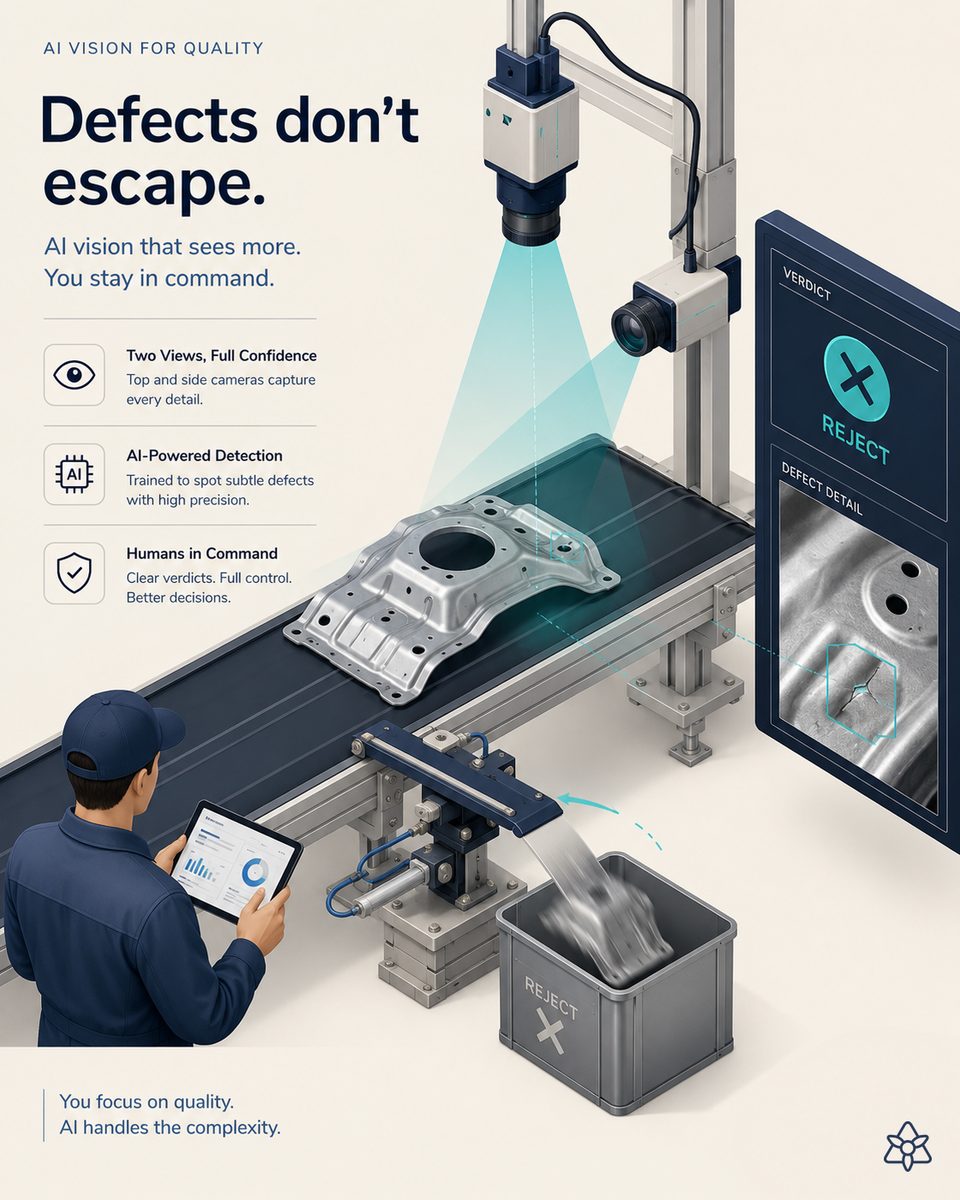
The leak that matters is not the one you see on the test bench — it is the one the end customer finds under warranty.
Radiators and heat exchangers (engine cooling, HVAC, power electronics in EVs) have a cruel failure profile: the micro-leak that does pass the quick test but fails at 30,000 or 50,000 km. By then it is already in the car of the OEM's customer, and it is a warranty campaign.
- Assembly — tubes, fins, headers. A deformed fin (fin damage) cuts thermal efficiency; a badly positioned tube complicates brazing. The operator inspects by sampling and the line does not stop.
- The brazing furnace — the flux melts, the alloy fills, the joint seals. The furnace curve is critical: peak temperature, time in zone, atmosphere. A small drift goes unnoticed until the leak pattern appears.
- Leak tightness testing — pressure decay to rule out gross leaks, helium for micro-leaks. The result lives inside the test equipment and often is never cross-referenced with the furnace curve of the same batch — two islands holding data that complement each other.
- The OEM customer — warranty campaigns for cooling or HVAC failure are extremely expensive, damage the contract and bring PPM escalation.
The classic system (operator + checklist + final test) no longer cuts it, because the data that determines reliability at 50,000 km is the furnace data, and that data lives on a different island from the test. The veteran operator senses it, but cannot watch the thermocouples and the helium reading at the same time.
iLEAN cross-references the furnace, the test and the line — without asking you to change anything.
Radiator control is not a problem of installing more sensors: it is a problem of cross-referencing the ones you already have. iLEAN is the putty that fills the crack between the brazing furnace curve and the leak test result of the same batch, without asking you to change the furnace, the helium equipment, the MES or the ERP.
Edge sees every assembly before brazing. Connect reads the furnace curve and the leak test at second zero. The agent cross-references with the batch and holds any part in doubt. The person signs — never the other way round.
The three iLEAN pieces applied to radiator and heat exchanger control:
- Edge — a terminal with machine vision (CNN) over the assembly line. It inspects 100% of assemblies before the furnace: fin damage, tube positioning, headers. It ejects the part in milliseconds. It works without a network.
- Connect — captures the brazing furnace curve (thermocouples by zone, atmosphere, conveyor) over OPC-UA or Modbus, the leak test result from the helium or pressure-decay equipment, and the tube and flux delivery notes by email. It unifies everything at second zero.
- Agents — continuously cross-reference the furnace curve with the leak test result in each batch, detect drift before the pattern turns into an OEM escalation, and build the file by batch and by VIN, ready for IATF 16949.
Control in islands vs. cross-referenced control with iLEAN
| Aspect | Classic control (every machine on its own island) | With iLEAN Edge + Connect + Agents |
|---|---|---|
| Inspection before brazing | Visual sampling | 100% inspected in line, in milliseconds |
| Furnace curve × leak test | Never cross-referenced | Cross-referenced continuously, drift caught earlier |
| Tube / flux batch | Paper delivery note, never reaches the furnace lead | Captured by Connect, linked to the batch |
| Traceability by VIN | Manual reconstruction when an incident hits | Automatic, continuously maintained file |
| Operation without a network | n/a | Edge keeps inspecting on panel power |
| IATF audit / warranty campaign | Defense from a standing start | Data ready, and the conversation with the OEM changes |
Impact estimate for your plant — to be validated with your numbers.
The block below is an estimate to be validated with the specific data of your plant. We put it forward so the committee has an order of magnitude; we refine it during the diagnostic.
- Radiator or heat exchanger plant, one assembly line + brazing furnace + leak test equipment (pressure decay and/or helium), European OEM under IATF 16949.
- Edge pilot before brazing + Connect reading the furnace curve and the test result + an agent that cross-references with the batch and builds the file by VIN. First value expected within a few weeks.
- Indicative payback between 4 and 9 months. The hard lever is a single warranty campaign avoided and the reduction in in-line rework from fin damage.
- Reduction in late-detected micro-leaks against the baseline of typically ≥30% — to be confirmed after measuring the "before".
And the OEM standard
The automotive quality standard for critical components sits on the order of 25 PPM[1]. Holding that without cross-referencing the furnace with the test is not viable in the medium term — the micro-leak is found by the end customer, not by the quality team. AI in anchored tasks (classifying a furnace curve against the catalog, reading the helium result and comparing it) has error rates below 1.5% in the best models[2], and even so it does not decide alone — it holds the part and asks for a human signature.
[1] Symestic — automotive quality standard on the order of 25 PPM for critical components.
[2] OpenAI paper "Why Language Models Hallucinate", 2025 — on the reliability of AI in anchored tasks.
What people ask about radiator and heat exchanger control with AI
What defects typically appear in an automotive radiator or heat exchanger?
In assembly: micro-leaks in the brazed joints between tube and fin, fin damage, collapsed tubes, incorrect positioning of the inlet and outlet. In testing: pressure drop out of tolerance (pressure decay), a loss detected by helium, assembly dimensions out of print. iLEAN Edge inspects the assembly after joining and before the brazing furnace, and Connect captures the leak-tightness test result to cross-reference it with batch, machine and operator. Any part in doubt is held; it never gets mixed in with the good batch.
How does leak testing (helium, pressure decay) integrate with iLEAN?
The helium or pressure-decay equipment produces a result per part — pass/fail, leak value, chart. iLEAN Connect captures it however it already exists (OPC-UA, local file, the equipment panel photographed by the operator if the machine is old) and hands it to the agent. The agent cross-references the result with the tube batch, the flux batch, the brazing furnace parameters and the Edge inspection carried out before the test. When micro-leaks rise in a specific batch, it catches it before the defective parts pile up — and the production manager corrects the root cause.
Why does it matter to cross-reference the brazing furnace with the leak test?
Because the root cause of most micro-leaks lies in the brazing furnace curve: peak temperature, time in zone, atmosphere. If the curve drifts slightly, the flux does not flow the same way and pores appear that pass the first quick test but fail the final one — or, worse, fail at the end customer after 50,000 km. iLEAN Agents cross-reference the furnace parameters (one or several thermocouples per zone, atmosphere, conveyor) with the leak test result in the same batch, and detect the drift before it turns into an OEM escalation.
Can iLEAN integrate with the brazing line and leak test equipment already installed?
Yes — that is the putty metaphor. iLEAN does not force you to change the furnace or the leak test equipment. Connect reads what is already there (OPC-UA and Modbus signals, local files, the HMI panel photographed by the operator if the machine is old) and puts it into the system. Edge is installed as an additional terminal. It works without a network: if the plant loses WiFi, the Edge inspection cycle carries on, because what is critical cannot depend on WiFi.
How long does it take to see the first savings from a pilot on a radiator line?
In comparable in-line quality projects in automotive, first value shows up within a few weeks. Estimated payback, to be validated with your data, lands between 4 and 9 months. The hard lever is a single mass OEM return avoided thanks to one micro-leak caught, plus the reduction in in-line rework from fin damage. We ask for your plant's real data and send you the estimated ROI in 48h.
Related automotive topics: Exhaust pipe and catalytic converter control · Water pump control · Car air conditioning control.
More cases in automotive
- Automotive plastic injection with AI — the defect is not discovered, it is anticipated before the scrap piles up.How iLEAN detects flash, sink marks and streaks in automotive plastic injection before the defect piles…
- Powder coating defects with AI — a crater found late is scrap; found on the line, it is nothing.iLEAN Edge detects craters, sags and orange peel in powder coating on automotive parts as they come out…
- Industrial AI in precision tubing plants for automotiveHow IRIS (Connect + Edge + Agents) eliminates paper, nonconformances, and recalls at IATF…
- REACH/ELV material traceability — an undeclared SVHC is not an incident, it is a suspended order.iLEAN links the supplier declaration, the BOM and the finished product to keep REACH and ELV covered on…
- AI control of seat belts — the failure does not show up until the day of the crash.iLEAN combines Edge vision over the webbing, load test data captured by Connect and VIN traceability,…
- Automotive seat manufacturing with AI — a silent module at end of line is a broken JIS sequence at the OEM.How iLEAN cross-references vision, tightening torque, electronic testing and traceability to build…
Tell us your case and in 48h we'll send you the estimated ROI of this AI project for your radiator line.
We work on your plant's real data, not ours. Diagnostic with no commitment.
Request estimated ROI in 48h See automotive