Automotive plastic injection with AI — the defect is not discovered, it is anticipated before the scrap piles up.
On an automotive plastic injection line, the cosmetic defect shows up once there is already a pile of bad parts. iLEAN Edge looks at every part as it leaves the mold and cross-references it with the press parameters for that cycle — pressure, temperature, time — and gives warning the moment the drift begins. The person decides what to change on the machine.
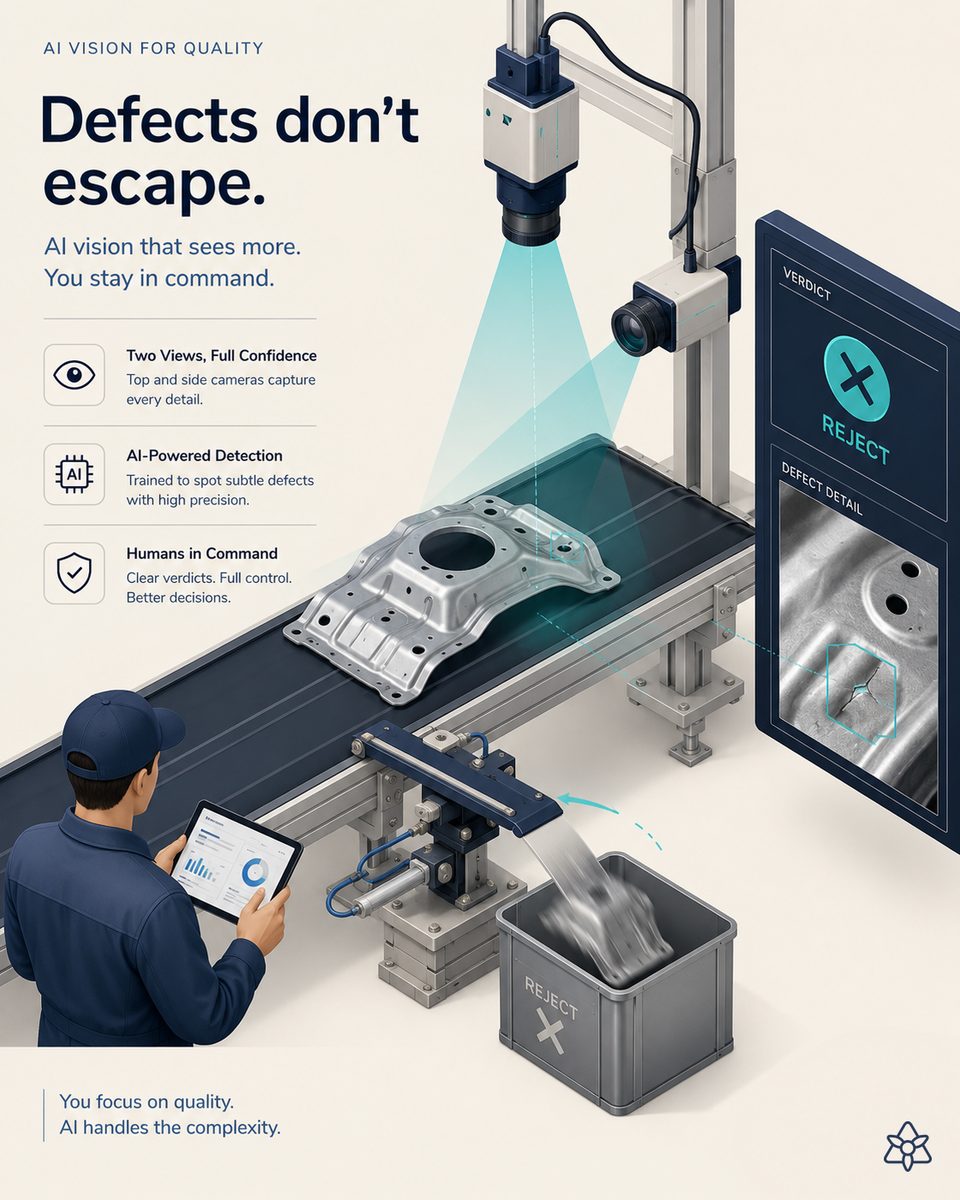
The defect shows up when the scrap bin is already half full.
On an automotive plastic injection line everybody knows the pattern: the press starts drifting mid-shift — the mold runs hot, material viscosity shifts with the moisture in the pellets, the process technician is busy with another press — and nobody notices until the end-of-line operator sees the pile of bumpers with flash along the edge and raises the alarm.
- The defect is upstream — in the cycle, in the mold, in the material. But it is discovered downstream, at visual review.
- The parameter is on the press's PC — Engel, Arburg, Krauss-Maffei, Battenfeld… every brand has its own screen, and the data is almost never cross-referenced with the outcome of the part.
- There is only one process technician — and six or eight presses. He cannot watch them all at once. The veteran's intuition covers 95% of cases; the other 5% is scrap.
The familiar irony: the data that would explain the defect (actual holding pressure, mold temperature on the previous cycle, effective back pressure) exists, the press stores it, and nobody cross-references it with the part that came out of that cycle.
iLEAN does not change your press — it puts vision where there was none and connects the press data with the outcome of the part.
The classic injection problem is that the information is already there, scattered across islands: the press knows its own story, the MES knows the work order, the operator knows the defect at the end of the shift. What does not exist is the cross-reference. iLEAN acts as the putty that fills that joint without asking you to throw out the press, the MES or the ERP.
Edge looks at the part as it leaves the mold. Connect reads the press wherever it is. The agent cross-references part ↔ cycle ↔ history and warns before the drift becomes scrap. The person decides what to change.
The three iLEAN pieces applied to automotive plastic injection:
- Edge — a terminal with machine vision (CNN) installed at the mold exit (over the take-out robot or over the discharge conveyor). It reads the freshly demolded part in milliseconds, recognizes the typical defects (flash, sink mark, visible weld line, burn mark, silver streak, short shot) and fires the actuator to divert the part into the bin if it does not pass. It works with no network: if the plant loses WiFi, Edge keeps inspecting and rejecting, because what is critical cannot depend on connectivity.
- Connect — captures the press parameters through three graduated modes (manual with a photo of the panel, intermediate over the old isolated local PC, integrated via Euromap 63/77 where available). It also captures what arrives from outside: the pellet supplier's notice of a batch change, the WhatsApp from the shift lead saying the temperature control unit is behaving oddly, the customer email with a PPAP change.
- Agent — cross-references the image of the part with the cycle parameters, the material batch, the mold history and the MES work order. If it detects drift (not just an isolated defect, but a trend), it does not send an email at 10 p.m.: it alerts the process technician on whatever channel they use, with the part, the cycle parameters and a root-cause hypothesis. The person decides what to correct on the press; the system does not touch critical actuators without a signature.
End-of-line inspection vs. in-cycle control with iLEAN
| Aspect | Visual inspection + SPC on screen | With iLEAN Edge + Connect + Agent |
|---|---|---|
| When it is detected | End of line or shift change | Part by part, at the mold exit, in milliseconds |
| Typical size of the scrap pile | 20-50 parts before the alarm is raised | 1-3 parts before holding and alerting the technician |
| Link between defect ↔ cycle parameter | Manual, rebuilt hours later | Automatic, at second zero, with a root-cause hypothesis |
| Older press with no interface | Not integrated, data lost | Connect captures manual / intermediate / integrated |
| Operation without network | n/a | Edge keeps running on cabinet power |
| File for PPAP/IATF 16949 | Rebuilt by hand, batch by batch | Dossier per part, automatic, with image and parameters |
Impact estimate for your plant — to be validated with your numbers.
The block below is an estimate to be validated with the specific data of your plant. We put it forward so the committee has an order of magnitude; we refine it during the diagnostic.
- Injection plant with 6-10 presses (200-2,500 T range), a mix of class A cosmetic parts (bumpers, door panels, instrument panels) and functional parts (structural components, brackets).
- Edge pilot on 1-2 critical presses (camera at the mold exit + diverting actuator + integration with the press through whichever Connect mode applies). First value expected within a few weeks.
- Indicative payback between 4 and 9 months, depending on the current frequency of scrap incidents, the average part weight and the cost per minute of recovered cycle.
- Hard levers: scrap avoided on large parts made of premium material (PP+EPDM-TD, ABS-PC) + cycle minutes recovered + an IATF 16949 audit with an automatic dossier per part, not per batch.
- The automotive quality standard sits in the order of 25 PPM (parts per million) [1] — a margin like that cannot be held with visual inspection alone.
And the process technician's reasonable doubt
“What if the AI mistakes a harmless cosmetic defect for a critical one and stops good parts?” — hallucination is a problem of free generation, not of anchored tasks. In tasks where the AI merely classifies an image against patterns trained on your own parts, the best models brought error below 1.5% [2]. And even so, what is critical is never decided alone: the system holds the part and raises the alert, the process technician decides. iLEAN's three safety rings are there precisely for this.
[1] Symestic — automotive quality standard ~25 PPM.
[2] OpenAI paper “Why Language Models Hallucinate”, 2025 — on the reliability of AI in anchored tasks.
Related processes: powder coating defects · body panel sheet metal defects · jidoka in robotic welding.
What people ask about plastic injection control with AI
Which typical injection defects does iLEAN detect?
The six that show up again and again in the weekly scrap report of an automotive plastics Tier 1: flash, sink mark, visible weld line, burn mark, silver streak and short shot. iLEAN Edge runs a CNN trained to recognize each pattern on the freshly demolded part — before it ends up in the scrap bin. And, crucially, it cross-references the defect with the press parameters for that cycle (injection pressure, back pressure, mold temperature, holding time) so the process technician knows why it is happening, not just what is happening.
How do you connect to an older injection press with no modern interface?
iLEAN Connect has three graduated capture modes so you are never forced to replace the press: (1) manual — a person photographs the panel and Connect extracts the values; (2) intermediate — if the press has an old, isolated local PC (the norm on a 15-20 year old installed base), Connect connects to it and pulls the data; (3) integrated — if it has Euromap 63/77 or a modern equivalent, integration is direct. We have spent decades working with Engel, Arburg, Krauss-Maffei, Negri Bossi and Battenfeld presses on the shop floor — from day-one compatible machines to the grand old Windows 2000 box with a floppy drive. The “that press is too old” excuse is over.
Is defect detection real time or post-cycle?
Real time. iLEAN Edge installs a camera with controlled lighting right at the mold exit (on the take-out robot or over the conveyor) and the part is analyzed in milliseconds — before it reaches the operator or the assembly cell. If the defect warrants ejection, the actuator diverts it into the scrap bin without touching the takt. And if the drift is confirmed over several consecutive cycles, the agent alerts the process technician to adjust the press — rather than waiting for the shift visual review, by which point thirty parts are already bad.
Does it work on large parts (bumpers, instrument panels, door panels)?
Yes — in fact that is where the system pays for itself fastest. A scrapped bumper or instrument panel on a 2000+ T press weighs several kilos of premium material (PP+EPDM-TD, ABS-PC) and, more expensive still, two to three minutes of cycle you never get back. iLEAN combines several cameras around the large part, covers the critical zones (weld line, fixing clip, class A surface) and consolidates a verdict per part. The operator's visual inspection at the end of the shift stops being the only filter — and stops being the late filter.
How much can it cut rejects on an injection line?
It depends heavily on your starting point — a press with a new, well-tuned mold and a veteran process technician who already senses the drift has less headroom than a press with an aging mold, frequent SKU changes and shift rotation. As a defensible floor to present to the committee, a ≥30% reduction in rejects from cosmetic and dimensional injection defects in the first months is realistic once the system cross-references vision with press parameters. The hard lever is cycle time recovered + scrap avoided on large parts. We send you the estimated ROI in 48h with the data from your line.
More cases in automotive
- OEM CSR digitized with AI — your customer publishes a new revision, nobody reads it end to end, and finding the gap at the audit is too late.iLEAN digitizes every OEM's CSR: it extracts requirements from the PDFs, cross-checks them against your…
- OEM injection molded part control with AI — the sink mark the eye does not catch until the OEM assembles it.How iLEAN verifies geometry, sink marks and flash on the OEM injection molded part in line with Edge and…
- Predictive maintenance for the paint booth and the curing oven — the one bottleneck that, when it stops, stops the whole plant.iLEAN detects paint booth and oven drift — filters, fans, zone temperatures — and proposes when to…
- Powder coating defects with AI — a crater found late is scrap; found on the line, it is nothing.iLEAN Edge detects craters, sags and orange peel in powder coating on automotive parts as they come out…
- Industrial AI in precision tubing plants for automotiveHow IRIS (Connect + Edge + Agents) eliminates paper, nonconformances, and recalls at IATF…
- Radiator and heat exchanger control with AI — zero leaks reaching the OEM.How iLEAN cross-references Edge vision on tubes and fins, helium or pressure-decay leak testing and…
Tell us your case and in 48h we'll send you the estimated ROI of this AI project for your injection line.
We work on your plant's real data, not ours. Diagnostic with no commitment.
Request estimated ROI in 48h See automotive