Predictive maintenance for the paint booth and the curing oven — the one bottleneck that, when it stops, stops the whole plant.
The booth and the oven degrade quietly for weeks before they fail — and they generate paint defects long before they stop. iLEAN detects early drift on top of the instrumentation you already have — zone temperatures, booth pressure, fan power draw — and proposes the intervention window that costs the least production. Maintenance signs the decision.
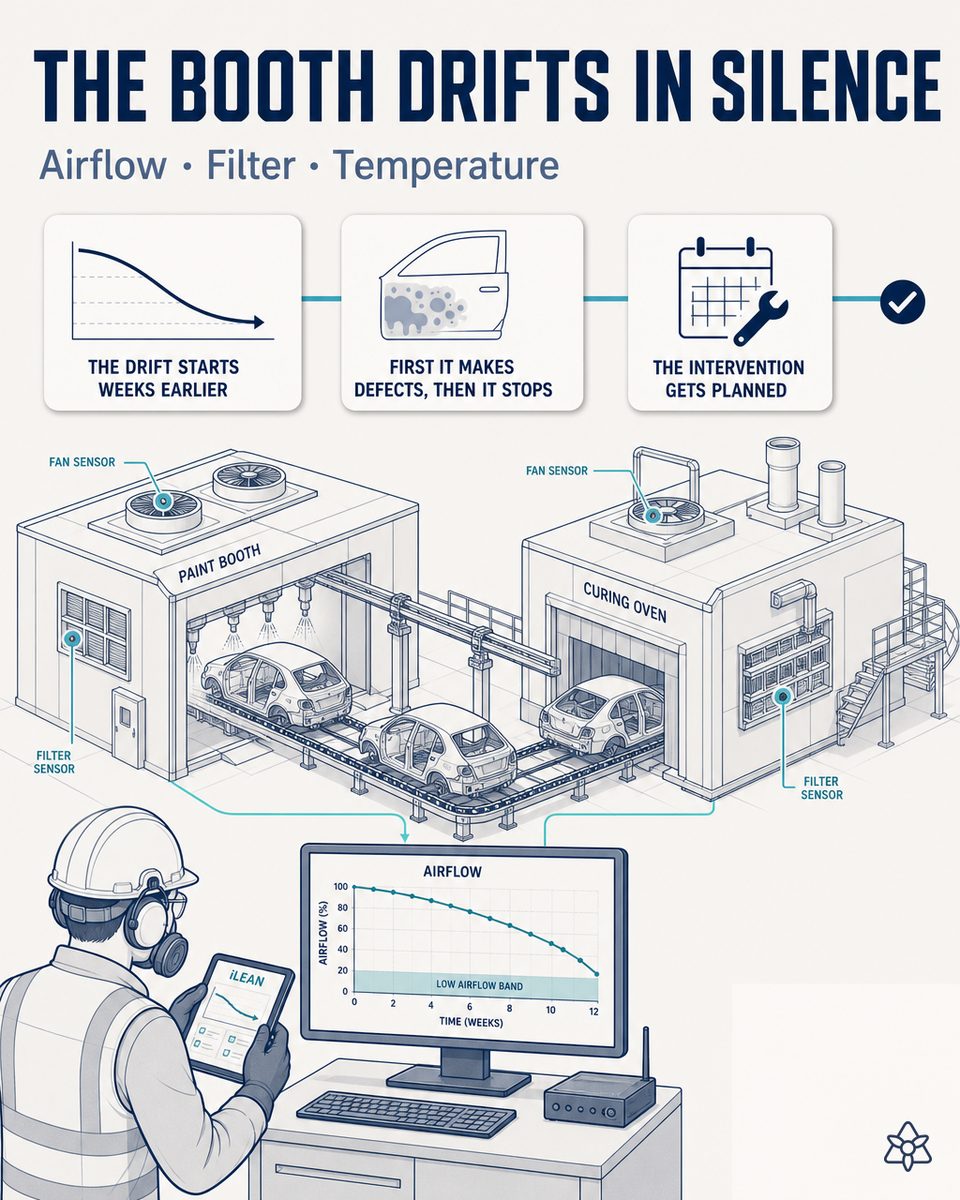
The installation degrades for weeks — and the defect gets blamed on something else.
In an automotive paint shop there is one place everything passes through: the application booth and the curing oven. There is no parallel line, no bypass, no buffer that lasts a shift. If the booth or the oven stops, the whole plant stops — bodies held upstream, assembly with no cars downstream. And yet maintenance on that critical installation is still done by the calendar: you change the filter that still had life in it and you miss the bearing that was already making noise.
Three things happen at once in a real paint installation, and almost nobody puts them together:
- The calendar cannot see actual condition — the service happens when it is due, not when the installation asks for it. You intervene where it was not needed (cost and downtime hours given away for free) and you miss what did need it (the failure arrives anyway, without warning and at the worst possible moment).
- Slow degradation trips no alarm — filters loading up little by little, fans going out of balance, temperature drifting in one oven zone. None of that is enough to stop the installation… but it generates craters, solvent pops and uneven cure long before anything fails outright.
- The defect gets blamed on something else — because the installation "is running", the crater is pinned on the paint, on the application, on cleanliness. Weeks of trial and error open up, adjusting process variables, while the real cause — the installation drifting — keeps marching toward the stoppage.
The result is always the same: the unplanned stoppage arrives with no warning, the spare part is bought on an emergency basis, and the veteran technician once again diagnoses by ear what no alarm ever told anyone. The knowledge that anticipates the failure lives in his head; the day he retires, it walks out with him.
iLEAN does not replace your CMMS or your SCADA — it cross-references what neither of them joins up.
The problem with the booth and the oven is not a lack of instrumentation: zone temperatures, differential pressure and fan power draw are already being measured. The problem is that every signal lives on its own island, the combined drift trips no individual alarm, and the paint defect is never cross-referenced with the state of the installation. iLEAN acts as the putty that binds those signals to the history of your specific installation and to outgoing quality, with no civil works and without touching the PLC logic.
Connect reads the existing instrumentation in real time. Agents model the installation's normal signature, detect early drift and propose the intervention window that costs the least production. Maintenance signs the decision.
The two iLEAN pieces applied to predictive maintenance in the paint shop:
- Connect — a connection layer on top of the instrumentation that already exists: oven zone temperature probes, booth differential pressure transmitters, electrical draw of the supply and exhaust fans, signals from the installation's PLC. No civil works: where there is a digital signal it integrates directly; where the instrumentation is old and isolated, it is read through the installation's local system. It works locally: if the plant loses its network, Connect keeps reading, recording and raising alerts on the shop-floor panel. What is critical does not depend on WiFi.
- Agents — agents that learn the normal signature of your booth and your oven (how it starts up on a Monday, how pressure breathes with each filter change, what temperature profile each zone holds at each line rate) and detect the early drift that no individual threshold sees. When a drift is confirmed, they propose the intervention window that costs the least production — end of shift, an already scheduled stoppage, the weekend — with the evidence in front of you. And they cross-reference every paint defect with the state of the installation at that moment: the crater whose cause is the installation stops disguising itself as a process problem. The agents propose; the intervention is always signed by maintenance.
Calendar-based maintenance vs. maintenance with iLEAN
| Aspect | Calendar + threshold alarms | With iLEAN Connect + Agents |
|---|---|---|
| Intervention criterion | Fixed date, whether it is due or not | Actual condition of the installation |
| Booth filters | Changed by date, loading invisible | Differential pressure trend, change inside a window |
| Temperature drift across oven zones | Invisible until the defect or the breakdown | Detected in hours, with the zone pinpointed |
| Paint defect caused by the installation | Weeks of trial and error on the process | Defect-to-installation cross-check, hypothesis in hours |
| Booth or oven stoppage | Unplanned — stops the whole plant | Anticipated, in the window that costs least |
| Spares and labor | Emergency purchase, technician called out at 3 a.m. | Planned along with the intervention |
| The veteran technician's knowledge | Lives in his head | A signature learned by the agents, repeatable |
Impact estimate for your plant — to be validated with your numbers.
The block below is an estimate to be validated with the specific data of your plant. We put it forward so the committee has an order of magnitude; we refine it during the diagnostic.
- Automotive plant with the paint booth and curing oven as the single bottleneck, calendar-based maintenance, classic instrumentation (zone temperatures, differential pressure, fan power draw) and at least one documented unplanned stoppage in recent months.
- A Connect pilot on the existing instrumentation + Agents learning the installation's signature for 4-6 weeks before they start anticipating. First value expected within a few weeks: the cross-reference dashboard and the first drifts in trend show up early, before the predictive model has fully sharpened.
- Expected reduction in unplanned booth and oven downtime of ≥30% in the first months — a defensible floor, estimate to be validated.
- Paint defects with an installation root cause identified in hours, not in weeks of trial and error adjusting process variables that were never the problem.
- Indicative payback between 4 and 9 months (estimate to be validated). The hard lever: every hour the booth or the oven is down is an hour of the entire plant, and every intervention moves from an emergency with an express-shipped spare to a planned window with the spare already in the storeroom.
- A recurring benefit that does not go into the ROI but carries weight: the learned signature of your installation stays as a permanent capability of the plant, not of the person who retires.
And the maintenance manager's reasonable doubt
“What if the AI infers a drift wrongly and makes me intervene when there was no need?” — iLEAN agents do not act on the installation by themselves. They propose; the maintenance manager decides; the intervention happens or it does not. Hallucination is a problem of free generation, not of anchored tasks: in tasks where the AI cross-references installation signals with history and outgoing quality, the best models brought error below 1.5%[1]. And even so, what is critical goes through the safety rings — the agents live in the outer ring, propose inward, and the intervention on the installation is signed by a person. Never the other way round.
[1] OpenAI paper “Why Language Models Hallucinate”, 2025 — on the reliability of AI in anchored tasks.
What people ask about predictive maintenance for the booth and the oven
What signals does it need, and where do they come from?
From the instrumentation the installation already has: oven zone temperatures (the probes in the heat-up and holding zones), booth differential pressure (the transmitters on the ceiling and floor filters), electrical draw of the supply and exhaust fans, and the signals the installation's PLC already exposes. iLEAN Connect reads what exists — no civil works, no exotic sensors. Where a genuinely important signal is missing, we propose it; but the pilot starts with what is already there. The value is not in reading each signal on its own — any SCADA does that — it is in cross-referencing them: the installation's combined signature drifts long before any individual threshold trips.
Do we have to stop the line to install it?
No. Connect hooks into the existing instrumentation and PLC live, or during a shutdown that is already scheduled — the kind of wiring work your team does routinely. There are no civil works, the PLC logic is not touched and the installation stays in charge. For the first few weeks the system only learns: it models the normal signature of your booth and your oven (Monday start-ups, rate changes, recovery after the weekend) before it starts flagging drift. And if something drops off the network, the line does not even notice: iLEAN observes, it does not govern.
How does it know whether a crater came from the process or from the installation?
By cross-referencing every paint defect with the state of the installation at the exact moment that body passed through: booth differential pressure, fan balance, oven temperature profile zone by zone. If the craters show up right when booth pressure had been falling for hours, the cause points to filters loading up — not to the paint or the application. That defect-to-installation cross-check is what is done by hand today, over weeks of trial and error, adjusting process variables that were never the problem. With the cross-referenced history, the evidence-backed hypothesis comes out in hours.
What if it proposes an intervention that was not needed?
It can happen, especially in the first few weeks — which is why the decision to intervene is always signed by maintenance, never by the system. iLEAN Agents stop nothing and act on nothing: they propose an intervention window with the evidence in front of you (which signal is drifting, since when, at what rate) and the maintenance manager decides whether to go in, when to go in and with which spare part. Every proposal confirmed or dismissed sharpens the model for that specific installation. The cost of a dismissed proposal is a five-minute conversation; the cost of an oven that stops without warning is a full plant shift.
How much does it cut unplanned downtime?
As an order of magnitude — and always as an estimate to be validated with your plant's real data: a ≥30% reduction in unplanned booth and oven downtime in the first months is a defensible floor once maintenance moves from the calendar to actual condition. Indicative payback runs between 4 and 9 months (estimate to be validated), because the saving is not only the stoppage avoided: it is the paint defect with an installation root cause identified in hours instead of weeks, and spares and labor planned into a window instead of bought on an emergency basis. We send you the estimated ROI in 48h with your numbers.
More cases in automotive
- Multipack fastener control with AI — one screw missing from the kit is a phone call from the customer.How iLEAN counts and verifies every screw in the multipack kit in line with Edge vision and agents —…
- OEM CSR digitized with AI — your customer publishes a new revision, nobody reads it end to end, and finding the gap at the audit is too late.iLEAN digitizes every OEM's CSR: it extracts requirements from the PDFs, cross-checks them against your…
- OEM injection molded part control with AI — the sink mark the eye does not catch until the OEM assembles it.How iLEAN verifies geometry, sink marks and flash on the OEM injection molded part in line with Edge and…
- Automotive plastic injection with AI — the defect is not discovered, it is anticipated before the scrap piles up.How iLEAN detects flash, sink marks and streaks in automotive plastic injection before the defect piles…
- Powder coating defects with AI — a crater found late is scrap; found on the line, it is nothing.iLEAN Edge detects craters, sags and orange peel in powder coating on automotive parts as they come out…
- Radiator and heat exchanger control with AI — zero leaks reaching the OEM.How iLEAN cross-references Edge vision on tubes and fins, helium or pressure-decay leak testing and…
Tell us your case and in 48h we'll send you the estimated ROI of this AI project for your booth and your oven.
We work on your plant's real data, not ours. Diagnostic with no commitment.
Request estimated ROI in 48h See automotive